
BuddhistCatholicContemplativeEvangelicalGeneral ChristianHinduJewishLatter-day SaintMuslimNew VisionsProgressive Christian
Beliefs
- Buddhist
- Catholic
- Contemplative
- Evangelical
- General Christian
- Hindu
- Jewish
- Latter-day Saint
- More Voices
- Muslim
- New Visions
- Pagan
- Progressive Christian
Topics
- Religion News
- Food and Religion
- Sports and Religion
- Religious Art
- Religious Music and Entertainment
- Religious Events
- History and Religion
- Style and Religion
- Politics and Religion
- Women in Religion
- Recreation Outdoors and Religion
- Business Finance and Religion
- Careers Workplace and Religion
- Education and Religion
- Family Parenting and Religion
- Health Fitness and Religion
- Home and Religion
- Relationships and Religion
- Technology and Religion
- Travel and Religion
Columnists
- Buddhist Columnists
- Business Finance and Religion Columnists
- Careers Workplace and Religion Columnists
- Catholic Columnists
- Contemplative Columnists
- Education and Religion Columnists
- Evangelists Columnists
- Family Parenting and Religion Columnists
- General Christian Columnists
- Health Fitness and Religion Columnists
- Hindu Columnists
- History and Religion Columnists
- Home and Religion Columnists
- Jewish Columnists
- More Voices Columnists
- Latter Day Columnists
- Muslim Columnists
- New Visions Columnists
- Nonreligious Columnists
- Pagan Columnists
- Politics and Religion Columnists
- Progressive Columnists
- Recreation Outdoors and Religion Columnists
- Relationships and Religion Columnists
- Religion News Columnists
- Religious Art Columnists
- Religious Events Columnists
- Religious Music and Entertainment Columnists
- Sports and Religion Columnists
- Style and Religion Columnists
- Technology and Religion Columnists
- Travel and Religion Columnists
- Women in Religion Columnists
Resource Library
- 2026 Calendar
- Library of World Religions
- The 100 Most Holy Places on Earth
- Patheos Answers
- Podcasts
- Videos
- Faith Leaders Database
- Anglican Episcopalian
- Bahai
- Baptist
- Buddhism
- Christianity
- Confucianism
- Eastern Orthodoxy
- Hinduism
- Holiness and Pentecostal
- ISKCON
- Islam
- Judaism
- Lutheran
- Methodist
- The Church of Jesus Christ of Latter-day Saints
- New Age
- Paganism
- Presbytarian and Reformed
- Protestantism
- Religion Behind the Scenes
- Roman Catholic
- Scientology
- Shia Islam
- Sikhism
- Sufism
- Sunni Islam
- Taoism
- Zen
- See all religions
Research Tools
 Ad-Free & Subscriber Log-In Subscription Support
Ad-Free & Subscriber Log-In Subscription Support
Follow Patheos 

- Trending:
- Forgiveness
- |
- Marriage
- |
- Consciousness
- |
- Death Penalty
- |
- Election
- |
- Halloween

- Home
- Catholic
- Vatican II and the Hermeneutic of Continuity
Vatican II and the Hermeneutic of Continuity
Last updated on: August 5, 2020 at 6:46 pm by Edwin Woodruff Tait
Vatican II and the Hermeneutic of Continuity 2020-08-05T18:46:23-05:00 Edwin Woodruff Tait
Patheos Explore the world's faith through different perspectives on religion and spirituality! Patheos has the views of the prevalent religions and spiritualities of the world.
It’s becoming more common for conservative Catholics to criticize Vatican II. Most recently, Anthony Esolen has written a piece for Inside the Vatican calling for Catholics to ignore Vatican II and “move on.” Esolen refers to an earlier piece by Archbishop Vigano, also published in Inside the Vatican. Vigano, in turn, alludes to criticisms of Vatican II made by Khazakh bishop Athanasius Schneider published on the LifeSiteNews website. The three pieces have their differences. Schneider’s is by far the most thorough and coherent in its argument. Esolen’s is the most moderate. Vigano is the least coherent and also comes the closest to rejecting the Council outright. But all three agree that the “hermeneutic of continuity” promoted by Pope Benedict XVI and other mainstream conservative Catholics runs into problems rooted in the texts of Vatican II themselves and in the intentions of the Fathers of that Council.
Getting the Council right
The person who first seriously set out to convert me to Catholicism, a former Scott Hahn student named Tim Gray who is now a professor of Biblical studies at the seminary in Denver, presented this hermeneutic of continuity to me as the correct way to understand Vatican II. I was a first-year Ph.D. student at Duke studying church history, but very ignorant of modern Catholicism. Tim was doing a second master’s degree after having earned one at Steubenville. Tim was devout, intelligent, and very evangelistic. I was still very much under the influence of my Holiness background, and very wary of the possibility that Catholicism might turn into the One World Church of dispensationalist eschatology.
Catholicism as I was experiencing it in the Diocese of Raleigh in 1995 was very different from my medievalist dreams. It seemed to be a bland, timid, dumbed-down caricature of the religion of Aquinas and Dante and Chesterton and Tolkien and Flannery O’Connor. Tim explained that liberals had distorted the true meaning of Vatican II but that John Paul II was restoring what Vatican II was supposed to be. (I may be oversimplifying the message, but that was the central idea as I remember it.)
As I read ressourcement theologians such as Bouyer and De Lubac, I found this interpretation convincing. These theologians had a vision for the Catholic Church that I found utterly compelling. It was deeply patristic, deeply Biblical, and free from the legalism and authoritarianism that have so often beset Western Catholicism. And I was willing to believe that this was the trajectory the Catholic Church was on: one that would implement the true vision of the Council as found in the ressourcement theologians.
Ratzinger and the hermeneutic of continuity
In particular, I found Cardinal Ratzinger, eventually Pope Benedict XVI, to be the champion of this kind of “conservative ressourcement” theology. I found–and still find–him to be one of the most profound and richly orthodox theologians of our time. While I had my disagreements with some specific things he said or did, I rejected the claims that he was trying to “undo Vatican II.” I agreed, fundamentally, with his argument for a “hermeneutic of continuity.” He took Vatican II seriously as part of the Church’s Tradition, but not as a radical new beginning.
Over and over again, I found those who argued for discontinuity making what seemed to me profoundly silly arguments. There was the woman who explained to me at a Chrism Mass in 1999 that the Franciscan parish where the Mass was being held didn’t have kneelers because “Vatican II forbade kneeling.” There was the young priest who assured me that Gaudium et Spes contradicted Trent and got rid of the doctrine of original sin. (This was the same priest who said that Jesus wasn’t either fully human or fully divine to begin with, but grew into both.) Liberal Catholics seemed not to care about the nuances of either history or theology. They seemed to be following a shallow religion that was more about feel-good cliches than about careful thinking or deep spirituality.
Be careful what you ask for
Then I moved to northern Indiana in 2006, after a few years in New Jersey. This coincided, of course, with Pope Benedict’s pontificate. Now I was living in an area with a strong Catholic heritage. Down the road from me were two Catholic parishes with large, beautiful buildings. (There were two, a couple of blocks from each other, because the Irish in the 19th century had demanded a separate parish from the Germans.) Not far from my house, too, was the former Capuchin convent where Venerable Solanus Casey had lived for a time. (It was a Protestant church when I came to town, but while I was there the Protestants sold it back and it became a novice house for a very conservative order of Dominican sisters.) The headquarters of Our Sunday Visitor were in town as well. And finally, the town contained the mother house of the (quite liberal) missionary order “Our Lady of Victory Missionary Sisters.”
So that adds up to two parishes, two convents, and one of the leading Catholic periodicals in America, all in a small Indiana town of about 18,000 people. I had never lived in such a Catholic environment in my life. For someone with my longstanding attraction to Catholicism, it should have been paradise.
But it wasn’t. On the personal side, I was teaching for an evangelical college and had reason to think I would lose my job if I became Catholic. But more to the point here, living in that environment helped me understand the deep problems with traditional Catholicism in a way that nothing else really had.
Sundown town
For one thing, alongside its piety the town had a long history of racism. It had been a “sundown town” for decades, excluding all African-Americans after dark. During the 2012 presidential campaign, a local resident posted a sign outside his house saying “Get the Muslim monkey off my back.” And while all of this certainly wasn’t the fault of the Catholics exclusively, they had been part of the problem much of the time. (I think the person with the racist sign in 2012 was Catholic, but I’m not sure.)
In my own time there, I met the viciously anti-Jewish Catholic author E. Michael Jones, who was the guest of honor at an “Epiphany party” I attended at the home of a local Catholic laywoman who wrote sacred music and talked a lot about restoring the beauty of Catholic worship. (And yes, I was drawn in by those things, and while I argued with Jones vigorously, I went to the party knowing he was the guest of honor.)
My closest Catholic friends in that town were people who were deeply disillusioned with the Church and not in good standing, though they continued to see themselves as Catholic and to raise their children as Catholic. I’d run into plenty of disillusioned Catholics before, and I knew a lot, in theory, about the twisted forms Catholic culture can take. But this was the first time it was brought home to me.
I don’t want to make it sound as if my experience of Catholicism in this town was altogether bad. I knew many fine Catholics there. I liked the priests insofar as I got to know them. And there was something beautiful about being able to walk a few blocks and go to daily Mass or Adoration, and about the matter-of-fact reverence with which people practiced their faith. But the vibrant, counter-cultural, deeply orthodox and sacramental faith for which I yearned was only visible, much of the time, through a thick veil of cultural inertia. And at the same time, my acquaintance with Sister Roseanne made me realize that my youthful scorn for “liberal nuns” had been arrogant and misguided.
The Republican party at prayer?
At the same time, I was very involved in online discussion on Catholic forums, particularly the forum run by Catholic Answers. (My alias was “Contarini” in case anyone wants to read some of my posts on that forum.) Later on, I became more involved in Facebook and eventually stopped posting on the CA forums. All these discussions cemented both my sense that I would never really be content as a Protestant and my growing discomfort with what conservative Catholicism was turning into. Mark Shea, whom I had always regarded as one of the finest of the popular apologists, was alienating more and more of the self-professed orthodox not by any doctrinal heresy but by his insistence on defending Catholic moral teaching where that teaching fit uneasily with right-wing Republican sensibilities. More and more, it seemed to me that American Catholicism under Pope Benedict was turning into a spiritual justification for conservative Republican politics and had just as little genuinely counter-cultural power as Episcopalianism.
In the end, three years after moving from Indiana to Kentucky, I did become Catholic. (The election of Pope Francis helped, even though I remain a deep admirer of Pope Benedict as a theologian and think he has been unfairly denigrated as Pope, and often served very poorly by his loudest admirers.) But by that time I had a much more complicated picture of Catholicism than I had had when Tim first ignited my desire to convert. I no longer thought of the conservative, “hermeneutic of continuity” wing of Catholicism as automatically the good guys. I realized that continuity could sometimes mean continuing things that were unhealthy.
The paradoxes of continuity
I now see continuity and discontinuity, like so many things, in terms of Barfield’s concept of polarity. They are opposites that depend on one another, in Catholicism as in other aspects of life.
And so I think Archbishop Vigano and his fellow critics of Vatican II have a point. There is something unconvincing about the effort many Catholics have put into proving that Vatican II really didn’t change anything much and that the progressives are just misinterpreting it. Obviously I disagree with them that this makes Vatican II something that needs to be “ignored” or rejected. It does no doubt need to be “corrected” in the sense that its interpretations of the Tradition will themselves, eventually, be reinterpreted. But no more so than any other Council.
So it’s not that I reject the “hermeneutic of continuity” entirely. If it means that Vatican II is just one among many Councils, not some unique work of the Spirit that nullifies what went before, I remain entirely committed to continuity. But every Council has its particular charism. And the charism of Vatican II was to wake up a Church that had too often rested smugly on its laurels, confident that it had a well-constructed, well-armored, perennial system to offer to the confused modern world. Much that is silly and sometimes profoundly harmful has resulted from the cracks that Vatican II opened in the armor of the Church Militant. But much of that armor was not, in fact, the armor of God, but rather like the armor Saul gave to David, burdening the Church down rather than protecting it.
The Church of 2020 is an obviously weakened and wounded Church in a way that the Church of 1960 was not. It is not, for that reason, necessarily a less apt instrument of the Spirit. In fact, we have the assurance of the Apostle Paul that it often works the other way round.
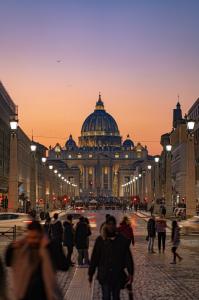
Image by Alberico Bartoccini, from https://unsplash.com/
Previous Post

July 17, 2020
Jumping out of the Flying Ship: Resisting False Traditionalism
Next Post
August 16, 2020 Rejoicing in the House of God's Prayer
Browse Our Archives
Select a Category apologetics Bible Catholicism Christianity economics history Middle Ages personal Reformation Rodney Stark Uncategorized
Select a Month August 2026 June 2026 January 2026 December 2025 October 2025 June 2025 February 2025 December 2024 November 2024 June 2024 May 2024 January 2024 December 2023 April 2023 December 2022 November 2022 September 2022 July 2022 June 2022 April 2022 November 2021 September 2021 March 2021 February 2021 January 2021 December 2020 November 2020 October 2020 August 2020 July 2020 June 2020 May 2020 December 2018 October 2018 June 2018 March 2018 December 2017 November 2017 October 2017 September 2017 May 2017 April 2017 March 2017 February 2017 January 2017 December 2016 November 2016 October 2016 September 2016 August 2016 July 2016 June 2016 May 2016 April 2016 March 2016 January 2016 December 2015 November 2015 September 2015 June 2015 May 2015 April 2015 March 2015 February 2015 January 2015 December 2014 November 2014 October 2014 August 2014 June 2014 March 2014 January 2014 September 2013 August 2013 June 2013 August 2012 July 2012 October 2011 June 2011 March 2011 July 2010 March 2010 January 2008 May 2007 April 2007 February 2007 October 2006 August 2006 March 2006 January 2006 November 2005 October 2005 September 2005 August 2005 June 2005 May 2005 April 2005 March 2005 February 2005 January 2005 December 2004 November 2004 September 2004
Follow Us!
TAKE THE
Religious Wisdom Quiz
Which book includes "A time to weep and a time to laugh"?
Select your answer to see how you score.
Genesis Judges Ecclesiastes Malachi
Related posts from Light in the West

What is "Christian Nationalism"? A Reply to Dennis...



TRENDING AT PATHEOS Catholic

Rejecting Doom: Christian Hope And Human Action
Christianity is a religion of hope. We are to have hope and...

It’s What Comes From Within Which Matters
One of the most difficult things for us to understand is why...

Why I Choose the Eucharist Over the Sermon
Choose the Eucharist, Not the Sermon What are we supposed to get...

5 Design Elements Found in Spiritually Rooted Homes
Putting Spirituality Into Home Decor Our homes are more than our living...

Credo: A Story of God Told with the...
About 10 years ago, I began to imagine a personal "Credo" that...

The Anatomy of Divine Revelation in Catholic Thought
The claim that God has made Himself known to human beings is...
view all Catholic blogs
Ad-Free & Subscriber Log-In Subscription Support
- About Us
- 2026 Calendar
- Videos
- Podcasts
- Library of World Religions
- Faith In Media Tracker
- Advertise With Us
- Write for Us
- Privacy Policy
- Terms of Service
- Do Not Sell My Data
- Contact Us
- Radiant Digital
- Manage Newsletter Subscriptions
- Unsubscribe From Notifications
- Sitemap
Copyright 2008-2026, Patheos. All rights reserved.
Subscription Support Ad-Free & Subscriber Log-In
Follow Patheos