
BuddhistCatholicContemplativeEvangelicalGeneral ChristianHinduJewishLatter-day SaintMuslimNew VisionsProgressive Christian
Beliefs
- Buddhist
- Catholic
- Contemplative
- Evangelical
- General Christian
- Hindu
- Jewish
- Latter-day Saint
- More Voices
- Muslim
- New Visions
- Pagan
- Progressive Christian
Topics
- Religion News
- Food and Religion
- Sports and Religion
- Religious Art
- Religious Music and Entertainment
- Religious Events
- History and Religion
- Style and Religion
- Politics and Religion
- Women in Religion
- Recreation Outdoors and Religion
- Business Finance and Religion
- Careers Workplace and Religion
- Education and Religion
- Family Parenting and Religion
- Health Fitness and Religion
- Home and Religion
- Relationships and Religion
- Technology and Religion
- Travel and Religion
Columnists
- Buddhist Columnists
- Business Finance and Religion Columnists
- Careers Workplace and Religion Columnists
- Catholic Columnists
- Contemplative Columnists
- Education and Religion Columnists
- Evangelists Columnists
- Family Parenting and Religion Columnists
- General Christian Columnists
- Health Fitness and Religion Columnists
- Hindu Columnists
- History and Religion Columnists
- Home and Religion Columnists
- Jewish Columnists
- More Voices Columnists
- Latter Day Columnists
- Muslim Columnists
- New Visions Columnists
- Nonreligious Columnists
- Pagan Columnists
- Politics and Religion Columnists
- Progressive Columnists
- Recreation Outdoors and Religion Columnists
- Relationships and Religion Columnists
- Religion News Columnists
- Religious Art Columnists
- Religious Events Columnists
- Religious Music and Entertainment Columnists
- Sports and Religion Columnists
- Style and Religion Columnists
- Technology and Religion Columnists
- Travel and Religion Columnists
- Women in Religion Columnists
Resource Library
- 2026 Calendar
- Library of World Religions
- The 100 Most Holy Places on Earth
- Patheos Answers
- Podcasts
- Videos
- Faith Leaders Database
- Anglican Episcopalian
- Bahai
- Baptist
- Buddhism
- Christianity
- Confucianism
- Eastern Orthodoxy
- Hinduism
- Holiness and Pentecostal
- ISKCON
- Islam
- Judaism
- Lutheran
- Methodist
- The Church of Jesus Christ of Latter-day Saints
- New Age
- Paganism
- Presbytarian and Reformed
- Protestantism
- Religion Behind the Scenes
- Roman Catholic
- Scientology
- Shia Islam
- Sikhism
- Sufism
- Sunni Islam
- Taoism
- Zen
- See all religions
Research Tools
 Ad-Free & Subscriber Log-In Subscription Support
Ad-Free & Subscriber Log-In Subscription Support
Follow Patheos 

- Trending:
- Forgiveness
- |
- Marriage
- |
- Consciousness
- |
- Death Penalty
- |
- Election
- |
- Halloween

- Home
- Catholic
- An appreciation of the Reformation
An appreciation of the Reformation
Last updated on: May 15, 2020 at 12:35 pm by Edwin Woodruff Tait
An appreciation of the Reformation 2020-05-15T12:35:22-05:00 Edwin Woodruff Tait
Patheos Explore the world's faith through different perspectives on religion and spirituality! Patheos has the views of the prevalent religions and spiritualities of the world.
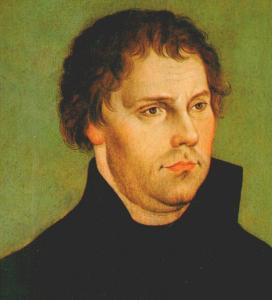
As usual, I’d meant to have posted more on the Reformation leading up to the 500th anniversary tonight, including a series on Brad Gregory (only one post out in that so far). However, this is only the anniversary of the posting of the Theses, which is typically seen as the public beginning of the Protestant movement. So I’ll be posting more in the months–and years–to come, perhaps up to (or even beyond) the anniversary of the Peace of Augsburg in 1555. Since I’ll be 81 by then, this assumes that I will still be alive–and that we won’t all have been enslaved by robot overlords, or slaughtered by a supervirus, or uploaded into an AI, or doomed to nuclear annihilation as a parlor game for billionaire playboys.
But tonight I’m going to set polemic aside and write about what is worth appreciating in the Protestant Reformation, and in Luther particularly, since this is his night.
Luther’s 95 Theses were provoked by the public scandal of “indulgence-selling.” Technically no selling took place–it was a lot like the “recommended donations” Christian radio and TV stations list these days. In return for a donation to the Church, people were given certificates assuring them of a partial or complete (the latter depending on certain spiritual conditions) forgiveness of the “debt of temporal punishment” due to sin. (I am not going to explain all of that here and now. If anyone reads this and wants it explained, post a comment asking and I’ll be happy to oblige.) In other words, he was attacking a kind of popular religion in which people assuaged their fears of God’s judgment (particularly of purgatory) by ritual acts.
The theology that produced the Theses, however, had been forged in the crucible of Luther’s struggle with a very different strand of late medieval theology: an intense, internalized piety that did not rely on external rituals to pacify the conscience. In this rigorist theology, to be forgiven even in the sacrament of confession required genuine contrition and a love for God above all else. In the theology Luther was taught (a version of “nominalism” mediated by the fifteenth-century theologian Gabriel Biel), God had established a covenant that he would give grace to anyone who “did what is in them.” This was meant to be reassuring–do your best and God will do the rest. But since “doing what is in you” was understood to mean loving God with all your heart, Luther found that it was not, in fact, in him at all. What was in him, after many efforts, was a smoldering resentment against the God who would demand such things in the name of the Gospel.
In the Presbyterian church where I played the organ last Sunday, the pastor said (in what was on the whole an excellent sermon) that late medieval Christians thought they would be justified by keeping the commandments of the Old Testament law. This isn’t accurate. But from Luther’s point of view, it would have been an improvement. Jesus made the law more difficult by internalizing it. And it was this internalized law that Luther had received as the Gospel–the “new law” of love, understood as a command to love God and neighbor at the very threshold of the spiritual life.
Luther’s fundamental starting point, which he learned from his confessor and mentor Johann von Staupitz, was that God’s love for us precedes and causes our love for God, not the other way round. For Staupitz, this was expressed through traditional Catholic devotional practices such as meditation on the Passion (something that, of course, would be central to Lutheranism as well, if in a somewhat altered form). But as early as portions of his first Psalm lectures (1513-15), and certainly in his Romans lectures (1515-16), Luther was moving beyond Staupitz. Staupitz was working within the broad Augustinian consensus of medieval theology (and indeed was part of the rigorously Augustinian wing of that theology), in which we are acceptable to God by being transformed by charity, infused by God into our hearts. Luther found this insufficient, because he worried that his charity was not enough and his transformation was too imperfect. Hence, he began to formulate a radical “negative theology,” partly influenced by the German mystics, in which our only righteousness is our acknowledgment of our unrighteousness.
This is why, for Luther, the practice of selling indulgences, or indeed encouraging people to earn them as means of avoiding purgatorial punishment for themselves and others, was so abhorrent. It was not simply that such a practice was an “abuse” and exploited people (though Luther certainly cared about that) but that it defeated the whole purpose of repentance and, indeed, of purgatory. A truly repentant person would not run away from God’s punishment, but would throw himself on God’s mercy. Purgatory, as Luther saw it at this point, was a postmortem state of uncertainty about one’s salvation, just as hell was the state of despair about one’s salvation. When the soul acknowledged that it deserved hell, it would find itself in heaven. Indulgences were not just a financial scam–they were a spiritual scam, luring people into a nervous, self-justifying quest for spiritual comfort rather than the true peace that is only found when we stop trying to cajole God into accepting us.
Luther’s mature doctrine of justification by faith alone was not yet present in the Theses or in the broader critique of scholastic theology out of which they arose. I’ll write more about that theology (and the points where I disagree with it) later. But clearly Luther was right that much of the religion of his time–and of ours–is about trying to strike a deal of some kind with God, and that all such deals fundamentally miss the point and trap us further in the very doom we are seeking to escape.
In the film version of Harry Potter and the Sorcerer’s Stone, the three heroes become trapped in something called “Devil’s Snare”–a vine that winds itself around its victims more tightly the more they struggle. (This happens in the book too, but they get out by lighting a fire–there’s good symbolism in that as well, to be sure.) Hermione calls out to the ever-nervous Ron, “Don’t struggle–relax.” Not an easy thing when you are being strangled to death by a sentient vine, but when he manages it, the tendrils loosen and he falls to the floor. Luther’s soteriology is, fundamentally, that we are all caught in the devil’s snare, and we only get out when we stop struggling. This is why he used extravagant, hyperbolic rhetoric such as the infamous advice to Melanchthon in 1521 to “sin boldly but believe yet more boldly.”
There are all kinds of criticisms that could be made of the way Luther interpreted and applied this concept. But for all of us who have suffered various kinds of spiritual anxiety, the fundamental insight is vitally important. Anxiety about salvation, the worry that somehow we may be displeasing God if we do or say or believe the wrong thing, is at the root of much of the evil Christians have done over the centuries. That’s why the focus on abuses and corruption is so wrongheaded, and so false to Luther, when talking about the Reformation. Much of the evil in the Church comes not from worldly prelates who don’t care about the things they profess to believe (though when that happens, it’s certainly harmful), but from people who are desperately, passionately attempting to secure their own standing with God, and who sacrifice other people on the altar of their own spiritual insecurities.
So here’s the fundamental truth in the Protestant Reformation, which Christians of all traditions should honor and take to heart: the sacrifice is already offered. The victory is already won. We do not have to convince God to save us. We have to refocus our attention from our own anguished self-importance to the objective, sovereign, unshakeable act of God in the death and resurrection of Jesus. Among all the theologians of the Christian Church, Luther may be the one who points most consistently and most inexorably to the Cross. And that is why we all need him.
Previous Post

October 22, 2017
The Unintended Reformation, part 1
Next Post
December 3, 2017 Silence
Browse Our Archives
Select a Category apologetics Bible Catholicism Christianity economics history Middle Ages personal Reformation Rodney Stark Uncategorized
Select a Month August 2026 June 2026 January 2026 December 2025 October 2025 June 2025 February 2025 December 2024 November 2024 June 2024 May 2024 January 2024 December 2023 April 2023 December 2022 November 2022 September 2022 July 2022 June 2022 April 2022 November 2021 September 2021 March 2021 February 2021 January 2021 December 2020 November 2020 October 2020 August 2020 July 2020 June 2020 May 2020 December 2018 October 2018 June 2018 March 2018 December 2017 November 2017 October 2017 September 2017 May 2017 April 2017 March 2017 February 2017 January 2017 December 2016 November 2016 October 2016 September 2016 August 2016 July 2016 June 2016 May 2016 April 2016 March 2016 January 2016 December 2015 November 2015 September 2015 June 2015 May 2015 April 2015 March 2015 February 2015 January 2015 December 2014 November 2014 October 2014 August 2014 June 2014 March 2014 January 2014 September 2013 August 2013 June 2013 August 2012 July 2012 October 2011 June 2011 March 2011 July 2010 March 2010 January 2008 May 2007 April 2007 February 2007 October 2006 August 2006 March 2006 January 2006 November 2005 October 2005 September 2005 August 2005 June 2005 May 2005 April 2005 March 2005 February 2005 January 2005 December 2004 November 2004 September 2004
Follow Us!
TAKE THE
Religious Wisdom Quiz
Which book is written almost completely as poetry?
Select your answer to see how you score.
Lamentations Jeremiah Isaiah Ezra
Related posts from Light in the West

What is "Christian Nationalism"? A Reply to Dennis...



TRENDING AT PATHEOS Catholic

Rejecting Doom: Christian Hope And Human Action
Christianity is a religion of hope. We are to have hope and...

It’s What Comes From Within Which Matters
One of the most difficult things for us to understand is why...

Why I Choose the Eucharist Over the Sermon
Choose the Eucharist, Not the Sermon What are we supposed to get...

5 Design Elements Found in Spiritually Rooted Homes
Putting Spirituality Into Home Decor Our homes are more than our living...

Credo: A Story of God Told with the...
About 10 years ago, I began to imagine a personal "Credo" that...

The Anatomy of Divine Revelation in Catholic Thought
The claim that God has made Himself known to human beings is...
view all Catholic blogs
Ad-Free & Subscriber Log-In Subscription Support
- About Us
- 2026 Calendar
- Videos
- Podcasts
- Library of World Religions
- Faith In Media Tracker
- Advertise With Us
- Write for Us
- Privacy Policy
- Terms of Service
- Do Not Sell My Data
- Contact Us
- Radiant Digital
- Manage Newsletter Subscriptions
- Unsubscribe From Notifications
- Sitemap
Copyright 2008-2026, Patheos. All rights reserved.
Subscription Support Ad-Free & Subscriber Log-In
Follow Patheos