
BuddhistCatholicContemplativeEvangelicalGeneral ChristianHinduJewishLatter-day SaintMuslimNew VisionsProgressive Christian
Beliefs
- Buddhist
- Catholic
- Contemplative
- Evangelical
- General Christian
- Hindu
- Jewish
- Latter-day Saint
- More Voices
- Muslim
- New Visions
- Pagan
- Progressive Christian
Topics
- Religion News
- Food and Religion
- Sports and Religion
- Religious Art
- Religious Music and Entertainment
- Religious Events
- History and Religion
- Style and Religion
- Politics and Religion
- Women in Religion
- Recreation Outdoors and Religion
- Business Finance and Religion
- Careers Workplace and Religion
- Education and Religion
- Family Parenting and Religion
- Health Fitness and Religion
- Home and Religion
- Relationships and Religion
- Technology and Religion
- Travel and Religion
Columnists
- Buddhist Columnists
- Business Finance and Religion Columnists
- Careers Workplace and Religion Columnists
- Catholic Columnists
- Contemplative Columnists
- Education and Religion Columnists
- Evangelists Columnists
- Family Parenting and Religion Columnists
- General Christian Columnists
- Health Fitness and Religion Columnists
- Hindu Columnists
- History and Religion Columnists
- Home and Religion Columnists
- Jewish Columnists
- More Voices Columnists
- Latter Day Columnists
- Muslim Columnists
- New Visions Columnists
- Nonreligious Columnists
- Pagan Columnists
- Politics and Religion Columnists
- Progressive Columnists
- Recreation Outdoors and Religion Columnists
- Relationships and Religion Columnists
- Religion News Columnists
- Religious Art Columnists
- Religious Events Columnists
- Religious Music and Entertainment Columnists
- Sports and Religion Columnists
- Style and Religion Columnists
- Technology and Religion Columnists
- Travel and Religion Columnists
- Women in Religion Columnists
Resource Library
- 2026 Calendar
- Library of World Religions
- The 100 Most Holy Places on Earth
- Patheos Answers
- Podcasts
- Videos
- Faith Leaders Database
- Anglican Episcopalian
- Bahai
- Baptist
- Buddhism
- Christianity
- Confucianism
- Eastern Orthodoxy
- Hinduism
- Holiness and Pentecostal
- ISKCON
- Islam
- Judaism
- Lutheran
- Methodist
- The Church of Jesus Christ of Latter-day Saints
- New Age
- Paganism
- Presbytarian and Reformed
- Protestantism
- Religion Behind the Scenes
- Roman Catholic
- Scientology
- Shia Islam
- Sikhism
- Sufism
- Sunni Islam
- Taoism
- Zen
- See all religions
Research Tools
 Ad-Free & Subscriber Log-In Subscription Support
Ad-Free & Subscriber Log-In Subscription Support
Follow Patheos 

- Trending:
- Forgiveness
- |
- Marriage
- |
- Consciousness
- |
- Death Penalty
- |
- Election
- |
- Halloween

- Home
- Catholic
- Why we need the words “conservative” and “liberal”
Why we need the words “conservative” and “liberal”
Last updated on: May 15, 2020 at 12:35 pm by Edwin Woodruff Tait
Why we need the words “conservative” and “liberal” 2020-05-15T12:35:43-05:00 Edwin Woodruff Tait
Patheos Explore the world's faith through different perspectives on religion and spirituality! Patheos has the views of the prevalent religions and spiritualities of the world.
One often hears people say that the labels “conservative” and “liberal” aren’t helpful and we should drop them. In particular, in Catholic circles it’s common for pious people to claim that the terms “conservative” and “liberal” don’t apply. Many of the folks who say this are what I would call very conservative Catholics who think that there is only one possible Catholic position on most controversial topics. There are no “conservatives” or “liberals” because that would imply two legitimate groups. Rather, there are those who are orthodox and there are those who are not. The “orthodox,” of course, agree with the speaker’s interpretation of orthodoxy. Others genuinely wish for a faith that transcends political labels, and rightly note that “conservative” and “liberal” in their current American political senses don’t map well onto the Catholic paradigm (or any traditional Christian paradigm).
Indeed, I think that it makes more sense to speak of conservative and liberal in terms of Catholicism than in terms of American politics. American political traditions are, by definition, “liberal” in the original 18th-century sense of the term. Americans exalt individual freedom and disparage tradition. To be a “conservative” in the contemporary political sense means to be pro-capitalist and generally pro-individualism–hardly what “conservative” traditionally meant.
While “conservative” and “liberal” do have specific meanings rooted in European politics, I think their most useful meaning is a general, relative one describing dynamics that occur in all organized groups or self-conscious traditions. In any group of people having an identity that endures over some time, there will be two related methodological questions:
1. How much change is compatible with maintaining the identity of the group? and
2. How strictly should norms of belief and/or conduct be enforced?
A “conservative” is one who pushes for less change and strict enforcement. A “liberal” is one who argues for more change and less policing of boundaries. These are the two most obvious alignments. However, one can draw up a quadrant in which the two questions form two distinct axes: change vs. continuity and strict enforcement vs. freedom.
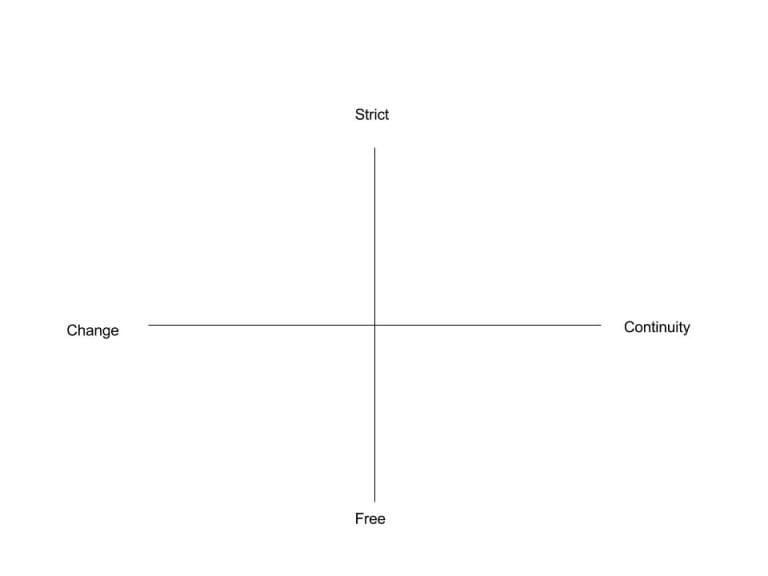
It’s possible to favor continuity with the past but relatively lax enforcement of boundaries, though this may be the hardest position to maintain (it’s also more or less where I fall–go figure). It’s also possible to make a break with the past and enforce it through rigid boundary controls (this is relatively more common, I think). For instance, in Calvin’s Geneva people who gave their children saints’ names could be hauled up before the Company of Pastors and fined. The break with the past was enforced through what looks to most of us today like very “conservative” forms of church discipline. But of course over time the “radical” position comes to be seen as the “traditional” one, making this position simply “conservative.” One very funny example of this was during the years leading up to the collapse of the Soviet Union. Western media referred to those who wanted to preserve Communism as the “right” within the Soviet Union, when of course the entire Soviet political tradition was originally extreme “left.” But by the 1980s people who were orthodox Marxist-Leninists were “conservatives” by the standard of their own tradition.
So there are four basic orientations:
Conservative (high continuity, rigid boundaries)
Liberal (low continuity, lax boundaries)
Radical (low continuity, rigid boundaries)
Traditional (high continuity, lax boundaries)
The naming of the fourth group is a problem. I’m not actually sure that it’s a rare position, but it is a position that tends over time to be eroded, at least in modern Western culture. That is to say, modern Western culture is fundamentally “liberal,” so continuity with tradition has to be a conscious effort by members of the particular community. My own position would (on a scale of 0 to 10 for each of the four categories) be something like 7 on continuity and 3 or 4 on freedom. That is to say, I favor quite a bit of freedom, but not by any means unlimited, while I stress continuity heavily.
A further complication is that these characteristics are, of course, tradition-specific. I’m describing my position primarily with regard to Catholicism–for years before I actually became Catholic, I thought about things through a primarily Catholic lens and saw Catholicism as the community against whose standards I should measure myself. As an Episcopalian, I was more straightforwardly conservative, because the Episcopal Church is much more liberal. Indeed, one of the reasons I became Catholic was so I didn’t have to be my own boundary police any more.
To be more precise, I think about the first category more in terms of the Christian tradition as a whole. That is to say, when I ask “how much should we maintain continuity with the past,” I am asking whether we should be more like liberal Protestants or fundamentalist Baptists or Pentecostals or neo-Anabaptist emergent hipsters or Eastern Orthodox or whatever. But when I ask how strictly the boundaries should be maintained, I am thinking of the authority structures which I have for years now accepted as normative–those of the Catholic Church. All baptized Christians are part of the Church. And this means that the authority structures of the Catholic Church are relevant for all Christians. That’s one reason why I have never fit in as an evangelical. I can’t take their authority structures seriously.
If I were asking the first question in terms of Catholicism alone (at least as represented by official teaching), I’d wind up as more like a 0, or maybe even a 1 in the direction of discontinuity. And if I were asking the second question in terms of all varieties of Christianity, I’d be more like a 2 in the direction of maintaining boundaries. If in terms of Episcopalianism alone, more like a 5.
In summary: we need the concepts of “liberal” and “conservative” because all communities have to ask questions about continuity and about boundaries. But we also need to recognize that this is not a simple binary and that the concepts are fluid and relative.
In a subsequent post, I’ll talk about liberal and conservative in terms of contemporary “culture wars,” and how the Christian faith relates to that particular liberal-conservative conflict.
Previous Post

April 11, 2017
"Missing out": why helicopter parenting commodifies children
Next Post
May 12, 2017 How mere Christianity made me a Catholic
Browse Our Archives
Select a Category apologetics Bible Catholicism Christianity economics history Middle Ages personal Reformation Rodney Stark Uncategorized
Select a Month August 2026 June 2026 January 2026 December 2025 October 2025 June 2025 February 2025 December 2024 November 2024 June 2024 May 2024 January 2024 December 2023 April 2023 December 2022 November 2022 September 2022 July 2022 June 2022 April 2022 November 2021 September 2021 March 2021 February 2021 January 2021 December 2020 November 2020 October 2020 August 2020 July 2020 June 2020 May 2020 December 2018 October 2018 June 2018 March 2018 December 2017 November 2017 October 2017 September 2017 May 2017 April 2017 March 2017 February 2017 January 2017 December 2016 November 2016 October 2016 September 2016 August 2016 July 2016 June 2016 May 2016 April 2016 March 2016 January 2016 December 2015 November 2015 September 2015 June 2015 May 2015 April 2015 March 2015 February 2015 January 2015 December 2014 November 2014 October 2014 August 2014 June 2014 March 2014 January 2014 September 2013 August 2013 June 2013 August 2012 July 2012 October 2011 June 2011 March 2011 July 2010 March 2010 January 2008 May 2007 April 2007 February 2007 October 2006 August 2006 March 2006 January 2006 November 2005 October 2005 September 2005 August 2005 June 2005 May 2005 April 2005 March 2005 February 2005 January 2005 December 2004 November 2004 September 2004
Follow Us!
TAKE THE
Religious Wisdom Quiz
Which book of the Bible contains the most direct prophecies about the Messiah?
Select your answer to see how you score.
Micah Psalms Isaiah Zechariah
Related posts from Light in the West

What is "Christian Nationalism"? A Reply to Dennis...



TRENDING AT PATHEOS Catholic

Rejecting Doom: Christian Hope And Human Action
Christianity is a religion of hope. We are to have hope and...

It’s What Comes From Within Which Matters
One of the most difficult things for us to understand is why...

Why I Choose the Eucharist Over the Sermon
Choose the Eucharist, Not the Sermon What are we supposed to get...

5 Design Elements Found in Spiritually Rooted Homes
Putting Spirituality Into Home Decor Our homes are more than our living...

Credo: A Story of God Told with the...
About 10 years ago, I began to imagine a personal "Credo" that...

The Anatomy of Divine Revelation in Catholic Thought
The claim that God has made Himself known to human beings is...
view all Catholic blogs
Ad-Free & Subscriber Log-In Subscription Support
- About Us
- 2026 Calendar
- Videos
- Podcasts
- Library of World Religions
- Faith In Media Tracker
- Advertise With Us
- Write for Us
- Privacy Policy
- Terms of Service
- Do Not Sell My Data
- Contact Us
- Radiant Digital
- Manage Newsletter Subscriptions
- Unsubscribe From Notifications
- Sitemap
Copyright 2008-2026, Patheos. All rights reserved.
Subscription Support Ad-Free & Subscriber Log-In
Follow Patheos