
BuddhistCatholicContemplativeEvangelicalGeneral ChristianHinduJewishLatter-day SaintMuslimNew VisionsProgressive Christian
Beliefs
- Buddhist
- Catholic
- Contemplative
- Evangelical
- General Christian
- Hindu
- Jewish
- Latter-day Saint
- More Voices
- Muslim
- New Visions
- Pagan
- Progressive Christian
Topics
- Religion News
- Food and Religion
- Sports and Religion
- Religious Art
- Religious Music and Entertainment
- Religious Events
- History and Religion
- Style and Religion
- Politics and Religion
- Women in Religion
- Recreation Outdoors and Religion
- Business Finance and Religion
- Careers Workplace and Religion
- Education and Religion
- Family Parenting and Religion
- Health Fitness and Religion
- Home and Religion
- Relationships and Religion
- Technology and Religion
- Travel and Religion
Columnists
- Buddhist Columnists
- Business Finance and Religion Columnists
- Careers Workplace and Religion Columnists
- Catholic Columnists
- Contemplative Columnists
- Education and Religion Columnists
- Evangelists Columnists
- Family Parenting and Religion Columnists
- General Christian Columnists
- Health Fitness and Religion Columnists
- Hindu Columnists
- History and Religion Columnists
- Home and Religion Columnists
- Jewish Columnists
- More Voices Columnists
- Latter Day Columnists
- Muslim Columnists
- New Visions Columnists
- Nonreligious Columnists
- Pagan Columnists
- Politics and Religion Columnists
- Progressive Columnists
- Recreation Outdoors and Religion Columnists
- Relationships and Religion Columnists
- Religion News Columnists
- Religious Art Columnists
- Religious Events Columnists
- Religious Music and Entertainment Columnists
- Sports and Religion Columnists
- Style and Religion Columnists
- Technology and Religion Columnists
- Travel and Religion Columnists
- Women in Religion Columnists
Resource Library
- 2026 Calendar
- Library of World Religions
- The 100 Most Holy Places on Earth
- Patheos Answers
- Podcasts
- Videos
- Faith Leaders Database
- Anglican Episcopalian
- Bahai
- Baptist
- Buddhism
- Christianity
- Confucianism
- Eastern Orthodoxy
- Hinduism
- Holiness and Pentecostal
- ISKCON
- Islam
- Judaism
- Lutheran
- Methodist
- The Church of Jesus Christ of Latter-day Saints
- New Age
- Paganism
- Presbytarian and Reformed
- Protestantism
- Religion Behind the Scenes
- Roman Catholic
- Scientology
- Shia Islam
- Sikhism
- Sufism
- Sunni Islam
- Taoism
- Zen
- See all religions
Research Tools
 Ad-Free & Subscriber Log-In Subscription Support
Ad-Free & Subscriber Log-In Subscription Support
Follow Patheos 

- Trending:
- Forgiveness
- |
- Marriage
- |
- Consciousness
- |
- Death Penalty
- |
- Election
- |
- Halloween
 LECTIO
- Home
- Progressive Christian
- Shepherds and Crucified Kings: The Lectionary for Reign of Christ
Shepherds and Crucified Kings: The Lectionary for Reign of Christ
Last updated on: November 14, 2016 at 7:50 am by Eric Smith
Shepherds and Crucified Kings: The Lectionary for Reign of Christ 2016-11-13T16:39:48-07:00 Eric Smith
Patheos Explore the world's faith through different perspectives on religion and spirituality! Patheos has the views of the prevalent religions and spiritualities of the world.
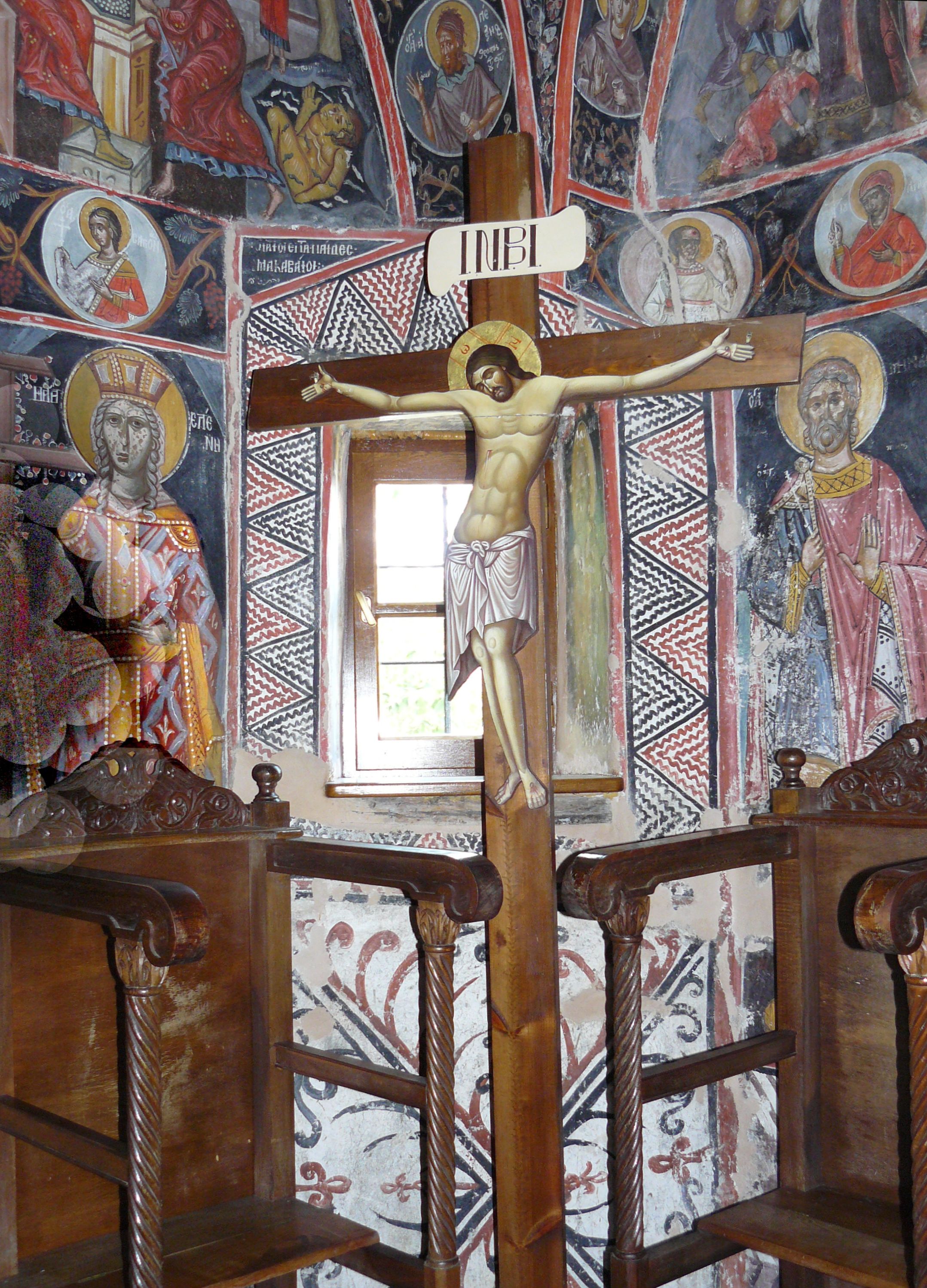
Jesus on the cross, St. Trinity Monastery, Meteora, Greece. Photograph by Janmad, licensed under Creative Commons license 1.0, and taken from Wikipedia.
What It’s About: Shepherds. But also kings.
When Christianity was young, and it was trying to piece together how to think about Jesus (was he God? was he a man? where did he fit in to Jewish texts and traditions?), Christians mined Jewish scriptures for models. They found many places, especially in prophetic texts, where something like Jesus could be seen in the margins of the texts. This is a prime example of that exegetical work of the early church. Jesus is not presented as a shepherd in the gospels in any systematic way; he does have shepherd-like moments (“I am the good shepherd” in John, shepherd parables, etc). Nor is Jesus presented as a king in any systematic way; questions about messiahship follow him everywhere, and the gospels have Jesus engage in discourse with Pilate about kingship, but kingship is not the primary way he is presented. But something like this passage from Jeremiah, with its mixture of shepherd and king language, had just enough of each to make contact with Jesus traditions in a powerful way. So a text like this came, for Christians to be a kind of prophecy about Jesus.
What It’s Really About: But this isn’t “Christ the Shepherd” day; it’s “Christ the King” or “Reign of Christ” day. So the main move this text makes in this context is to help transition from the image of shepherd–which is closer to the way Jesus is presented in the gospels–to the image of king. This passage makes that journey slowly, beginning with the notion of a shepherd, then a shepherd of the people, and then a kingly role of shepherding a nation. Jeremiah lived in a time when this kind of shepherdly-king figure would have been an immensely compelling image. It was perhaps even more compelling by the time of Jesus, when Judah (Judea) had been under the Roman thumb for a while, and the Greek thumb before that. A number of figures arose, each claiming to be the king of the Jews, and Rome was of course careful to quash them all, including Jesus. Christians were left, then, to consider other ways to think of this text from Jeremiah, and to think of Jesus, besides a king in the political sense.
What It’s Not About: It’s not about a political king. Early Christian authors were emphatic about this in varying degrees, but most of them were at pains to portray Jesus as innocuously as possible. Luke (see below) is actually the most aggressively Rome-comforting of the bunch; Luke seemed to sense that Christianity’s survival depended on convincing Rome that Christians were not a threat. But most early Christian writers were keen to downplay Jesus’ earthly, political kingliness and play up his spiritual kingship.
Maybe You Should Think About: Reading this and other prophetic texts as pointing to Jesus requires some exegetical acrobatics. They were, after all, not originally written about Jesus; Jeremiah didn’t know anything about Jesus. They only later came to be understood as foretelling Jesus’ life. Reading a few verses or even chapters on either side of this passage would help illuminate just how much this was taken out of context; early Christians were not so much concerned with holistic exegesis as they were with finding warrant for a theological take on Jesus. It’s worth thinking about how differently we read Jeremiah today, and whether these christological interpretations still make sense today. Is there a way to affirm Jesus’ kingship without reading Jeremiah this way?
What It’s About: This is a pretty richly christological passage; the author of Colossians is engaged in some fairly sophisticated theological work. It’s almost creedal in its succinctness, and almost liturgical in its repetitions. This reflects a fairly mature worshipping community, and it reflects some successful wrestling with Jesus’ identity. This is less explicitly kingly than the Jeremiah, but in verse 13 Jesus is the head of a kingdom, and in the verses that follow Jesus is tied closely to creation and to the origins of all things, including kings.
What It’s Really About: In a sense this passage is complicated, and in another sense it’s very simple. It’s complicated because it engages in sophisticated thinking about Jesus’ divinity, a task that would not reach its full expression until the fourth century. This text is well ahead of its time. But it’s also simple because it’s not really doing much that it doesn’t say it’s doing; this is a transparently christological text. There are no tricks here; no smoke and mirrors distract from the real purpose. This is a thoroughgoing theological kernel, and it’s remarkably well developed for a late first century or early second century context.
What It’s Not About: Most (but not all) scholars see Colossians as a pseudo-Pauline text; that is, Paul didn’t write it. This passage is part of the reason why. The theological language and reasoning in Colossians is just too savvy for Paul’s time, and anyway the grammar and vocabulary are not of the same kind that Paul used. Some inventive solutions have been created to solve this problem; maybe Paul dictated this letter to a scribe who was especially prone to paraphrasing and changing Paul’s words. But this kind of theological sophistication tells me that this is probably not Paul writing. That ought not dim our admiration for the text; clearly it comes from the pen of an erudite early Christian, whether it was Paul or not.
Maybe You Should Think About: It’s interesting to see the ways early Christians grasped for language for Jesus. Here Jesus is the “image of the invisible God,” the “firstborn of all creation,” the “firstborn from the dead.” These are all statements that would have been mildly heretical in certain times and places later on in the Christian tradition; the claim that Jesus was firstborn of creation, in particular, would have been scandalous in a Nicene context. (They claimed that Jesus was begotten, not made, in a very pointed part of the Nicene Creed). But you can see here the inadequacy of language for the Christian production of theology; they were running up against the limits of metaphor and description. It’s interesting to see it unfold.
What It’s About: This is a scene from the crucifixion, obviously, which would not seem to be a very fruitful place to think about Jesus’ kingship. But that’s the strange logic of the Christian story: it was in a scene of absolute desolation and death that Jesus’ true kingly nature was fully revealed. This was the source of a great deal of mockery of early Christians from their neighbors and opponents; what kind of king gets crucified? But Christians seized on the irony and turned it to their advantage, characterizing Jesus as a different sort of king and as having a different kind of kingdom.
What It’s Really About: This passage switches back and forth between the language of messiah and the language of king. It might be confusing, if you don’t know anything about messiahship. For Jews of the day, messiah wasn’t so much a theological title as it was a political one; a messiah (an “anointed one”) was a king in the Davidic line. So the thief verse 37 wasn’t changing the subject; he was riffing on the title from verse 35. The whole passage depends on a kind of incredulity about kings and messiahs; it was darkly comical for a “messiah,” who was a king, to be hanging on a cross.
What It’s Not About: What does verse 37 mean? “If you are the King of the Jews, save yourself!” That’s a strange thing to say; just being a king would not give one the ability to save one’s self from crucifixion. Was the thief suggesting that Jesus should call for his supporters to rescue him? Or is this theological language? It just seems slightly out of place to me.
Maybe You Should Think About: Christ the King or Reign of Christ Sunday marks the end of the church year. It’s a triumphant note to end on…but then we are left here at this scene, with the king on the cross. And the US election will be, by the time of this Sunday, a week and a half in the rear-view mirror. What kind of king do we claim Jesus to be? Certainly not a conventional one. Not even a triumphant or powerful one. It might be a useful time to ruminate on the nature of Jesus power, and the reasons his kingdom is not of this world.
Browse Our Archives
Select a Category Uncategorized
Select a Month November 2016 October 2016 September 2016 August 2016 July 2016 June 2016 May 2016 April 2016 March 2016 February 2016 January 2016 December 2015 November 2015 October 2015 September 2015 August 2015 July 2015 June 2015 May 2015 April 2015 March 2015 February 2015
Follow Us!
TAKE THE
Religious Wisdom Quiz
What did Lamentations describe happening to Jerusalem?
Select your answer to see how you score.
Its rebuilding Its prosperity Its destruction and mourning Its blessing and expansion
Related posts from LECTIO
The Days Will Come: The Lectionary for the...
Suffering and God: The Lectionary for the 25th...

Collaboration and Destruction: The Lectionary for the 24th...

The Righteous and the Religious: The Lectionary for...
TRENDING AT PATHEOS Progressive Christian

Why Christians Have a Sacred Duty to Vote:...
The Bible offers strong support for the sacred duty to vote. Here...

What Being a Modern-Day Apostle Means to Me
In my last column, I discussed the ins and outs of modern-day...

Did Ancient China Once Worship the God of...
Across human history, a common thread weaves through the origins of the...

Love Your Neighbor – Including Earth-Kin: Lev. 19,...
God’s command to love your neighbor means acting in an ethical and...

Lead a Church Study of “Jesus and Lao...
Guest writer Jack Thomas (The Irreverent Reverend) reflects on leading his church...

Principles for Understanding the Apostolic Ministry Today
Whenever people discover that my formal ministry title is "apostle," as in...
view all Progressive Christian blogs
Ad-Free & Subscriber Log-In Subscription Support
- About Us
- 2026 Calendar
- Videos
- Podcasts
- Library of World Religions
- Faith In Media Tracker
- Advertise With Us
- Write for Us
- Privacy Policy
- Terms of Service
- Do Not Sell My Data
- Contact Us
- Radiant Digital
- Manage Newsletter Subscriptions
- Unsubscribe From Notifications
- Sitemap
Copyright 2008-2026, Patheos. All rights reserved.
Subscription Support Ad-Free & Subscriber Log-In
Follow Patheos