
BuddhistCatholicContemplativeEvangelicalGeneral ChristianHinduJewishLatter-day SaintMuslimNew VisionsProgressive Christian
Beliefs
- Buddhist
- Catholic
- Contemplative
- Evangelical
- General Christian
- Hindu
- Jewish
- Latter-day Saint
- More Voices
- Muslim
- New Visions
- Pagan
- Progressive Christian
Topics
- Religion News
- Food and Religion
- Sports and Religion
- Religious Art
- Religious Music and Entertainment
- Religious Events
- History and Religion
- Style and Religion
- Politics and Religion
- Women in Religion
- Recreation Outdoors and Religion
- Business Finance and Religion
- Careers Workplace and Religion
- Education and Religion
- Family Parenting and Religion
- Health Fitness and Religion
- Home and Religion
- Relationships and Religion
- Technology and Religion
- Travel and Religion
Columnists
- Buddhist Columnists
- Business Finance and Religion Columnists
- Careers Workplace and Religion Columnists
- Catholic Columnists
- Contemplative Columnists
- Education and Religion Columnists
- Evangelists Columnists
- Family Parenting and Religion Columnists
- General Christian Columnists
- Health Fitness and Religion Columnists
- Hindu Columnists
- History and Religion Columnists
- Home and Religion Columnists
- Jewish Columnists
- More Voices Columnists
- Latter Day Columnists
- Muslim Columnists
- New Visions Columnists
- Nonreligious Columnists
- Pagan Columnists
- Politics and Religion Columnists
- Progressive Columnists
- Recreation Outdoors and Religion Columnists
- Relationships and Religion Columnists
- Religion News Columnists
- Religious Art Columnists
- Religious Events Columnists
- Religious Music and Entertainment Columnists
- Sports and Religion Columnists
- Style and Religion Columnists
- Technology and Religion Columnists
- Travel and Religion Columnists
- Women in Religion Columnists
Resource Library
- 2026 Calendar
- Library of World Religions
- The 100 Most Holy Places on Earth
- Patheos Answers
- Podcasts
- Videos
- Faith Leaders Database
- Anglican Episcopalian
- Bahai
- Baptist
- Buddhism
- Christianity
- Confucianism
- Eastern Orthodoxy
- Hinduism
- Holiness and Pentecostal
- ISKCON
- Islam
- Judaism
- Lutheran
- Methodist
- The Church of Jesus Christ of Latter-day Saints
- New Age
- Paganism
- Presbytarian and Reformed
- Protestantism
- Religion Behind the Scenes
- Roman Catholic
- Scientology
- Shia Islam
- Sikhism
- Sufism
- Sunni Islam
- Taoism
- Zen
- See all religions
Research Tools
 Ad-Free & Subscriber Log-In Subscription Support
Ad-Free & Subscriber Log-In Subscription Support
Follow Patheos 

- Trending:
- Forgiveness
- |
- Marriage
- |
- Consciousness
- |
- Death Penalty
- |
- Election
- |
- Halloween
 LECTIO
- Home
- Progressive Christian
- The Trouble With Money: The Lectionary for the 19th Sunday after Pentecost
The Trouble With Money: The Lectionary for the 19th Sunday after Pentecost
Last updated on: September 19, 2016 at 6:45 am by Eric Smith
The Trouble With Money: The Lectionary for the 19th Sunday after Pentecost 2016-09-18T08:01:31-07:00 Eric Smith
Patheos Explore the world's faith through different perspectives on religion and spirituality! Patheos has the views of the prevalent religions and spiritualities of the world.
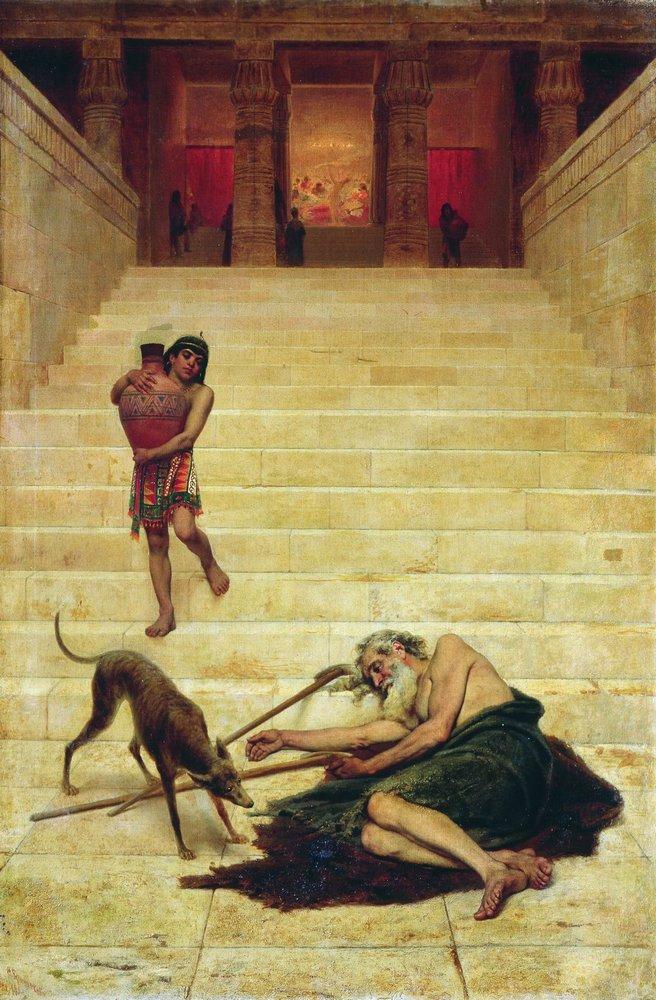
The Rich Man and Lazarus, by Fyodor Bronnikov, 1886. Image in the public domain, taken from Wikipedia.
Jeremiah 32:1-3a, 6-15 and/or Amos 6:1a, 4-7
What It’s About: The Jeremiah passage is about a real estate transaction–probably one of the most famous ones in the bible. Jeremiah has an opportunity to buy some family land–that’s what the language of “redemption” is about–and does so. This is perhaps not the best real estate investment strategy, but in the context of Jeremiah’s career it is a great expression of confidence in the future. The Amos text, meanwhile, is pretty standard Amos–decrying the rich and the comfortable. In some ways these passages mirror one another, with Jeremiah describing the desperation of people on the edge of annihilation and the small acts of hope that keep them going, and Amos describing the oblivious comfortableness of those who are about to be destroyed but do not know it yet.
What It’s Really About: Both of these texts–like much of the prophetic literature–presents a society under threat from external powers. Jeremiah was written during an especially dicey period of Judah’s history, when Josiah helped lead a revolt against the Assyrians (to whom they had been subjects). But Josiah was killed in battle soon after and Judah ended up as a vassal of Babylon. Hezekiah, in turn, led a rebellion against Babylon, ending in the infamous destruction of the temple and exile of the Israelites in 586/587 BCE. Amos, on the other hand, takes place a couple of hundred years earlier in the reigns of Uzziah (Judah) and Jeroboam II (Israel), as the threat from Assyria was arising–a threat that would eventually topple the northern kingdom permanently. So in both cases the character of society was brought into sharp relief, as people considered external threats and how to respond to them. This section of Amos is an invective against the casual luxury of the rich and powerful, while this part of Jeremiah is expressing hope in a coming restoration of Judah.
What It’s Not About: Both of these passages employ some selective reading. Amos skips over verses 1b through 3, which are comparisons to other nearby kingdoms (though the Hebrew is a little unclear there). Jeremiah skips over 3b through 5, which concern God’s intentionality in the process (“I am going to give this city into the hand of the king of Babylon, and he shall take it”) and the fate of Zedekiah (not good). This is the kind of stuff that the lectionary typically skips over, but it can be important to understanding the rest of the passage–especially in Jeremiah, where the missing text helps to make clear that this isn’t just something God is letting happen, this is something God is doing.
Maybe You Should Think About: This may be too “political” for many congregations, but it might be worth considering how these texts might speak to the American context in the present. (I always resent when people consider some topics “political,” as if religion weren’t always political, and as if all of scripture weren’t political in one sense or another. The bible and the Christian tradition are not politically neutral). There is a feeling among many, from Occupy Wall Street folks to #blacklivesmatter folks Trump supporters and Tea Partiers and Bernie Sanders supporters, that something has gone off the rails in our society. They don’t all agree on what it is, but there are broad sections of the American population that think that we are in some kind of crisis. These are two texts about crisis, and possible reactions to it. The two options here are 1) oblivious luxury (Amos), and 2) investment in a future you can’t see yet (Jeremiah). That’ll preach.
What It’s About: Speaking of politics! This passage from 1 Timothy is largely about money, and how money distracts from virtues like faith, love, gentleness, and so forth. Here the author seems to have in mind particular people in the community (“in their eagerness to be rich some have wandered away from the faith”) and the ways that the love of money has corrupted both the person and the community they were a part of. Interestingly, the section in 6:13-16 is a kind of recitation of tradition about Jesus, and this might have been a place where the author was quoting from a creed, a piece of liturgy, a prayer, or something similar.
What It’s Really About: The notes in my Harper Collins NRSV say that the saying in 6:10 (“the love of money is the root of all kinds of evil”) was a common saying within Greek philosophical traditions. That’s what this passage is playing on–just good, common-sense wisdom. There isn’t much specifically in here about why money ought to be viewed with skepticism, aside from generic claims that it is better to be content with what you have, and that greed is opposed to Christian virtues listed in verse 11. But this is the kind of wisdom that would have appealed and made sense to a wide variety of people, not just people already immersed in the Christian tradition.
What It’s Not About: I’ve made a point the past few weeks about how 1 Timothy (and 2 Timothy and Titus) are understood by most scholars to have been written by someone besides Paul, probably a bit later on, so I won’t rehash that here. But it’s worth noting that the message and character of this passage fits much better with an early 2nd century context than it does with a mid 1st century context like Paul’s. Concerns like wealth and community dynamics and traces of liturgy and more developed theology are part of the evidence that make scholars think that this is a later writer, and not Paul.
Maybe You Should Think About: This is from the closing part of the letter; there are only two concluding verses left after this passage. These are the author’s closing thoughts. Why put such strident language about wealth so close to the end? Why was this the kind of thing that belonged among the last things that the reader would see?
What It’s About: Yikes…this is a pretty powerful parable. It has it all: the ranting against wealth (echoing the passages above), vivid descriptions of social disparity, vignettes from heaven and Hades. It’s hard to read this and reconcile the words of Jesus with something like the prosperity gospel (and its modern prophets like Joel Osteen) who preach that God wants you to be wealthy and happy. Here, Lazarus suffers on earth and is rewarded in heaven, while the rich man feasts on earth and is tormented in Hades. This is a reference to the Deuteronomistic notion that you get what is coming to you, for good or for bad, and here Jesus is playing on that to uncover the hidden dangers of wealth.
What It’s Really About: This whole system that Jesus references–a heaven for those who have done well, a Hades (hell) for those who have done bad–is fairly new on the scene when Christianity arrives and takes it up. The Hebrew Bible doesn’t have this kind of system; in the Hebrew Bible there is a Sheol to which everybody goes. Sheol is the grave, a place of grayness and blah-ness kind of like Hades in Greek mythology. Likewise, Greek religious and philosophical thought usually had one afterlife for all, not a good one and a bad one depending on your earthly behavior. By the time of Jesus, however, this was changing, and Jesus is playing on this difference in the telling of this parable. I don’t know that we are supposed to take this too literally; Jesus is using the afterlife as a device to reveal the true nature of each man’s lifestyle. But this kind of language would have been confusing to both Jews and Greeks just a hundred or two hundred years earlier.
What It’s Not About: There is a tendency among some Christians to read a passage like this, and say, “oh, it’s callous wealth that you have to avoid. The rich man’s problem was that he didn’t pay attention to Lazarus and share his wealth with him, not that he was wealthy in the first place.” That’s a noble sentiment, but it’s worth noting that that’s not how Jesus tells the story. Wealth here is inherently dangerous; nowhere does Jesus say “if only you had just been charitable you could have been saved.” It is the disparity itself that is so dangerous. “Remember that during your lifetime you received your good things.” It’s a zero-sum game in this parable. You get it now, or you get it later, but you don’t get both. It’s pretty harsh.
Maybe You Should Think About: The Amos text, the 1 Timothy text, and this text form a pretty potent trio on the subject of wealth. Even if you’re only preaching on one of them, maybe it makes sense to read all three of them, if that’s not your church’s usual practice. Or, better yet, preach on all three, and talk about the trajectory throughout the bible of understanding wealth as an inherently dangerous thing.
Previous Post

September 12, 2016
Balms and Kings: The Lectionary for the 18th Sunday after Pentecost

Browse Our Archives
Select a Category Uncategorized
Select a Month November 2016 October 2016 September 2016 August 2016 July 2016 June 2016 May 2016 April 2016 March 2016 February 2016 January 2016 December 2015 November 2015 October 2015 September 2015 August 2015 July 2015 June 2015 May 2015 April 2015 March 2015 February 2015
Follow Us!
TAKE THE
Religious Wisdom Quiz
Which feast was reinstituted with great joy, reading the Law daily for seven days?
Select your answer to see how you score.
Day of Atonement Feast of Tabernacles Purim Passover
Related posts from LECTIO
Shepherds and Crucified Kings: The Lectionary for Reign...

The Days Will Come: The Lectionary for the...

Suffering and God: The Lectionary for the 25th...

Collaboration and Destruction: The Lectionary for the 24th...
TRENDING AT PATHEOS Progressive Christian

Why Christians Have a Sacred Duty to Vote:...
The Bible offers strong support for the sacred duty to vote. Here...

What Being a Modern-Day Apostle Means to Me
In my last column, I discussed the ins and outs of modern-day...

Did Ancient China Once Worship the God of...
Across human history, a common thread weaves through the origins of the...

Love Your Neighbor – Including Earth-Kin: Lev. 19,...
God’s command to love your neighbor means acting in an ethical and...

Lead a Church Study of “Jesus and Lao...
Guest writer Jack Thomas (The Irreverent Reverend) reflects on leading his church...

Principles for Understanding the Apostolic Ministry Today
Whenever people discover that my formal ministry title is "apostle," as in...
view all Progressive Christian blogs
Ad-Free & Subscriber Log-In Subscription Support
- About Us
- 2026 Calendar
- Videos
- Podcasts
- Library of World Religions
- Faith In Media Tracker
- Advertise With Us
- Write for Us
- Privacy Policy
- Terms of Service
- Do Not Sell My Data
- Contact Us
- Radiant Digital
- Manage Newsletter Subscriptions
- Unsubscribe From Notifications
- Sitemap
Copyright 2008-2026, Patheos. All rights reserved.
Subscription Support Ad-Free & Subscriber Log-In
Follow Patheos