
BuddhistCatholicContemplativeEvangelicalGeneral ChristianHinduJewishLatter-day SaintMuslimNew VisionsProgressive Christian
Beliefs
- Buddhist
- Catholic
- Contemplative
- Evangelical
- General Christian
- Hindu
- Jewish
- Latter-day Saint
- More Voices
- Muslim
- New Visions
- Pagan
- Progressive Christian
Topics
- Religion News
- Food and Religion
- Sports and Religion
- Religious Art
- Religious Music and Entertainment
- Religious Events
- History and Religion
- Style and Religion
- Politics and Religion
- Women in Religion
- Recreation Outdoors and Religion
- Business Finance and Religion
- Careers Workplace and Religion
- Education and Religion
- Family Parenting and Religion
- Health Fitness and Religion
- Home and Religion
- Relationships and Religion
- Technology and Religion
- Travel and Religion
Columnists
- Buddhist Columnists
- Business Finance and Religion Columnists
- Careers Workplace and Religion Columnists
- Catholic Columnists
- Contemplative Columnists
- Education and Religion Columnists
- Evangelists Columnists
- Family Parenting and Religion Columnists
- General Christian Columnists
- Health Fitness and Religion Columnists
- Hindu Columnists
- History and Religion Columnists
- Home and Religion Columnists
- Jewish Columnists
- More Voices Columnists
- Latter Day Columnists
- Muslim Columnists
- New Visions Columnists
- Nonreligious Columnists
- Pagan Columnists
- Politics and Religion Columnists
- Progressive Columnists
- Recreation Outdoors and Religion Columnists
- Relationships and Religion Columnists
- Religion News Columnists
- Religious Art Columnists
- Religious Events Columnists
- Religious Music and Entertainment Columnists
- Sports and Religion Columnists
- Style and Religion Columnists
- Technology and Religion Columnists
- Travel and Religion Columnists
- Women in Religion Columnists
Resource Library
- 2026 Calendar
- Library of World Religions
- The 100 Most Holy Places on Earth
- Patheos Answers
- Podcasts
- Videos
- Faith Leaders Database
- Anglican Episcopalian
- Bahai
- Baptist
- Buddhism
- Christianity
- Confucianism
- Eastern Orthodoxy
- Hinduism
- Holiness and Pentecostal
- ISKCON
- Islam
- Judaism
- Lutheran
- Methodist
- The Church of Jesus Christ of Latter-day Saints
- New Age
- Paganism
- Presbytarian and Reformed
- Protestantism
- Religion Behind the Scenes
- Roman Catholic
- Scientology
- Shia Islam
- Sikhism
- Sufism
- Sunni Islam
- Taoism
- Zen
- See all religions
Research Tools
 Ad-Free & Subscriber Log-In Subscription Support
Follow Patheos 

- Trending:
- Advent
- |
- Forgiveness
- |
- Thanksgiving
- |
- Election
- |
- Seasonal Holidays
- |
- Marriage
 LECTIO
- Home
- Progressive Christian
- Love and Newness: The Lectionary for the Fifth Sunday of Easter
Love and Newness: The Lectionary for the Fifth Sunday of Easter
Last updated on: April 18, 2016 at 12:26 pm by Eric Smith
Love and Newness: The Lectionary for the Fifth Sunday of Easter 2016-04-18T12:26:12-07:00 Eric Smith
Patheos Explore the world's faith through different perspectives on religion and spirituality! Patheos has the views of the prevalent religions and spiritualities of the world.

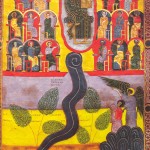
Image of Jerusalem descending from the sky, from the 14th-century “Tapestry of the Apocalypse.” Image in the public domain, taken from Wikipedia.
What It’s About: This passage from Acts narrates an episode in one of the most urgent crises of the early Christian movement: the problem of gentile inclusion. There are roots of gentile inclusion sunk deep into the Jewish tradition, and there had been a sense in Jewish scriptures and practices that gentiles were, should be, or would be included in the worship of Israel’s God. These roots helped to feed the early Christian movement, which was of course an expression of second-temple Judaism. In the way the current New Testament tells it, the main actors in this crisis in the early church were Paul and the Jerusalem Christians, which included people like Peter and James. Paul was obviously all-in on gentile inclusion; he felt that the event of Jesus meant that God’s family had been opened to everyone, even those outside of Israel. The Jerusalem faction, though, seemed resistant to this, and Peter’s vision seems to narrate a kind of breakthrough compromise in that dispute.
What It’s Really About: Peter’s vision is cast in terms of an epiphany or a revelation. In his vision, Peter sees a sheet (which is strange) coming from heaven, with a variety of animals on it. He’s told to “kill and eat” (also kind of jarring), but he protests: many of the animals on the sheet are not acceptable to eat under Jewish law. But the voice told him to accept what God had made. So it came to pass that Peter changed his mind on eating unclean foods, and therefore on eating with gentiles. It’s interesting that the story is told somewhat out of order; the vision had already taken place by the time the passage begins, and it is related in the service of explaining Peter’s new eating habits.
What It’s Not About: Maybe it happened this way, but I tend to see this story as a kind of concession–a convenient, face-saving vision–to the kind of Christianity preached and practiced by Paul. I think this is evidence that Paul won the day, even among the Jerusalem crowd, and so Peter had to adjust his position, and ascribe it to divine instruction. Or, perhaps, Luke had to account somehow for Peter coming out on the wrong side of the debate, and so in Acts he has Peter’s change of heart come at the instigation of God.
Maybe You Should Think About: The church has spent a lot of time being (in my opinion) wrong about a lot of things, only to see the error of its ways later on. The roles of women, the inclusion of GLBT persons, the problem with divorce, and so on–on many issues the church has held a (sometimes) well-intentioned position only to change it down the line. People who hold to the old position often chalk this up to political correctness run amok (Stanley Hauerwas is one who sometimes says this). But I see this story of Peter’s vision as solid evidence that sometimes God wants us to change our minds about things, and to do so is not an act of apostasy, but an act of faithfulness. “God is still speaking,” as the slogan goes…and it would be wise to listen.
What It’s About: This is a beautiful passage from near the end of the Apocalypse, which features a vision of the aftermath of that book’s various struggles and conflicts. It is often assumed that the outcome of Revelation is annihilation; popular riffs on the eschaton (like the Left Behind series) see the world as being destroyed. But Revelation ends in a pretty different place–the remaking of heaven and earth, and not in a generic, abstract way, but in a very concrete (pun intended) way. Jerusalem–in all its city-ness–is part of the future. And, most promisingly, “the home of God is among mortals.” God is intimately bound up with us, and this place, in which we find ourselves. The world is not disposable or irrelevant, as many strains of Christianity have often assumed or even argued. The earth is integral to God’s plan.
What It’s Really About: This passage is part of a larger sweep (in chapters 20 and 21) of the telos of the book of Revelation, but also of the cosmos. It’s the payoff to all the sound and fury of the earlier chapters. And I think it’s connected to the notion of the Kingdom of God (or Kingdom of Heaven) found in the gospels. The message of that narrative is distilled to “the kingdom is at hand, and the kingdom is among you,” which resonates quite nicely with the vision of a new Jerusalem. New Jerusalem, yes–but also new Peoria, new Dubuque, new Sausalito, new Charlotte. The world is being remade, at God’s direction, and we are invited to be a part of it, because the home of God is among mortals. That’s pretty powerful.
What It’s Not About: Christianity owes a lot to Platonism, including a lot that is really valuable. But one legacy of Platonic thought is dualism, which usually constructs pairs of things (light/dark, good/evil, life/death, etc) and privileges one of those things over the other. Heaven/earth is one of the most powerful of these, and earth, in that dualism, is de-valued. So Christianity has often dismissed the world as fallen, bad, sinful, and ultimately useless. This passage is a valuable corrective to that.
Maybe You Should Think About: What does a commitment to this world look like? What, if God dwells among mortals, do we do about God’s dwelling place? Earth Day is upon us…this could be the seed for a really good sermon.
What It’s About: “That you love one another.” That’s pretty much what it’s about. Jesus is announcing in this passage that he is going on to another place, where his disciples cannot go, and the instruction he pairs with this news is “love one another.”
What It’s Really About: It’s about identity. Look at verse 35. This is supposed to be the sign that you’ve encountered some Jesus-disciples: that they love one another. That’s a pretty strong identifying feature, and if that’s supposed to be the identifying feature, then that’s a pretty strong commandment.
What It’s Not About: It’s not about selfishness, is it? The prosperity gospel, in all its forms, founders on this passage. Sure, you could argue about “love yourself so that you can love others.” But that’s willfully misreading the text. Jesus here is describing a communal ethic that is profoundly focused on the other, not the self.
Maybe You Should Think About: Does this loving-one-another signal something about that new heaven, new earth, and new Jerusalem above? How does all that fit together? Does loving one another help bring on the remaking of the world?
Previous Post

April 11, 2016
Heaven and Earth: The Lectionary for the Fourth Sunday of Easter
Next Post
April 25, 2016 Visions of What's to Come: The Lectionary for the Sixth Sunday of Easter
Browse Our Archives
Select a Category Uncategorized
Select a Month November 2016 October 2016 September 2016 August 2016 July 2016 June 2016 May 2016 April 2016 March 2016 February 2016 January 2016 December 2015 November 2015 October 2015 September 2015 August 2015 July 2015 June 2015 May 2015 April 2015 March 2015 February 2015
Follow Us!
TAKE THE
Religious Wisdom Quiz
Elisha purified a pot of stew that had been poisoned with what?
Select your answer to see how you score.
Bad Cheese Wild Mushrooms Wild Gourds Arsenic
Related posts from LECTIO
Shepherds and Crucified Kings: The Lectionary for Reign...

The Days Will Come: The Lectionary for the...
Suffering and God: The Lectionary for the 25th...

Collaboration and Destruction: The Lectionary for the 24th...
TRENDING AT PATHEOS Progressive Christian

The Secret behind A Charlie Brown Thanksgiving
Do you know the secret behind A Charlie Brown Thanksgiving? Sparky was...

Bridging the Gap Between God and Man
From Far Off to the Ultimate Embrace “God is a Spirit: and...

Let Matthew 25 Guide You to a Greater...
With the crisp feel of fall in the air, our minds quickly...

Can a Chatbot Touch Your Soul?
Can a chatbot offer genuine spiritual counsel? One conversation brought me to...

Religion and Politics: How Should We Then Live?
Two cultural axioms get repeated in polite company. Don't mix religion and...

7 Things We Get Wrong About Giving Thanks
It's a time of year when many of us turn to the...
view all Progressive Christian blogs
Ad-Free & Subscriber Log-In Subscription Support
- About Us
- 2026 Calendar
- Videos
- Podcasts
- Library of World Religions
- Faith In Media Tracker
- Advertise With Us
- Write for Us
- Privacy Policy
- Terms of Service
- Do Not Sell My Data
- Contact Us
- Radiant Digital
- Manage Newsletter Subscriptions
- Unsubscribe From Notifications
- Sitemap
Copyright 2008-2026, Patheos, part of the Radiant Digital network of media brands. All rights reserved.
Subscription Support Ad-Free & Subscriber Log-In
Follow Patheos