
BuddhistCatholicContemplativeEvangelicalGeneral ChristianHinduJewishLatter-day SaintMuslimNew VisionsProgressive Christian
Beliefs
- Buddhist
- Catholic
- Contemplative
- Evangelical
- General Christian
- Hindu
- Jewish
- Latter-day Saint
- More Voices
- Muslim
- New Visions
- Pagan
- Progressive Christian
Topics
- Religion News
- Food and Religion
- Sports and Religion
- Religious Art
- Religious Music and Entertainment
- Religious Events
- History and Religion
- Style and Religion
- Politics and Religion
- Women in Religion
- Recreation Outdoors and Religion
- Business Finance and Religion
- Careers Workplace and Religion
- Education and Religion
- Family Parenting and Religion
- Health Fitness and Religion
- Home and Religion
- Relationships and Religion
- Technology and Religion
- Travel and Religion
Columnists
- Buddhist Columnists
- Business Finance and Religion Columnists
- Careers Workplace and Religion Columnists
- Catholic Columnists
- Contemplative Columnists
- Education and Religion Columnists
- Evangelists Columnists
- Family Parenting and Religion Columnists
- General Christian Columnists
- Health Fitness and Religion Columnists
- Hindu Columnists
- History and Religion Columnists
- Home and Religion Columnists
- Jewish Columnists
- More Voices Columnists
- Latter Day Columnists
- Muslim Columnists
- New Visions Columnists
- Nonreligious Columnists
- Pagan Columnists
- Politics and Religion Columnists
- Progressive Columnists
- Recreation Outdoors and Religion Columnists
- Relationships and Religion Columnists
- Religion News Columnists
- Religious Art Columnists
- Religious Events Columnists
- Religious Music and Entertainment Columnists
- Sports and Religion Columnists
- Style and Religion Columnists
- Technology and Religion Columnists
- Travel and Religion Columnists
- Women in Religion Columnists
Resource Library
- 2026 Calendar
- Library of World Religions
- The 100 Most Holy Places on Earth
- Patheos Answers
- Podcasts
- Videos
- Faith Leaders Database
- Anglican Episcopalian
- Bahai
- Baptist
- Buddhism
- Christianity
- Confucianism
- Eastern Orthodoxy
- Hinduism
- Holiness and Pentecostal
- ISKCON
- Islam
- Judaism
- Lutheran
- Methodist
- The Church of Jesus Christ of Latter-day Saints
- New Age
- Paganism
- Presbytarian and Reformed
- Protestantism
- Religion Behind the Scenes
- Roman Catholic
- Scientology
- Shia Islam
- Sikhism
- Sufism
- Sunni Islam
- Taoism
- Zen
- See all religions
Research Tools
 Ad-Free & Subscriber Log-In Subscription Support
Ad-Free & Subscriber Log-In Subscription Support
Follow Patheos 

- Trending:
- Forgiveness
- |
- Marriage
- |
- Consciousness
- |
- Death Penalty
- |
- Election
- |
- Halloween
 LECTIO
- Home
- Progressive Christian
- Seraphs, Storms, and Being Born: The Lectionary for the first Sunday after Pentecost
Seraphs, Storms, and Being Born: The Lectionary for the first Sunday after Pentecost
Last updated on: May 24, 2015 at 11:00 am by Eric Smith
Seraphs, Storms, and Being Born: The Lectionary for the first Sunday after Pentecost 2015-05-23T16:18:42-07:00 Eric Smith
Patheos Explore the world's faith through different perspectives on religion and spirituality! Patheos has the views of the prevalent religions and spiritualities of the world.
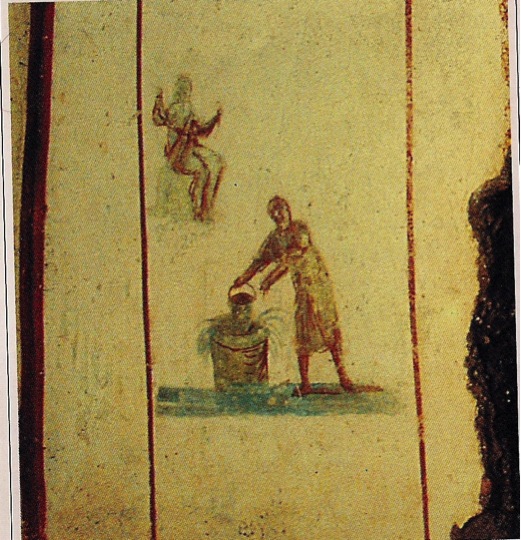
A painting of the Samaritan woman’s meeting with Jesus, Callistus Catacomb, Rome. This story is not in the lectionary for this week, but maybe it shoudl be.
Earlier this week I wrote a post that isn’t on any of the week’s lectionary texts, but might provide an alternative text if you’re so inclined. It’s a meditation on the synoptic gospel stories of the rich young ruler (as Luke puts it) in the context of the revelations that Josh Duggar molested his sisters and other girls. You can read it here.
What It’s About: This is Isaiah’s call narrative, in which he hears God’s call to speak on God’s behalf. The setting seems to be the Jerusalem temple, and God is enthroned and surrounded by seraphim (but not the cherubim that you might expect alongside them). Isaiah protests his call, which is not uncommon in biblical narratives, but in the end his professed impurity is cleansed, and he is sent out to do God’s work.
What It’s Really About: This text is really about the justification for Isaiah’s ministry. Notice how connected this story is to official power structures; it’s pegged to the year the king died, and it all takes place in the temple. This story has “you should listen to this guy” written all over it. Prophets in ancient Israel were not just one-off wild men in the wilderness; they belong to a “guild” of sorts with different ways of legitimizing their right to speak for God. Here, Isaiah is claiming a mandate from God in the way he was called to the work of prophesy.
What It’s Not About: It’s not about cherubim, but it seems like some of the details of cherubs overlap with some of the details of seraphs. I recently finished a 3,000 word entry on cherubs for the Brill Encyclopedia of Early Christianity, which hasn’t been published yet, and so I’m a bit traumatized by the experience of having to figure out the various cosmological significances of angelic beings. Suffice it to say that Ezekiel is pretty vivid in his descriptions.
Maybe You Should Think About: Coming a week after Pentecost, maybe you should think about asking your congregation: what are we being called to do? In the midst of our polities and politics, in the midst of our own house of worship, what call do we hear, and how should we respond? Isaiah’s response was one of reluctance and unworthiness, which echoes the responses of other figures, like Moses. How does your congregation feel ill-equipped or unready for its call, and how can it overcome those hesitations?
What It’s About: My Oxford NRSV calls this a “Hymn to the God of the storm.” That seems like a pretty good description. Here is a powerful God, enthroned over the world, who shakes the world with flames and voice and glory. This pairs in interesting ways with the Isaiah text, which also has God enthroned–but in a much more domesticated (literally) sense. In the Isaiah text, God is in the temple, which is also described as a house, and God is waited on by the attending seraphs. In this psalm, God is set loose in the wild, among the trees and mountains, and God’s presence is felt everywhere.
What It’s Really About: The psalms have a knack for putting God in nature, and this one is definitely in that tradition. Verse 3 is especially interesting to me; ancient near eastern cosmologies often have a god doing battle with and overcoming the waters. In Ugarit the god of the sea was Yam, and the Baal Cycle (a series of tales about the gods) has Baal-Hadad fight against Yam for control of the world. Compare that to the opening chapter of Genesis, where God moves over the face of the deep, bringing order from the chaos of primordial waters. Psalm 29:3 (and also 29:10, for that matter) is a good reminder that the Hebrew Bible comes out of a place and a time, and its references might not always be apparent to us today.
What It’s Not About: It’s not about panentheism. Here, God is clearly more powerful than the creation God oversees. This is a God who rules, not one who is intertwined with the world.
Maybe You Should Think About: Spring is a season of storms for many places. Does this text speak to our own experiences of storms? Do you see God in storms, literal or otherwise, or do you see God as outside of nature, ready to comfort those who are impacted by nature’s whims?
What It’s About: It’s about being led by the Spirit of God to become children of God–and not slaves.
What It’s Really About: Listen, can we be real for a moment? Paul is not always very easy to understand. He starts by saying one thing, and then halfway through he decides he has a better way to say it. He backs himself into corners, circles around to the same point again and again, and gets lost in his own logic. Nowhere is the difficulty of reading Paul as great as it is in the middle chapters of Romans. Chapters 9-11 are infamously difficult to interpret, but here in chapter 8 there is plenty of confusion to go around. In Romans, one gets the sense that Paul has the jitters; after all, these are people he doesn’t know, and he makes a point of saying he has no authority over them. I think sometimes in Romans he is either tiptoeing around things, or going out of his way to be deferential, and it comes across as messy writing. This is, I think, one of those places.
What It’s Not About: It’s not about keeping the metaphors straight. Life and death, slavery and freedom, children, adopted children, heirs…there is a lot going on in these few verses. Paul is casting about for the right way to say what he means, and I definitely get the sense that he wouldn’t have used the image of adoption if he knew the Christological controversies that would envelop Christianity in later times. Nevertheless, what Paul seems to be getting at here is a sense that Jesus has changed something for humans in relation to God, and that the change means that we are no longer beholden to our sinfulness and isolation.
Maybe You Should Think About: One way to approach a difficult text is to read it through a half a dozen times, and then try to re-tell it to yourself. Write down what you remember it saying, and then see how closely your version matches what’s in the bible. Where there are divergences, see if you can figure out what’s accounting for them. What are you hearing that the text isn’t saying, and what is the text saying that you’re missing?
What It’s About: This is the story of Nicodemus, a Pharisee (read: important smart guy) who came to Jesus to talk to him. I think you have to read this story alongside the story that comes just one chapter later in John 4:7-42. In both cases Jesus is encountering someone, but they are very different people, and the stories go in different directions. The Samaritan woman in chapter 4 is an outsider in nearly every imaginable way, but she is able to accept what Jesus is saying. Nicodemus, meanwhile, is as status-laden as a person can be, but he is on the receiving end of some taunting from Jesus about how he just doesn’t get it (in verse 10). Read together, what are these stories telling us about Jesus’ audience?
What It’s Really About: This story all hinges on a pun. In Greek, the word anothen can mean “from above” or it can mean “anew” or “again.” When Jesus says the word, Nicodemus hears “again,” but Jesus actually means “from above.” So much like the story of the Samaritan woman in chapter 4, a lot of this conversation is spent working out a miscommunication. “Born from above” is the correct meaning, and this comports nicely with the Johannine focus on verticality; good things come from above. “Born again” is the wrong interpretation, which is why I have always been baffled that Christians use this word as the way to describe finding religion.
Note well, by the way, that this pun only works in Greek. Jesus and Nicodemus spoke Aramaic. So this story is one that historical Jesus scholars often flag as being unlikely to have gone all the way back to Jesus.
What It’s Not About: It’s not about John 3:16! Read that passage, and notice how incidental 3:16 is to the whole thing. It’s really almost beside the point, an afterthought to the main idea. And yet John 3:16 has become the bible verse for things like signs in the end zones of football games. I suppose it is a nice encapsulation of salvation (according to one perspective on salvation), but it’s strange that the verse has been taken so far out of context for its use as a pop-Christianity touchstone.
Maybe You Should Think About: John 4 isn’t in the lectionary for this week, but I think the two stories are so much better together. Maybe, instead of a sermon (all the preachers’ ears just perked up), do a dramatic reading of the two stories. Intertwine and intermesh them, highlighting the contrasts and similarities. Invite lay readers to take parts–perhaps men for the Nicodemus story and women for the story of the Samaritan woman. The ending of the Samaritan woman’s story, where she become an enthusiastic evangelist, will be a powerful coda to the exercise.
Previous Post

May 22, 2015
Bonus Text: Josh Duggar and the Six Commandments
Next Post

May 27, 2015 Tobacco, Church, and Nostalgia: A Sermon for Pentecost
Browse Our Archives
Select a Category Uncategorized
Select a Month November 2016 October 2016 September 2016 August 2016 July 2016 June 2016 May 2016 April 2016 March 2016 February 2016 January 2016 December 2015 November 2015 October 2015 September 2015 August 2015 July 2015 June 2015 May 2015 April 2015 March 2015 February 2015
Follow Us!
TAKE THE
Religious Wisdom Quiz
According to Jesus, "Blessed are those who hunger and thirst for." what?
Select your answer to see how you score.
Righteousness Power Popularity Money
Related posts from LECTIO
Shepherds and Crucified Kings: The Lectionary for Reign...
The Days Will Come: The Lectionary for the...
Suffering and God: The Lectionary for the 25th...

Collaboration and Destruction: The Lectionary for the 24th...
TRENDING AT PATHEOS Progressive Christian

Why Christians Have a Sacred Duty to Vote:...
The Bible offers strong support for the sacred duty to vote. Here...

What Being a Modern-Day Apostle Means to Me
In my last column, I discussed the ins and outs of modern-day...

Did Ancient China Once Worship the God of...
Across human history, a common thread weaves through the origins of the...

Love Your Neighbor – Including Earth-Kin: Lev. 19,...
God’s command to love your neighbor means acting in an ethical and...

Lead a Church Study of “Jesus and Lao...
Guest writer Jack Thomas (The Irreverent Reverend) reflects on leading his church...

Principles for Understanding the Apostolic Ministry Today
Whenever people discover that my formal ministry title is "apostle," as in...
view all Progressive Christian blogs
Ad-Free & Subscriber Log-In Subscription Support
- About Us
- 2026 Calendar
- Videos
- Podcasts
- Library of World Religions
- Faith In Media Tracker
- Advertise With Us
- Write for Us
- Privacy Policy
- Terms of Service
- Do Not Sell My Data
- Contact Us
- Radiant Digital
- Manage Newsletter Subscriptions
- Unsubscribe From Notifications
- Sitemap
Copyright 2008-2026, Patheos. All rights reserved.
Subscription Support Ad-Free & Subscriber Log-In
Follow Patheos