
BuddhistCatholicContemplativeEvangelicalGeneral ChristianHinduJewishLatter-day SaintMuslimNew VisionsProgressive Christian
Beliefs
- Buddhist
- Catholic
- Contemplative
- Evangelical
- General Christian
- Hindu
- Jewish
- Latter-day Saint
- More Voices
- Muslim
- New Visions
- Pagan
- Progressive Christian
Topics
- Religion News
- Food and Religion
- Sports and Religion
- Religious Art
- Religious Music and Entertainment
- Religious Events
- History and Religion
- Style and Religion
- Politics and Religion
- Women in Religion
- Recreation Outdoors and Religion
- Business Finance and Religion
- Careers Workplace and Religion
- Education and Religion
- Family Parenting and Religion
- Health Fitness and Religion
- Home and Religion
- Relationships and Religion
- Technology and Religion
- Travel and Religion
Columnists
- Buddhist Columnists
- Business Finance and Religion Columnists
- Careers Workplace and Religion Columnists
- Catholic Columnists
- Contemplative Columnists
- Education and Religion Columnists
- Evangelists Columnists
- Family Parenting and Religion Columnists
- General Christian Columnists
- Health Fitness and Religion Columnists
- Hindu Columnists
- History and Religion Columnists
- Home and Religion Columnists
- Jewish Columnists
- More Voices Columnists
- Latter Day Columnists
- Muslim Columnists
- New Visions Columnists
- Nonreligious Columnists
- Pagan Columnists
- Politics and Religion Columnists
- Progressive Columnists
- Recreation Outdoors and Religion Columnists
- Relationships and Religion Columnists
- Religion News Columnists
- Religious Art Columnists
- Religious Events Columnists
- Religious Music and Entertainment Columnists
- Sports and Religion Columnists
- Style and Religion Columnists
- Technology and Religion Columnists
- Travel and Religion Columnists
- Women in Religion Columnists
Resource Library
- 2026 Calendar
- Library of World Religions
- The 100 Most Holy Places on Earth
- Patheos Answers
- Podcasts
- Videos
- Faith Leaders Database
- Anglican Episcopalian
- Bahai
- Baptist
- Buddhism
- Christianity
- Confucianism
- Eastern Orthodoxy
- Hinduism
- Holiness and Pentecostal
- ISKCON
- Islam
- Judaism
- Lutheran
- Methodist
- The Church of Jesus Christ of Latter-day Saints
- New Age
- Paganism
- Presbytarian and Reformed
- Protestantism
- Religion Behind the Scenes
- Roman Catholic
- Scientology
- Shia Islam
- Sikhism
- Sufism
- Sunni Islam
- Taoism
- Zen
- See all religions
Research Tools
 Ad-Free & Subscriber Log-In Subscription Support
Ad-Free & Subscriber Log-In Subscription Support
Follow Patheos 

- Trending:
- Forgiveness
- |
- Marriage
- |
- Consciousness
- |
- Death Penalty
- |
- Election
- |
- Halloween

- Home
- Progressive Christian
- Education and Religion
- Meeting the Apostle John
Meeting the Apostle John
Last updated on: June 5, 2024 at 9:43 pm by Lee Ann B. Marino
Meeting the Apostle John 2024-06-05T21:43:05-04:00 Lee Ann B. Marino
Patheos Explore the world's faith through different perspectives on religion and spirituality! Patheos has the views of the prevalent religions and spiritualities of the world.
Among the twelve apostles, there were two sets of brothers: Peter and Andrew and James and John, sons of Zebedee. In this column, we will be looking at the second brother of the second set: the Apostle John. So far, we’ve seen the way Peter, Andrew, James (the Greater) and Philip influenced early Christianity, even unto their death. They speak to us about the virtues of ministry leadership. We are inspired by both their humanity and their courage under fire.
Today, we will learn about the Apostle John and his essential role as an apostle in the first century.
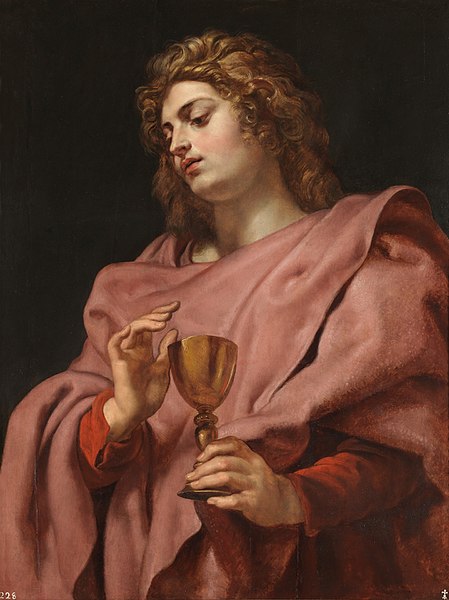
The Apostle John, Peter Paul Rubens (1577-1640), Public Domain. Source: Wikimedia Commons
Who was John?
The best guess anyone has of John’s birth year is somewhere around 6 AD. Like his brother, James, he was a fisherman. We believe he was from Capernaum on the Sea of Galilee. The Bible says his father was named Zebedee (Matthew 4:21-22, Mark 1:19-20) and his mother, Salome (Matthew 27:56, Mark 15:40). Salome was Mary’s cousin, thus making John a cousin of Jesus. In Orthodox tradition, Salome is considered a Myrrhbearer, one of the first women to visit the tomb and witness the resurrection of Jesus. His brother James was also an apostle.
John and James were nicknamed Boanerges, meaning “sons of thunder.”
James son of Zebedee and his brother John (to them He gave the name Boanerges, which means “sons of thunder”). (Mark 3:17, NIV)
this indicates they had impatient temperaments. They were quick to be angry and act impulsively, without considering what might happen as a result.
John the Apostle is credited with the Gospel of John, 1, 2, and 3 John, and Revelation in the New Testament. His writings compose about 5% of the Bible!
John’s walk with Jesus
John is a major figure in the New Testament. Along with Peter and James, he’s considered part of Jesus’ inner circle. Sometimes described as “the disciple Jesus loved,” it’s obvious he played an important role as a disciple. Some major experiences include:
- Raising of Jarius’ daughter from the dead: John was there when Jesus raised Jarius’ daughter from the dead (Mark 5:37 and Luke 8:51).
- The Transfiguration: Peter, James, and John were privileged to see the transfiguration of Jesus. (Matthew 17:1-13).
- The agony in the garden of Gethsemane: As Jesus prepared to die, He took the three with Him through His time of reflection and agony (Mark 14:33 and Matthew 26:37).
- The Last Supper: Peter and John were sent to find a location for the Passover meal (Luke 22:8). Later, John reclined on Jesus’ chest when prompted by Peter to ask who of the twelve would betray Him (John 13:23-25).
- The crucifixion: Jesus entrusted the care of Mary, his mother, to John during the crucifixion (John 19:26-27).
John after the resurrection
John was one of the first apostles to witness the resurrection.
So Peter and the other disciple started for the tomb. Both were running, but the other disciple outran Peter and reached the tomb first. He bent over and looked in at the strips of linen lying there but did not go in. Then Simon Peter came along behind him and went straight into the tomb. He saw the strips of linen lying there, as well as the cloth that had been wrapped around Jesus’ head. The cloth was still lying in its place, separate from the linen. Finally the other disciple, who had reached the tomb first, also went inside. He saw and believed. (They still did not understand from Scripture that Jesus had to rise from the dead.) (John 20:3-9, NIV)
Throughout much of Acts, John is mentioned alongside Peter. He was present when Peter healed the blind beggar (Acts 3:1-10), when the two were arrested and stood before the Sanhedrin (Acts 4:1-31), and to lay hands for the reception of the Holy Spirit in Samaria and preach to Jerusalem (Acts 8:24-25).
Later accounts
John ministered throughout Judea for about twelve years after Pentecost. There are no records of his ministry during this time. After the death of Mary (Jesus’ mother), he ministered in Ephesus. There he wrote 1, 2, and 3 John. Under the Emperor Trajan, he was exiled to Patmos, where he would spend the rest of his life.
John the Apostle was the youngest of the twelve. Tradition states he outlived the rest of them. He’s the only one who died a natural death, of old age (around 94) around 100 AD. This also means he’s the only apostle with a Biblical testament into advanced age (Revelation 1:1-4, Revelation 22:8). Scholars suggest the book of Revelation was written sometime after 90 AD, which means John wrote Revelation well into his late eighties.
There are two apocryphal writings attributed to or about John:
Neither of these works were written by John himself. The Acts of John contains medieval legends about his work, while the Apocryphon of John is considered a Gnostic text.
Summary
The Apostle John reveals a unique perspective of Jesus as well as a powerful understanding of faith. For one, he shows us it’s all right to be different, even in ministry presentation and style. While Peter, Paul, and several other apostles ministered in multiple areas, John worked predominantly in two regions. This didn’t nullify his call; it just made it different. Additionally, being young isn’t a detriment in the work of God. As the youngest of the twelve, he outlived them all! This means he served the longest, over much of his life. Beyond these obvious points, John’s revelation of Jesus as the Word incarnate proves he saw something in Jesus that the others didn’t. His insights were needed because they weren’t like the others. For his revelations, we, as believers, are thankful.
The revelation from Jesus Christ, which God gave Him to show His servants what must soon take place. He made it known by sending His angel to His servant John, who testifies to everything he saw—that is, the word of God and the testimony of Jesus Christ. Blessed is the one who reads aloud the words of this prophecy, and blessed are those who hear it and take to heart what is written in it, because the time is near. (Revelation 1:1-3, NIV)
General Christian
History and Religion

About Lee Ann B. Marino
Dr. Lee Ann B. Marino, Ph.D., D.Min., D.D. (”The Spitfire”) is “everyone’s favorite theologian” leading Gen X, Millennials, and Gen Z as apostle of Spitfire Apostolic Ministries. Her work encompasses study and instruction on leadership training and development, typology, Pneumatology, conceptual theology, Ephesians 4:11 ministry, and apostolic theology. She is author of over thirty-five books, host of the top twenty percentile podcast Kingdom Now, and serves as founder and overseer of Sanctuary International Fellowship Tabernacle - SIFT and Chancellor of Apostolic University. Dr. Marino has over twenty-five years of experience in ministry, leadership, counseling, mentoring, education, and business. You can read more about the author here.
Previous Post
May 29, 2024
Meeting the Apostle James (Son of Zebedee)
Next Post
June 12, 2024 Meeting the Apostle Bartholomew (Nathaniel)
Browse Our Archives
Select a Category BIble education Bible history Bible study bible women church history Cult education current events holidays Leadership Ministry queer events Spiritual development Uncategorized wellbeing women in christianity women in ministry world religion
Select a Month October 2026 September 2026 August 2026 July 2026 June 2026 May 2026 April 2026 March 2026 February 2026 January 2026 December 2025 November 2025 October 2025 September 2025 August 2025 July 2025 June 2025 May 2025 April 2025 March 2025 February 2025 January 2025 December 2024 November 2024 October 2024 September 2024 August 2024 July 2024 June 2024 May 2024 April 2024 March 2024 February 2024 January 2024 December 2023 November 2023 October 2023 September 2023 August 2023 July 2023 June 2023
Follow Us!
TAKE THE
Religious Wisdom Quiz
Who was thrown into a fiery furnace but survived?
Select your answer to see how you score.
Noah Daniel Shadrach, Meshach, Abednego Joseph
Related posts from Leadership on Fire

What Being a Modern-Day Apostle Means to Me

Principles for Understanding the Apostolic Ministry Today

Resist the Devil, and He Will Flee

Assessing How Much You Want to Find God...
TRENDING AT PATHEOS Progressive Christian

What Being a Modern-Day Apostle Means to Me
In my last column, I discussed the ins and outs of modern-day...

Did Ancient China Once Worship the God of...
Across human history, a common thread weaves through the origins of the...

Love Your Neighbor – Including Earth-Kin: Lev. 19,...
God’s command to love your neighbor means acting in an ethical and...

Lead a Church Study of “Jesus and Lao...
Guest writer Jack Thomas (The Irreverent Reverend) reflects on leading his church...

Pastoral Wisdom for Responding to Sermon Pushback
Getting sermon pushback on your social justice sermon? Learn practical, Proverbs-based strategies...

Principles for Understanding the Apostolic Ministry Today
Whenever people discover that my formal ministry title is "apostle," as in...
view all Progressive Christian blogs
Ad-Free & Subscriber Log-In Subscription Support
- About Us
- 2026 Calendar
- Videos
- Podcasts
- Library of World Religions
- Faith In Media Tracker
- Advertise With Us
- Write for Us
- Privacy Policy
- Terms of Service
- Do Not Sell My Data
- Contact Us
- Radiant Digital
- Manage Newsletter Subscriptions
- Unsubscribe From Notifications
- Sitemap
Copyright 2008-2026, Patheos. All rights reserved.
Subscription Support Ad-Free & Subscriber Log-In
Follow Patheos