
BuddhistCatholicContemplativeEvangelicalGeneral ChristianHinduJewishLatter-day SaintMuslimNew VisionsProgressive Christian
Beliefs
- Buddhist
- Catholic
- Contemplative
- Evangelical
- General Christian
- Hindu
- Jewish
- Latter-day Saint
- More Voices
- Muslim
- New Visions
- Pagan
- Progressive Christian
Topics
- Religion News
- Food and Religion
- Sports and Religion
- Religious Art
- Religious Music and Entertainment
- Religious Events
- History and Religion
- Style and Religion
- Politics and Religion
- Women in Religion
- Recreation Outdoors and Religion
- Business Finance and Religion
- Careers Workplace and Religion
- Education and Religion
- Family Parenting and Religion
- Health Fitness and Religion
- Home and Religion
- Relationships and Religion
- Technology and Religion
- Travel and Religion
Columnists
- Buddhist Columnists
- Business Finance and Religion Columnists
- Careers Workplace and Religion Columnists
- Catholic Columnists
- Contemplative Columnists
- Education and Religion Columnists
- Evangelists Columnists
- Family Parenting and Religion Columnists
- General Christian Columnists
- Health Fitness and Religion Columnists
- Hindu Columnists
- History and Religion Columnists
- Home and Religion Columnists
- Jewish Columnists
- More Voices Columnists
- Latter Day Columnists
- Muslim Columnists
- New Visions Columnists
- Nonreligious Columnists
- Pagan Columnists
- Politics and Religion Columnists
- Progressive Columnists
- Recreation Outdoors and Religion Columnists
- Relationships and Religion Columnists
- Religion News Columnists
- Religious Art Columnists
- Religious Events Columnists
- Religious Music and Entertainment Columnists
- Sports and Religion Columnists
- Style and Religion Columnists
- Technology and Religion Columnists
- Travel and Religion Columnists
- Women in Religion Columnists
Resource Library
- 2026 Calendar
- Library of World Religions
- The 100 Most Holy Places on Earth
- Patheos Answers
- Podcasts
- Videos
- Faith Leaders Database
- Anglican Episcopalian
- Bahai
- Baptist
- Buddhism
- Christianity
- Confucianism
- Eastern Orthodoxy
- Hinduism
- Holiness and Pentecostal
- ISKCON
- Islam
- Judaism
- Lutheran
- Methodist
- The Church of Jesus Christ of Latter-day Saints
- New Age
- Paganism
- Presbytarian and Reformed
- Protestantism
- Religion Behind the Scenes
- Roman Catholic
- Scientology
- Shia Islam
- Sikhism
- Sufism
- Sunni Islam
- Taoism
- Zen
- See all religions
Research Tools
 Ad-Free & Subscriber Log-In Subscription Support
Ad-Free & Subscriber Log-In Subscription Support
Follow Patheos 

- Trending:
- Forgiveness
- |
- Marriage
- |
- Consciousness
- |
- Death Penalty
- |
- Election
- |
- Halloween

- Home
- Progressive Christian
- Education and Religion
- Five More Women Ordained First in Their Denominations
Five More Women Ordained First in Their Denominations
Last updated on: April 22, 2024 at 3:59 pm by Lee Ann B. Marino
Five More Women Ordained First in Their Denominations 2024-04-22T15:59:25-04:00 Lee Ann B. Marino
Patheos Explore the world's faith through different perspectives on religion and spirituality! Patheos has the views of the prevalent religions and spiritualities of the world.
In the first part of this two-part column, we discussed the lives of five women who were the first within their respective denominations to receive the rite of ordination: Clarissa Danforth, Antoinette Brown Blackwell, Ann Allebach, Addie Elizabeth Davis, and Mary Dill Matz. As Women’s History Month continues, we also continue with our look at women’s ordination.
Even though the Bible supports the work of women in ministry, denominational support for female ministers (especially around women’s ordination) remains controversial. In the past few years alone, we’ve seen debates among Catholics, Southern Baptists, and independent churches alike. This means knowing the history of women’s ordination – especially in modern times – is essential to understanding the purpose of women in church. In supporting women’s ordination, we support women to be anything they know God calls them to be.
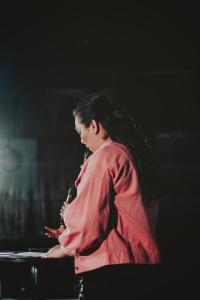
Church pastor. Photo by Melyna Valle on Unsplash
In concluding this series, we will look at five more women who were the first women ordained in their respective denominations.
Anna Howard Shaw (Methodist Church, Ordained 1875)
Anna Howard Shaw was a triple history maker in her own right. She was the first woman ordained in the Methodist Church, a physician, and a leader of the women’s rights movement. Born in Newcastle-upon-Tyne in England, 1847, Anna’s family came to the United States when she was four. After years in Massachusetts, the family relocated to Michigan when Anna was twelve. From a young age, she felt called to ministry; as a child, she would go in the woods and “preach to the forest.” Determined, she resolved to attend college, even without her family’s support.
After the Civil War, Anna lived with her sister, working as a dressmaker. Her life changed when she met Marianna Thompson, a Universalist minister. Upon hearing her preach, Anna shared her aspirations to preach with the minister. Marianna, as an advocate of women’s ordination, encouraged her. She entered a high school program and at twenty-four, connected with H.C. Peck, a man looking to ordain women in the Methodist Episcopal Church. Though hesitant at first, Anna preached her first message in Ashton, Michigan. She continued preaching despite opposition, and in 1873, the Methodist Church issued her a preacher’s license.
That same year, she started training with Albion College. Her family refused to support her educational endeavors. Upon graduation in 1876, she attended Boston University School of Theology. As the only woman in a class of forty-two men, she felt unwanted, dealing with financial, social, and spiritual discrimination. She persisted. Yet despite having the top exam score in her graduating class, the Methodist Episcopal Church denied both her and Anna Oliver the rite of ordination. Anna switched churches and was ordained by the Protestant Methodist Church. She received a medical degree from Boston University in 1880 and became an outspoken advocate of women’s rights.
Later work
Anna served the Women’s Christian Temperance Union and later, as president of the National Women’s Suffrage Association. During World War I, she was head of the Women’s Committee of the United States Council of National Defense (being the first woman to receive the Distinguished Service Medal).
In her personal life, Anna never married. Instead, she built a house and lived with her companion, Lucy Elmina Anthony (niece of Susan B. Anthony). They spent over thirty years together, until Anna’s death of pneumonia in 1919.
Olive Winchester (Church of the Nazarene, Ordained 1912)
The first official instance of women’s ordination in the Church of the Nazarene was with Elsie Wallace (in Spokane, Washington) in 1902. Olive May Winchester, however, was the first woman ordained in any Trinitarian church within the United Kingdom (under the auspices of the Church of the Nazarene). She was born in Monson, Maine in 1879. After familial moves and a number of tragedies (including the death of her father), Olive and her mother moved to Lynn, Massachusetts. In 1895, Olive became a Christian and joined the Association of Pentecostal Churches of America, which would later merge with the Church of the Nazarene. Three years later, she enrolled in Radcliffe Ladies College (then part of Harvard University). While in school, she preached often, and graduated with a degree in Hebrew and Aramaic.
After graduation, Olive taught at the Pentecostal Collegiate Institute (now Eastern Nazarene College). After her fiance died, she dedicated her life to teaching, and never married. Instead, she traveled, often raising funds for the church and holding services in communities without local churches. In 1908, she set sail for Scotland to study at the University of Glasgow. She was the first woman matriculated into their Divinity program.
While in Scotland, Olive joined the Pentecostal Church of Scotland. She graduated in 1912 with honors, and that same year, was ordained by her church. Olive became the first woman ordained by any church in Scotland. She was involved in the establishment of a Bible college, periodical, and creation of the church’s missionary society.
Later work
In 1918, Olive became a professor at Northwest Nazarene College in Nampa, Idaho. In 1922, she became vice-president of the college. She became academic dean a year later and retained this position until 1935. In 1925, she became the first woman to complete a doctor of theology degree from Drew University in Madison, New Jersey. Following her departure from Northwest Nazarene College in 1935, Olive taught at Pasadena College (now Point Loma Nazarene University). While there, she was an advisor for the Revised Standard Version of the New Testament, published in 1946. She died a year later, in 1947.
Maria Izabela Wilucka-Kowalska (Catholic Mariavite Church, Ordained 1929)
Antonia Maria Izabela Wilucka-Kowalska’s work was historic in two ways: both as the first woman to receive Holy Orders and as the first woman consecrated to the Bishopric. She was born in 1890 among the Polish landed gentry (landowners with estates passed down through families). Maria attended Marta Łojkówna’s Pedagogical Institute for Women in Warsaw, graduating in 1909. She worked as a tutor, spoke several languages, and enjoyed the world of music.
World War I forced the family to relocate more than once. While in transit, Maria discovered Mariavitism, a Polish Catholic renewal movement denounced heretical by the Vatican. (The result of these movements were two churches: the Mariavite Church and the Catholic Mariavite Church.) Despite her family’s objections, Maria joined the Mariavite Sisters , taking the religious name of Maria Izabela. In 1922, she professed perpetual vows and became the Superior General of the Miravite Sisters.
Later that year, the Old Catholic Mariavite Church changed the rules, allowing clergy to marry. Maria married the leader of the group, Archbishop Jan Maria Michal Kowalska. Seven years later, the church started ordaining women. She and eleven other nuns were ordained in 1929. At that time, Maria was consecrated as a bishop. She was part of the Old Catholic Mariavite Church synod of bishops and oversaw the priesthood of sisters.
Later work
The 1935 schism of the Old Catholic Mariavite Church forced Maria and husband to move again. She remained the Superior General of the Congregation of the Mariavite Sisters and now assisted in the management of the Catholic Mariavite Church. A critic of Adolf Hitler, Maria’s husband was arrested and later died in an Austrian Nazi camp in 1942. She assumed leadership of the church after his death, until her death in 1946. She is considered a saint in her denomination.
Katie Canon (United Presbyterian Church USA, Ordained 1974)
Katie Geneva Canon was born in 1950 in Kannapolis, North Carolina. Her mother, Emanuelette Corine Lytle Cannon, was the first woman to work at the Cannon Mills Company. Growing up in a heavily segregated community, Katie’s life was dominated by an inability to use public facilities, such as the library. As an African American child the only early education available to her was through the Lutheran church. She went on to graduate from Barber-Scotia College in Concord, North Carolina, Johnson C. Smith Theological Seminary in Atlanta, Georgia, and Union Theological Seminary in Manhattan, New York.
Katie was ordained in 1974 in Shelby, North Carolina by the Catawba Presbytery. She was the first African American woman ordained in the United Presbyterian Church (USA). After ordination, she worked at Ascension Presbyterian Church in East Harlem, New York.
With a strong interest in scholarship, Katie is known as a founder of both womanist theology and ethics. Her book, Black Womanist Ethics, is considered a pioneering text in the study of womanist ideas. She worked as professor at Temple University, Episcopal Divinity School, Harvard Divinity School, Union Presbyterian Seminary, Davidson College, and Williams College. From 2004-2008, she served as President for the Society for the Study of Black Religion. In 2012, she became executive director of Squaring the Womanist Circle Project at Union Presbyterian Seminary. She also worked to establish The Center For Womanist Leadership (now The Katie Geneva Cannon Center for Womanist Leadership) at Union Presbyterian Seminary. As a distinguished professor, Katie received numerous awards for excellence in both teaching and scholarship. She died in 2018.
Bola Odeleke (Power Pentecostal Church, Ordained 1995)
While female leadership in Pentecostalism is not new, Africa did not have a female bishop until 1995. That woman is Bola Odeleke, founder and general overseer of Power Pentecostal Church.
Bola was born in 1950 in Ibadan in southwestern Nigeria. She received her education in Ilesa, her mother’s hometown. In 1970, she became a Christian. Four years later, Bola started work as an evangelist. She was the first woman to be ordained as a bishop in Africa on May 28, 1995. In August of 2014, she celebrated forty years in ministry.
Want to learn more?
Women’s ordination is an important and essential part of our faith lives, regardless of Christian denomination. If you would like to learn more about Christian women through history, check out my book, Surrounded by so Great a Cloud of Witnesses: Women of Faith who Revolutionized History. In that book, I provide short biographies of over two hundred and fifty women who changed the world – moved by great faith and spiritual power.
General Christian
Women in Religion

About Lee Ann B. Marino
Dr. Lee Ann B. Marino, Ph.D., D.Min., D.D. (”The Spitfire”) is “everyone’s favorite theologian” leading Gen X, Millennials, and Gen Z as apostle of Spitfire Apostolic Ministries. Her work encompasses study and instruction on leadership training and development, typology, Pneumatology, conceptual theology, Ephesians 4:11 ministry, and apostolic theology. She is author of over thirty-five books, host of the top twenty percentile podcast Kingdom Now, and serves as founder and overseer of Sanctuary International Fellowship Tabernacle - SIFT and Chancellor of Apostolic University. Dr. Marino has over twenty-five years of experience in ministry, leadership, counseling, mentoring, education, and business. You can read more about the author here.
Previous Post

March 13, 2024
Five Women Ordained First in their Denominations
Next Post

March 27, 2024 Ten Unusual Easter Traditions
Browse Our Archives
Select a Category BIble education Bible history Bible study bible women church history Cult education current events holidays Leadership Ministry queer events Spiritual development Uncategorized wellbeing women in christianity women in ministry world religion
Select a Month October 2026 September 2026 August 2026 July 2026 June 2026 May 2026 April 2026 March 2026 February 2026 January 2026 December 2025 November 2025 October 2025 September 2025 August 2025 July 2025 June 2025 May 2025 April 2025 March 2025 February 2025 January 2025 December 2024 November 2024 October 2024 September 2024 August 2024 July 2024 June 2024 May 2024 April 2024 March 2024 February 2024 January 2024 December 2023 November 2023 October 2023 September 2023 August 2023 July 2023 June 2023
Follow Us!
TAKE THE
Religious Wisdom Quiz
What Christian group follows the "Three Self Principle" in church governance?
Select your answer to see how you score.
Seventh-day Adventists Orthodox Christians Chinese Protestant Churches Quakers
Related posts from Leadership on Fire

What Being a Modern-Day Apostle Means to Me

Principles for Understanding the Apostolic Ministry Today

Resist the Devil, and He Will Flee

Assessing How Much You Want to Find God...
TRENDING AT PATHEOS Progressive Christian

What Being a Modern-Day Apostle Means to Me
In my last column, I discussed the ins and outs of modern-day...

Did Ancient China Once Worship the God of...
Across human history, a common thread weaves through the origins of the...

Love Your Neighbor – Including Earth-Kin: Lev. 19,...
God’s command to love your neighbor means acting in an ethical and...

Lead a Church Study of “Jesus and Lao...
Guest writer Jack Thomas (The Irreverent Reverend) reflects on leading his church...

Pastoral Wisdom for Responding to Sermon Pushback
Getting sermon pushback on your social justice sermon? Learn practical, Proverbs-based strategies...

Principles for Understanding the Apostolic Ministry Today
Whenever people discover that my formal ministry title is "apostle," as in...
view all Progressive Christian blogs
Ad-Free & Subscriber Log-In Subscription Support
- About Us
- 2026 Calendar
- Videos
- Podcasts
- Library of World Religions
- Faith In Media Tracker
- Advertise With Us
- Write for Us
- Privacy Policy
- Terms of Service
- Do Not Sell My Data
- Contact Us
- Radiant Digital
- Manage Newsletter Subscriptions
- Unsubscribe From Notifications
- Sitemap
Copyright 2008-2026, Patheos. All rights reserved.
Subscription Support Ad-Free & Subscriber Log-In
Follow Patheos