
BuddhistCatholicContemplativeEvangelicalGeneral ChristianHinduJewishLatter-day SaintMuslimNew VisionsProgressive Christian
Beliefs
- Buddhist
- Catholic
- Contemplative
- Evangelical
- General Christian
- Hindu
- Jewish
- Latter-day Saint
- More Voices
- Muslim
- New Visions
- Pagan
- Progressive Christian
Topics
- Religion News
- Food and Religion
- Sports and Religion
- Religious Art
- Religious Music and Entertainment
- Religious Events
- History and Religion
- Style and Religion
- Politics and Religion
- Women in Religion
- Recreation Outdoors and Religion
- Business Finance and Religion
- Careers Workplace and Religion
- Education and Religion
- Family Parenting and Religion
- Health Fitness and Religion
- Home and Religion
- Relationships and Religion
- Technology and Religion
- Travel and Religion
Columnists
- Buddhist Columnists
- Business Finance and Religion Columnists
- Careers Workplace and Religion Columnists
- Catholic Columnists
- Contemplative Columnists
- Education and Religion Columnists
- Evangelists Columnists
- Family Parenting and Religion Columnists
- General Christian Columnists
- Health Fitness and Religion Columnists
- Hindu Columnists
- History and Religion Columnists
- Home and Religion Columnists
- Jewish Columnists
- More Voices Columnists
- Latter Day Columnists
- Muslim Columnists
- New Visions Columnists
- Nonreligious Columnists
- Pagan Columnists
- Politics and Religion Columnists
- Progressive Columnists
- Recreation Outdoors and Religion Columnists
- Relationships and Religion Columnists
- Religion News Columnists
- Religious Art Columnists
- Religious Events Columnists
- Religious Music and Entertainment Columnists
- Sports and Religion Columnists
- Style and Religion Columnists
- Technology and Religion Columnists
- Travel and Religion Columnists
- Women in Religion Columnists
Resource Library
- 2026 Calendar
- Library of World Religions
- The 100 Most Holy Places on Earth
- Patheos Answers
- Podcasts
- Videos
- Faith Leaders Database
- Anglican Episcopalian
- Bahai
- Baptist
- Buddhism
- Christianity
- Confucianism
- Eastern Orthodoxy
- Hinduism
- Holiness and Pentecostal
- ISKCON
- Islam
- Judaism
- Lutheran
- Methodist
- The Church of Jesus Christ of Latter-day Saints
- New Age
- Paganism
- Presbytarian and Reformed
- Protestantism
- Religion Behind the Scenes
- Roman Catholic
- Scientology
- Shia Islam
- Sikhism
- Sufism
- Sunni Islam
- Taoism
- Zen
- See all religions
Research Tools
 Ad-Free & Subscriber Log-In Subscription Support
Ad-Free & Subscriber Log-In Subscription Support
Follow Patheos 

- Trending:
- Forgiveness
- |
- Marriage
- |
- Consciousness
- |
- Death Penalty
- |
- Election
- |
- Halloween

- Home
- Progressive Christian
- Education and Religion
- Learning From the Pharisees and Sadducees
Learning From the Pharisees and Sadducees
Last updated on: October 4, 2023 at 12:00 pm by Lee Ann B. Marino
Learning From the Pharisees and Sadducees 2023-09-25T19:00:11-04:00 Lee Ann B. Marino
Patheos Explore the world's faith through different perspectives on religion and spirituality! Patheos has the views of the prevalent religions and spiritualities of the world.
If you’ve spent any time in church (or connected to church), you’ve probably heard mention of two groups: the Pharisees and Sadducees. There are three distinct things we know about them from casual observation:
- They opposed the ministry of Jesus
- Both were representative of Jewish sects in the first century
- They seem to appear out of nowhere in the Bible
These three points are enough to make us wonder more about who these people were. Where did they come from? Why were they so relevant? Most importantly, what can we learn from studying more about them? Read on to learn more about the Pharisees and Sadducees – and why they are relevant today as much as in times past.
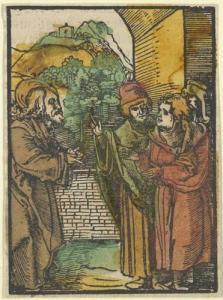
An illustration showing Christ and the Pharisees. From Das Plenarium (1517). Created by Hans Schäufelein. / Photo courtesy Metropolitan Museum of Art, Creative Commons
Opposites in every way
In modern Christianity (actually such is prevalent in all religions), we hear about two groups of people: spiritual conservatives and spiritual liberals. While these designations do often cross political lines, spiritual liberalism or conservatism relate to the way one sees the divine and their relationship with the divine. Some interpret the issue to be a rejection or upholding of Scripture, but it’s more complicated than this. Groups identified as “liberal” Christians understand their life of faith and interpretation of Scripture through modern ideas: science, ethics, knowledge, and information. In an attempt to reconcile such with Scripture, liberal groups don’t see the Bible as inerrant. Instead, they examine different historical interpretations of the Bible and see many texts as metaphorical, allegorical, or inspirational.
Conservative Christians formed in response to the rise of liberal Christianity. They reject liberal Christian ideas about Scripture and history. A “conservative” Christian believes the Bible to be both inspired and inerrant. As a result, conservatives believe things such as the divinity of Christ, virgin birth, and miracles are literal truths rather than abstract ideas to teach a lesson.
As with most views, we often hear the most from extreme viewpoints among liberals and conservatives. The majority of Christians fall somewhere in the middle of the spectrum. There are also Christians who espouse ideas from both sectors. But I’m sure you’re wondering, what does any of this have to do with the Pharisees and the Sadducees?
I mention the specific divide in a modern context because this same divide was present among the Pharisees and Sadducees in Jesus’ day. If we carefully examine the two, we can see them in these modern-day scenarios. The attitudes of the modern-day Pharisees resemble that of conservative Christians, while the Sadducees resemble more of liberal Christianity.
The Pharisees
The Pharisees were not just a spiritual ideology, as some may believe. They were also a socio-political movement and school of thought ruling for about 240 years between 167 BC and 73 AD. Their name literally means “set apart” or “separated.” This very intimately relates to how they saw themselves as part of the larger Jewish community prevalent at this point in history. Their name had a dual purpose: they were to remain “separate” from the Gentiles as well as politically from the Sadducees. The Pharisees were one of four different schools of thought present in ancient Judaism (the others were the Sadducees, Essenes, and Zealots). They rose to power during the Maccabean Revolt, with one major agenda: to stand against the hellenization (Greek influence) of the Jewish people.
Their understanding of faith
The Pharisees believed in the centrality of Jewish tradition. To them, being a Jew wasn’t just something for the Sabbath day or holidays. Every day the law was there for observance. As a result, they developed strict interpretations on the law. Its understanding included a number of different categories and technicalities. Some offered loopholes, but more often than not, imposed burdens on those who didn’t understand the law as well.
The Pharisees also believed in the idea of an existing oral law that was as authoritative as the written law. Moses was seen as the originator of both their oral law and interpretation of written law. This tradition of oral law became important after the destruction of the Temple in 70 AD. At this time, they became part of the foundations of what we now know as the Talmud (Jewish traditional law) and Rabbinical Judaism. (Modern Judaism is a product of Rabbinical Judaism, which understands the law and Jewish tradition through the Rabbis down through the centuries.) The Pharisees were interested in a literal understanding of Judaism, one that had no influence from Greek or Roman society. They expected the Jews to follow the letter of the law according to their interpretation of it.
Outside of these beliefs, the Pharisees also believed in strict monotheism, resurrection from the dead, Israel as a kingdom of priests, free will, and God’s foreknowledge of human destiny.
Their aspirations
The Pharisees sought political power, even though they weren’t a political party. They maintained their status by refusing to interfere in the Roman occupation of Israel. As long as they didn’t rock the boat, so to speak, the Pharisees were free to enforce Jewish law as they saw fit.
Replying to @allipants406 Kingdom Moments: Who Were the Pharisees and the Sadducees? #kingdomnow #pharisees #sadducees #conservativechristians #liberalchristians #womenauthors #femaleapostles #firstcenturyjudaism
The Sadducees
The Sadducees fulfilled a number of different roles in first-century Judaism. The two most important roles were maintaining the Jerusalem temple and serving as scribes of the written law. They served as instructors on the details of the law, believing the law should be written down. As a result, the Sadducees had very detailed understandings of its contents, especially in a literal way. They rejected the idea of any separate, undocumented oral tradition. Considered to be the inheritors of priestly privilege, the Sadducees claimed their lineage through Zadok, a high priest under Solomon, rather than Moses.
Outside of these beliefs, the Sadducees are probably better known for what they didn’t believe rather than what they did. It’s known from the New Testament text that they denied the resurrection. They also didn’t believe in heaven, hell, spirits, angels, or demons. We could probably compare the Sadducees to modern-day deists: they had a concept of God, but He was seen as impersonal. In favor of spiritual ideas, they preferred historicity and understanding of literal things rather than embracing the abstract.
Their aspirations
Unlike the Pharisees, the Sadducees were a political party and did embrace political power. They believed it was acceptable for Jews to embrace the secular lifestyles of the Greeks and Romans. We also know they held high positions of power in the government and military (especially in areas of administration, representation, and tax collection). As an added bonus, the Sadducees were also tremendously wealthy.
The Pharisees and Sadducees versus believers today
It’s no secret these two groups hated each other. They represented different worldviews and spiritual views. I think in a bigger sense, however, the Pharisees resented the influence of the Sadducees. They saw them as compromising to have a high level of worldly prestige, which was something the Pharisees would never have.
There is definite case to say that, in some ways, there are valid comparisons between the Pharisees and Sadducees and modern-day Christian conservatives and liberals. The two were embroiled in a battle of interpretation and understanding of their faith within greater society. Neither one fully represented the average believer of their day and age. Both caused confusion about belief as the two aspired for greater power and prestige within society. There are differences, however. The theology of modern groups varies from those present in the first century. Christians today don’t live under the Roman Empire, and our governmental structures are different than in Biblical times. Christians are also not Jews; and while there’s nothing wrong with this different, it is a fact.
In a bigger sense, the Pharisees and Sadducees teach us that power corrupts theology. Whether the temptation is to be very liberal or very conservative, neither group, in their extremes, represent “theologically correct positions. Both found ways to do what they wanted with Scripture and make it work for them. This is not unlike what both liberals and conservatives do today. While one focuses on a literal sense of doctrine and implementing something against societal application, the other focuses on applying belief in modern society. They both have valid points, but accuracy isn’t a focus.
What we can learn from the Pharisees and Sadducees
There’s one area where the Pharisees and Sadducees aligned: neither group liked Jesus. He threatened their influence and power. Thus, whether we like to admit it or not, Jesus wasn’t a theological conservative or liberal. He represented a different level of authority and ideology. We also can see a certain level of implication within His words to both groups. For example, He was quick to mention Moses, or the teaching of Moses, a number of times while debating with them. Jesus knew the Pharisees claimed insights from Moses, while the Sadducees would have been familiar with the law. Neither group liked Him, simply because He pointed out their own theological inconsistencies.
I would argue that neither Christian conservatives nor liberals fully represent Jesus today. While some might focus on an infallible sense of tradition and others more on the essence of their message, both miss major points in embracing the truth about Jesus and Who He is. It’s easy for us to sit back and assume we are the “multitudes” to which Jesus spoke…but in the tensions of modern-day Christianity, it’s also possible we might need to hear His rebuke as we act or think like Pharisees or Sadducees. The Bible speaks of a narrow way on purpose: conservatism represents the ditch on one side, while liberalism represents the other. The truth lies in the tension on the narrow way, striving to believe.
Instead of our endless arguments, let’s walk the narrow way, reasoning together, as God instructs.
General Christian
History and Religion

About Lee Ann B. Marino
Dr. Lee Ann B. Marino, Ph.D., D.Min., D.D. (“the Spitfire”) is “everyone’s favorite theologian” leading Gen X, Millennials, and Gen Z with expertise in leadership training, queer and feminist theology, general religion, and apostolic theology. She is founder of Spitfire Apostolic Ministries, working as founder and Overseer of Sanctuary International Fellowship Tabernacle – SIFT and Chancellor of Apostolic University. Dr. Marino is author of over thirty-five books and the Patheos column, Leadership on Fire. She is also host of the top twenty percentile Kingdom Now podcast, heard in over one hundred countries. You can read more about the author here.
Previous Post

September 27, 2023
Ten Things Christians Should Get Over, Now
Next Post

October 11, 2023 An Introduction to the Law for Christians
Recent Comments
Browse Our Archives
Select a Category BIble education Bible history Bible study bible women church history Cult education current events holidays Leadership Ministry queer events Spiritual development Uncategorized wellbeing women in christianity women in ministry world religion
Select a Month October 2026 September 2026 August 2026 July 2026 June 2026 May 2026 April 2026 March 2026 February 2026 January 2026 December 2025 November 2025 October 2025 September 2025 August 2025 July 2025 June 2025 May 2025 April 2025 March 2025 February 2025 January 2025 December 2024 November 2024 October 2024 September 2024 August 2024 July 2024 June 2024 May 2024 April 2024 March 2024 February 2024 January 2024 December 2023 November 2023 October 2023 September 2023 August 2023 July 2023 June 2023
Follow Us!
TAKE THE
Religious Wisdom Quiz
Which Christian denomination practices the sacrament of Confirmation?
Select your answer to see how you score.
Baptist Catholic Methodist Jehovah’s Witnesses
Related posts from Leadership on Fire

What Being a Modern-Day Apostle Means to Me

Principles for Understanding the Apostolic Ministry Today

Resist the Devil, and He Will Flee

Assessing How Much You Want to Find God...
TRENDING AT PATHEOS Progressive Christian

What Being a Modern-Day Apostle Means to Me
In my last column, I discussed the ins and outs of modern-day...

Did Ancient China Once Worship the God of...
Across human history, a common thread weaves through the origins of the...

Love Your Neighbor – Including Earth-Kin: Lev. 19,...
God’s command to love your neighbor means acting in an ethical and...

Lead a Church Study of “Jesus and Lao...
Guest writer Jack Thomas (The Irreverent Reverend) reflects on leading his church...

Pastoral Wisdom for Responding to Sermon Pushback
Getting sermon pushback on your social justice sermon? Learn practical, Proverbs-based strategies...

Principles for Understanding the Apostolic Ministry Today
Whenever people discover that my formal ministry title is "apostle," as in...
view all Progressive Christian blogs
Ad-Free & Subscriber Log-In Subscription Support
- About Us
- 2026 Calendar
- Videos
- Podcasts
- Library of World Religions
- Faith In Media Tracker
- Advertise With Us
- Write for Us
- Privacy Policy
- Terms of Service
- Do Not Sell My Data
- Contact Us
- Radiant Digital
- Manage Newsletter Subscriptions
- Unsubscribe From Notifications
- Sitemap
Copyright 2008-2026, Patheos. All rights reserved.
Subscription Support Ad-Free & Subscriber Log-In
Follow Patheos