
BuddhistCatholicContemplativeEvangelicalGeneral ChristianHinduJewishLatter-day SaintMuslimNew VisionsProgressive Christian
Beliefs
- Buddhist
- Catholic
- Contemplative
- Evangelical
- General Christian
- Hindu
- Jewish
- Latter-day Saint
- More Voices
- Muslim
- New Visions
- Pagan
- Progressive Christian
Topics
- Religion News
- Food and Religion
- Sports and Religion
- Religious Art
- Religious Music and Entertainment
- Religious Events
- History and Religion
- Style and Religion
- Politics and Religion
- Women in Religion
- Recreation Outdoors and Religion
- Business Finance and Religion
- Careers Workplace and Religion
- Education and Religion
- Family Parenting and Religion
- Health Fitness and Religion
- Home and Religion
- Relationships and Religion
- Technology and Religion
- Travel and Religion
Columnists
- Buddhist Columnists
- Business Finance and Religion Columnists
- Careers Workplace and Religion Columnists
- Catholic Columnists
- Contemplative Columnists
- Education and Religion Columnists
- Evangelists Columnists
- Family Parenting and Religion Columnists
- General Christian Columnists
- Health Fitness and Religion Columnists
- Hindu Columnists
- History and Religion Columnists
- Home and Religion Columnists
- Jewish Columnists
- More Voices Columnists
- Latter Day Columnists
- Muslim Columnists
- New Visions Columnists
- Nonreligious Columnists
- Pagan Columnists
- Politics and Religion Columnists
- Progressive Columnists
- Recreation Outdoors and Religion Columnists
- Relationships and Religion Columnists
- Religion News Columnists
- Religious Art Columnists
- Religious Events Columnists
- Religious Music and Entertainment Columnists
- Sports and Religion Columnists
- Style and Religion Columnists
- Technology and Religion Columnists
- Travel and Religion Columnists
- Women in Religion Columnists
Resource Library
- 2026 Calendar
- Library of World Religions
- The 100 Most Holy Places on Earth
- Patheos Answers
- Podcasts
- Videos
- Faith Leaders Database
- Anglican Episcopalian
- Bahai
- Baptist
- Buddhism
- Christianity
- Confucianism
- Eastern Orthodoxy
- Hinduism
- Holiness and Pentecostal
- ISKCON
- Islam
- Judaism
- Lutheran
- Methodist
- The Church of Jesus Christ of Latter-day Saints
- New Age
- Paganism
- Presbytarian and Reformed
- Protestantism
- Religion Behind the Scenes
- Roman Catholic
- Scientology
- Shia Islam
- Sikhism
- Sufism
- Sunni Islam
- Taoism
- Zen
- See all religions
Research Tools
 Ad-Free & Subscriber Log-In Subscription Support
Ad-Free & Subscriber Log-In Subscription Support
Follow Patheos 

- Trending:
- Forgiveness
- |
- Marriage
- |
- Consciousness
- |
- Death Penalty
- |
- Election
- |
- Halloween

- Home
- Progressive Christian
- Education and Religion
- Are You a Doubting Thomas?
Are You a Doubting Thomas?
Last updated on: October 25, 2023 at 12:00 pm by Lee Ann B. Marino
Are You a Doubting Thomas? 2023-10-16T23:59:53-04:00 Lee Ann B. Marino
Patheos Explore the world's faith through different perspectives on religion and spirituality! Patheos has the views of the prevalent religions and spiritualities of the world.
We’ve all heard the expression, “Doubting Thomas.” This expression is based is based on the Apostle Thomas’ experience with Jesus in John 20:24-29:
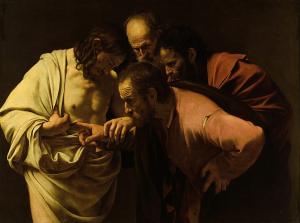
The Incredulity of Saint Thomas by Caravaggio, c. 1602. Public Domain. From Wikimedia Commons.
Thomas, the one called Didymus, one of the Twelve, wasn’t with the disciples when Jesus came. The other disciples told him, “We’ve seen the Lord!” But he replied, “Unless I see the nail marks in his hands, put my finger in the wounds left by the nails, and put my hand into his side, I won’t believe.” After eight days his disciples were again in a house and Thomas was with them. Even though the doors were locked, Jesus entered and stood among them. He said, “Peace be with you.” Then He said to Thomas, “Put your finger here. Look at My hands. Put your hand into My side. No more disbelief. Believe!” Thomas responded to Jesus, “My Lord and my God!” Jesus replied, “Do you believe because you see Me? Happy are those who don’t see and yet believe.” (CEB)
By this time, Jesus had appeared to the other disciples. For some reason, Thomas wasn’t there when Jesus appeared. As a result, Jesus refused to believe Jesus was alive. He didn’t just doubt resurrection; he doubted testimony that Christ was alive. Thomas wanted tangible proof that Jesus rose from the dead.
It’s a simple enough story, but have we paused to consider what it means to be a “doubting Thomas?” Moreover…have we considered the ways we display doubt, ourselves?
Dwelling in doubt
We tend to cast judgment on Thomas. It seems unfathomable that someone who walked, talked, and lived with Jesus could doubt His resurrection. Now, down through the ages, Thomas is seen as a screw-up, as one who failed to believe as he should. We look down on him. But the truth of the matter is we do exactly what Thomas did, all the time.
Thomas didn’t just fail to understand the teaching of Jesus. He also failed to accept the testimony of his brothers and sisters. Thomas’ doubt wasn’t just directed toward Jesus, but also toward those who came to give him report. Why? In the words of Henri Poincare, “To doubt everything, or, to believe everything, are two equally convenient solutions; both dispense with the necessity of reflection.”
We like doubt. When faced with situations that call for discernment, it’s easier to doubt everything and everyone. We call this “sound judgment” instead of assessing situations and taking the time to listen to others.
The common bond of disbelief
Many claim to be believers, but many still have one thing in common: disbelief. Like Thomas, they won’t believe it unless they see it. They don’t want to hear anything that might cause them to reach out or extend help, because they need proof. As long as one remains in a place of “I’ll believe it when it’s here,” nothing is expected of them.
Pay careful attention to Jesus’ words: “Blessed are they who have not seen, and yet believe.” “Seeing yet believing” does not just come from nothing – it often comes from testimony. The Bible came into existence through testimony. Most of us are believers today because of someone else’s testimony. We believe in the possibilities of faith because someone lived their faith through testimony. It’s impossible to “see and yet believe” without testimony.
Yet when it comes to the testimonies that might stand in front of us, we retreat as doubting Thomases. We doubt, we judge, and we find reasons to reject their testimony.
Hurting our witness
Failing to accept the testimony of others hurts our witness. If we expect people to believe our testimony, why do we doubt theirs? Still, have you ever considered how awful it feels to give a report and have others disbelieve it? Some of the most difficult things in life come with the chronic stigma of others’ disbelief:
- We doubt the testimony of rape victims; many say they “asked for it.”
- We doubt the testimony of homeless people; many say they didn’t “try” hard enough.
- We doubt the testimony of people who are called to ministry; many say they are “crazy.”
- We doubt the testimony of those who have mystical or revelatory encounters with God; many say that’ “can’t happen today.”
- We doubt the testimony of people who come and tell us they are different; many say they are still “the same.”
- We doubt the testimony of people who say they have been healed; many say there is some other explanation.
- We doubt the testimony of spouses or partners abused by their spouse or partner; many say they did something to “provoke” them.
- We doubt the testimony of people who come and tell us that they are unhappy, facing temptations, or other things; many casually tell them to “brush” it off, like it doesn’t matter.
- We doubt the testimony of people who are mistreated on their job; many assume in favor of the boss over the worker.
- We doubt when someone has seen or experienced something and we haven’t experienced it or we weren’t there; many openly criticize such possibilities.
We doubt, we doubt, we doubt. We are doubting Thomas.
The facts
We will never impact the world if we allow our doubts to overshadow testimony. If we want to change people’s lives, we need to stop disbelieving them. Instead, let’s pray for a gift of discernment. This will help us know what is true from what is false. This way, we can be a resource. Faith begins with trust. Have we ever considered that people might waiver because we do not extend to them what we expect them to extend themselves.
Put the doubt away, doubting Thomas. Let’s learn to listen and gain greater insight into the spiritual gifts God gives us. Maybe then we will live our faith in a radical way, without doubt.
General Christian
Relationships and Religion

About Lee Ann B. Marino
Dr. Lee Ann B. Marino, Ph.D., D.Min., D.D. (“the Spitfire”) is “everyone’s favorite theologian” leading Gen X, Millennials, and Gen Z with expertise in leadership training, queer and feminist theology, general religion, and apostolic theology. She is founder of Spitfire Apostolic Ministries, working as founder and Overseer of Sanctuary International Fellowship Tabernacle – SIFT and Chancellor of Apostolic University. Dr. Marino is author of over thirty-five books and the Patheos column, Leadership on Fire. She is also host of the top twenty percentile Kingdom Now podcast, heard in over one hundred countries. You can read more about the author here.
Previous Post

October 18, 2023
Ten Things to Know About the Israeli/Palestinian Conflict
Next Post

November 1, 2023 Terms for Biblical Love (and What We Can Learn From Them)
Recent Comments
Browse Our Archives
Select a Category BIble education Bible history Bible study bible women church history Cult education current events holidays Leadership Ministry queer events Spiritual development Uncategorized wellbeing women in christianity women in ministry world religion
Select a Month October 2026 September 2026 August 2026 July 2026 June 2026 May 2026 April 2026 March 2026 February 2026 January 2026 December 2025 November 2025 October 2025 September 2025 August 2025 July 2025 June 2025 May 2025 April 2025 March 2025 February 2025 January 2025 December 2024 November 2024 October 2024 September 2024 August 2024 July 2024 June 2024 May 2024 April 2024 March 2024 February 2024 January 2024 December 2023 November 2023 October 2023 September 2023 August 2023 July 2023 June 2023
Follow Us!
TAKE THE
Religious Wisdom Quiz
Who said, "For me to live is Christ, and to die is gain"?
Select your answer to see how you score.
John James Paul Peter
Related posts from Leadership on Fire

What Being a Modern-Day Apostle Means to Me

Principles for Understanding the Apostolic Ministry Today

Resist the Devil, and He Will Flee

Assessing How Much You Want to Find God...
TRENDING AT PATHEOS Progressive Christian

What Being a Modern-Day Apostle Means to Me
In my last column, I discussed the ins and outs of modern-day...

Did Ancient China Once Worship the God of...
Across human history, a common thread weaves through the origins of the...

Love Your Neighbor – Including Earth-Kin: Lev. 19,...
God’s command to love your neighbor means acting in an ethical and...

Lead a Church Study of “Jesus and Lao...
Guest writer Jack Thomas (The Irreverent Reverend) reflects on leading his church...

Pastoral Wisdom for Responding to Sermon Pushback
Getting sermon pushback on your social justice sermon? Learn practical, Proverbs-based strategies...

Principles for Understanding the Apostolic Ministry Today
Whenever people discover that my formal ministry title is "apostle," as in...
view all Progressive Christian blogs
Ad-Free & Subscriber Log-In Subscription Support
- About Us
- 2026 Calendar
- Videos
- Podcasts
- Library of World Religions
- Faith In Media Tracker
- Advertise With Us
- Write for Us
- Privacy Policy
- Terms of Service
- Do Not Sell My Data
- Contact Us
- Radiant Digital
- Manage Newsletter Subscriptions
- Unsubscribe From Notifications
- Sitemap
Copyright 2008-2026, Patheos. All rights reserved.
Subscription Support Ad-Free & Subscriber Log-In
Follow Patheos