
BuddhistCatholicContemplativeEvangelicalGeneral ChristianHinduJewishLatter-day SaintMuslimNew VisionsProgressive Christian
Beliefs
- Buddhist
- Catholic
- Contemplative
- Evangelical
- General Christian
- Hindu
- Jewish
- Latter-day Saint
- More Voices
- Muslim
- New Visions
- Pagan
- Progressive Christian
Topics
- Religion News
- Food and Religion
- Sports and Religion
- Religious Art
- Religious Music and Entertainment
- Religious Events
- History and Religion
- Style and Religion
- Politics and Religion
- Women in Religion
- Recreation Outdoors and Religion
- Business Finance and Religion
- Careers Workplace and Religion
- Education and Religion
- Family Parenting and Religion
- Health Fitness and Religion
- Home and Religion
- Relationships and Religion
- Technology and Religion
- Travel and Religion
Columnists
- Buddhist Columnists
- Business Finance and Religion Columnists
- Careers Workplace and Religion Columnists
- Catholic Columnists
- Contemplative Columnists
- Education and Religion Columnists
- Evangelists Columnists
- Family Parenting and Religion Columnists
- General Christian Columnists
- Health Fitness and Religion Columnists
- Hindu Columnists
- History and Religion Columnists
- Home and Religion Columnists
- Jewish Columnists
- More Voices Columnists
- Latter Day Columnists
- Muslim Columnists
- New Visions Columnists
- Nonreligious Columnists
- Pagan Columnists
- Politics and Religion Columnists
- Progressive Columnists
- Recreation Outdoors and Religion Columnists
- Relationships and Religion Columnists
- Religion News Columnists
- Religious Art Columnists
- Religious Events Columnists
- Religious Music and Entertainment Columnists
- Sports and Religion Columnists
- Style and Religion Columnists
- Technology and Religion Columnists
- Travel and Religion Columnists
- Women in Religion Columnists
Resource Library
- 2026 Calendar
- Library of World Religions
- The 100 Most Holy Places on Earth
- Patheos Answers
- Podcasts
- Videos
- Faith Leaders Database
- Anglican Episcopalian
- Bahai
- Baptist
- Buddhism
- Christianity
- Confucianism
- Eastern Orthodoxy
- Hinduism
- Holiness and Pentecostal
- ISKCON
- Islam
- Judaism
- Lutheran
- Methodist
- The Church of Jesus Christ of Latter-day Saints
- New Age
- Paganism
- Presbytarian and Reformed
- Protestantism
- Religion Behind the Scenes
- Roman Catholic
- Scientology
- Shia Islam
- Sikhism
- Sufism
- Sunni Islam
- Taoism
- Zen
- See all religions
Research Tools
 Ad-Free & Subscriber Log-In Subscription Support
Ad-Free & Subscriber Log-In Subscription Support
Follow Patheos 

- Trending:
- Forgiveness
- |
- Marriage
- |
- Consciousness
- |
- Death Penalty
- |
- Election
- |
- Halloween

- Home
- Evangelical
- Business, Finance and Religion
- Quiet Life Stewardship: Reflections on The Good Steward
Quiet Life Stewardship: Reflections on The Good Steward
Last updated on: May 14, 2026 at 11:38 pm by Jeff McLain
Quiet Life Stewardship: Reflections on The Good Steward 2026-05-14T23:38:08-04:00 Jeff McLain
Patheos Explore the world's faith through different perspectives on religion and spirituality! Patheos has the views of the prevalent religions and spiritualities of the world.
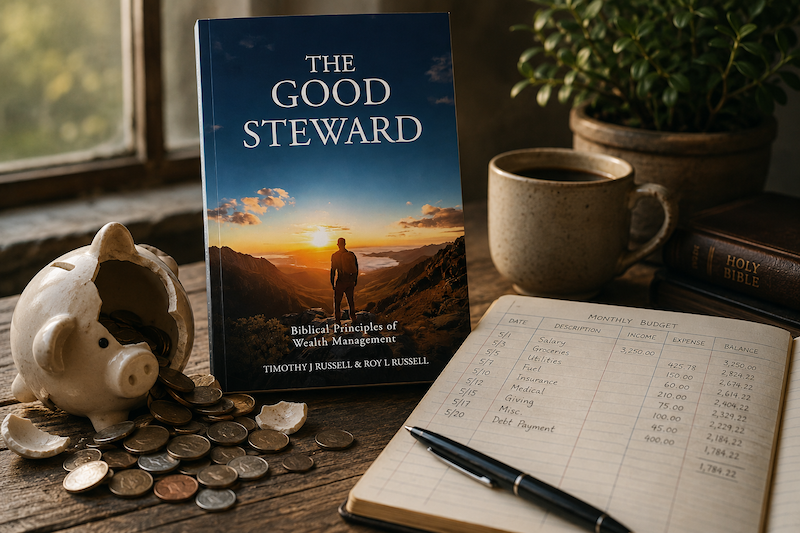
Conversations started by The Good Steward from Kharis Publishing.
“In one sense, good stewardship is simple: live your life using all your resources to bring glory to God by serving others.” That is how Timothy J. Russell and Roy L. Russell summarize stewardship in their 2025 book, The Good Steward.
Stewardship is a loaded word. We hear it used in conversations about finances, the environment, churches, nonprofits, leadership, and so much more. Yet for followers of Jesus, stewardship is not merely one category of life. It is a way of living in all areas of life. It is a way of living that also recognizes that we are not the owners of anything.
As the Psalmist writes:
“The Lord owns the earth, and all it contains,
the world and all who live in it.”
— Psalm 24:1 NET
If that is true, and I confess that it is, then how we relate to everything and everyone becomes an act of stewardship. I mean everything: our money, skills, spiritual gifts, homes, yards, time, relationships, bodies, churches work, possessions—everything. Even our suffering becomes a part of stewardship.
Don’t Reduce Stewardship
We often reduce stewardship to gifts and abilities. We think of the parable of the talents or Peter’s reminder:
“Just as each one has received a gift, use it to serve one another as good stewards of the varied grace of God.”
— 1 Peter 4:10 NET
That is certainly stewardship. But stewardship is larger than gifting. Scripture also speaks about wealth:
“Honor the Lord from your wealth
and from the firstfruits of all your crops.”
— Proverbs 3:9 NET
It goes all the way back to the garden itself and just the world around us.
“The Lord God took the man and placed him in the orchard in Eden to care for it and to maintain it.”
— Genesis 2:15 NET
From the beginning, Scripture reminds us that human beings were created to steward. That all of life and its goodness is an act of responsibility that has been entrusted to us. What we do with that matters. It matters a lot.
Paul writes:
“Now what is sought in stewards is that one be found faithful.”
— 1 Corinthians 4:2 NET
It is not just the early church that understood stewardship in this way. It is a way of Jesus. Consider Jesus’ words when he says:
“The one who is faithful in a very little is also faithful in much.”
— Luke 16:10 NET
Stewardship, then, is faithfulness with everyone and everything that has been entrusted to us.
To reduce it to just one area or a few areas undermines the way of life in the garden, I think God expects us to understand and live out.
Stewardship As a Rule of Life
In my own Daily Office packet, something I try to read at the start of every workday, stewardship is a recurring theme. The first document in it is my Personal Philosophy for life. I have six priorities that I have identified that I want to shape my life as a follower of Jesus: family, self, vocation, stewardship, community, and creating. I may speak to these more in the future, but I want to center in on the act of stewardship.
In my Rule of Life, Stewardship for me includes my house, my land, my family, my debt, my possessions, my time, and even the legacy I leave behind. It aligns with the values I try to cultivate and the legacy I aim to leave.
That is why the line from The Good Steward stayed with me:
“In one sense, good stewardship is simple: live your life using all your resources to bring glory to God by serving others.”
The challenge is that the more things we own, pursue, manage, and consume, the harder it becomes to focus on what matters most.
I have not been shy over the years about the two places I have struggled to steward well: my stuff and my finances. That is why it needs to be an intentional focus for me. However, it probably needs to be an intentional focus for all of us.
The chief end of mankind is to worship God, to use all our resources and relationships to bring glory to God by serving others.
Stewardship is a rule of life for us.
A Journey of Learning Stewardship
When Katie McLain and I bought our house in 2015, we moved with a smaller u-haul truck. It is amazing how much has accumulated since then in closets, shelves, and the basement. We would ned a battleship to move us now. We didn’t ever wanto be be those people. Our later-in-life health diagnoses—epilepsy for Katie and diabetes for me—have also created ongoing financial strain. Every few months it feels like we are trying to establish a new normal after another setback.
But struggle is not permission to quit. It isn’t permission for me or for the guests that I work with, that I challenge around this spiritual reality all the time.
With possessions, we have tried to become more and more intentional. I write often about leading a quiet life and learning contentment in less. That is not just something I write about. It is something I am working towards. At the beginning of the year, part of my rule of life was simple: get rid of one thing a week. Then I raised it to five things a week.
I reflected often on what Paul writes:
“If we have food and shelter, we will be satisfied with that.”
— 1 Timothy 6:8 NET
So, to live into this, to steward life better, I started with the hardest categories for me to address first: baseball cards, books, and vinyl records. It’s been a few months, and I am still working on these areas. However, so far, I have let go of more than 600 books, over 140 records, and hundreds of baseball cards.
Though I am happy with the outcome, I am not done. It takes steps. Sometimes you trim one pile and come back a few days later and realize there is more you can do. Through this action, I am learning to be more okay with Logos software than full bookshelves, Apple Music over vinyl, and collecting memoirs more selectively.
If we have food and shelter, I should be satisfied. So, every day I am learning to toss something or to let something go.
Honestly, it has felt like preparation for whatever God may have next. Letting go of things tied to identity, comfort, nostalgia, or security is emotionally taxing. Yet I am slowly discovering that simplicity is not necessarily a loss. Sometimes it is freedom.
I would encourage you to develop a rule of life. And somewhere within it, consider including the regular practice of giving things away.
Financial Stewardship May Be the Hardest
Financial stewardship is harder for me.
It also might be the most telling. In The Good Steward, the authors agree. They write ““Our ultimate allegiance is revealed when we observe our spending habits.” Even more, they cause us to reflect on this truth: “When our minds are renewed, the way we value and prioritize money changes.”
Over the years, like many of you, I have tried different systems and percentages. I have read the strategies and listened to the experts. Yet every few months, something seems to wipe out the emergency fund everyone says you should have.
I am increasingly convinced that stewardship begins with a renewed mind more than a perfected spreadsheet.
Paul writes:
“Do not be conformed to this present world, but be transformed by the renewing of your mind.”
— Romans 12:2 NET
And again:
“Keep thinking about things above, not things on the earth.”
— Colossians 3:2 NET
If we want to hear, “Well done, good and faithful slave,” then we must learn to steward who we are and what we have been entrusted with.
“Well done, good and faithful slave! You were faithful in a few things, I will put you in charge of many things.”
— Matthew 25:23 NET
That requires a shift in vision. We must remember that we were placed in our garden with purpose. We are called:
“to aspire to lead a quiet life, to attend to your own business, and to work with your hands.”
— 1 Thessalonians 4:11 NET
Biblical stewardship is not about becoming wealthy or stingy. Scripture warns the wealthy against arrogance:
“Command those who are rich in this world’s goods not to be haughty.”
— 1 Timothy 6:17 NET
And Paul famously reminds us:
“For the love of money is the root of all evils.”
— 1 Timothy 6:10 NET
Instead, stewardship is about faithful participation in the life God has given us. It is learning to do good and not grow weary.
“So we must not grow weary in doing good.”
— Galatians 6:9 NET
That is part of why I picked up The Good Steward in the first place.
I hated The Good Steward less than most financial books
At the end of last year, or the beginning of this year, I was invited to a pastoral conference hosted by a financial group. The day was mostly what I expected: decent food, a few useful workshops, and several sessions that felt disconnected from ordinary pastoral life and financial struggle. On the way out, they handed out a free copy of the book to everyone.
I thought, “Oh, great, another Ramsey-like book,” though I decided to read it. Why? Because I do want to do better. I do want to steward well.
I am not going to lie. The book has a stronger editor and probably a larger publisher. There were moments when I wrote arguments in the margins about how the financial experts should have left theology to theologians. There were also places where the conversation drifted into a world that feels unreachable for many ordinary Americans navigating setbacks, debt, medical expenses, and instability.
Yet despite all that, I found it to be one of the few financial stewardship books I did not dislike reading. I even typed up my notes from it.
It wrestled honestly with Scripture. It focused heavily on mindset and biblical foundations. Most importantly, I did not finish the book feeling condemned.
One line especially stayed with me:
“The journey to stewardship excellence is a long one, and the reality of interruptions and delays…”
That feels true.
Faith itself is a long journey of waking up, confessing, repenting, and saying yes to Jesus one more day. Stewardship works much the same way.
Defining Stewardship Is A Start
The book defines stewardship this way:
“Stewardship is the responsibility to manage all of the resources of life for the glory of God, acknowledging God as provider.”
I LOVE that.
And elsewhere:
“As stewards, we are responsible for achieving the objectives of the Owner.”
That changes the conversation entirely. If God is the owner, then stewardship is not fundamentally about accumulation. It is about faithfulness.
The authors also write:
“Our stewardship isn’t just about managing our income and possessions; it also includes how we manage our relationships, work, abilities, time, and health.”
That is important. Stewardship includes finances, but it is not limited to finances.
Still, finances reveal much about us. So do our financial hardships. Perhaps that is why financial hardship can sometimes become a moment of spiritual awakening. The authors pointed this out: “…sometimes God allows financial difficulties to occur in our lives as a way of getting our attention.” At first, I didn’t like this. Then I did. I believe it to be true.
Maybe better stewardship begins when we finally admit that our priorities have been disordered and say honestly before God: You have my attention.
The Good Steward Follows Good Priorities
Stewardship, no matter the area of our lives, is about following good priorities. The book argues that biblical stewardship starts by reordering priorities:
- God → Give
- Family → Save
- Testimony to the World → Spend
- Less Fortunate → Offerings
- Ourselves → Luxuries
I am sure we realize without much thought that such a way of living certainly and sharply stands in glaring contrast to the cultural pattern many of us absorb inherently and unconsciously:
- Luxuries.
- Consumption.
- Comfort.
- Debt.
- Then maybe generosity, if there is anything left over.
One of the more challenging sections of the book deals with giving. Scripture consistently presents generosity as liberation rather than loss.
“Honor the Lord from your wealth…”
— Proverbs 3:9 NET
The authors also talk about how giving is an act of spiritual warfare (my words, not theirs). They write: “Giving breaks the power of money in our lives.” I think there is truth in that. The more tightly we grip money, the more it grips us. I keep finding that to be true. The more you try to hold, the more it seems to leak, too.
What I appreciated most about The Good Steward was not that it offered a magical financial formula. It did not. Life is too complicated for formulas. Health crises happen. Jobs change. Cars break. Roofs leak. Circumstances shift.
But it did remind me that stewardship is deeply spiritual.
It is about how we live with what we have been entrusted.
It is about whether our lives reflect contentment, generosity, faithfulness, humility, and trust.
It is about whether we are becoming the kind of people who can quietly care for our garden.
A Few Ways Forward
Stewardship was present in Eden. It remains central to discipleship today, for all followers of Jesus—both those who have and those who have not.
Maybe that is why stewardship fits so naturally within the call to lead a quiet life.
Not because quiet lives are passive lives, but because quiet lives are attentive to how everything is spiritual and how everything can drive us towards or away from dependency on God alone. To lead quiet lives is to live a life rooted in faithfulness. Lives learning to manage less, want less, consume less, and give more. Lives learning that everything belongs to God anyway.
I think many of us need a better framework for that kind of way of life. We need a Rule of Life that helps identify what actually matters. We need rhythms and priorities that remind us what we are trying to steward and why. Otherwise, life just becomes reactionary. We spend, consume, scroll, collect, and drift without much reflection.
Take time to identify your priorities and values. Name them. Pray through them. Write them down. Admit them to yourself, to others, and to God. Ask yourself what God has actually entrusted to you in this season. Family? Health? Ministry? Debt? Relationships? Time? Creativity? Recovery? Simplicity? Community? Work? Then ask whether your energy, attention, money, and habits reflect those priorities honestly. Make a map to live them out, not just identify them.
Remember, our finances tell us more about ourselves than we often want to admit, and certainly to others. Surprisingly, Jesus spoke about money more than we like to realize, not because money was the point, but because money often reveals the point. It reveals our fears, loyalties, comforts, habits, insecurities, ambitions, and loves. Where our money goes often reveals where our heart already is.
And yet, if you are struggling in this area, do not give up.
- Keep saying yes.
- Keep trimming the excess.
- Keep trying again after setbacks.
- Keep learning contentment.
- Keep paying attention.
- Keep repenting where you need to repent.
- Keep becoming more faithful with what has been entrusted to you.
For me, stewardship has not been a straight line. I am sure I have a few more bad curves ahead. The journey of stewardship has involved starting over many times. It has involved failed budgets, changing systems, medical bills, moments of discouragement, and realizing I still have more to learn. I tried the Ramsey approach multiple times, but it didn’t work for me long term. That is not a criticism of those it helps. It simply was not my story.
But The Good Steward did help me rethink some mindset issues connected to stewardship, simplicity, priorities, and generosity. If you are looking for a financial stewardship book you might hate less than most, this may actually be worth reading.
Not because it offers easy formulas. It does not.
But because stewardship itself is not a formula.
It is a long obedience of learning to faithfully manage what belongs to God.
A Quick Review of The Good Steward
As a book, The Good Steward is structured to move from biblical foundations to increasingly practical financial stewardship. The opening chapters establish the theology and framework of stewardship, defining what it means to live as managers rather than owners while grounding the discussion deeply in Scripture. The early sections on priorities, generosity, and mindset are easily the book’s strongest parts and will likely be the most helpful for readers wrestling with stewardship in ordinary life.
From there, the book shifts into more focused financial themes, including parenting, the love of money, wealth, legacy planning, and estate stewardship. In some places, the later chapters drift into a financial world that may feel distant or unrealistic for readers living paycheck to paycheck, navigating debt, medical bills, or ongoing setbacks. Still, even when I disagreed with parts of the book or found myself frustrated with some of the assumptions behind it, I appreciated that the authors consistently returned to Scripture, faithfulness, generosity, and long-term thinking rather than prosperity language or quick-fix formulas. At its best, the book challenges readers to think differently about ownership, priorities, and what it actually means to steward life well before God.
- What area of stewardship do you find hardest right now: time, finances, possessions, relationships, health, or something else?
- What is one small step you could take this week toward living more simply and stewarding your life more faithfully before God?
Buy The Good Steward on Amazon.
“In one sense, good stewardship is simple:
live your life using all your resources to bring glory to God
by serving others.”
Thanks for reading. I’m Jeff McLain, and I write the Lead a Quiet Life blog on Patheos, exploring Christian spiritual formation and the call of 1 Thessalonians 4:11–12 to lead a quiet life in a noisy world. If this post resonated, share it, leave a comment, or connect with the Lead a Quiet Life page on Facebook. You can also learn more about me at jeffmclain.com.
General Christian
Business, Finance and Religion
Home and Religion
Lead A Quiet Life as Resistance

About Jeff McLain
Jeff McLain writes the Lead a Quiet Life blog on Patheos, where he explores Christian spiritual formation, the Lord’s Prayer, and the call of 1 Thessalonians 4:11–12 to live faithfully in a noisy world. He serves as Director of Pastoral Ministries at Water Street Mission in Lancaster, Pennsylvania, and pastors River Corner Church. You can read more about the author here.
Previous Post

May 7, 2026
Be a Christian Where You Are
Next Post

June 1, 2026 Remembering the Nudge: Revisit the Place God First Spoke
Recent Comments
"We can never reflect enough."
The Earth Is the Lord’s: Learning ..."
"Yes!"
The Earth Is the Lord’s: Learning ..."
"As pilgrims on journey we are invited to do further rethinking for the remaining stretch ..."
The Earth Is the Lord’s: Learning ..."
"Not only do other people belong to God, they are loved by God. So we ..."
The Earth Is the Lord’s: Learning ..."
Browse Our Archives
Select a Category A Simple Church Way Hard Conversations Lead A Quiet Life as Resistance Reading in the Trenches Sacred in the Everyday Chaos Series: Advent Series: Bible Study Essentials Series: Four Walls of Gratitude Series: Reading Shelf Series: Sojourn Series: This Is The Lord's Table Series: Year in Review Spiritual Disciplines for Ordinary People The Holy Work of Parenting The Pilgrimage of Jeff McLain Theology in the Wild Uncategorized
Select a Month October 2026 September 2026 August 2026 July 2026 June 2026 May 2026 April 2026 March 2026 February 2026 January 2026 December 2025 November 2025 October 2025 September 2025 August 2025 July 2025 June 2025 May 2025 April 2025 March 2025 February 2025 January 2025 December 2024 November 2024 October 2024 September 2024 August 2024 July 2024 June 2024 May 2024 April 2024 March 2024 February 2024 December 2023 November 2023 October 2023 June 2022
Follow Us!
TAKE THE
Religious Wisdom Quiz
In 2 Peter, what did God not spare when he judged the people of Noah's Time?
Select your answer to see how you score.
Angels who sinned The wicked The ancient world Sodom and Gomorrah
Related posts from Lead a Quiet Life

Do Not Rejoice When Your Enemy Falls: The...
ESV Large Print Thinline Reference Bible Review
Can a Bible Be Both Free and Trustworthy?

Learning to Confess and Understand Our Father Even...
TRENDING AT PATHEOS Evangelical

I was strolling through the top floor of the brand new Parthenon...

What Does Gêvâh Mean For Kimberley Guifoyle &...
This week, a lot of the news is focused on Kimberly Guilfoyle....

INNER CIRCLE: Profound Mystery (Of Christ In All...
Ephesians 5:31-32 “For this reason, a man will leave his father and...

Do Not Rejoice When Your Enemy Falls: The...
Turning an execution into a public spectacle is a disturbing expression of...

'The Chosen' S6 Trailer: The Passion Gets Very...
Not many watching 'The Chosen' worry about spoilers, but just because they...

The purpose-driven labor priest
A labor activist reads Rick Warren and it gets me wondering about...
view all Evangelical blogs
What Are Your Thoughts?leave a comment
Ad-Free & Subscriber Log-In Subscription Support
- About Us
- 2026 Calendar
- Videos
- Podcasts
- Library of World Religions
- Faith In Media Tracker
- Advertise With Us
- Write for Us
- Privacy Policy
- Terms of Service
- Do Not Sell My Data
- Contact Us
- Radiant Digital
- Manage Newsletter Subscriptions
- Unsubscribe From Notifications
- Sitemap
Copyright 2008-2026, Patheos. All rights reserved.
Subscription Support Ad-Free & Subscriber Log-In
Follow Patheos