
BuddhistCatholicContemplativeEvangelicalGeneral ChristianHinduJewishLatter-day SaintMuslimNew VisionsProgressive Christian
Beliefs
- Buddhist
- Catholic
- Contemplative
- Evangelical
- General Christian
- Hindu
- Jewish
- Latter-day Saint
- More Voices
- Muslim
- New Visions
- Pagan
- Progressive Christian
Topics
- Religion News
- Food and Religion
- Sports and Religion
- Religious Art
- Religious Music and Entertainment
- Religious Events
- History and Religion
- Style and Religion
- Politics and Religion
- Women in Religion
- Recreation Outdoors and Religion
- Business Finance and Religion
- Careers Workplace and Religion
- Education and Religion
- Family Parenting and Religion
- Health Fitness and Religion
- Home and Religion
- Relationships and Religion
- Technology and Religion
- Travel and Religion
Columnists
- Buddhist Columnists
- Business Finance and Religion Columnists
- Careers Workplace and Religion Columnists
- Catholic Columnists
- Contemplative Columnists
- Education and Religion Columnists
- Evangelists Columnists
- Family Parenting and Religion Columnists
- General Christian Columnists
- Health Fitness and Religion Columnists
- Hindu Columnists
- History and Religion Columnists
- Home and Religion Columnists
- Jewish Columnists
- More Voices Columnists
- Latter Day Columnists
- Muslim Columnists
- New Visions Columnists
- Nonreligious Columnists
- Pagan Columnists
- Politics and Religion Columnists
- Progressive Columnists
- Recreation Outdoors and Religion Columnists
- Relationships and Religion Columnists
- Religion News Columnists
- Religious Art Columnists
- Religious Events Columnists
- Religious Music and Entertainment Columnists
- Sports and Religion Columnists
- Style and Religion Columnists
- Technology and Religion Columnists
- Travel and Religion Columnists
- Women in Religion Columnists
Resource Library
- 2026 Calendar
- Library of World Religions
- The 100 Most Holy Places on Earth
- Patheos Answers
- Podcasts
- Videos
- Faith Leaders Database
- Anglican Episcopalian
- Bahai
- Baptist
- Buddhism
- Christianity
- Confucianism
- Eastern Orthodoxy
- Hinduism
- Holiness and Pentecostal
- ISKCON
- Islam
- Judaism
- Lutheran
- Methodist
- The Church of Jesus Christ of Latter-day Saints
- New Age
- Paganism
- Presbytarian and Reformed
- Protestantism
- Religion Behind the Scenes
- Roman Catholic
- Scientology
- Shia Islam
- Sikhism
- Sufism
- Sunni Islam
- Taoism
- Zen
- See all religions
Research Tools
 Ad-Free & Subscriber Log-In Subscription Support
Ad-Free & Subscriber Log-In Subscription Support
Follow Patheos 

- Trending:
- Forgiveness
- |
- Marriage
- |
- Consciousness
- |
- Death Penalty
- |
- Election
- |
- Halloween

- Home
- Evangelical
- A Dangerous Reminder: Synagogues & the Shape of Shared Faith
A Dangerous Reminder: Synagogues & the Shape of Shared Faith
Last updated on: October 1, 2025 at 11:59 pm by Jeff McLain
A Dangerous Reminder: Synagogues & the Shape of Shared Faith 2025-10-01T23:59:54-04:00 Jeff McLain
Patheos Explore the world's faith through different perspectives on religion and spirituality! Patheos has the views of the prevalent religions and spiritualities of the world.

The synagogue room tells the story of a faith built on conversation, community, and the scriptures.
Not long ago, I stood inside a re-created first-century synagogue at the Museum of the Bible. The room was simple, featuring stone benches along the walls, columns that framed an open space, and a table in the center. But as I stood there, it struck me: this wasn’t just an architectural design. It was an ethos.
These synagogues, common in Jerusalem between the first and third centuries, were not primarily performance halls or places of worship through song. They were mainly places of teaching, but also of conversation, dialogue, and shared life. The seating itself preached a message: people faced one another, not merely a platform. The community wrestled with the scriptures together. Smiles, questions, prayers, and stories were exchanged across the room.
Recently, while visiting the Museum of the Bible, I attended a meeting of the Biblical Archaeological Society. One of the presenters noted how, just a few decades ago, we had very little archaeological insight into first-century synagogues. We had clear remains from the second and third centuries, but not complete examples from the first century. That changed in recent years with some newer discoveries, and they revealed something striking: the “stage” was even less prominent than what developed later. In the earliest synagogues, the focus was not on a platform but on one another. The elevated stages we associate with later synagogues, and eventually with church life, were built up over time. By the time church life was commercialized and professionalized, the stage had become central to the process. But its roots were not there in the beginning.
I often think of the Richard Halverson quote, the former chaplain of the United States Senate, that reads:
“In the beginning, the church was a fellowship of men and women centering on the living Christ. Then the church moved to Greece, where it became a philosophy. Then it moved to Rome, where it became an institution. Next, it moved to Europe, where it became a culture. And, finally, it moved to America, where it became an enterprise.”
This rhythm of the synagogue undoubtedly shaped the earliest followers of Jesus. Many of them still attended synagogue, while also meeting in homes for worship, prayer, and the breaking of bread. In Acts, we hear of disciples gathering daily in the temple courts and in homes (Acts 2:46). In Romans, Paul greets the church that meets in the house of Priscilla and Aquila (Romans 16:5). These house churches, like the synagogues they knew so well, carried forward an ethos of participation—everyone’s voice mattered. Practices, disciplines, teaching, food, and worship were shared.
Synagogues & The New Testament Ethos
When Paul instructed churches, he consistently called them to this shared practice. To the Colossians, he wrote:
“Let the message of Christ dwell among you richly as you teach and admonish one another with all wisdom through psalms, hymns, and songs from the Spirit, singing to God with gratitude in your hearts.” (Colossians 3:16)
And to the Corinthians, describing what their gatherings should look like:
“When you come together, each of you has a hymn, or a word of instruction, a revelation, a tongue or an interpretation. Everything must be done so that the church may be built up.” (1 Corinthians 14:26)
This wasn’t a suggestion for a few gifted leaders—it was the ethos of the whole body. Each member came bringing something. Each one contributed. Teaching was not the sole possession of the preacher, nor was it the music of the worship leader. The Spirit equipped the whole community, and the community was expected to share what God had given them.
It’s no accident that this mirrors synagogue life. The early believers, shaped by synagogue practice, brought that participatory expectation into their gatherings as they became the church.
From the Didache to Today
Even as the early church grew and its worship became more defined, this ethos didn’t vanish. The Didache—one of the earliest Christian writings outside the New Testament—offers glimpses of order and liturgy, including prayers, fasting, baptism, and the Eucharist. Yet woven throughout is a consistent expectation of community participation.
For example, the Didache instructs the whole church to examine traveling teachers, prophets, and evangelists—not just a single minister or overseer. It charges the church—not an outside authority—to discern whether someone’s life matches their words. Likewise, it is the community’s responsibility to appoint bishops and deacons. In other words, the conversational weight, the examination of leaders, and the forming of structure all rely on the community as a whole.
This shows us that even as Christian practice gained structure, the ethos of “all investing in” remained central. Leadership wasn’t about hierarchy or personality but about shared responsibility under Christ.
I want It, The Synagogue Way
I believe most of us still long for something like what this room represents: authentic conversation, engagement, scripture wrestling, and shared life centered on God. Sadly, I think we are too addicted to what we have now to ever really rediscover another way. We have been discipled by the ethos of our culture in a way that we can never truly shed bigger, better, theatrical performance.
The synagogue wasn’t perfect. It had its communal and cultural faults, just like the church today. The church community is God‘s idea; the synagogue is not. However, could it be that some of God‘s intent for the church is more embedded in a synagogue model, and it is in our church practices today? Although the synagogue provided Jesus with a platform to proclaim his ideas, he also did so in the streets. Our places of worship need to be a place that reminds us who we are worshiping, engages all of us, and propels us back into the streets.
The Biblical Archaeological Society has a great article on what first-century synagogues look like. I quote from an article from 2023:
Synagogues from this period share certain features, including a central hall supported by pillars and lined with benches. Ryan elaborates:
Synagogue buildings in the early Roman period featured a main assembly hall, which was quadrilateral in shape. Stepped benches typically lined the walls, meaning that the attendees sat facing the center of the room, and people seated along opposite walls would have faced one another. The seating arrangement was thus designed to facilitate discussion, particularly among people seated along different and especially opposite walls. … Synagogue assembly rooms also typically featured columns, usually in the central floor area, which supported a clerestory ceiling. The columns would have obscured the view of the central floor from the benches, which indicates that synagogues were likely designed with hearing rather than seeing in mind. In short, the architectural evidence reveals that synagogues of the early Roman period were places of community assembly, made for listening and discussing.
Synagogues served many purposes in ancient Galilee and Judea. Not only were they places of worship, but they also functioned as a town hall, court of law, community center, and even guesthouse.
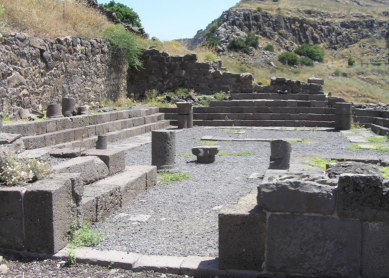
Borrowed Synagogue Photo from a Bible Odyssey article by Chad Spigel.
A Dangerous Reminder
Standing in that reconstructed synagogue, I couldn’t help but grieve how much we’ve drifted. Many of our churches have become places of consumption rather than conversation, with stages replacing circles and programs replacing participation. Somewhere along the way, as Frank Viola and George Barna suggest, much of this shift occurred during the Constantinian era (see Pagan Christianity).
But Paul’s words still echo across the centuries: let the Word dwell richly among you. Each one brings something. Build up the body together.
This is more than history. It’s an ethos the New Testament consistently witnesses to—an ethos that should haunt us still. It needs to inform us today, as well.
In 2026, our church community of River Corner Church will be wrestling with a ‘key verse’ from Hebrews 10:24-25. This verse reads, “And let us consider how to spur one another on toward love and good deeds, not giving up meeting together, as some are in the habit of doing, but encouraging one another—and all the more as you see the Day approaching” (NIV).
That synagogue room has become for me a dangerous reminder. Once you see it, you can’t unsee it. Once you recognize that church was never meant to be a spectator event, you’ll never be satisfied with less.
General Christian

About Jeff McLain
Through 'Lead a Quiet Life,' Jeff McLain explores his pursuit of simplicity in a tumultuous world as he serves as the Director of Pastoral Ministries at Water Street Mission and as pastor at River Corner Church. Jeff's commitment to Jesus as been shaped by an unconventional journey from activism to hitchhiking, is reflected in his academic pursuits and throughout his involvement with various initiatives. Residing in Lancaster, Pennsylvania, Jeff, along with his wife and three daughters, embraces family moments outdoors, while his love for baseball, boardwalks, beaches, and books adds depth to his vibrant life. You can read more about the author here.
Previous Post

September 15, 2025
5 Books That Shaped My Rule of Life and Quiet Life Pursuit
Next Post

October 9, 2025 Sojourn: Becoming a Spiritual Pilgrim (Part One)
Recent Comments
"We can never reflect enough."
The Earth Is the Lord’s: Learning ..."
"Yes!"
The Earth Is the Lord’s: Learning ..."
"As pilgrims on journey we are invited to do further rethinking for the remaining stretch ..."
The Earth Is the Lord’s: Learning ..."
"Not only do other people belong to God, they are loved by God. So we ..."
The Earth Is the Lord’s: Learning ..."
Browse Our Archives
Select a Category A Simple Church Way Hard Conversations Lead A Quiet Life as Resistance Reading in the Trenches Sacred in the Everyday Chaos Series: Advent Series: Bible Study Essentials Series: Four Walls of Gratitude Series: Reading Shelf Series: Sojourn Series: This Is The Lord's Table Series: Year in Review Spiritual Disciplines for Ordinary People The Holy Work of Parenting The Pilgrimage of Jeff McLain Theology in the Wild Uncategorized
Select a Month October 2026 September 2026 August 2026 July 2026 June 2026 May 2026 April 2026 March 2026 February 2026 January 2026 December 2025 November 2025 October 2025 September 2025 August 2025 July 2025 June 2025 May 2025 April 2025 March 2025 February 2025 January 2025 December 2024 November 2024 October 2024 September 2024 August 2024 July 2024 June 2024 May 2024 April 2024 March 2024 February 2024 December 2023 November 2023 October 2023 June 2022
Follow Us!
TAKE THE
Religious Wisdom Quiz
What does Proverbs say about hard work?
Select your answer to see how you score.
Lazy people win It is pointless Diligence brings profit Sleep always
Related posts from Lead a Quiet Life

When Psalm 23 Began Reading Me

Introducing the Story of Corrie Ten Boom to...

Owning Things Without Being Owned: The 100 Thing...
Church Is Not a Waiting Room: It’s Where...
TRENDING AT PATHEOS Evangelical

Archdiocese Hosts Military Marriage Retreat in Germany
RASTATT, Germany — The transient military lifestyle, with its frequent deployments and...

Nearly every morning, I make the drive to Detroit with my high-school-age...

The Real AI Story Is Adoption Without Trust
Artificial intelligence has crossed a political threshold. It is no longer a...

A new article, written by Jeff Lindsay and Gale L. Pooley,...

Swimfan: Forgotten Aughts Pleasures
This is a recovery effort. In 2002, My Big Fat Greek Wedding...

Top Three Anti-Catholic Lies About Catholicism
This is my initial transcript for the video, "THE 3 WORST...
view all Evangelical blogs
What Are Your Thoughts?leave a comment
Ad-Free & Subscriber Log-In Subscription Support
- About Us
- 2026 Calendar
- Videos
- Podcasts
- Library of World Religions
- Faith In Media Tracker
- Advertise With Us
- Write for Us
- Privacy Policy
- Terms of Service
- Do Not Sell My Data
- Contact Us
- Radiant Digital
- Manage Newsletter Subscriptions
- Unsubscribe From Notifications
- Sitemap
Copyright 2008-2026, Patheos. All rights reserved.
Subscription Support Ad-Free & Subscriber Log-In
Follow Patheos