
BuddhistCatholicContemplativeEvangelicalGeneral ChristianHinduJewishLatter-day SaintMuslimNew VisionsProgressive Christian
Beliefs
- Buddhist
- Catholic
- Contemplative
- Evangelical
- General Christian
- Hindu
- Jewish
- Latter-day Saint
- More Voices
- Muslim
- New Visions
- Pagan
- Progressive Christian
Topics
- Religion News
- Food and Religion
- Sports and Religion
- Religious Art
- Religious Music and Entertainment
- Religious Events
- History and Religion
- Style and Religion
- Politics and Religion
- Women in Religion
- Recreation Outdoors and Religion
- Business Finance and Religion
- Careers Workplace and Religion
- Education and Religion
- Family Parenting and Religion
- Health Fitness and Religion
- Home and Religion
- Relationships and Religion
- Technology and Religion
- Travel and Religion
Columnists
- Buddhist Columnists
- Business Finance and Religion Columnists
- Careers Workplace and Religion Columnists
- Catholic Columnists
- Contemplative Columnists
- Education and Religion Columnists
- Evangelists Columnists
- Family Parenting and Religion Columnists
- General Christian Columnists
- Health Fitness and Religion Columnists
- Hindu Columnists
- History and Religion Columnists
- Home and Religion Columnists
- Jewish Columnists
- More Voices Columnists
- Latter Day Columnists
- Muslim Columnists
- New Visions Columnists
- Nonreligious Columnists
- Pagan Columnists
- Politics and Religion Columnists
- Progressive Columnists
- Recreation Outdoors and Religion Columnists
- Relationships and Religion Columnists
- Religion News Columnists
- Religious Art Columnists
- Religious Events Columnists
- Religious Music and Entertainment Columnists
- Sports and Religion Columnists
- Style and Religion Columnists
- Technology and Religion Columnists
- Travel and Religion Columnists
- Women in Religion Columnists
Resource Library
- 2026 Calendar
- Library of World Religions
- The 100 Most Holy Places on Earth
- Patheos Answers
- Podcasts
- Videos
- Faith Leaders Database
- Anglican Episcopalian
- Bahai
- Baptist
- Buddhism
- Christianity
- Confucianism
- Eastern Orthodoxy
- Hinduism
- Holiness and Pentecostal
- ISKCON
- Islam
- Judaism
- Lutheran
- Methodist
- The Church of Jesus Christ of Latter-day Saints
- New Age
- Paganism
- Presbytarian and Reformed
- Protestantism
- Religion Behind the Scenes
- Roman Catholic
- Scientology
- Shia Islam
- Sikhism
- Sufism
- Sunni Islam
- Taoism
- Zen
- See all religions
Research Tools
 Ad-Free & Subscriber Log-In Subscription Support
Ad-Free & Subscriber Log-In Subscription Support
Follow Patheos 

- Trending:
- Forgiveness
- |
- Marriage
- |
- Consciousness
- |
- Death Penalty
- |
- Election
- |
- Halloween

- Home
- Evangelical
- Business, Finance and Religion
- Lead a Quiet Life: The Early Church’s Rule for Freeloaders
Lead a Quiet Life: The Early Church’s Rule for Freeloaders
Last updated on: September 16, 2025 at 12:54 pm by Jeff McLain
Lead a Quiet Life: The Early Church’s Rule for Freeloaders 2025-09-16T12:54:56-04:00 Jeff McLain
Patheos Explore the world's faith through different perspectives on religion and spirituality! Patheos has the views of the prevalent religions and spiritualities of the world.
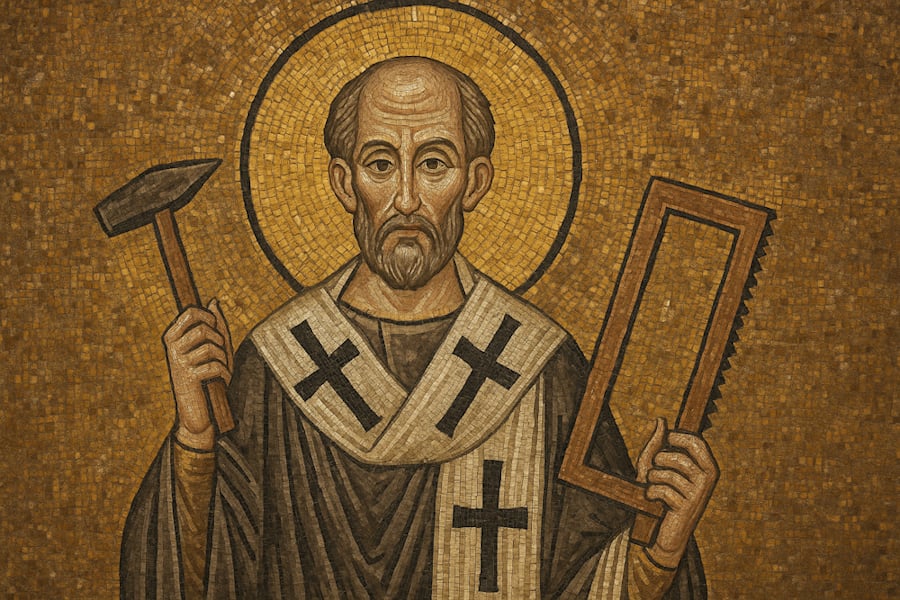
Lead A Quiet Life – The Early Church’s Rule for Freeloaders. Image created by Jeff McLain and ChatGPT.
In 1983, Todd Rundgren released a forever-remembered single that energetically declared, “I don’t want to work, I want to bang on the drum all day.” This song has been used by football teams, talk show hosts, video games, commercials, movies, and in a popular episode of The Office TV show. It is a song that resonates with many of us when Monday rolls around, and perhaps Tuesday, and Wednesday. In 2007, pop punk band, The Frantics, released a song called Kids of Summer that similarly expressed vocational frustration, singing “I don’t wanna go to work again. Think it’s the only place that I’ve ever been, I would rather be at home, watching TV all alone, than to be in this.” Admittedly, this song has played as a soundtrack in my head more times than I would probably care to admit. Work, an activity that we were created to do, a necessity that we must do to survive, but also an act that brings about much stress in our lives.
Interestingly, work finds itself as the core of Paul’s challenge to the Thessalonian church to lead a quiet life in 1 Thessalonians 4:11-12. In this post, I will explore this command to lead a quiet life and seemingly how it is an early church rule for freeloaders.
Theology of Work: Created to Contribute
Work is both a complicated and God-ordained activity. God models work as he orders the chaos of creation into structure and life (Genesis 2:2). Work is not only the responsibility we are given in the garden as part of God’s good creation, but it becomes a necessity of laboring activity that we must do to eat (Genesis 3:17). Paul tells those individuals in the church in Colossae who are enslaved to reframe their work as an act of worship “with sincerity of heart and reverence for the Lord,” and an act that we do, “with all your heart, as working for the Lord, not for human masters” (Colossians 3:23, NIV). Work is both something we want to do, have been designed to do well as those created in the image of God, but also something we have to do at times.
Jesus and the Sacredness of Labor
Jesus himself modeled work as a part of the human experience (Mark 6:3). We also see Jesus repurpose work for the Kingdom (Matthew 4:18-22). Many of his parables dealt with work, an everyday of their existence (Matthew 20:1-16, Luke 12:43-48). Jesus describes God as still working to bring order into creation, and identifies that his own vocation is to be about the father’s work (John 5:17). However, Jesus also gave us clues that in all we do – including the work we do – our motives matter. Work isn’t about selfish ambition, personal gain, appearances, or to fit some need of affirmation. Rather, we do not work or do anything as a way of being seen (Matthew 6:1). God worked, instituted work with purpose. Jesus also worked and Jesus reminded us of the purpose of work.
When Work Feels Heavy
The problem is that work is not always as life-giving as we want it to be. Some days I still feel like a kid figuring out what I want to be when I grow up. Right now, my retirement dream is to grow old drinking coffee by the beach, selling t-shirts on the boardwalk, and spending more time in a hammock than I probably should—ideally with reggae playing in the background. That is the kind of work that sounds life-giving to me. Right now, I fill the space as a Director of Pastoral Ministries, Lead Pastor, Student and Writer. Work isn’t easy, it is a complicated matter of our experience, and this is why it is common for us to say, “I don’t wanna go to work again. Think it’s the only place that I’ve ever been, I would rather be at home, watching TV all alone, than to be in this.” We get through work, by “working for the weekend,” as Loverboy would say.
The Call to Lead a Quiet Life Involves Work
Though this Lead a Quiet Life blog on Patheos covers themes of many topics and reflections, from bible study essentials to book reviews, it also deeply wrestles with what a life influenced by Paul’s challenge “to make it your ambition to lead a quiet life: You should mind your own business and work with your hands, just as we told you, so that your daily life may win the respect of outsiders and so that you will not be dependent on anybody” (1 Thessalonians 4:11-12, NIV). For several years now, this verse has become a life verse or key verse for me, after feeling like the Holy Spirit highlighted it for me during some bible study.
In previous blogs I have reflected on this verse and highlighted how a life of stillness before and with the Lord is undoubtedly connected to Paul’s idea of leading a quiet life. For example, when the church is unable to persuade Paul not to go to Jerusalem, they become still or quiet, and say, “The Lord’s will be done” (Acts 21:14, NIV). 1 Thessalonians 4:11-12 is a verse that I have written inside the cover of my journals to remind myself of its rich way of living. However, as Craig Keener points out “Paul asks his readers to be inconspicuous, not monastic.”
Again, it is interesting that work finds itself as the core of Paul’s challenge to lead a quiet life to the Thessalonian church in 1 Thessalonians 4:11-12.
Paul’s Vision: Work with Your Hands
The core of Paul’s challenge to the Thessalonian church in 1 Thessalonians 4:11-12, calls them to work. However, it was not just any work, but the work that we do with our hands. This implies crafts and skills. Keener again remarks that though there might have been some landowning aristocrats in the church community, who culturally would have been opposed to laborious work, Paul seems not to be fighting a laziness but a reminder that “Treating outsiders appropriately presumably means one’s witness in giving, or perhaps avoiding begging,” like the propertyless poor and donating seeking cynic philosophers.
Paul’s concern was not about their laziness as much as it seems to be around the way work can be missional and invested. Similarly, known for his preaching and teaching, Church Father John Chrysostom remarks about this passage that Paul “shows of how many evils idleness is the cause, and of how many benefits industry.” However we are not called to benefit industry, but work and live in a way that benefits others. Again, Chrystotom remarks, “For it is a mark of love to our neighbors not to receive from them, but to impart to them….And this is the effect of working, that one does not receive of others, nor live idly, but by working imparts to others.” This is at the heart of Paul’s challenge, “work with your hands….so that you will behave properly toward outsiders and not be in any need.” Work is how God designed us to provide for ourselves and others, but also witness to who God is.
The Witness of the Early Church
This week, while reading the Didache a few times over, in a few translations, for my doctoral studies, I felt I grasped a little more of how the early church also saw Paul’s command in this verse to “work with your hands” (1 Thessalonians 4:11-12, NIV). It is important to understand how the early church saw this command and the Didache helps us to grasp an understanding. The Didache, as explained by The Anchor Yale Bible Dictionary, was an early work on Christian discipline and church practice. It was forgotten by many, until it was recovered by P. Bryennios in 1873. Though a copy from 1056 was rediscovered in 1873, we have found other fragments and hints to this document that give some commenters a “date of effective origin as early as around 70 or soon thereafter.” It certainly gives us a look at 1st and 2nd Century church practice and worship. The issue of work is a notable part of the teachings and commands of worship and practice in the Didache.
Hospitality, Limits, and Mutual Contribution
In the Didache, Hospitality is to be extended to leaders and visitors to their communities. First fruits of our work were to be given to the poor and visiting prophets. However, all of these things had an expectation, they were extended wholeheartedly, but also they were extended temporarily in nature. No one, not even the prophets, were supposed to overstay in their communities and become dependent on the gifts and goodwill of others. Even more, anyone who wanted to join the church community, was expected to give themselves over to work. The Didache, as translated by Thomas O’ Loughlin, remarks “If the visitor is someone who is passing through, help him as much as you can. However, he is not to stay for more than two days—or three out of necessity. If the visitor wishes to settle in your community, then, if he is a craftsman, he should work for his living.” Living dependent on others should be temporary, even in a hospitality situation.
In the Didache, the expectation is that those joining their house church communities will provide for themselves and others by working in the crafts so that they could not only survive independently but also have things to invest and share in common with the community, and resources to extend to those in need (Acts 2:44-45). If you are like me, you may already be asking, what about those of us lacking craft skill. I am one of those guys that can hold a flashlight for the guy working on our car or house electric, but I struggle to craft with my hands. The Didache provides an understanding as it continues, “But if he does not have a trade, then use your own judgement to decide how he is to live among you as a Christian: but he is not to live in idleness.” The discernment on how this individual exists in their community, perhaps because of illness or disability, or just lacking a laboring craft or skill, is given to the community. However, the one thing they cannot do is be lazy. Idleness is not permitted in the church community that lives, works, worships, and plays.
The Didache has a mic-dropping statement that follows this, stating “If he (the new person in your community) is unhappy with this arrangement then he is a ‘christ-monger’. Be on the watch for such people.” A Christ-monger is someone who sells in the name of Jesus.
Guarding Against Abuse and Merchandising Faith
This line in the Didache, which I believe echoes the heart of 1 Thessalonians 4:11-12, also has important reminders for fundraisers, Christian organizations and charities. Theologian Thomas O’ Loughlin remarks;
“Everyone who has been involved in running a charity knows this dilemma in one way or another. Welcome and support is something that Christians should give; but at the same time no one should be allowed to abuse that generosity and sponge rather than work. Such people are not brothers who should be welcomed in Christ as coming in the Lord’s name but people who are using the name of Christian for their own ends.”
O’ Loughlin also helps us to see that “the name the Didache coins for such a sponger is christemporos (literally: one who trades on the name of Christ), which is sometimes rendered.” Peter hints at this and the King James Version gives a unique twist on Peter’s word in 2 Peter 2:3, saying that these type of people “make merchandise of you.” One blog I encountered jarred me with an important challenge, “The merchandising of Christianity is a heinous sin that is growing terribly in these last days. The word for exploit in the Greek is emporeuomai, meaning, “I travel as a merchant, engage in trade, I traffic in, make gain or business of.” It is where we get our English word emporium, which means mall or marketplace.” In a world of Christian organizations living off the donations of others, and circuit speakers traveling the world on stages, we are reminded to adhere to this call to work to support ourselves through the skills and crafts.
Paul’s Continued Warning to the Thessalonians
Paul continues to address this idea to the Thessalonians in his second letter. He writes, “In the name of the Lord Jesus Christ, we command you, brothers and sisters, to keep away from every believer who is idle and disruptive and does not live according to the teaching you received from us” (2 Thessalonians 3:6-12). Paul explains how they worked among them, not living idly, and he says he gave them a rule, “The one who is unwilling to work shall not eat” (2 Thessalonians 3:10, NIV). Paul’s challenge comes hard, “We heard that some among you are idle and disruptive. They are not busy; they are busybodies” (2 Thessalonians 3:11). Again, they are reminded to mind their own business, work with their hands, and “settle down (lead a quiet life) and earn the food they eat” (2 Thessalonians 3:12).
Summary of Early Christian Practice
The community was built on shared responsibility and mutual welcome, where everyone contributed—those with skills were expected to work, and while the community could decide how to handle those without a trade, no one was to exploit the community by refusing to work.
Three Practical Reminders
In this understanding of “work with your hands…so that your daily life may win the respect of outsiders and so that you will not be dependent on anybody,” and the early church’s understanding of this challenge, we find three practical reminders.
- Reframe Your Work as Worship. Whether you’re fixing cars, leading meetings, caring for others, or stocking shelves—see your work as sacred. As Paul urged, work “with sincerity of heart and reverence for the Lord” (Col. 3:23). Even mundane or difficult tasks can become acts of worship when done with the right heart.
- Reframe Your Work as Investment and Contribution. We may not all have hands skilled in carpentry or crafts, but God has gifted each of us with something to contribute. Work doesn’t have to be paid employment—it may be volunteering, caregiving, mentoring, or creating. Whatever it looks like, resist the pull toward passivity. The early church had no room for idleness, only shared purpose.
- Reframe Your Work to Resist the Temptation to Merchandise Ministry. In a culture where platform often overshadows God’s heart, it’s easy to slip into viewing ministry as a means of gain rather than a gift of grace. But Jesus reminds us, “Freely you have received; freely give” (Matthew 10:8). Paul and the early church understood that our work should not be a way to make merchandise of the gospel, but a means of reflecting the generosity and integrity of Christ. Reframing our work means resisting the urge to build brands, chase stages, or profit from piety.
A Better Way Forward
We’ve been given a clear and loving warning – it is important to work with your hands. We cannot live in dependency, and we must be invested vocationally in a way that contributes and blesses others. In a culture obsessed with personal freedom and flexible schedules, we risk forgetting that Christian independence isn’t about self-serving autonomy—it’s about not living off the labor of others. Ironically, many seek that freedom by monetizing or merchandising the Church or leveraging a cause, but that’s not the way of Jesus or the early church. Paul offers the Thessalonians—and us—a better vision: one marked by brotherly love, shared responsibility, and meaningful contribution. Yes, we’re called to carry each other’s burdens, but we’re also called to carry our own. Living this way quietly reflects God’s transforming work in us and missionally earns the respect of the world around us
General Christian
Business, Finance and Religion
Careers, Workplace and Religion

About Jeff McLain
Through 'Lead a Quiet Life,' Jeff McLain explores his pursuit of simplicity in a tumultuous world as he serves as the Director of Pastoral Ministries at Water Street Mission and as pastor at River Corner Church. Jeff's commitment to Jesus as been shaped by an unconventional journey from activism to hitchhiking, is reflected in his academic pursuits and throughout his involvement with various initiatives. Residing in Lancaster, Pennsylvania, Jeff, along with his wife and three daughters, embraces family moments outdoors, while his love for baseball, boardwalks, beaches, and books adds depth to his vibrant life. You can read more about the author here.
Previous Post
May 13, 2025
Rethinking Membership: A Review of Committing to One Another
Next Post

May 20, 2025 Forming Family Habits That Disciple: Habits of the Household
Recent Comments
"We can never reflect enough."
The Earth Is the Lord’s: Learning ..."
"Yes!"
The Earth Is the Lord’s: Learning ..."
"As pilgrims on journey we are invited to do further rethinking for the remaining stretch ..."
The Earth Is the Lord’s: Learning ..."
"Not only do other people belong to God, they are loved by God. So we ..."
The Earth Is the Lord’s: Learning ..."
Browse Our Archives
Select a Category A Simple Church Way Hard Conversations Lead A Quiet Life as Resistance Reading in the Trenches Sacred in the Everyday Chaos Series: Advent Series: Bible Study Essentials Series: Four Walls of Gratitude Series: Reading Shelf Series: Sojourn Series: This Is The Lord's Table Series: Year in Review Spiritual Disciplines for Ordinary People The Holy Work of Parenting The Pilgrimage of Jeff McLain Theology in the Wild Uncategorized
Select a Month October 2026 September 2026 August 2026 July 2026 June 2026 May 2026 April 2026 March 2026 February 2026 January 2026 December 2025 November 2025 October 2025 September 2025 August 2025 July 2025 June 2025 May 2025 April 2025 March 2025 February 2025 January 2025 December 2024 November 2024 October 2024 September 2024 August 2024 July 2024 June 2024 May 2024 April 2024 March 2024 February 2024 December 2023 November 2023 October 2023 June 2022
Follow Us!
TAKE THE
Religious Wisdom Quiz
What Christian group emphasizes "The Inner Light" as guidance from God?
Select your answer to see how you score.
Quakers Methodists Pentecostals Baptists
Related posts from Lead a Quiet Life

Learning to Confess and Understand Our Father Even...

Making Room for the Conversation

When Psalm 23 Began Reading Me

Introducing the Story of Corrie Ten Boom to...
TRENDING AT PATHEOS Evangelical

Archdiocese Hosts Military Marriage Retreat in Germany
RASTATT, Germany — The transient military lifestyle, with its frequent deployments and...

Nearly every morning, I make the drive to Detroit with my high-school-age...

The Real AI Story Is Adoption Without Trust
Artificial intelligence has crossed a political threshold. It is no longer a...

A new article, written by Jeff Lindsay and Gale L. Pooley,...

Swimfan: Forgotten Aughts Pleasures
This is a recovery effort. In 2002, My Big Fat Greek Wedding...

Top Three Anti-Catholic Lies About Catholicism
This is my initial transcript for the video, "THE 3 WORST...
view all Evangelical blogs
What Are Your Thoughts?leave a comment
Ad-Free & Subscriber Log-In Subscription Support
- About Us
- 2026 Calendar
- Videos
- Podcasts
- Library of World Religions
- Faith In Media Tracker
- Advertise With Us
- Write for Us
- Privacy Policy
- Terms of Service
- Do Not Sell My Data
- Contact Us
- Radiant Digital
- Manage Newsletter Subscriptions
- Unsubscribe From Notifications
- Sitemap
Copyright 2008-2026, Patheos. All rights reserved.
Subscription Support Ad-Free & Subscriber Log-In
Follow Patheos