
BuddhistCatholicContemplativeEvangelicalGeneral ChristianHinduJewishLatter-day SaintMuslimNew VisionsProgressive Christian
Beliefs
- Buddhist
- Catholic
- Contemplative
- Evangelical
- General Christian
- Hindu
- Jewish
- Latter-day Saint
- More Voices
- Muslim
- New Visions
- Pagan
- Progressive Christian
Topics
- Religion News
- Food and Religion
- Sports and Religion
- Religious Art
- Religious Music and Entertainment
- Religious Events
- History and Religion
- Style and Religion
- Politics and Religion
- Women in Religion
- Recreation Outdoors and Religion
- Business Finance and Religion
- Careers Workplace and Religion
- Education and Religion
- Family Parenting and Religion
- Health Fitness and Religion
- Home and Religion
- Relationships and Religion
- Technology and Religion
- Travel and Religion
Columnists
- Buddhist Columnists
- Business Finance and Religion Columnists
- Careers Workplace and Religion Columnists
- Catholic Columnists
- Contemplative Columnists
- Education and Religion Columnists
- Evangelists Columnists
- Family Parenting and Religion Columnists
- General Christian Columnists
- Health Fitness and Religion Columnists
- Hindu Columnists
- History and Religion Columnists
- Home and Religion Columnists
- Jewish Columnists
- More Voices Columnists
- Latter Day Columnists
- Muslim Columnists
- New Visions Columnists
- Nonreligious Columnists
- Pagan Columnists
- Politics and Religion Columnists
- Progressive Columnists
- Recreation Outdoors and Religion Columnists
- Relationships and Religion Columnists
- Religion News Columnists
- Religious Art Columnists
- Religious Events Columnists
- Religious Music and Entertainment Columnists
- Sports and Religion Columnists
- Style and Religion Columnists
- Technology and Religion Columnists
- Travel and Religion Columnists
- Women in Religion Columnists
Resource Library
- 2026 Calendar
- Library of World Religions
- The 100 Most Holy Places on Earth
- Patheos Answers
- Podcasts
- Videos
- Faith Leaders Database
- Anglican Episcopalian
- Bahai
- Baptist
- Buddhism
- Christianity
- Confucianism
- Eastern Orthodoxy
- Hinduism
- Holiness and Pentecostal
- ISKCON
- Islam
- Judaism
- Lutheran
- Methodist
- The Church of Jesus Christ of Latter-day Saints
- New Age
- Paganism
- Presbytarian and Reformed
- Protestantism
- Religion Behind the Scenes
- Roman Catholic
- Scientology
- Shia Islam
- Sikhism
- Sufism
- Sunni Islam
- Taoism
- Zen
- See all religions
Research Tools
 Ad-Free & Subscriber Log-In Subscription Support
Ad-Free & Subscriber Log-In Subscription Support
Follow Patheos 

- Trending:
- Forgiveness
- |
- Marriage
- |
- Consciousness
- |
- Death Penalty
- |
- Election
- |
- Halloween

- Home
- Evangelical
- Religious Events
- How a Pastor Actually Writes a Sermon
How a Pastor Actually Writes a Sermon
Last updated on: August 12, 2026 at 3:03 pm by Layne Wallace
How a Pastor Actually Writes a Sermon 2026-08-12T15:03:23-04:00 Layne Wallace
Patheos Explore the world's faith through different perspectives on religion and spirituality! Patheos has the views of the prevalent religions and spiritualities of the world.
Selecting Text (Continued)
This article is part two of The Process of Preaching
Some pastors will choose texts based on their personal devotion or on their sense of what the congregation needs. While these two options can—and do—produce good preaching, the potential drawbacks make this my least favored method. If the pastor is choosing from devotional texts, he will likely choose a much narrower scope of the Scriptures than those choosing another method—those who preach only about the felt needs of the congregation risk making preaching too human-centered.

When I preach, I follow the church calendar. That focuses preaching on the life and work of Jesus Christ. I think preaching at its best is a Christ-centered venture. In ordering my sermons, I tend to think of preaching in sets of 4. For example, in ’26-’27, I have planned to do 4 sermons on the parables of Jesus, 4 sermons on the Patriarchs, and 4 sermons on the name of Jesus. I have a 5-week series on 1 Timothy, and a longer look at the Sermon on the Mount, though. While the sermons are connected, each is episodic. Like an episode of Law and Order, if you have missed last week, you will not be lost this week. I also seldom announce my sermons as a series.
After Text Selection
Once the text is in view, study is vital. There is nothing worse than a sermon that has not engaged in serious study of the text. I’m a Bible and theology nerd, so engaging commentaries and theological texts in sermon preparation is life for me. It is not unusual for me to read from 10 or more commentaries in sermon preparation.
It is wise to select a variety of commentaries from across Christian perspectives. Even though that is true, I will admit freely that my favorite New Testament commentator is David Garland. I have his commentaries on Matthew, Mark (his theological commentary on Mark is perhaps my favorite commentary, period), 1 Corinthians, 2 Corinthians, and Romans. If I am preaching from a passage he has a commentary on, I’m studying him. I will note that these commentaries are in different commentary series. While commentary series can often be quite good, I prefer to focus on individual authors.
When I do look at commentary sets, I will most frequently reach for the New American Commentary and the New International Greek Testament Commentary series. The work in them is usually helpful. I have access to the Hermeneia series, but it is not my favorite. I will also often consult William Barclay. He’s not perfect by any stretch, but he gives historical background on Biblical texts that is quite helpful.
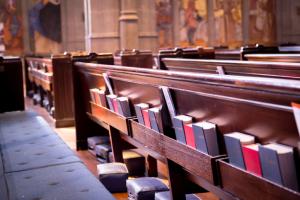
Writing
When people ask me how long it takes to write a sermon, I have two answers. The first sounds flip, but it is actually the truest answer. “My whole life until now.” Writing a sermon brings every event in life to writing. If the sermon is about forgiveness, I’m going to think about times I have needed forgiveness, and times I have extended it. I will also think about when forgiveness has been hard. Invariably, I will remember a TV show, a movie, a book, an article, or an incident as I sit down to write. Many of those will end up in the sermon, or at least be in my mind as I’m writing.
Just last night I was wrapping up my day watching The Big Bang Theory. It was the episode where Sheldon and Amy won the Nobel Prize for their scientific work. On the trip to Sweden, Penny is desperately trying to conceal from the group that she is expecting. She did not want to upstage Sheldon and Amy’s award. Sheldon discovered the news and promptly made a jerk of himself. After a blunt confrontation with his wife, Amy, Sheldon recognizes how selfish he was and apologizes to his friends during his Nobel acceptance speech. The next time I preach on forgiveness, I will be thinking of that episode.
It is more than just TV shows. News items, events from my town, anything that happens, anything I observe, anything and everything is part of the process. How long does it take to write a sermon? Well, my whole life until now.
How Much Time?
The second answer is probably what people want to know when they ask the question. I budget a day for sermon writing. On average, it takes 4-6 hours. There have been times it has taken days, and there are times it takes only an hour, but I budget a day.
Different Styles
I view preachers who use manuscripts well with a bit of awe. I love the power of a particular turn of a phrase and the punch of perfectly selected prose.
For me, however, manuscripts have never worked. I’ve tried them, but … well … I end up reading them. I lose eye contact. When I look up at the congregation, I lose my place in the manuscript.
Instead, I use 7 bullet points. Each bullet is a heading of the sermon. I do not like to call it an outline, because an outline is a particular way of communicating. Most outlines look something like this:
I
A
1
2
3
B
1
2
3
C
1
2
3
II
A
1
2
3
Etc.
My Typical Sermon Blocks
For me, the bullets are not so much subsequent to each other as they play a different part in the sermon. I refer to each of them as a “block,” and each block has a task.
It looks something like this.
1) Build a connection between the text and the congregation.
2) Explain the text in detail. Point to important highlights in the text. If there is information about the book as a whole that the congregation might not be aware of, point that out. If there are Greek or Hebrew words that are important to the sermon, call attention to them.
3) What is the claim of the text (I foreshadow this in 1)
4) Why would the text say that?
5) What would be our natural opposition to the text?
6) What would it be like if we observed what the text said?
7) Closing the case, demonstrating how we could practice what the text says.
Flexibility
Obviously, this can vary significantly from week to week. For example, sometimes the text will have multiple claims. In those cases, each of the claims will need to be explained individually, and other sections will have to be shortened.
My way is not the only way. It is probably not even the best way. It is only my way. I’m convinced that there are as many ways to organize and preach a sermon as there are pastors.
How to Evaluate a Sermon
I’m not sure any church I ever attended taught me how to listen to a sermon, and I think this is true for most people who go to church. If not taught how to listen to a sermon, people tend to go to their defaults. A sermon is good, under those conditions, if it is engaging. I love engaging sermons as much as anyone else, but that is not the most important criterion.
Here are the steps to evaluating a good sermon:
1) Was this the right text?
2) Did the pastor understand and explain the text rightly?
3) Did the pastor clearly state what the text said?
4) Did the sermon have the same function as the text did? In other words, if the text was about comforting the congregation, did the sermon serve as a sermon of comfort, etc?
5) Did the pastor preach with passion?
When I am most critical of my own preaching, it is because I feel the sermon lacks energy or passion. My word is ‘bloodless.” If I feel like it was a bloodless sermon, I leave very deflated.
The highest compliment I ever get about my preaching is when people say they understand me. In the ancient world, the herald was the one who brought news from far away. The function of the herald was to convey the message accurately and speak clearly. The New Testament, Paul in particular, thinks of the preacher as a herald. I think of my role, then, as getting the message right and using clear speech.
Here is a link to Garland’s commentary on Mark
Previous Post

August 3, 2026
The Process of Preaching
Next Post
August 25, 2026 The Problem is Character
Recent Comments
Browse Our Archives
Select a Category Biblical Studies Mental Health and Religion News Philosophy of Religion Uncategorized
Select a Month August 2026 July 2026 June 2026 February 2025 January 2025 November 2024 October 2024 September 2024 July 2024 June 2024 May 2024 February 2024 November 2023 October 2023 September 2023 August 2023 July 2023 April 2022 March 2022 December 2021 November 2021 October 2021 September 2021 August 2021 July 2021 June 2021 April 2021 March 2021 February 2021 December 2020 November 2020 October 2020 September 2020 August 2020 March 2020 February 2020 January 2020 December 2019 November 2019 September 2019 August 2019 July 2019 June 2019 May 2019 April 2019 March 2019 February 2019 January 2019 January 2018
Follow Us!
TAKE THE
Religious Wisdom Quiz
In 3 John, what does John say he has no greater joy than?
Select your answer to see how you score.
Hearing that his children are walking in the truth Preaching the gospel Serving the church Seeing souls saved
Related posts from Layne Wallace

The SBC Didn't Change Its Mind. It Changed...

The Problems with Progressive Theology
TRENDING AT PATHEOS Evangelical

57th Dove Awards Honor Dolly Parton, Crown New...
On gospel music’s biggest night, the 57th annual GMA Dove Awards honored...

The First Eucharistic Controversy: Christ’s Real Presence
For Catholics, the Eucharist is the source and summit of the Christian...

What a Stop Sign Can Teach Us About...
How to Make a Decision When You Can't Hear God Main point:...

Archdiocese Hosts Military Marriage Retreat in Germany
RASTATT, Germany — The transient military lifestyle, with its frequent deployments and...

Nearly every morning, I make the drive to Detroit with my high-school-age...

The Real AI Story Is Adoption Without Trust
Artificial intelligence has crossed a political threshold. It is no longer a...
view all Evangelical blogs
What Are Your Thoughts?leave a comment
Ad-Free & Subscriber Log-In Subscription Support
- About Us
- 2026 Calendar
- Videos
- Podcasts
- Library of World Religions
- Faith In Media Tracker
- Advertise With Us
- Write for Us
- Privacy Policy
- Terms of Service
- Do Not Sell My Data
- Contact Us
- Radiant Digital
- Manage Newsletter Subscriptions
- Unsubscribe From Notifications
- Sitemap
Copyright 2008-2026, Patheos. All rights reserved.
Subscription Support Ad-Free & Subscriber Log-In
Follow Patheos