
BuddhistCatholicContemplativeEvangelicalGeneral ChristianHinduJewishLatter-day SaintMuslimNew VisionsProgressive Christian
Beliefs
- Buddhist
- Catholic
- Contemplative
- Evangelical
- General Christian
- Hindu
- Jewish
- Latter-day Saint
- More Voices
- Muslim
- New Visions
- Pagan
- Progressive Christian
Topics
- Religion News
- Food and Religion
- Sports and Religion
- Religious Art
- Religious Music and Entertainment
- Religious Events
- History and Religion
- Style and Religion
- Politics and Religion
- Women in Religion
- Recreation Outdoors and Religion
- Business Finance and Religion
- Careers Workplace and Religion
- Education and Religion
- Family Parenting and Religion
- Health Fitness and Religion
- Home and Religion
- Relationships and Religion
- Technology and Religion
- Travel and Religion
Columnists
- Buddhist Columnists
- Business Finance and Religion Columnists
- Careers Workplace and Religion Columnists
- Catholic Columnists
- Contemplative Columnists
- Education and Religion Columnists
- Evangelists Columnists
- Family Parenting and Religion Columnists
- General Christian Columnists
- Health Fitness and Religion Columnists
- Hindu Columnists
- History and Religion Columnists
- Home and Religion Columnists
- Jewish Columnists
- More Voices Columnists
- Latter Day Columnists
- Muslim Columnists
- New Visions Columnists
- Nonreligious Columnists
- Pagan Columnists
- Politics and Religion Columnists
- Progressive Columnists
- Recreation Outdoors and Religion Columnists
- Relationships and Religion Columnists
- Religion News Columnists
- Religious Art Columnists
- Religious Events Columnists
- Religious Music and Entertainment Columnists
- Sports and Religion Columnists
- Style and Religion Columnists
- Technology and Religion Columnists
- Travel and Religion Columnists
- Women in Religion Columnists
Resource Library
- 2026 Calendar
- Library of World Religions
- The 100 Most Holy Places on Earth
- Patheos Answers
- Podcasts
- Videos
- Faith Leaders Database
- Anglican Episcopalian
- Bahai
- Baptist
- Buddhism
- Christianity
- Confucianism
- Eastern Orthodoxy
- Hinduism
- Holiness and Pentecostal
- ISKCON
- Islam
- Judaism
- Lutheran
- Methodist
- The Church of Jesus Christ of Latter-day Saints
- New Age
- Paganism
- Presbytarian and Reformed
- Protestantism
- Religion Behind the Scenes
- Roman Catholic
- Scientology
- Shia Islam
- Sikhism
- Sufism
- Sunni Islam
- Taoism
- Zen
- See all religions
Research Tools
 Ad-Free & Subscriber Log-In Subscription Support
Ad-Free & Subscriber Log-In Subscription Support
Follow Patheos 

- Trending:
- Forgiveness
- |
- Marriage
- |
- Consciousness
- |
- Death Penalty
- |
- Election
- |
- Halloween

- Home
- Evangelical
- Religious Events
- What We Miss: Jesus Walks on Water and Claims of Divinity
What We Miss: Jesus Walks on Water and Claims of Divinity
Last updated on: November 11, 2023 at 10:56 am by Layne Wallace
What We Miss: Jesus Walks on Water and Claims of Divinity 2023-11-11T10:56:19-05:00 Layne Wallace
Patheos Explore the world's faith through different perspectives on religion and spirituality! Patheos has the views of the prevalent religions and spiritualities of the world.
Jesus Walks on the Water and Jesus’ Divinity
In my social media adventures over the last several months, I have noticed a group of people denying the divinity of Jesus. Because it is social media, it is hard to tell if it is a large movement or if it is just a small group whose voices seem more numerous because they are concentrated on Twitter. Some of them are following the work of UNC professor Bart Ehman, who has sold a lot of books after losing his religion. Others are just internet trolls with an anti-Christian ax to grind. A few of them are Jehovah’s Witnesses who read the Bible in some unfortunate ways.
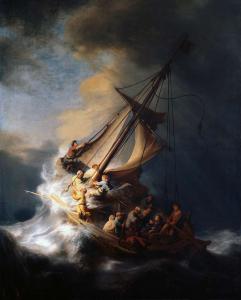
Rembrandt: Jesus Calms the Sea Public Domain
The argument goes something like, “Jesus never claimed divine status it is an invention of the early Church leaders who were under the influence of pagan Greek philosophy.” Of course, that argument is absurd. Jesus makes divine claims explicitly and implicitly in the Gospels. One of the most interesting implicit claims is often missed: Jesus’ walking on the water. Matthew, Mark, and John all record Jesus treading on the sea.

Calm before the storm
Jesus Treads on the Sea in Mark
When we read a Bible story, we often miss the backdrop and subtleties that a first-century reader would have noticed immediately. We do not share their culture or mindset. Because we do not share those constructs, we are often reduced to seeing a miracle like Jesus walking on the water as nothing more than an interesting trick. It was much more than an interesting trick. It was a demonstration of who Jesus was, God in the flesh.
The Sea As A Symbol in the Bible
Symbols matter. In the Bible, certain terms carry meaning beyond just their ordinary usage. Biblical literature is not alone in using words this way. We moderns have the same practice. For example, in modern literature and movies, a red sports car can mean freedom, or it can mean a mid-life crisis. A person wearing a black suit can mean there is an important event or it can mean there is a funeral. Eagles mean liberty to Americans. Dawn can mean hope. A fox can mean sly.
The Bible uses symbols in the same way. One of the symbols the Bible uses is sea/water. When we see water or the sea in the Bible, it is important to see if the terms mean more than just the physical element. For example, in Genesis 1:2 we read, “… The Spirit of God was moving over the face of the waters.” There, water means chaos. In Revelation 21:1 we read “… and there was no longer any sea.” There sea/water of the sea represents chaos, evil, death, and the source of evil powers. Frequently in the Bible, the sea represents a chaotic, demonic power that humans cannot tame. When Jesus walks on the water, it is important to see the reference as more than just Jesus doing the impossible he is treading on the sources of evil.
Grave Danger
Focusing on Mark’s recounting of the story in Mark 6:45-56, we notice the disciples are in trouble, grave danger. They are on the sea, and a strong storm has come up. The wind and the waves battered their small boat, and a strong wind blew them far off course.[1] Terrified, the disciples struggled to get the boat to shore. They fought against the storm for hours in the pitch darkness*.*
To their terror, they saw something approaching the boat, and they thought it was a ghost. A ghost is not the remnants of a deceased person in this Biblical usage, it is an association with evil and the forces of Satan. A better translation would be “phantasm” or “specter.”[2] Their knees knocked, hands quivered, their pulse quickened.
The disciples were in grave danger of being swallowed up by the forces of darkness and evil. The sea and its malevolent forces were battering their small boat. The wind and storm blew the boat miles off course. After hours of struggling torturously against the storm, a phantasm was approaching the boat. It is no stretch to conclude the disciples believed they were about to be destroyed by the demonic hordes of Satan himself. Mark notes the disciples screamed in terror– “cried out” in the NASB.
Jesus and the Sea
What the disciples could not know was that it was Jesus who was walking on the water. The word “water,” however, is not a good translation. Thalassa in Greek is either “sea” or “lake.” “Sea” is the right rendering here contra the NIV.
The early Jewish readers of the Gospels would have had other texts come to mind as they read this account. Job 9:8-11 says of God,
He alone stretches out the heavens and treads on the waves of the sea… He performs wonders that cannot be counted. When he passes me, I cannot see him; when he goes by, I cannot perceive him” (emphasis author here and in the following paragraphs).
In Job 38:16-18 God says to Job,
Have you entered into the springs of the sea, or walked in the recesses of the deep? Have the gates of death been revealed to you, or have you seen the gates of deep darkness? Have you comprehended the expanse of the earth? Declare, if you know all this?
Psalm 77:16-20 reads,
When the waters saw you, O God,
when the waters saw you, they were afraid;
the very deep trembled.
The clouds poured out water;
the skies thundered;
your arrows flashed on every side.
The crash of your thunder was in the whirlwind;
Your lightnings lit up the world;
the earth trembled and shook.
Your way was through the sea,
your path, through the mighty waters;
yet your footprints were unseen (NRSV).
A Common Biblical Theme
It is a common Biblical theme that God treads over the sea. This is code for God stomps on the forces of evil. Job is the central text here. If we are not aware of Job, the miracle of walking on the sea is still interesting, but with Job in view, the miracle is a revelation of Jesus’ divine nature. In Job, there is only One who can tread on the sea. God alone treads on the sea. When we see Jesus do what God alone can do, the implication is clear. Jesus is God.
Passing By
The similarities between Job and Mark become more striking the further one reads. Job reads “…he passes me…” The NRSV gets the translation correct when it says that Jesus “intended to” pass the disciples by. The literal translation of the Greek is, “He wanted to pass by them.”[3] It looks like this statement is from the disciples’ perspective, not a reflection of Jesus’ inner thoughts.[4] The “pass by them” language is a connection to Job as well but with a critical difference. In Job, God cannot be perceived. In Mark, Jesus is revealed. So, we go from a hidden God in Job, to a revealed God in Mark. The point remains, Jesus is the One who treads on the sea and is the revealed God.
Not Just Walking, Stilling
Another connection to Job comes from Job 26:12-13
By His power, He stilled the Sea;
By His understanding, He struck down Rahab.
By His wind the heavens were made fair:
His hand pierced the fleeing serpent.
Two things to note here. Rahab is a sea monster in Ancient Near Eastern mythology. Job is not saying there is some strange monster in the deep, he is using the image to describe the forces of evil in a symbolic or spiritual way. Think of Rahab as a spiritual being who caused the seas to rage. The fleeing serpent is probably a reference to Rahab or the Leviathan, another depiction of the chaos.[5] The forces of chaos and evil, represented by Rahab, Leviathan, or Satan, have the power to destroy humanity. They are, however, no match for the power of God.
Mark has Jesus calm the storm in chapter 4, and here in chapter 6 He calmed the wind and sea. Mark 4 is rather humorous as Jesus tells the storm to “be muzzled,” which is the ancient equivalent of our rejoinder, “Shut up.” These two miracles were exercises of power reserved for God alone in the Old Testament. Who is it that stills the sea in the Old Testament? God alone stills the sea. Who stills the sea in Mark? Jesus stills the sea. There is only one conclusion, Jesus is God.
The Disciples Understand
In Matthew’s telling of the narrative, the Disciples finally understand the meaning of the events at least for the moment. They worship Jesus. Recall the temptation narrative for a moment. Why did Jesus not worship Satan? Worship is for God alone. Jesus said, “Away from me, Satan! For it is written, ‘You shall worship the Lord your God, and serve Him only'” (Matt 4:10 NIV).
In the narrative of Jesus walking on the water (I think we should start saying “the narrative of Jesus treading on the sea” as it is a better descriptor.) we find Jesus calming the sea as only God can do, Jesus stilling a storm as only God can do, and Jesus receiving worship as is only fitting for God. The only conclusion is that the Gospel writers want you to conclude that Jesus is God in the flesh.
[1] James Brooks, New American Commentary. Broadman, Smith & Holman: Nashville, TN. Logos Edition, 111.
[2] Kenneth S. Wuest, Wuest’s Word Studies in the Greek New Testament. Wm. B. Eerdmans: Grand Rapids, MI. 137.
[3] Brooks, 111.
[4] Brooks, 111.
[5] Robert Allen. The New American Commentary: Broadman & Holman Publishers, Nashville. 260-261.
General Christian
History and Religion
Previous Post

November 2, 2023
If I Were Her Friend: Brielle Asero and Work
Next Post

November 29, 2023 Disappointment and the Courage to Hope
Recent Comments
Browse Our Archives
Select a Category Biblical Studies Mental Health and Religion News Philosophy of Religion Uncategorized
Select a Month August 2026 July 2026 June 2026 February 2025 January 2025 November 2024 October 2024 September 2024 July 2024 June 2024 May 2024 February 2024 November 2023 October 2023 September 2023 August 2023 July 2023 April 2022 March 2022 December 2021 November 2021 October 2021 September 2021 August 2021 July 2021 June 2021 April 2021 March 2021 February 2021 December 2020 November 2020 October 2020 September 2020 August 2020 March 2020 February 2020 January 2020 December 2019 November 2019 September 2019 August 2019 July 2019 June 2019 May 2019 April 2019 March 2019 February 2019 January 2019 January 2018
Follow Us!
TAKE THE
Religious Wisdom Quiz
True or False: All Scripture is God-breathed and is useful for teaching, rebuking, correcting and training in righteousness.
Select your answer to see how you score.
FALSE TRUE
Related posts from Layne Wallace

How a Pastor Actually Writes a Sermon

The SBC Didn't Change Its Mind. It Changed...
TRENDING AT PATHEOS Evangelical

Emotion in Early Christianity by Andrew Crislip
Andrew Crislip’s Emotion in Early Christianity examines an often overlooked dimension of...

16 Spiritual Touchstones for a More Grounded Life
After decades of spiritual study, here are 16 principles I try...

Catholic Evangelization: Sharing Your Faith Every Day
Welcome back to the Graceful Awakening mini-series called, “From Faith to Mission.” ...

The Pillar of the Boatmen: the Ancient Monument...
The Pillar of the Boatmen is a Romano-Gaulish sculpture that dates from...

In one sense walking into Westminster Abbey is like walking down the...

'Super Scam Me' Exposes AI Jon Bon Jovi...
Leslie Pickett believed she was in a relationship with Jon Bon Jovi....
view all Evangelical blogs
What Are Your Thoughts?leave a comment
Ad-Free & Subscriber Log-In Subscription Support
- About Us
- 2026 Calendar
- Videos
- Podcasts
- Library of World Religions
- Faith In Media Tracker
- Advertise With Us
- Write for Us
- Privacy Policy
- Terms of Service
- Do Not Sell My Data
- Contact Us
- Radiant Digital
- Manage Newsletter Subscriptions
- Unsubscribe From Notifications
- Sitemap
Copyright 2008-2026, Patheos. All rights reserved.
Subscription Support Ad-Free & Subscriber Log-In
Follow Patheos