
BuddhistCatholicContemplativeEvangelicalGeneral ChristianHinduJewishLatter-day SaintMuslimNew VisionsProgressive Christian
Beliefs
- Buddhist
- Catholic
- Contemplative
- Evangelical
- General Christian
- Hindu
- Jewish
- Latter-day Saint
- More Voices
- Muslim
- New Visions
- Pagan
- Progressive Christian
Topics
- Religion News
- Food and Religion
- Sports and Religion
- Religious Art
- Religious Music and Entertainment
- Religious Events
- History and Religion
- Style and Religion
- Politics and Religion
- Women in Religion
- Recreation Outdoors and Religion
- Business Finance and Religion
- Careers Workplace and Religion
- Education and Religion
- Family Parenting and Religion
- Health Fitness and Religion
- Home and Religion
- Relationships and Religion
- Technology and Religion
- Travel and Religion
Columnists
- Buddhist Columnists
- Business Finance and Religion Columnists
- Careers Workplace and Religion Columnists
- Catholic Columnists
- Contemplative Columnists
- Education and Religion Columnists
- Evangelists Columnists
- Family Parenting and Religion Columnists
- General Christian Columnists
- Health Fitness and Religion Columnists
- Hindu Columnists
- History and Religion Columnists
- Home and Religion Columnists
- Jewish Columnists
- More Voices Columnists
- Latter Day Columnists
- Muslim Columnists
- New Visions Columnists
- Nonreligious Columnists
- Pagan Columnists
- Politics and Religion Columnists
- Progressive Columnists
- Recreation Outdoors and Religion Columnists
- Relationships and Religion Columnists
- Religion News Columnists
- Religious Art Columnists
- Religious Events Columnists
- Religious Music and Entertainment Columnists
- Sports and Religion Columnists
- Style and Religion Columnists
- Technology and Religion Columnists
- Travel and Religion Columnists
- Women in Religion Columnists
Resource Library
- 2026 Calendar
- Library of World Religions
- The 100 Most Holy Places on Earth
- Patheos Answers
- Podcasts
- Videos
- Faith Leaders Database
- Anglican Episcopalian
- Bahai
- Baptist
- Buddhism
- Christianity
- Confucianism
- Eastern Orthodoxy
- Hinduism
- Holiness and Pentecostal
- ISKCON
- Islam
- Judaism
- Lutheran
- Methodist
- The Church of Jesus Christ of Latter-day Saints
- New Age
- Paganism
- Presbytarian and Reformed
- Protestantism
- Religion Behind the Scenes
- Roman Catholic
- Scientology
- Shia Islam
- Sikhism
- Sufism
- Sunni Islam
- Taoism
- Zen
- See all religions
Research Tools
 Ad-Free & Subscriber Log-In Subscription Support
Ad-Free & Subscriber Log-In Subscription Support
Follow Patheos 

- Trending:
- Forgiveness
- |
- Marriage
- |
- Consciousness
- |
- Death Penalty
- |
- Election
- |
- Halloween

- Home
- Catholic
- Religion News
- Martyrs of the Gospel: Pedro de Corpa and Companions
Martyrs of the Gospel: Pedro de Corpa and Companions
Last updated on: June 18, 2026 at 3:57 pm by Father Pablo Migone
Martyrs of the Gospel: Pedro de Corpa and Companions 2026-06-18T15:57:43-05:00 Father Pablo Migone
Patheos Explore the world's faith through different perspectives on religion and spirituality! Patheos has the views of the prevalent religions and spiritualities of the world.
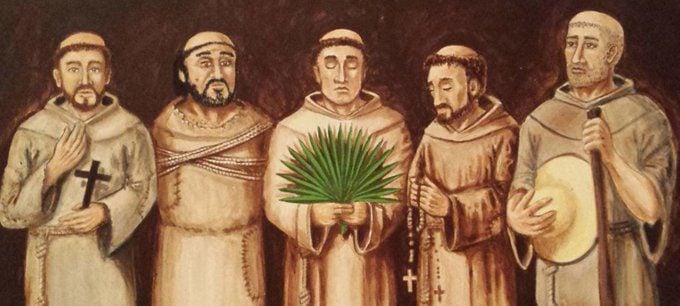
As I stepped out of the chapel at Franciscan University of Steubenville sometime in 2002, a light-brown brochure lying on a large table among countless prayer cards and pamphlets caught my eye—The Georgia Martyrs. I had never heard of these martyrs. Having been raised in Augusta, Georgia, I assumed they must be from the distant country of Georgia in the Caucasus. I was stunned to quickly realize the pamphlet told the story of five Franciscan friars who had been martyred for the sake of the Gospel on the shores of “my” Georgia. How did it happen that I was from Georgia, and had even attended Catholic school, but had never heard about Friar Pedro de Corpa and Companions? Little did I know that what began as a passing glance over a table of pamphlets as I exited noon Mass, would unfold over time and become deeply woven into my own priesthood.
Evangelization of the New World
The late fifteenth century marked a turning point in Spanish history, giving rise to a period of extraordinary religious zeal within the Catholic Church. The Kingdom of Spain was unified in 1492 under the Catholic monarchs Ferdinand of Aragon and Isabella of Castille after the completion of the Reconquista, the 800-year-old period of conflict which led to the expulsion of the Moors from the Iberian Peninsula after the conquest of the Emirate of Granada. That same year, the voyage of Christopher Columbus opened a vast new world not only for conquest but also for evangelization. The military and religious fervor which led the various kingdoms of Spain to reclaim their land from the Moors continued onto foreign territories across the Atlantic Ocean.
By the mid sixteenth century, the Spanish successfully established colonies and missions along the eastern coast of present-day Florida and Georgia. Though this territory collectively called “La Florida” was not rich in silver and gold, it was a strategic location since Spanish galleons full of riches sailed back to Europe along the coast. Fearful of British attacks and unfriendly natives along the coast, the Spanish had an interest in colonizing the region for defensive purposes. After the successful founding of Saint Augustine in present-day Florida in 1565, the first permanent European settlement in what is now the United States, the Spanish founded a string of missions along the coast, both on the mainland and barrier islands.
Religious fervor prompted countless men and women to willingly leave everything behind to spread the Gospel in distant lands. This missionary movement in Spain lasted until the late twentieth century. Among the fifteenth-century missionaries was the Franciscan Friar Pedro de Corpa, ordained in 1584 in Castille, Spain. He volunteered in 1587 along with eleven friars to evangelize the New World in the Province of La Florida. The friars first traveled to La Havana, Cuba, and then continued on a six-day journey to Saint Augustine. Friar Pedro worked at a mission near Saint Augustine until twelve more friars arrived, freeing him and others to evangelize farther north. It is unknown when exactly he arrived to the Mission of Tolomato (located near present-day Darien, Georgia), but his assignment there was significant since it was the main city of the Guale people, and its chief was considered the principal leader of the Guale.
Historians and archeologists recount that the Franciscan friars sent to the approximately 3,000 Guale arrived in peace, willing to make cultural accommodations and respecting traditional power hierarchies. These barefoot missionaries, sent without soldiers, were welcomed by the natives as witnesses rather than conquerors. They learned the Guale language, respected local customs, and lived simply among the people. By 1597, several missions had been established along the present-day Georgia coast where the friars preached the Gospel and lived harmoniously with the native population. Most Guale not only embraced Christianity but also welcomed European goods such as glass beads, metal tools, and cloth, reflecting the good relations fostered between the missionaries and the community.
A poem written by Friar Alonso Escobedo in the early 1600s described Friar Pedro emphasizing his life of poverty, chastity and obedience. Escobedo wrote: “I and the people who accompanied him to the land where we lived together are witnesses of his sanctity. Poverty was his favorite virtue. He admired the chaste and holy angelic choir and he was submissive to his bishop or superior, always demonstrating his obedience by quickly obeying all orders. Being a wise and holy man, the love of God burned in his heart, and by means of prayer, abstinence and self-discipline he gave good example to the Indians of the West (New World) whom he strove to convert.”
Witnesses to the Sacrament of Marriage
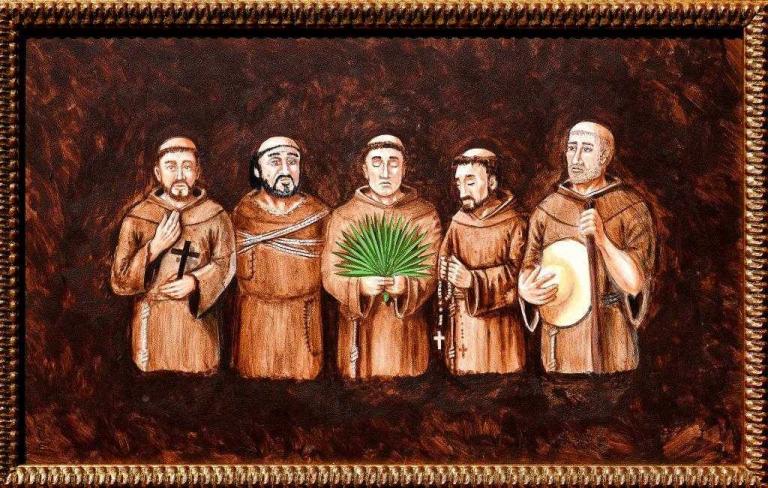
Friar Luis Geronimo de Oré (a Peruvian Franciscan friar) recorded in 1618 after visiting La Florida, that on September 1597, the friar assigned to the mission of Nuestra Señora de Guadalupe de Tolomato did not allow a baptized, Guale man to take a second wife. Juanillo, who was the heir to a Guale chiefdom, refused Friar Pedro de Corpa’s correction and faithfulness to Christian teaching that marriage is a permanent and binding union between one man and one woman. What followed was not simply a personal dispute, but a violent rejection of the Gospel’s demands. Enraged, Juanillo gathered a group of men and murdered Friar Pedro. The war party continued to the Mission in Tupiquí where Friar Blass was also killed.
Before arriving to Saint Catherines Island, Juanillo sent an order to the chief of the island to execute the two friars stationed there, Father Miguel de Añon and Brother Antonio de Badajoz. Unwilling to carry out the order, the chief begged the friars to flee south to the mission on San Pedro Island (present day Cumberland Island). The friars refused to believe the rumors of coming murder since their relationship with the Guale was profoundly positive. Once Juanillo and his men reached Saint Catherines, the two friars were brutally murdered after they prayed fervently at the Mission of Santa Catalina de Guale. Friar Francisco was martyred last as he returned by canoe with supplies from Saint Augustine to build the new mission of Asao. The exact location is disputed, though the current Park Manager at Fort King George in Darien, Georgia, argues it was within the limits of the present-day park. A sixth friar, Francisco de Avila, was held captive for several months and eventually released. He refused to testify for fear of what the government officials in Saint Augustine would do to the natives.
These five Franciscans died during their ministry to the Guale of Coastal Georgia as martyrs for defending the Church’s teaching on marriage. Though the Franciscans had made numerous accommodations to the traditional customs of the Guale, Friar Pedro knew he could not go against Church teaching when it came to the Sacrament of Marriage. The ultimate sacrifice made by these friars was recorded immediately by Spanish authorities in Saint Augustine, even informally referring to them as “blessed.” The friars first demonstrated tremendous detachment by leaving behind everything that was familiar in the Old World, knowing well they may never return to their hometowns. They further gave an example of detachment by losing their own lives as witnesses to Christian marriage, in the rich line of Christian martyrs who have shed blood in imitation of Jesus on the cross.
At a time when society’s understanding of marriage and family has rapidly broken down, the example of the steadfastness of these friars is needed now more than ever. Saint John Paul II pointed out that “[Some families] have become uncertain and bewildered over their role or even doubtful and almost unaware of the ultimate meaning and truth of conjugal and family life.” Though these friars died centuries ago, their example is a source of strength today for the faithful to persevere in the commitment of Christian Marriage.
Despite their premature death, the evangelization efforts of these first Franciscan missionaries took hold. Other friars returned to coastal Georgia at the request of the Guale, missions were rebuilt and expanded, while a thriving indigenous Catholic society emerged. The year 1661 was particularly devastating when English forces from Charleston along with enemy mainland tribes attacked the Mission of Santo Domingo de Talaje on June 20th. Westos medicine men poisoned twelve Timucuan Catholic men, women and children at this mission located on the present-day site of Fort King George in Darien, Georgia. As they were attacked, the faithful implored that they be spared in the name of God and the Most Holy Virgin. The medicine men taunted them, stating they would soon “experience the pain of hell” before dying. The account of their deaths illustrates that the Catholic faith took root over the decades, and was extinguished only as the English acquired the territory of La Florida.
In Search of Saint Catherines
The Spanish missions along the coast of Georgia and Florida have intrigued historians and archaeologists over time. Predating the more widely known California missions, these settlements marked the northernmost reach of the Spanish Empire along the Atlantic. Today, however, little physical evidence remains—especially in Georgia, where time, conflict, and coastal erosion have nearly erased their presence.
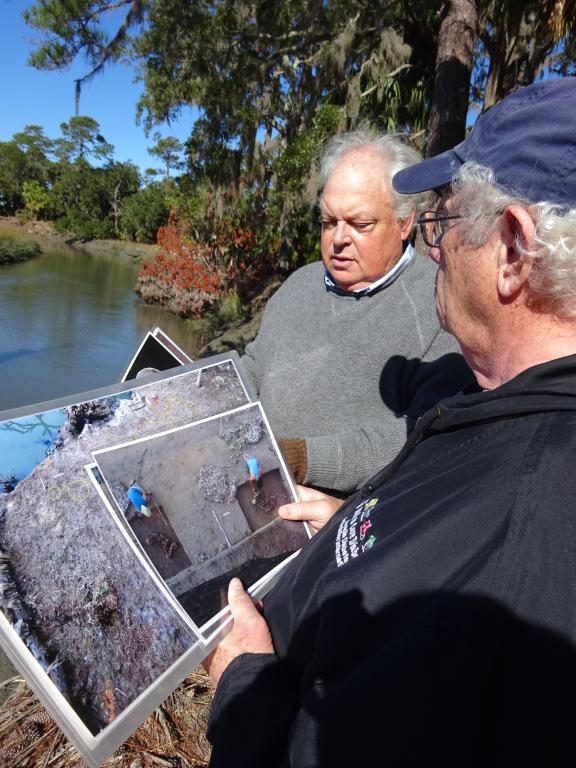
One exception is Saint Catherines Island, a remote barrier island accessible only by boat. In the late 20th century, archaeologist Dr. David Hurst Thomas of the American Museum of Natural History led extensive excavations there, uncovering the remains of the Mission of Santa Catalina de Guale—the oldest known church site in Georgia. Buried beneath layers of hurricane debris, the site revealed a carefully planned Spanish mission complex, including a church, friary, kitchen, and well arranged around a central plaza in accordance with Spanish colonial design. Far from being a minor outpost, it functioned as a fully developed community.
Founded in the 1590s by Spanish Franciscan friars, the mission became a center of both evangelization and daily life for the Guale people. In 1597, during the uprising led by Juanillo, the mission was burnt to the ground. Despite this violence, the Guale quickly rebuilt the mission and requested authorities in Saint Augustine to send Franciscan friars again, demonstrating a lasting commitment to the faith they had embraced.
The mission endured for nearly a century before its final destruction in 1687 during an English-led slave raid from Charleston. Survivors were either captured and enslaved by the English, or fled south toward Spanish Florida where their freedom was guaranteed. By 1706, increasing English pressure forced the remaining missionaries and converts to cross the Saint Marys River, effectively ending the missions in present-day Georgia. When the Spanish abandoned Saint Augustine in 1763, the remaining Guale descendants who had preferred to remain allied with the Spanish, migrated to Cuba.
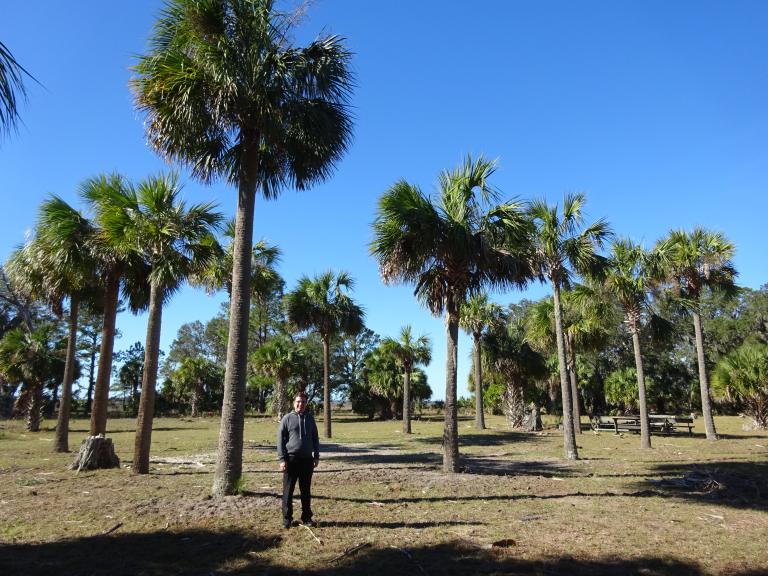
In 1984, Bishop Raymond W. Lessard of the Diocese of Savannah reconsecrated the rediscovered church site and oversaw the reburial of 432 individuals found beneath its floor—Guale Christians whose lives were once centered around the mission. When Dr. David Hurst Thomas discovered the mission in the late 1970s, he called Bishop Lessard on the phone and said, “Bishop, I have something that belongs to you!” Since that time, both the archologists and the Saint Catherines Foundation which owns the island have considered the cemetery and remains of the mission sacred ground which now stands as a living church. Today, twelve palm trees encircle the site, marking the footprint of the original church and creating a place of quiet pilgrimage and remembrance.
Archaeological findings and ongoing research suggest that the Franciscans may have played a broader role than previously understood, possibly serving as mediators among local groups. Importantly, little evidence has been found of sustained hostility between the Guale and the missionaries themselves, contradicting older narratives that portray the missions solely in terms of conflict or oppression. One or two missionaries lived in villages with hundreds of Guale warriors. Had they been unwanted throughout the century of evangelization, they would have been easily expelled.
This historic site now faces the threat of rising sea levels and shoreline erosion, placing the archeological site at risk of disappearing within a few decades. Without significant preservation efforts, the physical traces of this early chapter of American and Catholic history may be lost. Even so, the story of Santa Catalina de Guale endures beyond its fragile remains. It reflects a moment when coastal Georgia was connected to a vast global empire, when faith took root among the Guale people, and when individuals—both missionary and native—shaped a shared history that still challenges modern assumptions. The twelve palm trees on Saint Catherines Island stand not only as markers of what once was, but as a reminder that this legacy lives on—in memory, in witness, and in the continuing life of the Church. Dr. David Hurst Thomas has recorded his extensive work on the island in a highly recommended book titled “Saint Catherines: An Island in Time.”
My Involvement
In the early months of 2015, I traveled to Rome as the diocesan Vocation Director along with Bishop Hartmayer for the official annual visit of the now Father Andrew Larkin who at that time was studying at the Pontifical North American College in Rome. While in the city, Bishop Hartmayer requested an appointment at the Congregation for the Causes of Saints (now called Dicastery for the Causes of Saints) in order to inquire about the status of the Cause for the Beatification of Friar Pedro de Corpa and Companions. The Franciscan Province of the Most Holy Name from New York had finalized the documentation and presented it to the Dicastery almost eight years prior, but this was followed by a long, silent pause.
We were warmly welcomed by a Bishop who worked at the Dicastery, and he quickly stated that the Cause should have already concluded because most of the work was done. We were quite surprised and pleased with this news. The Bishop put us in contact with Father Giovanni Giuseppe Califano, OFM, the priest in Rome who was the Postulator, the person who advances beatification and canonization causes and serves as an advocate before the Dicastery. Father Califano was pleased to welcome us the next morning. Ever since that initial visit, and through several more in years after, Father Califano became the indispensable link to move the Cause forward.
Among the many instructions from Father Califano, were included the commissioning of a monument and the production of a documentary. Much effort by many was channeled to build a beautiful monument in Darien, Georgia by the Canadian Catholic sculptor Timothy Schmaltz. The stunning work of art by this internationally-acclaimed artist was dedicated in 2021. Thanks to a grant from the Communications Committee of the U.S. Bishops, Guerilla Productions from Savannah was engaged to produce For the Sake of the Gospel, a thirty-minute documentary that tells the heroic story of Friar Pedro de Corpa and Companions within its historical context. This documentary, as well as other video productions by the Diocese of Savannah, has become effective tools to raise awareness of the story of the friars.
In response to the increased interest in the Cause, and the unwavering commitment from both the Diocese of Savannah and the Franciscan Order, Father Califano moved on to write the final document to present to the Dicastery, called a Positio in 2020. The same historian who wrote the Positio for the Canonization of Saint Junipero Serra got to work, and the document was submitted to the Dicastery in 2022. In early 2023, we welcomed the good news that the Historical Commission of the Dicastery for the Causes of Saints gave the document a unanimous favorable vote. In February 2024, Father Califano indicated the Cause had moved forward through the theological committee, and finally, in January 27th, 2025, the wonderful news reached Savannah, that the Cause had been approved by the final committee of Cardinals who assess the pastoral application of the Cause in today’s society. This immediately led Pope Francis to issue a decree declaring that the friars died as martyrs, and that they should be beatified.
What to Expect
By recognizing that Friar Pedro de Corpa and Companions died as martyrs, the Church declares explicitly that they died as a direct consequence of the defense of one of the tenants of the Christian faith. To be considered a martyr, an argument must be presented that someone died out of hatred of the faith, or odium fidei. The historical documentation of this particular Cause clearly points to the fact that the friars were killed directly in response to their defense of Christian Marriage. In addition, their witness bears witness to Christian Marriage in today’s society where confusion hovers over the definition of marriage.
During this 800th anniversary of the birth of Saint Francis of Assisi, five of his spiritual sons will be recognized by the Universal Church as blessed among the saints. The Beatification Ceremony will take place in Savannah on October 31st, 2026 at the Savannah Convention Center on Hutchinson Island. Cardinal Frank Leo of Toronto will be the principal celebrant. A delegation from Rome will be in attendance, led by Father Giovanni Giuseppe Califano, OFM, as well as prominent representatives of the Franciscan Order, especially from the Our Lady of Guadalupe Province headquartered in Atlanta. The date chosen not only hopes to steer the celebration away from weather related complications, but it embodies a desire to recapture the original Christian understanding of the date. On the eve of the Feast of All Saints, the Universal Church will recognize the presence of five faithful Franciscan missionaries among the saints in heaven. What a beautiful date to unite the Church on earth and the Church in heaven through such a significant liturgical celebration.
Many who advanced this Cause throughout the years will not be present at the ceremony, but will certainly rejoice in the presence of the friars among the Church in heaven. In particular the three Vice-Postulators for the Cause: Father Marion Habig, OFM, Father Alexander Wyse, OFM, and Father Conrad Harkins, OFM; Bishop Raymond Lessard who formally opened the Diocesan Phase of the investigation and finally, Father Jeremiah McCarthy who led the investigation and prepared the documentation to present it to Rome.
What began for me as a passing glance at a pamphlet became a profound encounter with a forgotten chapter of the Church’s life in my own home state. The story of Friar Pedro de Corpa and Companions reveals both the missionary heart of the Church and the Franciscan witness of lives lived in closeness to those they served. Their witness is not confined to the past—it speaks directly to our own time, calling the Church to renewed courage, fidelity, and trust in the Gospel when it is most costly. In their beatification, the Church proclaims that they died in defense of Christian marriage and now places them before the faithful as intercessors and models of steadfast faith. Their lives call us not simply to admire their sacrifice, but to imitate their fidelity in the concrete demands of our own vocation. Their legacy endures wherever the Gospel is lived without compromise, a living testimony that fidelity to Christ is never in vain.
Pictures are mine or of the Diocese of Savannah, all rights reserved.
History and Religion
Previous Post
June 3, 2026
Monsignor Rossetti removed from assignment
Next Post
June 18, 2026 Pope Leo to visit Peru in November
Recent Comments
"Thank you for your words Linda. Father Fred was an excellent mentor, he taught me ..."
A life of Dedication: Lessons of ..."
"Beautiful Father Pablo, yes he was a Dad to ALL of US. But YOU are ..."
A life of Dedication: Lessons of ..."
"The Good News is healing and empowering. Evangelization and conversion are ongoing and never-ending opportunities. ..."
"as a life long SDA, I don't trust much from the Catholic perspective, but Stephen ..."
Monsignor Rossetti removed from assignment
Browse Our Archives
Select a Category Article Catholic Lima Christmas Commentary History Homily Immigration martyrs Meditation Pope Reflection Saint Story Uncategorized
Select a Month September 2026 August 2026 July 2026 June 2026 May 2026 April 2026 December 2025 November 2025 October 2025 September 2025 August 2025 July 2025 June 2025 May 2025 April 2025 March 2025 February 2025 January 2025 December 2024 November 2024 September 2024 August 2024 July 2024 June 2024 May 2024 April 2024 March 2024 February 2024 January 2024 December 2023 November 2023 October 2023 September 2023 August 2023 June 2023 May 2023 April 2023 February 2023 January 2023 December 2022 November 2022 October 2022 September 2022 August 2022 July 2022 June 2022 May 2022 April 2022 March 2022 February 2022 January 2022 December 2021 November 2021 October 2021 September 2021 August 2021 July 2021 June 2021 May 2021 April 2021 March 2021 February 2021 January 2021 December 2020 November 2020 October 2020 September 2020 August 2020 July 2020 June 2020 May 2020 April 2020 March 2020 February 2020 January 2020 December 2019 November 2019 October 2019 September 2019 August 2019 July 2019 June 2019 May 2019 April 2019 March 2019 February 2019 January 2019 December 2018 November 2018 October 2018 September 2018 August 2018 July 2018 June 2018 May 2018 April 2018 March 2018 February 2018 January 2018 December 2017 November 2017 October 2017 September 2017 August 2017 July 2017 June 2017 May 2017 April 2017 March 2017 February 2017 January 2017 December 2016 November 2016 October 2016 September 2016 August 2016 July 2016 June 2016 May 2016 April 2016 March 2016 February 2016 January 2016 December 2015 November 2015 October 2015 September 2015 August 2015 July 2015 June 2015 May 2015 April 2015 March 2015 February 2015 January 2015 December 2014 November 2014 October 2014 September 2014 August 2014 July 2014 June 2014 May 2014 April 2014 March 2014 February 2014 January 2014 December 2013 November 2013 October 2013 September 2013 August 2013 July 2013 June 2013 May 2013 April 2013 March 2013 February 2013 January 2013 December 2012 November 2012 October 2012 September 2012 August 2012 July 2012 June 2012 May 2012 April 2012 March 2012 February 2012 January 2012 December 2011 November 2011 October 2011 September 2011 August 2011 July 2011 June 2011 May 2011 April 2011 March 2011 February 2011 January 2011 December 2010 November 2010 October 2010 September 2010 August 2010 July 2010 June 2010 May 2010 April 2010 January 2010 June 2009 September 2008 August 2008
TAKE THE
Religious Wisdom Quiz
What mountain did Moses receive the Ten Commandments on?
Select your answer to see how you score.
Mount Sinai Mount Carmel Mount Zion Mount Ararat
Related posts from Labyrinthine Mind
National Eucharistic Pilgrimage Visits Savannah
A visit to Nicea 1700 years later
El Origen Inesperado de los Años Jubilares
Greeting to Pope Leo XIV by Peruvian President...
TRENDING AT PATHEOS Catholic

A new article, written by Jeff Lindsay and Gale L. Pooley,...

Swimfan: Forgotten Aughts Pleasures
This is a recovery effort. In 2002, My Big Fat Greek Wedding...

Top Three Anti-Catholic Lies About Catholicism
This is my initial transcript for the video, "THE 3 WORST...

Pope Leo Celebrates Mass for Nurses & Docs...
I don't have any idea how he did it, but Pope Leo...

The Sermon on the Mount, Part I: Matthew...
The Sermon on the Mount, Part I (Matthew 4:12-5:12) St. Matthew moves...

What's up from Crossway: Reviewing some of their latest A few weeks...
view all Catholic blogs
What Are Your Thoughts?leave a comment
Ad-Free & Subscriber Log-In Subscription Support
- About Us
- 2026 Calendar
- Videos
- Podcasts
- Library of World Religions
- Faith In Media Tracker
- Advertise With Us
- Write for Us
- Privacy Policy
- Terms of Service
- Do Not Sell My Data
- Contact Us
- Radiant Digital
- Manage Newsletter Subscriptions
- Unsubscribe From Notifications
- Sitemap
Copyright 2008-2026, Patheos. All rights reserved.
Subscription Support Ad-Free & Subscriber Log-In
Follow Patheos