
BuddhistCatholicContemplativeEvangelicalGeneral ChristianHinduJewishLatter-day SaintMuslimNew VisionsProgressive Christian
Beliefs
- Buddhist
- Catholic
- Contemplative
- Evangelical
- General Christian
- Hindu
- Jewish
- Latter-day Saint
- More Voices
- Muslim
- New Visions
- Pagan
- Progressive Christian
Topics
- Religion News
- Food and Religion
- Sports and Religion
- Religious Art
- Religious Music and Entertainment
- Religious Events
- History and Religion
- Style and Religion
- Politics and Religion
- Women in Religion
- Recreation Outdoors and Religion
- Business Finance and Religion
- Careers Workplace and Religion
- Education and Religion
- Family Parenting and Religion
- Health Fitness and Religion
- Home and Religion
- Relationships and Religion
- Technology and Religion
- Travel and Religion
Columnists
- Buddhist Columnists
- Business Finance and Religion Columnists
- Careers Workplace and Religion Columnists
- Catholic Columnists
- Contemplative Columnists
- Education and Religion Columnists
- Evangelists Columnists
- Family Parenting and Religion Columnists
- General Christian Columnists
- Health Fitness and Religion Columnists
- Hindu Columnists
- History and Religion Columnists
- Home and Religion Columnists
- Jewish Columnists
- More Voices Columnists
- Latter Day Columnists
- Muslim Columnists
- New Visions Columnists
- Nonreligious Columnists
- Pagan Columnists
- Politics and Religion Columnists
- Progressive Columnists
- Recreation Outdoors and Religion Columnists
- Relationships and Religion Columnists
- Religion News Columnists
- Religious Art Columnists
- Religious Events Columnists
- Religious Music and Entertainment Columnists
- Sports and Religion Columnists
- Style and Religion Columnists
- Technology and Religion Columnists
- Travel and Religion Columnists
- Women in Religion Columnists
Resource Library
- 2026 Calendar
- Library of World Religions
- The 100 Most Holy Places on Earth
- Patheos Answers
- Podcasts
- Videos
- Faith Leaders Database
- Anglican Episcopalian
- Bahai
- Baptist
- Buddhism
- Christianity
- Confucianism
- Eastern Orthodoxy
- Hinduism
- Holiness and Pentecostal
- ISKCON
- Islam
- Judaism
- Lutheran
- Methodist
- The Church of Jesus Christ of Latter-day Saints
- New Age
- Paganism
- Presbytarian and Reformed
- Protestantism
- Religion Behind the Scenes
- Roman Catholic
- Scientology
- Shia Islam
- Sikhism
- Sufism
- Sunni Islam
- Taoism
- Zen
- See all religions
Research Tools
 Ad-Free & Subscriber Log-In Subscription Support
Ad-Free & Subscriber Log-In Subscription Support
Follow Patheos 

- Trending:
- Forgiveness
- |
- Marriage
- |
- Consciousness
- |
- Death Penalty
- |
- Election
- |
- Halloween

- Home
- Catholic
- Religion News
- Viva Romero! The Beatification of a Saint
Viva Romero! The Beatification of a Saint
Last updated on: March 25, 2016 at 5:15 pm by Father Pablo Migone
Viva Romero! The Beatification of a Saint 2016-03-25T17:15:20-05:00 Father Pablo Migone
Patheos Explore the world's faith through different perspectives on religion and spirituality! Patheos has the views of the prevalent religions and spiritualities of the world.
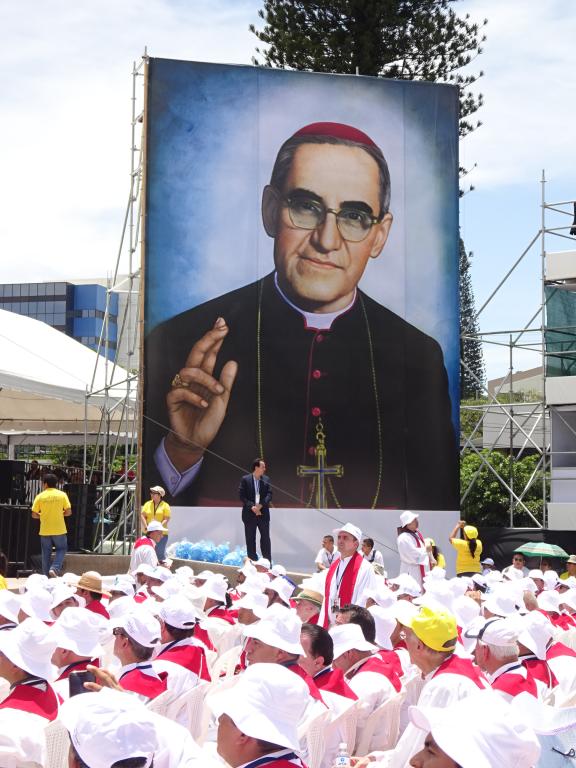
As 2015 comes to an end and I begin to consider some of the most significant moments of the year, the beatification of Archbishop Oscar Romero quickly emerges in my mind as one of the most significant events I took part of in 2015. After a quick visit to Guatemala and El Salvador three years ago, a fellow priest and I made a promise that we would attend the beatification of Archbishop Romero whenever and wherever it happened. We were both shocked that the day arrived so quickly. Though not all in El Salvador rejoiced at the beatification of a man whom the Salvadorian people had already canonized, there was an exhilarating atmosphere throughout the country as the Church beatified a man whom locals had called “San Romero de America” for some time. I share with you now my reflections about Blessed Oscar Romero, a courageous man who gave up his life for the sake of the Gospel.
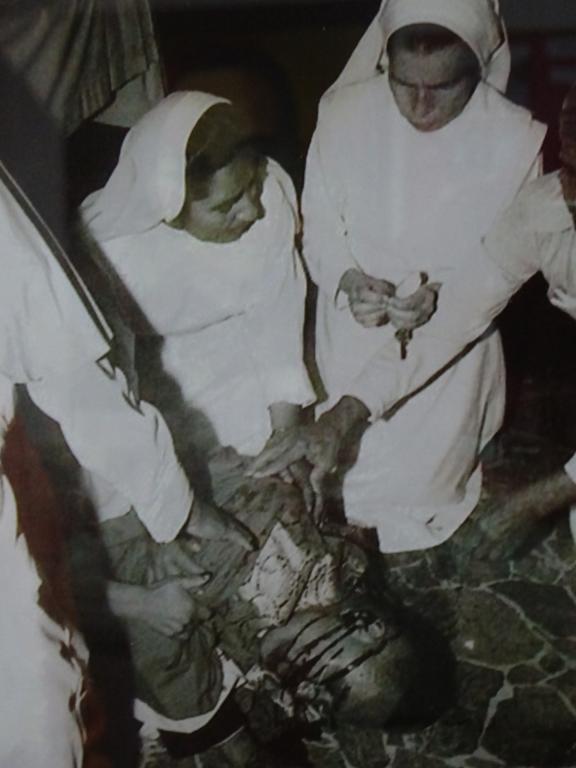
Archbishop Romero after being shot while celebrating Mass
In 1977, San Salvador cautiously welcomed a new archbishop, Oscar Arnulfo Romero. Three years later, the archbishop was killed by a single bullet shot from the backseat of a car parked outside the chapel where he was celebrating Mass. Thirty-five years later, the same man was declared a martyr by Pope Francis and was beatified in San Salvador on May 23rd, 2015 at a ceremony attended by about half a million faithful, including 100 bishops and 1400 concelebrating priests.
For the Church to declare a martyr, evidence must surface that the person was killed out of hatred for the faith. The person carrying out the execution must have been motivated directly out of a disregard for the Gospel, not political, personal or any other reason. For years Romero’s case was carefully studied in Rome due to accusations that the Archbishop had been killed for political reasons and not out of hatred for the faith. The case was eventually blocked until Pope Benedict XVI ordered the case reopened. While in Brazil in 2007, Benedict described Archbishop Romero as a “great witness of the faith, a man of great Christian virtue who worked for peace and against the dictatorship and was assassinated while celebrating Mass.” Benedict accurately identified the reason why the case remained blocked for so many years by stating, “the problem was that a political party wrongly wished to use him as their badge; as an emblematic figure.” Rome feared that the modern remnant of once leftist guerrillas would feel vindicated by Romero’s beatification. Benedict concluded, “Romero merits beatification, I do not doubt.”
Procession of priests to the Beatification Mass
Romero’s enemies accused him of ascribing to liberation theology, yet the liberation Romero preached is the freedom enjoyed by the children of God, “a liberation that has, above all else, respect for the dignity of the person, hope for humanity’s common good, and the transcendence that looks before all to God and only from God derives its hope and its strength.” He was killed by fellow Catholics who did not want to be challenged by the Gospel and preferred to silence him. They may have silenced him, but his prophetic voice has persevered and Blessed Romero, in the words of Saint John Paul II, now “belongs to the Church.” John Paul II described him as “a zealous and venerated pastor who tried to stop violence. I ask that his memory be always respected, and let no ideological interest try to distort his sacrifice as a pastor given over to his flock.”
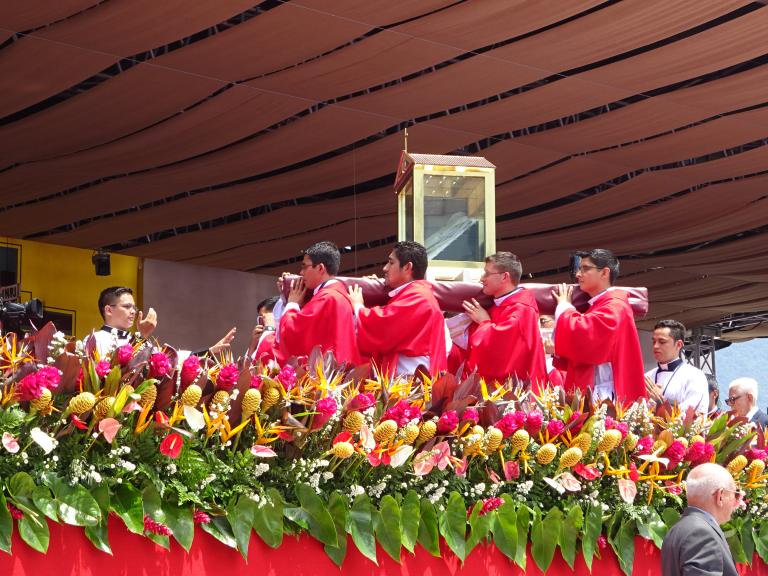
Reliquary with Archbishop Romero’s bloody shirt
Pope Francis, as a fellow Latin American bishop, certainly gave Romero’s cause its last push so his beatification would become a reality.
During the times of Oscar Romero, Catholics gathering for a Bible study were considered subversive by the government since the catechists were teaching peasants how to read and write. Any criticism of the ruling party earned one a death sentence. In its attempt to fight communist guerrillas that were present in El Salvador, the government killed over 70,000 innocent civilians including hundreds of priests, sisters (including four American church women, three of them nuns) and thousands of catechists. The murder by right-wing government forces of his good friend Father Rutilio Grande marked an awakening in Archbishop Romero. The government’s unwillingness to investigate the murder caused Romero to speak against the injustices committed by the country’s rulers. His desire to uphold the equality of all before God regardless of social status was not appreciated by the powerful.

After proclaiming the decree of beatification, a solar halo appeared over the faithful
Romero spoke openly against the right-wing, US-supported government of El Salvador, which was actively persecuting the Church and killing thousands of innocent civilians. The day before he was martyred, he made an emotional plea to the men of the army, National Guard, police and military. During his Sunday homily at the cathedral he preached, “you are killing your own brother peasants when any human order to kill must be subordinate to the law of God which says, ‘thou shalt not kill.’ No soldier is obliged to obey an order contrary to the law of God…. It is time you… obeyed your consciences rather than a sinful order. The Church, the defender of the rights of God, of the law of God, of human dignity, of the person, cannot remain silent before such an abomination. In the name of God, in the name of this suffering people whose cries rise to heaven more loudly each day, I implore you, I beg you, I order you in the name of God: stop the repression.”
With these words Romero had crossed a line. For the government, he was calling for insubordination. For him, he was proclaiming the Gospel. In the same way Jesus Christ did not intend to enter politics but was executed with the political charge of “king of the Jews,” Archbishop Romero, who did not intend to enter politics, was accused of politicking while he was simply proclaiming the Gospel.
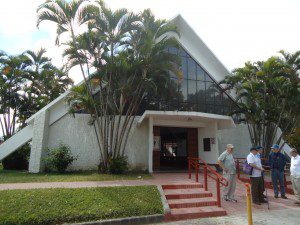
Chapel were Archbishop Romero was murdered
On March 24th, 1980, Archbishop Romero was celebrating a memorial Mass at the chapel of the hospital where he lived. After preaching, the archbishop moved towards the center of the sanctuary to prepare the altar. He no longer allowed others to assist him at the altar for fear of his future murderer accidentally shooting the wrong person. From the back seat of a car that had parked at the door of the church while the driver pretended to check on the tires, a sharpshooter shot Archbishop Romero right in the heart. He collapsed and died instantly. Women soaked up his blood with their veils and handkerchiefs.
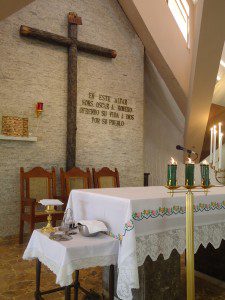
Altar where Archbishop Romero was murdered
The archbishop’s vicar general, Monsignor Urioste, tells that Romero feared a violent death, yet he persevered preaching the Gospel in a country at war. He stood up against a government that oppressed its people and killed thousands of innocent civilians. Monsignor Urioste states that Archbishop Romero often said it was difficult to be a ‘man of the magisterium’ because it was not easy to be always consistent in the proclamation of the Gospel. Romero firmly believed he had to accept and live out the wholeness of the teachings of the Church, including standing up against oppression and injustice.
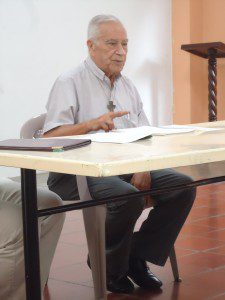
Monsignor Urioste speaking to a group of priests providing us with great insight into the life of Archbishop Romero
It was an honor to be part of a ceremony that recognized the courage of a man who admitted he was fearful of a violent death. Blessed Romero became a voice for the voiceless, and his words still echo throughout Latin America where millions still labor tirelessly to create a society where Gospel values are not only preached but lived. His witness is worthy to be imitated, especially by priests and all those who come face to face with oppression and injustice. Using the words of Saint John Paul II, Romero certainly “belongs to the Church,” and by beatifying him, the Church presents him as a model of Christian witness that loves like Jesus Christ, even to the point of death.
Pictures are mine, all rights reserved.
Previous Post

December 24, 2015
Joy of Christmas
Next Post

December 29, 2015 Thomas Becket and the King
Browse Our Archives
Select a Category Article Catholic Lima Christmas Commentary History Homily Immigration martyrs Meditation Pope Reflection Saint Story Uncategorized
Select a Month September 2026 August 2026 July 2026 June 2026 May 2026 April 2026 December 2025 November 2025 October 2025 September 2025 August 2025 July 2025 June 2025 May 2025 April 2025 March 2025 February 2025 January 2025 December 2024 November 2024 September 2024 August 2024 July 2024 June 2024 May 2024 April 2024 March 2024 February 2024 January 2024 December 2023 November 2023 October 2023 September 2023 August 2023 June 2023 May 2023 April 2023 February 2023 January 2023 December 2022 November 2022 October 2022 September 2022 August 2022 July 2022 June 2022 May 2022 April 2022 March 2022 February 2022 January 2022 December 2021 November 2021 October 2021 September 2021 August 2021 July 2021 June 2021 May 2021 April 2021 March 2021 February 2021 January 2021 December 2020 November 2020 October 2020 September 2020 August 2020 July 2020 June 2020 May 2020 April 2020 March 2020 February 2020 January 2020 December 2019 November 2019 October 2019 September 2019 August 2019 July 2019 June 2019 May 2019 April 2019 March 2019 February 2019 January 2019 December 2018 November 2018 October 2018 September 2018 August 2018 July 2018 June 2018 May 2018 April 2018 March 2018 February 2018 January 2018 December 2017 November 2017 October 2017 September 2017 August 2017 July 2017 June 2017 May 2017 April 2017 March 2017 February 2017 January 2017 December 2016 November 2016 October 2016 September 2016 August 2016 July 2016 June 2016 May 2016 April 2016 March 2016 February 2016 January 2016 December 2015 November 2015 October 2015 September 2015 August 2015 July 2015 June 2015 May 2015 April 2015 March 2015 February 2015 January 2015 December 2014 November 2014 October 2014 September 2014 August 2014 July 2014 June 2014 May 2014 April 2014 March 2014 February 2014 January 2014 December 2013 November 2013 October 2013 September 2013 August 2013 July 2013 June 2013 May 2013 April 2013 March 2013 February 2013 January 2013 December 2012 November 2012 October 2012 September 2012 August 2012 July 2012 June 2012 May 2012 April 2012 March 2012 February 2012 January 2012 December 2011 November 2011 October 2011 September 2011 August 2011 July 2011 June 2011 May 2011 April 2011 March 2011 February 2011 January 2011 December 2010 November 2010 October 2010 September 2010 August 2010 July 2010 June 2010 May 2010 April 2010 January 2010 June 2009 September 2008 August 2008
TAKE THE
Religious Wisdom Quiz
Where did the Pentecostal movement begin in the early 1900s?
Select your answer to see how you score.
Berlin London Azusa Street, Los Angeles Rome
Related posts from Labyrinthine Mind
Saint Joseph Protector of Christ, Model for Families
Beatification Coming to USA, Pedro de Corpa and...
Advancing a Cause for Beatification: Friar Pedro de...
Franciscan Friars one step closer to beatification
TRENDING AT PATHEOS Catholic

How to Make a Decision When You Can't...
Main point: It’s much more valuable to stay close to God so...

Archdiocese Hosts Military Marriage Retreat in Germany
RASTATT, Germany — The transient military lifestyle, with its frequent deployments and...

Nearly every morning, I make the drive to Detroit with my high-school-age...

The Real AI Story Is Adoption Without Trust
Artificial intelligence has crossed a political threshold. It is no longer a...

A new article, written by Jeff Lindsay and Gale L. Pooley,...

Swimfan: Forgotten Aughts Pleasures
This is a recovery effort. In 2002, My Big Fat Greek Wedding...
view all Catholic blogs
Ad-Free & Subscriber Log-In Subscription Support
- About Us
- 2026 Calendar
- Videos
- Podcasts
- Library of World Religions
- Faith In Media Tracker
- Advertise With Us
- Write for Us
- Privacy Policy
- Terms of Service
- Do Not Sell My Data
- Contact Us
- Radiant Digital
- Manage Newsletter Subscriptions
- Unsubscribe From Notifications
- Sitemap
Copyright 2008-2026, Patheos. All rights reserved.
Subscription Support Ad-Free & Subscriber Log-In
Follow Patheos