
BuddhistCatholicContemplativeEvangelicalGeneral ChristianHinduJewishLatter-day SaintMuslimNew VisionsProgressive Christian
Beliefs
- Buddhist
- Catholic
- Contemplative
- Evangelical
- General Christian
- Hindu
- Jewish
- Latter-day Saint
- More Voices
- Muslim
- New Visions
- Pagan
- Progressive Christian
Topics
- Religion News
- Food and Religion
- Sports and Religion
- Religious Art
- Religious Music and Entertainment
- Religious Events
- History and Religion
- Style and Religion
- Politics and Religion
- Women in Religion
- Recreation Outdoors and Religion
- Business Finance and Religion
- Careers Workplace and Religion
- Education and Religion
- Family Parenting and Religion
- Health Fitness and Religion
- Home and Religion
- Relationships and Religion
- Technology and Religion
- Travel and Religion
Columnists
- Buddhist Columnists
- Business Finance and Religion Columnists
- Careers Workplace and Religion Columnists
- Catholic Columnists
- Contemplative Columnists
- Education and Religion Columnists
- Evangelists Columnists
- Family Parenting and Religion Columnists
- General Christian Columnists
- Health Fitness and Religion Columnists
- Hindu Columnists
- History and Religion Columnists
- Home and Religion Columnists
- Jewish Columnists
- More Voices Columnists
- Latter Day Columnists
- Muslim Columnists
- New Visions Columnists
- Nonreligious Columnists
- Pagan Columnists
- Politics and Religion Columnists
- Progressive Columnists
- Recreation Outdoors and Religion Columnists
- Relationships and Religion Columnists
- Religion News Columnists
- Religious Art Columnists
- Religious Events Columnists
- Religious Music and Entertainment Columnists
- Sports and Religion Columnists
- Style and Religion Columnists
- Technology and Religion Columnists
- Travel and Religion Columnists
- Women in Religion Columnists
Resource Library
- 2026 Calendar
- Library of World Religions
- The 100 Most Holy Places on Earth
- Patheos Answers
- Podcasts
- Videos
- Faith Leaders Database
- Anglican Episcopalian
- Bahai
- Baptist
- Buddhism
- Christianity
- Confucianism
- Eastern Orthodoxy
- Hinduism
- Holiness and Pentecostal
- ISKCON
- Islam
- Judaism
- Lutheran
- Methodist
- The Church of Jesus Christ of Latter-day Saints
- New Age
- Paganism
- Presbytarian and Reformed
- Protestantism
- Religion Behind the Scenes
- Roman Catholic
- Scientology
- Shia Islam
- Sikhism
- Sufism
- Sunni Islam
- Taoism
- Zen
- See all religions
Research Tools
 Ad-Free & Subscriber Log-In Subscription Support
Ad-Free & Subscriber Log-In Subscription Support
Follow Patheos 

- Trending:
- Forgiveness
- |
- Marriage
- |
- Consciousness
- |
- Death Penalty
- |
- Election
- |
- Halloween
 Kyle Cupp
- Home
- Catholic
- Politics and Religion
- Dietrich von Hildebrand against the Nazis: An Interview with John Henry Crosby
Dietrich von Hildebrand against the Nazis: An Interview with John Henry Crosby
Last updated on: January 9, 2017 at 11:50 pm by Kyle Cupp
Dietrich von Hildebrand against the Nazis: An Interview with John Henry Crosby 2017-01-09T23:50:10-05:00 Kyle Cupp
Patheos Explore the world's faith through different perspectives on religion and spirituality! Patheos has the views of the prevalent religions and spiritualities of the world.
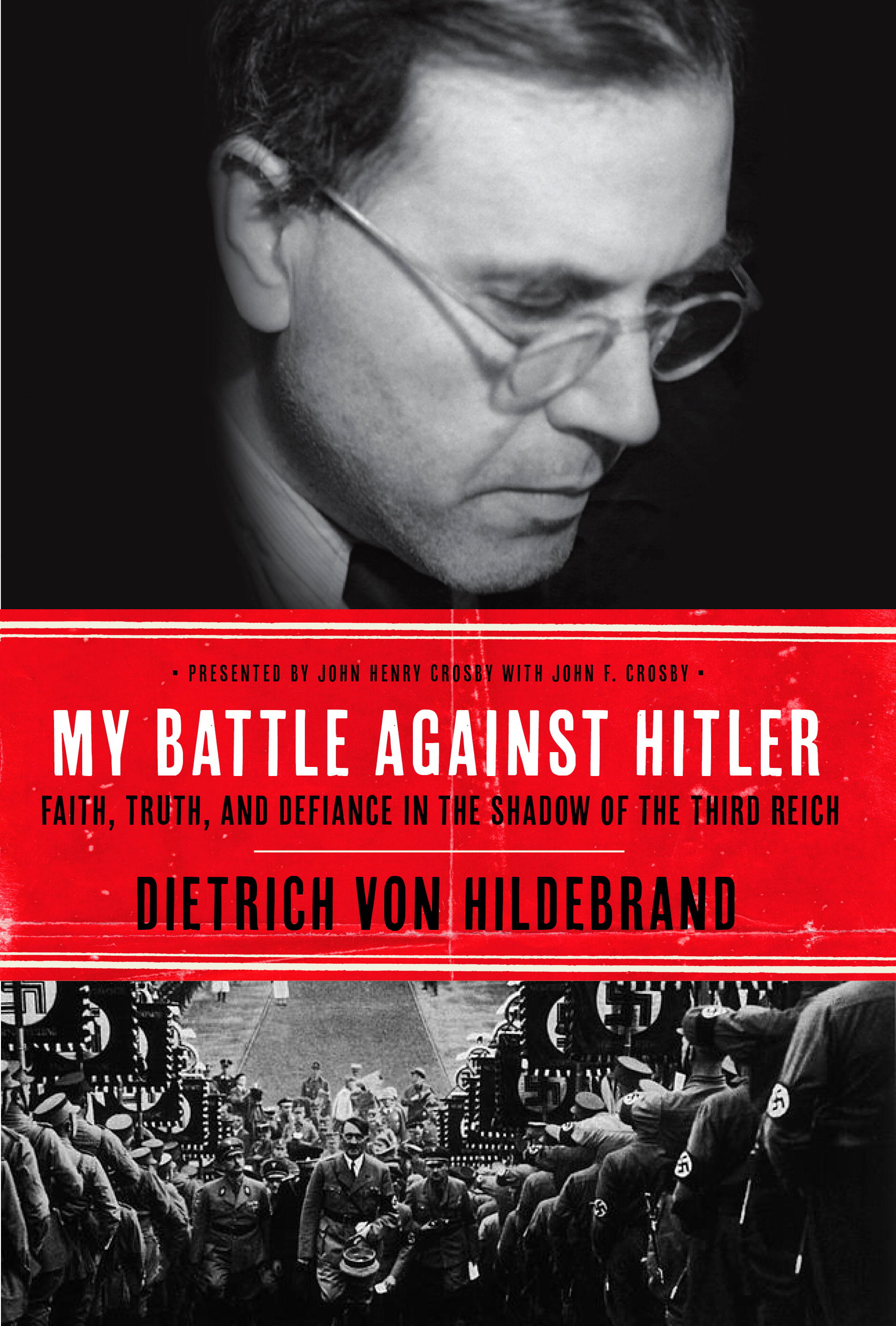 I was introduced to the work of Dietrich von Hildebrand while studying philosophy at Franciscan University of Steubenville and was excited to see a book of his translated and newly published by Image Books. My Battle against Hitler: Faith, Truth, and Defiance in the Shadow of the Third Reich is a collection of von Hildebrand’s memoirs and essays written and response to the perverse ideas and spread of Nazism. They are deeply personal and accessibly philosophical.
The book is edited and translated by John Henry Crosby, one of my former classmates, and John F. Crosby, one of my former professors. Below you can read my interview with John Henry Crosby about the book, its relevance for us today, and von Hildebrand’s political thought.
1. What inspired you to translate and edit these anti-Nazi essays of von Hildebrand?
When you find something precious, you want to share it. In the case of Hildebrand’s memoirs, which I first read in German in 2003 and 2004, I was immediately taken by the moving and inspiring figure of Dietrich von Hildebrand. Once the Hildebrand Project was founded in 2004, and our work of translation underway, it was not long before I came to see his anti-Nazi papers as the great point of entry into his thought—and thus the work I believed could have the broadest possible appeal to audiences far and wide.
2. Does this book have relevance for today’s personal, communal, and global struggles? How so?
This book is, indeed, relevant at all the levels you indicate—and this in two different modes. The first is that the book has multiple objective links to us in the present moment. It is a major historical document of a period whose impact will be felt for all of human history. It is an amazing case study of the power of ideas. And it is also rich in practical moral wisdom—a field manual for moral witness, as I like to say.
But the book’s greatest potential surely lies in the immediate encounter that readers will have with it. Like a great work of art, Hildebrand’s witness is a story that can evoke a wide range of reflection in readers. Many will be inspired, others renewed and strengthened. Above all, it is impossible not to feel challenged by Hildebrand’s witness. It would require a state akin to somnolence to read his testimony and not feel the force of the question, “But what about me? What am I called to do? What witness is asked of me?”
3. How did von Hildebrand understand the relationship between his philosophy and his faith?
This is a very rich question—and indeed a direction that I hope students of philosophy and theology will explore. Hildebrand certainly does not espouse an easy interface between the two, as if they were two separate realms. Faith and reason interpenetrate deeply in his thought. His wife Alice von Hildebrand has coined the expression “baptized reason,” which I think captures a key aspect of his approach as a Catholic philosopher.
4. Why does von Hildebrand call nationalism a heresy (p.251)?
Another astute question. I don’t think he is using the term in the primarily theological sense of a doctrine that has been declared heretical by the Church. But the choice of term is not accidental. Hildebrand wants to say that nationalism exists as a sort of corruption of patriotism. Whereas patriotism is fundamentally a form of gratitude and loyalty to the land from which one has received one’s language and culture, nationalism praises one’s own country at the expense of others. While patriotism is fully compatible with recognizing the genius of other countries and cultures, nationalism is not. Patriotism could never give rise to war, while militant nationalism gave us World War I. Like a heresy, nationalism begins with a truth which it then manages to distort.
5. Why did von Hildebrand reject the “depoliticization of Catholicism”?
The short answer is that Hildebrand believed that the call for depoliticization meant a false and illegitimate retreat from the world. He would remind his fellow Catholics that Nazism and Communism were not merely political alternatives but worldviews. He attributes so much importance to Christian participation in public life that in one of his essays he goes so far as to describe depoliticization a “cowardly flight from the battle to which God is calling us.”
A longer answer, which I cannot adequate address here, would begin by noting that Hildebrand recognized a legitimate depoliticization of Catholicism following the era of the so-called Kulturkampf—a period of severe discrimination, marginalization, and even persecution of Catholics under the aggressively anti-Catholic Chancellor Otto von Bismarck. Reeling from this painful period, during which time Catholic activities and organizations took on an exaggerated importance, many Catholics were calling for a return to a more interior and authentic Catholic existence. Hildebrand wanted to validate the desire for a properly religious life while reminding Catholics that this renewed fervor should lead to a richer presence in the public square rather than life in a self-imposed ghetto.
6. What do you think he would say about Catholic political organization today? What recommendations might he have?
This follows naturally from your previous question. In fact, I always find myself resisting the urge to speculate on what Hildebrand might have said about current events. Of course, I have no doubt that he would deeply regret the marginalization of religion from public life. He would also have been a powerful voice on behalf of the unborn and the vulnerable.
But I imagine somehow that he would have called us to look beyond the political sphere in addressing many of these issues. His anti-Nazi papers in Vienna are at bottom not just intellectual but broadly cultural in focus. Great as the sphere of law and policy surely are in shaping the culture, a man like Hildebrand—steeped in history, art, and alive to the wealth of Western culture—would know that real cultural renewal requires a rich appeal to the moral imagination and to those centers of the human soul that are only awakened through beauty and truth.
7. In the essay, “The Struggle for the Person,” he says that, in the person, we find “‘awakened’ being that is aware of itself.” Can you explain what this means?
Hildebrand means to say that it is in the nature of persons to be consciously self-present and that this self-presence is an essential precondition for being a free moral agent. The contrast here is between “awakened being” (i.e. persons) and “unawakened being,” which includes not just inanimate matter but also (in Hildebrand’s philosophy) animals, which, while not unconscious, are also not self-present.
8. For von Hildebrand, why can’t the state be a means of salvation?
Another good and helpful question. This can be answered in two different ways. First, Hildebrand wants to say that God alone offers salvation. Thus any explicit or even implicit attempt to solve all human problems in earthly terms must be rejected—and, of course, the aim of totalitarian regimes, being “totalizing” in nature, is to attempt to be the organizing principle for all aspects of life.
Second, the state cannot be a means of salvation, in Hildebrand’s vision, because this wrongly places the locus of grace in a political system rather than in the soul of the individual person in whom God dwells.
9. This book gives us a good sense of von Hildebrand’s political philosophy. What aspects of his thought here do you think are the most important? Are there any areas here where you disagree with his analysis or feel that it could use more development?
This question could be the basis of an entire interview (one I’d be delighted to do with you subsequently—hint, hint!), but a few observations.
We see in Hildebrand’s fight against Nazism (and Communism) the primacy of the individual person over against the community. This must be rightly understand, for he is the furthest thing from being an individualist. He affirms that persons are destined for community and find their deepest fulfillment in relation to others. But he wants to say that only when we treat the person as individual can we achieve a true community of persons. If we begin with the idea that persons are essentially parts of a social whole, we get, Hildebrand would say, not a “community” but a “mass.” To put it concretely, Nazism and Communism proved so devastating because from the ground up they reduced the individual to a part of the collective—and thus eviscerated the grounds for the inviolability of individual person.
As for further development of Hildebrand’s political thought, the systematic formulation of this is found in his major work in social philosophy, The Metaphysics of Community. Being as yet untranslated into English, it remains little known. Yet this crucial work, which he published in 1930, provided the philosophical foundation for his fight against Nazism. The real work of developing Hildebrand’s political vision can only begin once this work is properly received by students and scholars. Those who read German should take advantage of the head start they will have until our English translation is published in 2017 or after.
10. What surprised or impressed you the most when translating these essays?
What impressed me most—indeed, what moved me the most—was the person of Hildebrand. There was no anger in him, no hatred, no desire for retribution. He was animated by a great and boundless love for truth and justice. This comes out in countless moving episodes, like when the Austrian chancellor, Engelbert Dollfuss, is murdered and Hildebrand falls to his knees and bursts into sobs at the thought of the terrible loss for Austria—and for Europe—through the death of Hitler’s most courageous and committed political opponent. That sort of other-centeredness—at a moment when Hildebrand quite naturally might have perceived Dollfuss’ death as a personal blow (because he knew that Dollfuss’ successor would be far less support of his anti-Nazi newspaper)—was typical of the man. Far from diminishing through greater familiarity with Hildebrand’s story, my admiration and esteem have only grown over the years.
_____
You can learn more about this book and the life and thought of Dietrich von Hildebrand by visiting the Hildebrand Project webpage.
Kyle Cupp is the author of Living by Faith, Dwelling in Doubt. Follow him on Facebook and Twitter.

Next Post

November 14, 2014 Derrida, Heidegger, and the Bible Speak
Browse Our Archives
Select a Category Book Reviews Confessions Culture Current Events Family Life Hermeneutics Humor LEGO Sets Mindless Monday Question Personal Philosophy Policy Politics and Society Quotes Religion in Pop Culture Series Theology Uncategorized
Select a Month April 2016 December 2015 August 2015 July 2015 March 2015 February 2015 January 2015 December 2014 November 2014 October 2014
Follow Us!
TAKE THE
Religious Wisdom Quiz
What will happen to Satan at the end of time, according to Revelation 20:10?
Select your answer to see how you score.
He will roam the earth forever He will be thrown into the lake of fire He will be cast out of heaven again He will repent and be forgiven
Related posts from Kyle Cupp


To Love This Poor Perishable World
Why I Hold on to My Faith, Even...

Ted Cruz's Religious Politics Are Not Especially Christian
TRENDING AT PATHEOS Catholic

Creation, Preservation, and Teleology in Catholic Theology
As I write this, it is very early Monday morning. Like millions...

The Parable Of The Sower And The Word...
One of Christ’s most famous parables is that of the sower who...

Rejecting Doom: Christian Hope And Human Action
Christianity is a religion of hope. We are to have hope and...

Why I Choose the Eucharist Over the Sermon
Choose the Eucharist, Not the Sermon What are we supposed to get...

5 Design Elements Found in Spiritually Rooted Homes
Putting Spirituality Into Home Decor Our homes are more than our living...

Credo: A Story of God Told with the...
About 10 years ago, I began to imagine a personal "Credo" that...
view all Catholic blogs
Ad-Free & Subscriber Log-In Subscription Support
- About Us
- 2026 Calendar
- Videos
- Podcasts
- Library of World Religions
- Faith In Media Tracker
- Advertise With Us
- Write for Us
- Privacy Policy
- Terms of Service
- Do Not Sell My Data
- Contact Us
- Radiant Digital
- Manage Newsletter Subscriptions
- Unsubscribe From Notifications
- Sitemap
Copyright 2008-2026, Patheos. All rights reserved.
Subscription Support Ad-Free & Subscriber Log-In
Follow Patheos