
BuddhistCatholicContemplativeEvangelicalGeneral ChristianHinduJewishLatter-day SaintMuslimNew VisionsProgressive Christian
Beliefs
- Buddhist
- Catholic
- Contemplative
- Evangelical
- General Christian
- Hindu
- Jewish
- Latter-day Saint
- More Voices
- Muslim
- New Visions
- Pagan
- Progressive Christian
Topics
- Religion News
- Food and Religion
- Sports and Religion
- Religious Art
- Religious Music and Entertainment
- Religious Events
- History and Religion
- Style and Religion
- Politics and Religion
- Women in Religion
- Recreation Outdoors and Religion
- Business Finance and Religion
- Careers Workplace and Religion
- Education and Religion
- Family Parenting and Religion
- Health Fitness and Religion
- Home and Religion
- Relationships and Religion
- Technology and Religion
- Travel and Religion
Columnists
- Buddhist Columnists
- Business Finance and Religion Columnists
- Careers Workplace and Religion Columnists
- Catholic Columnists
- Contemplative Columnists
- Education and Religion Columnists
- Evangelists Columnists
- Family Parenting and Religion Columnists
- General Christian Columnists
- Health Fitness and Religion Columnists
- Hindu Columnists
- History and Religion Columnists
- Home and Religion Columnists
- Jewish Columnists
- More Voices Columnists
- Latter Day Columnists
- Muslim Columnists
- New Visions Columnists
- Nonreligious Columnists
- Pagan Columnists
- Politics and Religion Columnists
- Progressive Columnists
- Recreation Outdoors and Religion Columnists
- Relationships and Religion Columnists
- Religion News Columnists
- Religious Art Columnists
- Religious Events Columnists
- Religious Music and Entertainment Columnists
- Sports and Religion Columnists
- Style and Religion Columnists
- Technology and Religion Columnists
- Travel and Religion Columnists
- Women in Religion Columnists
Resource Library
- 2026 Calendar
- Library of World Religions
- The 100 Most Holy Places on Earth
- Patheos Answers
- Podcasts
- Videos
- Faith Leaders Database
- Anglican Episcopalian
- Bahai
- Baptist
- Buddhism
- Christianity
- Confucianism
- Eastern Orthodoxy
- Hinduism
- Holiness and Pentecostal
- ISKCON
- Islam
- Judaism
- Lutheran
- Methodist
- The Church of Jesus Christ of Latter-day Saints
- New Age
- Paganism
- Presbytarian and Reformed
- Protestantism
- Religion Behind the Scenes
- Roman Catholic
- Scientology
- Shia Islam
- Sikhism
- Sufism
- Sunni Islam
- Taoism
- Zen
- See all religions
Research Tools
 Ad-Free & Subscriber Log-In Subscription Support
Ad-Free & Subscriber Log-In Subscription Support
Follow Patheos 

- Trending:
- Forgiveness
- |
- Marriage
- |
- Consciousness
- |
- Death Penalty
- |
- Election
- |
- Halloween
 KiwiMormon
- Home
- Latter-day Saint
- In the Wake of General Conference: Let’s Talk About Spiritual Abuse
In the Wake of General Conference: Let’s Talk About Spiritual Abuse
Last updated on: October 9, 2018 at 4:16 pm by Gina Colvin
In the Wake of General Conference: Let’s Talk About Spiritual Abuse 2018-10-09T16:16:54+13:00 Gina Colvin
Patheos Explore the world's faith through different perspectives on religion and spirituality! Patheos has the views of the prevalent religions and spiritualities of the world.
 Zina Huntington (1821-1901) was a young woman in her prime when she married Henry Jacobs. But Joseph Smith had long fancied her. Her marriage to Henry, however, was no impediment to Joseph whose superior priesthood afforded him the right to approach the married Zina with a polygamous marriage proposal. This he did proclaiming that he’d had a revelation involving (you guessed it) flaming swords and angels and threats of death. She finally consented.
When Joseph Smith was killed, Zina was claimed by Brigham Young as deceased estate.
How did Joseph and Brigham convince Zina to deprive herself of the romantic love that she appeared to have with Henry?
They spiritually abused her.
They used their power to manipulate her. They appealed to her spiritual sensitivities and that deeper sense of ‘moreness’ that is associated with spiritual feeling. They could do this because they had set up a vertical structure with them at the top. From there they declared their ‘revelation’ to be superior and the church was obligated to treat their declarations as good as God. If the people didn’t follow them, they were warned that their disobedience would lead to dire mortal and spiritual consequences.
It’s not a new thing. Those claiming priestly or prophetic status were making a mess of God back in the days of Jeremiah, enough for him to lament:
“From the least to the greatest,
all are greedy for gain;
prophets and priests alike,
all practice deceit.
14 They dress the wound of my people
as though it were not serious.
‘Peace, peace,’ they say,
when there is no peace.
-Jeremiah 6:13-14 (NIV)
The trouble is, our soul selves, our spiritual selves are probably the most wide-open part of us. We want to feel that there is more to us than just our bodies, our minds, and this life. And we get a sense of our moreness in prayer, or reading scripture, or seeing a landscape, or hearing a beautiful song that hints at a frequency of love that hums under and through our hearts.
But, many of our religious traditions aren’t always committed to our spiritual formation. Spiritual formation is that training that is necessary for us to read our spirituality well, and to manage it healthfully. It takes time, effort, gentle guidance and maturity to spiritually form. But many religious traditions have a history of arousing our spiritual feeling, and then exploiting that spiritual tenderness. They imprint the church’s authority onto our opening souls and make the church’s discourses, demands and beliefs a compulsory spiritual language through which we are to understand the Divine’s working in us.
Spiritual abuse is never about meeting our spiritual needs nor about our spiritual formation. Spiritual abuse is all about meeting the needs of our leaders. But, the sleight of hand is in making us believe that meeting our leaders’ ego needs is meeting our own needs.
Much like Zina Huntington who would go on to attest that she did the right thing, even though she mournfully observed that:
“…a successful polygamous wife must regard her husband with indifference, and with no other feeling than that of reverence, for love we regard as a false sentiment; a feeling which should have no existence in polygamy.”[1]
Zina was never to experience an intimate pair bond with Joseph or with Brigham. She was deprived of a loving sexual and life partner that she may have found in Henry, her chosen husband. This power to decide what was right for her heart was removed from her by the religious authority of men who exploited her spiritually to satisfy their own ego needs.
Our spiritual formation is never achieved by out-sourcing our inner authority to another. Spiritual formation involves the personal and inward work of the inner life. Spiritual formation is profoundly personal and carefully and sensitively done affords us a wealth of depth and understanding as to who we are at our very core. Spiritual formation is about bringing us into a familiarity with our souls.
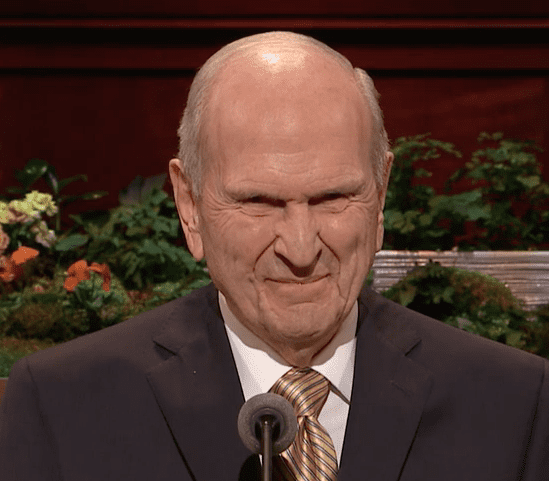
I say this because General Conference has just passed and it strikes me that while Conference builds religious resolve it may also spiritual weaken. As well as being a theological muddle, General Conference is what you get when you combine a disinterest in spiritual formation, with a febrific desire to secure religious commitment by theologically and exegetically untrained white males with profound ego needs. Oaks wants us to ride his same-sex marriage hobby horse which always has dire consequences for the Mormon LGBTQ community. And Nelson (whose intention to court adoration has been troubling in the extreme) has now directed the womenfolk off social media (which might be a good thing because sensitive feminine hearts might be affronted by the now offensive name ‘Mormon’).
If the intention was for us to be spiritually well formed then it didn’t show. General Conference demonstrated that the General Authorities of the Church of Jesus Christ of Latter-day Saints, however well-intentioned some may be, are theologically careless and contradictory and in order to cover over their dullness in scriptural exegesis many resorted to religious drum-beating leading to a kind of grating ego filled spiritual falsity:
“The way you can spot a false system is that the leaders require the place of honor. It is our belief that the less secure a leader is, the more important titles will be to him or her.”[2]
Shaming us into agreeing with the leaders’ positions is a spiritual abuse and is really about our religious leaders using their institutional power to meet their ego needs. People with ego needs who support false spiritual systems too often enjoy descending from pulpits knowing that the people will be frantically and even hopefully doing what they are told. Even when those pronouncements are destined to keep the people spiritually half-starved.
Authentic spiritual leadership comes in underneath us and gives us the support to find God and form a personal relationship with the Divine. Authentic spiritual leadership is uncluttered and uninfected by another’s ego and serves the needs of the soul rather than seeks the interests of the leader.
As Johnson & Vanvonderen argue:
“When all is said and done, abusive spirituality is more interested in supporting doctrines (spiritual mind-sets, mentalities, ways of viewing God) than in supporting people. It is not interested in learning the true conditions in which God builds a living relationship with people—by grace, for free, to become a wellspring of inner spiritual resource.”[3]
I’ve had the many experiences wherein I’ve felt the pressure to take the ‘counsel’ of my male leaders seriously only to find that that path is a spiritual dead-end and didn’t really serve my spiritual needs after-all. Too often I would ignore the quieter voice of the spirit in favour of that louder demanding voice of my male leaders which, in the end, made my spiritual burdens heavier, not lighter.
So, I feel safe in saying to all of the Presidents and men with titles who think they have the power to order my spiritual world and the spiritual world of young women like Zina Huntington,
‘No.
I belong to God.
I don’t belong to you.
And if you think I can only get to God through you,
you don’t know God.’
[1] Compton, Todd (1997). In Sacred Loneliness. pp. 77–91, 108, 466–467.
[2] Johnson, David, and Jeff VanVonderen. 1991. The subtle power of spiritual abuse: [recognizing & escaping spiritual manipulation and false spiritual authority within the Church]. Bloomington (Minnesota): Bethany House Publishers. p. 134
[3] Johnson, David, and Jeff VanVonderen. P.144
Previous Post

September 17, 2018
When Church Leaders are More Important than Church Children
Next Post
December 9, 2018 When the LDS Church Disciplines a Woman
Browse Our Archives
Select a Category A Thoughtful Faith Adultery Apostasy Brigham Young BYU Church Culture Church Leadership Clergy Sex Abuse Community of Christ Divorce Excommunication faith crisis Faith Development Heavenly mother Heresy Indigenous Mormon James Fowler Jesus Christ John Dehlin Joseph Smith Kate Kelly LDS Church Politics LDS doctrine LDS Essays LGTB Maori Mormon marriage and family Mitt Romney Mormon church discourse Mormon church history Mormon Conservatism Mormon corporate culture Mormon Cultural Identity Mormon feminist politics Mormon finances mormon matters podcast Mormon Political Economy Mormons feminism New Zealand and US Mormonism New Zealand Mormon Culture New Zealand Mormon Feminist Thought New Zealand temple Official Declaration Two Ordain Women Pastoral Theology for Mormons phillip barlow Polygamy Practical Theology Prayer Protect LDS Children Racism in the LDS church Sexual Abuse temple recommend temple recommend interview Temples tyranny of certainty Uncategorized why mormons leave
Select a Month April 2020 December 2019 March 2019 December 2018 October 2018 September 2018 June 2018 April 2018 March 2018 February 2018 January 2018 December 2017 November 2017 October 2017 September 2017 July 2017 June 2017 May 2017 March 2017 January 2017 December 2016 November 2016 October 2016 August 2016 May 2016 March 2016 February 2016 January 2016 December 2015 November 2015 October 2015 September 2015 August 2015 June 2015 May 2015 April 2015 March 2015 February 2015 January 2015 December 2014 November 2014 October 2014 September 2014 August 2014 July 2014 June 2014 May 2014 April 2014 March 2014 February 2014 January 2014 December 2013 November 2013 October 2013 September 2013 August 2013 July 2013 June 2013 May 2013 March 2013 January 2013 December 2012 November 2012 October 2012 September 2012 August 2012 July 2012 June 2012 May 2012 April 2012 March 2012 February 2012 January 2012
Follow Us!
TAKE THE
Religious Wisdom Quiz
What book of the Bible tells about Jesus’ birth?
Select your answer to see how you score.
Hebrews Revelation Luke Acts
Related posts from KiwiMormon


Hoarding the Sacrifices of Ordinary People: A Question...

A Year After a Church Discipline and I'm...
Five Days after the Christchurch Shootings: Subversive Compassion
TRENDING AT PATHEOS Latter-day Saint

Did Prayer Cure His Cancer? Or Was It...
At 4 AM one morning, Joshua W. Brown’s wife awoke to a...

8 Ways a Near-Death Experience Rewires the Soul
Does Consciousness Survive Physical Death? After 50 Years of Research, Dr. Raymond...

Holy Longing: What Our Restlessness Is Telling Us
“One can find so many pains when the rain is falling.” -John...

What this is NOT about. This blog is definitely not about...

Who said the Israelites were God’s chosen? That’s right, they did. Who...

The Spirit World Is the Real World: God...
A Monk’s Wisdom on Body and Spirit I sit with Brother Martin...
view all Latter-day Saint blogs
Ad-Free & Subscriber Log-In Subscription Support
- About Us
- 2026 Calendar
- Videos
- Podcasts
- Library of World Religions
- Faith In Media Tracker
- Advertise With Us
- Write for Us
- Privacy Policy
- Terms of Service
- Do Not Sell My Data
- Contact Us
- Radiant Digital
- Manage Newsletter Subscriptions
- Unsubscribe From Notifications
- Sitemap
Copyright 2008-2026, Patheos. All rights reserved.
Subscription Support Ad-Free & Subscriber Log-In
Follow Patheos