
BuddhistCatholicContemplativeEvangelicalGeneral ChristianHinduJewishLatter-day SaintMuslimNew VisionsProgressive Christian
Beliefs
- Buddhist
- Catholic
- Contemplative
- Evangelical
- General Christian
- Hindu
- Jewish
- Latter-day Saint
- More Voices
- Muslim
- New Visions
- Pagan
- Progressive Christian
Topics
- Religion News
- Food and Religion
- Sports and Religion
- Religious Art
- Religious Music and Entertainment
- Religious Events
- History and Religion
- Style and Religion
- Politics and Religion
- Women in Religion
- Recreation Outdoors and Religion
- Business Finance and Religion
- Careers Workplace and Religion
- Education and Religion
- Family Parenting and Religion
- Health Fitness and Religion
- Home and Religion
- Relationships and Religion
- Technology and Religion
- Travel and Religion
Columnists
- Buddhist Columnists
- Business Finance and Religion Columnists
- Careers Workplace and Religion Columnists
- Catholic Columnists
- Contemplative Columnists
- Education and Religion Columnists
- Evangelists Columnists
- Family Parenting and Religion Columnists
- General Christian Columnists
- Health Fitness and Religion Columnists
- Hindu Columnists
- History and Religion Columnists
- Home and Religion Columnists
- Jewish Columnists
- More Voices Columnists
- Latter Day Columnists
- Muslim Columnists
- New Visions Columnists
- Nonreligious Columnists
- Pagan Columnists
- Politics and Religion Columnists
- Progressive Columnists
- Recreation Outdoors and Religion Columnists
- Relationships and Religion Columnists
- Religion News Columnists
- Religious Art Columnists
- Religious Events Columnists
- Religious Music and Entertainment Columnists
- Sports and Religion Columnists
- Style and Religion Columnists
- Technology and Religion Columnists
- Travel and Religion Columnists
- Women in Religion Columnists
Resource Library
- 2026 Calendar
- Library of World Religions
- The 100 Most Holy Places on Earth
- Patheos Answers
- Podcasts
- Videos
- Faith Leaders Database
- Anglican Episcopalian
- Bahai
- Baptist
- Buddhism
- Christianity
- Confucianism
- Eastern Orthodoxy
- Hinduism
- Holiness and Pentecostal
- ISKCON
- Islam
- Judaism
- Lutheran
- Methodist
- The Church of Jesus Christ of Latter-day Saints
- New Age
- Paganism
- Presbytarian and Reformed
- Protestantism
- Religion Behind the Scenes
- Roman Catholic
- Scientology
- Shia Islam
- Sikhism
- Sufism
- Sunni Islam
- Taoism
- Zen
- See all religions
Research Tools
 Ad-Free & Subscriber Log-In Subscription Support
Ad-Free & Subscriber Log-In Subscription Support
Follow Patheos 

- Trending:
- Forgiveness
- |
- Marriage
- |
- Consciousness
- |
- Death Penalty
- |
- Election
- |
- Halloween
 Kimberly Knight
- Home
- Progressive Christian
- Politics and Religion
- Post-Traumatic Church Syndrome: A book review
Post-Traumatic Church Syndrome: A book review
Last updated on: October 30, 2017 at 3:53 pm by Kimberly Knight
Post-Traumatic Church Syndrome: A book review 2017-10-30T15:53:17+04:00 Kimberly Knight
Patheos Explore the world's faith through different perspectives on religion and spirituality! Patheos has the views of the prevalent religions and spiritualities of the world.
It seems nearly every week we hear another report about the demise of the church. Just Google the term “leaving church” and you’ll get about 169,000,000 search results. For real, go try it. Posts range from why are people leaving, how to leave well, why not to leave, to to win members back and why those who have left aren’t missing anything and have no interest in returning – ever.
What many of these posts boil down to is that the church has hurt a lot of people who just can’t stomach anything remotely related to what has become the industry of getting and keeping asses in pews. This is especially true for those who have been wounded by the cultish version of church manifested as “fundamentalism” that is anything but based on the fundamental teachings of Jesus, but I digress.
Being on the other side of this process, it can be painful to watch the all-consuming force it has on those in the midst of the disillusionment with all that previously grounded them. Without language to understand what they are experiencing, the church-wounded often flounder to find a way forward.
Enter Reba Riley‘s new book, Post-Traumatic Church Syndrome. Here’s a summary lifted straight off the author’s website:
Reba Riley’s twenty-ninth year was a terrible time to undertake a spiritual quest. But when untreatable chronic illness forced her to her metaphorical (and physical) derriere on her birthday, Reba realized that even if she couldn’t fix her body, she might be able to heal her injured spirit. And so began a yearlong journey to recover from her whopping case of Post-Traumatic Church Syndrome by visiting thirty religions before her thirtieth birthday.
During her spiritual sojourn, Reba:
- Was interrogated by Amish grandmothers about her sex life
- Danced the disco in a Buddhist temple
- Went to church in virtual reality, a movie theater, a drive-in bar, and a basement
- Fasted for thirty days without food—or wine
- Washed her lady parts in a mosque bathroom
- Was audited by Scientologists
- Learned to meditate with an urban monk, sucked mud in a sweat lodge with a suburban shaman, and snuck into Yom Kippur with a fake grandpa in tow
- Discovered she didn’t have to choose religion to choose God—or good
For anyone who has ever longed for transformation of body, mind, or soul, but didn’t know where to start, Post-Traumatic Church Syndrome reminds us that sometimes we have to get lost to get found.
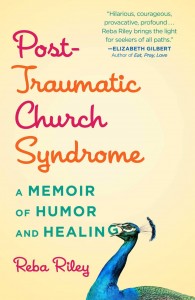 Riley’s book is a fun and easy read that immediately draws the reader into her journey. She courageously reveals a painful process of searching for, and ultimately finding, her way back to a faith that is deeper and more expansive than can be ever be eviscerated by the machinations of man-made religiosity.
Now to be honest, at times the book reads, or me, more like a novel than a memoir. Some of the scenes described feel hyper-real, embellished for an exciting read, yet when I made the internal move to read it more as a work of fiction I was able to connect with her profound journey and message.
Here is my take-away. Riley has made concrete and accessible some critical concepts for millions, especially the post-evangelical crowd.
- The cult of American Churchianity, replete with “Christianese,” specious theology and strict indoctrination is deeply wounding A LOT of people.
- There are tangible symptoms experienced by those who have been traumatized by the festering boil (okay, those are my words) of fundamentalist American Christianity.
- Knowing that other people have, and are suffering from, PTCS and are in the process of recovery can be a life-changing step toward healing.
- When people have the freedom to ask questions and explore faith beyond human construct of the religion of their upbringing, a glittering disco ball of spiritual truths might appear and open the door for reconnecting one with the Divine and ultimately life.
Riley conveys all this with humor, vulnerability and a perfect penchant for the dramatic. If you are of the post-evangelical set and think you might be suffering from PTCS, pick up this book. If you looking for a deeper understanding of why so many people are leaving the church, pick up this book. If you are part of the problem that fosters religiosity that is devastating so many, please pick up this book.
Previous Post

August 4, 2015
My cup runneth over
Next Post

September 23, 2015 Farewell Phyllis
Browse Our Archives
Select a Category A Lesbian's Lectionary Journey Ally Ask a Jesus Loving Lesbian Church Connect the dots Ex-Gay Family Homosexual lifestyle Justice Love Marriage Poetry Sermons Theology Uncategorized
Select a Month April 2017 March 2017 January 2017 December 2016 November 2016 October 2016 September 2016 August 2016 July 2016 June 2016 May 2016 April 2016 March 2016 February 2016 January 2016 December 2015 October 2015 September 2015 August 2015 July 2015 June 2015 May 2015 April 2015 March 2015 February 2015 January 2015 December 2014 November 2014 October 2014 September 2014 August 2014 July 2014 June 2014 May 2014 April 2014 March 2014 February 2014 January 2014 December 2013 November 2013 October 2013 September 2013 August 2013 July 2013 June 2013 May 2013 April 2013 March 2013 February 2013 January 2013 December 2012 November 2012 October 2012 September 2012 August 2012 July 2012 June 2012 May 2012
Follow Us!
TAKE THE
Religious Wisdom Quiz
What does Paul tell Titus that God's grace teaches us to deny?
Select your answer to see how you score.
Our sinful nature The flesh The devil Ungodliness and worldly passions
Related posts from Kimberly Knight

I was wrong, Trump is the right president...

Done being Gay and Christian in America

Our wedding was not a great gay wedding...
If you're not preaching "politics", you're not preaching...
TRENDING AT PATHEOS Progressive Christian

What Being a Modern-Day Apostle Means to Me
In my last column, I discussed the ins and outs of modern-day...

Did Ancient China Once Worship the God of...
Across human history, a common thread weaves through the origins of the...

Love Your Neighbor – Including Earth-Kin: Lev. 19,...
God’s command to love your neighbor means acting in an ethical and...

Lead a Church Study of “Jesus and Lao...
Guest writer Jack Thomas (The Irreverent Reverend) reflects on leading his church...

Pastoral Wisdom for Responding to Sermon Pushback
Getting sermon pushback on your social justice sermon? Learn practical, Proverbs-based strategies...

Principles for Understanding the Apostolic Ministry Today
Whenever people discover that my formal ministry title is "apostle," as in...
view all Progressive Christian blogs
Ad-Free & Subscriber Log-In Subscription Support
- About Us
- 2026 Calendar
- Videos
- Podcasts
- Library of World Religions
- Faith In Media Tracker
- Advertise With Us
- Write for Us
- Privacy Policy
- Terms of Service
- Do Not Sell My Data
- Contact Us
- Radiant Digital
- Manage Newsletter Subscriptions
- Unsubscribe From Notifications
- Sitemap
Copyright 2008-2026, Patheos. All rights reserved.
Subscription Support Ad-Free & Subscriber Log-In
Follow Patheos