
BuddhistCatholicContemplativeEvangelicalGeneral ChristianHinduJewishLatter-day SaintMuslimNew VisionsProgressive Christian
Beliefs
- Buddhist
- Catholic
- Contemplative
- Evangelical
- General Christian
- Hindu
- Jewish
- Latter-day Saint
- More Voices
- Muslim
- New Visions
- Pagan
- Progressive Christian
Topics
- Religion News
- Food and Religion
- Sports and Religion
- Religious Art
- Religious Music and Entertainment
- Religious Events
- History and Religion
- Style and Religion
- Politics and Religion
- Women in Religion
- Recreation Outdoors and Religion
- Business Finance and Religion
- Careers Workplace and Religion
- Education and Religion
- Family Parenting and Religion
- Health Fitness and Religion
- Home and Religion
- Relationships and Religion
- Technology and Religion
- Travel and Religion
Columnists
- Buddhist Columnists
- Business Finance and Religion Columnists
- Careers Workplace and Religion Columnists
- Catholic Columnists
- Contemplative Columnists
- Education and Religion Columnists
- Evangelists Columnists
- Family Parenting and Religion Columnists
- General Christian Columnists
- Health Fitness and Religion Columnists
- Hindu Columnists
- History and Religion Columnists
- Home and Religion Columnists
- Jewish Columnists
- More Voices Columnists
- Latter Day Columnists
- Muslim Columnists
- New Visions Columnists
- Nonreligious Columnists
- Pagan Columnists
- Politics and Religion Columnists
- Progressive Columnists
- Recreation Outdoors and Religion Columnists
- Relationships and Religion Columnists
- Religion News Columnists
- Religious Art Columnists
- Religious Events Columnists
- Religious Music and Entertainment Columnists
- Sports and Religion Columnists
- Style and Religion Columnists
- Technology and Religion Columnists
- Travel and Religion Columnists
- Women in Religion Columnists
Resource Library
- 2026 Calendar
- Library of World Religions
- The 100 Most Holy Places on Earth
- Patheos Answers
- Podcasts
- Videos
- Faith Leaders Database
- Anglican Episcopalian
- Bahai
- Baptist
- Buddhism
- Christianity
- Confucianism
- Eastern Orthodoxy
- Hinduism
- Holiness and Pentecostal
- ISKCON
- Islam
- Judaism
- Lutheran
- Methodist
- The Church of Jesus Christ of Latter-day Saints
- New Age
- Paganism
- Presbytarian and Reformed
- Protestantism
- Religion Behind the Scenes
- Roman Catholic
- Scientology
- Shia Islam
- Sikhism
- Sufism
- Sunni Islam
- Taoism
- Zen
- See all religions
Research Tools
 Ad-Free & Subscriber Log-In Subscription Support
Ad-Free & Subscriber Log-In Subscription Support
Follow Patheos 

- Trending:
- Forgiveness
- |
- Marriage
- |
- Consciousness
- |
- Death Penalty
- |
- Election
- |
- Halloween
 Kimberly Knight
- Home
- Progressive Christian
- Politics and Religion
- God and the Gay [Evangelical] Christian
God and the Gay [Evangelical] Christian
Last updated on: October 30, 2017 at 3:53 pm by Kimberly Knight
God and the Gay [Evangelical] Christian 2017-10-30T15:53:25+04:00 Kimberly Knight
Patheos Explore the world's faith through different perspectives on religion and spirituality! Patheos has the views of the prevalent religions and spiritualities of the world.
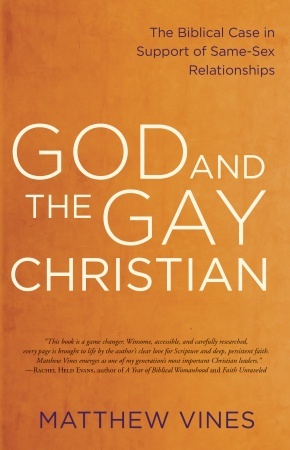 Deborah Arca, who I lovingly (and maybe and maybe a bit delusionally) call my editor here at Patheos invited me to participate in this month’s book club featuring Matthew Vine’s new book God and The Gay Christian.
Before I even opened the book I had an odd feeling about the task at hand. The very title God and The Gay Christian: The Biblical Case in Support of Same-Sex Relationships seems both intriguing and ridiculous to me at this post-Christian juncture in my journey. Maybe I would like the title better if it read God and A Gay Christian since it is specifically both evangelical and nearly all male focused. While I agree that this sort of work is absolutely critical for both gay and not gay people trying to live into an evangelical lifestyle I am also troubled by the continued obsession with arguing over a handful of scriptures to the complete exclusion of the messages of love, justice, grace and peace that permeate the Gospel.
I liked the book but I did not love it for a multitude of reasons but I will try to get at a few of them here.
Why I like it: Vines attempts to move beyond labels of conservative/fundamentalist vs. liberal/progressive and goes with categories that stick to the single topic at hand – whether or not a person, church or theology is non-affirming vs. affirming of gay and lesbian relationships.
Why I don’t love it: This shift in labeling does not entirely or honestly capture the spectrum of the non-affirming. “Non-affirming” waters down what is a very a hard and hateful truth – those who are gently say “love the sinner, hate the sin” are not so theologically different from those who scream “God Hates Fags”. Or with a little less hyperbole, they are not so different than my mamma who called me an abomination to my face and my extended family who still do behind my back. Non-affirming sounds real nice but it completely white-washes the reality that parents and churches are killing their children with their “welcoming but not affirming” nonsense.
Why I liked it: This book speaks to the evangelical community from within the evangelical community. It written by a young, white male who looks a little like a teenage Joel (and even gayer) Osteen which sure ain’t hurting his success with his evangelical audience. This audience of course, to be perfectly honest, remains the biggest active barrier to fundamental civil and human rights for LGBT people so every single voice that can get even one fundie ear to listen is worth his weight in gold.
Why I don’t love it: Vines speaks a great deal about the “God breathed” inerrancy of the bible and in no way challenges his readers to broaden their understanding of that complex collection of texts that consists of multiple genres written, edited and objectified by men. I realize he can not start there or his audience will immediately tune him out. I also realize that a great deal of his intended audience has already dismissed (or worse, demonized) him because he is gay. But still.
Why I like it: Vines does not equivocate on the concept that some people simply are born gay. From this premise he leads the reader to explore an essential aspect of our humanity and the Christian faith – relationship. And not just any relationship but a committed relationship that included sexual intimacy. And he is exceptionally clear that forced celibacy is contrary to Biblical teaching.
Why I don’t love it: Matthew does not share with his readers the human, relational aspect of his own journey to coming out. I found it a bit sterile that his big gay epiphany (as written) occurs alone in a toothpaste aisle (yes, I had snarky and highly inappropriate jokes in my head at this point) and without any human context for his homosexual desire. For a book centered on the sacramental nature of a loving, committed, sexual relationships it seems amiss to have little to no mention of his own experience of such a relationship that might have confirmed for his heart and soul what his body and mind had suspected. Yes, I realize that one can come to a full understanding of their sexuality prior to and apart from a relationship or sexual intimacy but I just felt like he was leaving a little depth-creating context out. Would sharing his own same-sex desires turn away some of his intended audience. Yes. Could making it about his life undermine the dedicated exploration of scripture – maybe. Could sharing more about a personal experience with the power of love and depth of anguish maybe help gay and straight evangelicals alike understand that a person of deep faith and intense love of the bible could also be gay. Absolutely.
Why I like it: This book speaks directly to evangelical Christians who insist on reading the bible in a way that it is not meant to be read. The author is not doing anything even remotely new theologically or biblically in this book (many mainline and progressive theologians, pastors and church goers have been here quite a while) but he is offering it in an accessible way for an audience that he claims as own community. For them, Vines carefully shines new light on passages that have been used within his tradition over and over again to reject LGBT children of God. This is a critical step in the conversation being had within evangelicalism since he concurs with his readers that the bible is inerrant and to be read literally. Christians who read the bible differently from one another often enter a conversation already at a stalemate because they are both dismissive and dismissed. Without evangelical voices who are willing to engage in the same-sex relationship conversation with that community many will be forever be locked in a “non-affirming” position.
Why I don’t love it: In the introduction, Vines says of same-sex relationship affirming Christians that we “…tend to see Scripture as a helpful though dated guidebook, not as the final authority on questions of morality and doctrine.” This statement is woefully sweeping and regretfully ignorant of progressive theology and perpetuates the “real Christians” debate. Though I might not claim that the Bible is the FINAL authority on questions of sexual morality and doctrine I most certainly have and still do read scripture to glean God’s will on matters of morality and doctrine – just about different things like say, feeding the hungry, clothing the naked and welcoming the stranger. As a progressive (affirming) Christian I have been educated both in church and seminary that the bible speaks far more to issues regarding poverty and welcoming the stranger that it does about who’s bumping uglies with who. For many “affirming Christians” the overarching moral and doctrinal message is about God’s love, grace and radical hospitality as revealed in the struggle by humans to understand their relationship to God and one another God and ultimately in the Incarnation of God in the person of Jesus. This is not a lack of regard for the moral teachings, this is in fact a higher regard than trivializing the bible as a book of rules about what we should or should not be doing with our genitals.
Why I like it: Vines carefully and faithfully explores the “clobber texts”. He does not ask his readers to simply toss out these texts, rather he invites them to explore them deeply and to be open to the possibility that these texts, like others in human history, have been misunderstood by humans. This is a solid and effective approach that yields success first with his father and then with other (but in no way all) evangelical Christians he encounters.
Why I don’t love it: Now this is just me, so bear with me. Matthew, like so many other evangelicals, seems to have a righteous hard on for Paul. Astonishingly, in chapter six, he writes, “When asked what brought them to faith in Christ, many people will point to Paul’s letter to the Christians in Rome.” In my 45 years as a Christian, hanging out with Christians all over the theological map, I have NEVER once heard this. Thanks be to God. For if the key to faith is reading the letters of a man, broken as we all are, rather than the lived experience of Christ, well we are in very sad shape indeed. And this is where I return to my leaving off of Christianity because religion that is obsessed on the “authority of Paul”, or frankly any theologians across the ages (who were just as much a human hot-damn mess as the rest of us) is just to cray-cray for me right now.
Why I like it: It just may save someone’s life.
Why in the end, I do love it: If just one person’s life is saved from the hell of self-loathing, family rejecting, Gospel hijacking, fear inducing, faith killing “Christianity” then it has served it’s purpose. Well done good and faithful servant, Matthew.
Y’all are TOTALLY invited to help me make sense of what I just said.
Previous Post

May 7, 2014
Ramblings of a Pub Theologian: Beer & Hymns in Atlanta
Next Post

May 11, 2014 Big Gay Christian Tingle
Recent Comments
1,185 Comments | Leave a Comment
Browse Our Archives
Select a Category A Lesbian's Lectionary Journey Ally Ask a Jesus Loving Lesbian Church Connect the dots Ex-Gay Family Homosexual lifestyle Justice Love Marriage Poetry Sermons Theology Uncategorized
Select a Month April 2017 March 2017 January 2017 December 2016 November 2016 October 2016 September 2016 August 2016 July 2016 June 2016 May 2016 April 2016 March 2016 February 2016 January 2016 December 2015 October 2015 September 2015 August 2015 July 2015 June 2015 May 2015 April 2015 March 2015 February 2015 January 2015 December 2014 November 2014 October 2014 September 2014 August 2014 July 2014 June 2014 May 2014 April 2014 March 2014 February 2014 January 2014 December 2013 November 2013 October 2013 September 2013 August 2013 July 2013 June 2013 May 2013 April 2013 March 2013 February 2013 January 2013 December 2012 November 2012 October 2012 September 2012 August 2012 July 2012 June 2012 May 2012
Follow Us!
TAKE THE
Religious Wisdom Quiz
True or False: The Israelites wandered in the wilderness for forty years.
Select your answer to see how you score.
FALSE TRUE
Related posts from Kimberly Knight

Done being Gay and Christian in America

Our wedding was not a great gay wedding...


Freaking out and making plans - welcome 2017
TRENDING AT PATHEOS Progressive Christian

What Being a Modern-Day Apostle Means to Me
In my last column, I discussed the ins and outs of modern-day...

Did Ancient China Once Worship the God of...
Across human history, a common thread weaves through the origins of the...

Love Your Neighbor – Including Earth-Kin: Lev. 19,...
God’s command to love your neighbor means acting in an ethical and...

Lead a Church Study of “Jesus and Lao...
Guest writer Jack Thomas (The Irreverent Reverend) reflects on leading his church...

Pastoral Wisdom for Responding to Sermon Pushback
Getting sermon pushback on your social justice sermon? Learn practical, Proverbs-based strategies...

Principles for Understanding the Apostolic Ministry Today
Whenever people discover that my formal ministry title is "apostle," as in...
view all Progressive Christian blogs
Ad-Free & Subscriber Log-In Subscription Support
- About Us
- 2026 Calendar
- Videos
- Podcasts
- Library of World Religions
- Faith In Media Tracker
- Advertise With Us
- Write for Us
- Privacy Policy
- Terms of Service
- Do Not Sell My Data
- Contact Us
- Radiant Digital
- Manage Newsletter Subscriptions
- Unsubscribe From Notifications
- Sitemap
Copyright 2008-2026, Patheos. All rights reserved.
Subscription Support Ad-Free & Subscriber Log-In
Follow Patheos