
BuddhistCatholicContemplativeEvangelicalGeneral ChristianHinduJewishLatter-day SaintMuslimNew VisionsProgressive Christian
Beliefs
- Buddhist
- Catholic
- Contemplative
- Evangelical
- General Christian
- Hindu
- Jewish
- Latter-day Saint
- More Voices
- Muslim
- New Visions
- Pagan
- Progressive Christian
Topics
- Religion News
- Food and Religion
- Sports and Religion
- Religious Art
- Religious Music and Entertainment
- Religious Events
- History and Religion
- Style and Religion
- Politics and Religion
- Women in Religion
- Recreation Outdoors and Religion
- Business Finance and Religion
- Careers Workplace and Religion
- Education and Religion
- Family Parenting and Religion
- Health Fitness and Religion
- Home and Religion
- Relationships and Religion
- Technology and Religion
- Travel and Religion
Columnists
- Buddhist Columnists
- Business Finance and Religion Columnists
- Careers Workplace and Religion Columnists
- Catholic Columnists
- Contemplative Columnists
- Education and Religion Columnists
- Evangelists Columnists
- Family Parenting and Religion Columnists
- General Christian Columnists
- Health Fitness and Religion Columnists
- Hindu Columnists
- History and Religion Columnists
- Home and Religion Columnists
- Jewish Columnists
- More Voices Columnists
- Latter Day Columnists
- Muslim Columnists
- New Visions Columnists
- Nonreligious Columnists
- Pagan Columnists
- Politics and Religion Columnists
- Progressive Columnists
- Recreation Outdoors and Religion Columnists
- Relationships and Religion Columnists
- Religion News Columnists
- Religious Art Columnists
- Religious Events Columnists
- Religious Music and Entertainment Columnists
- Sports and Religion Columnists
- Style and Religion Columnists
- Technology and Religion Columnists
- Travel and Religion Columnists
- Women in Religion Columnists
Resource Library
- 2026 Calendar
- Library of World Religions
- The 100 Most Holy Places on Earth
- Patheos Answers
- Podcasts
- Videos
- Faith Leaders Database
- Anglican Episcopalian
- Bahai
- Baptist
- Buddhism
- Christianity
- Confucianism
- Eastern Orthodoxy
- Hinduism
- Holiness and Pentecostal
- ISKCON
- Islam
- Judaism
- Lutheran
- Methodist
- The Church of Jesus Christ of Latter-day Saints
- New Age
- Paganism
- Presbytarian and Reformed
- Protestantism
- Religion Behind the Scenes
- Roman Catholic
- Scientology
- Shia Islam
- Sikhism
- Sufism
- Sunni Islam
- Taoism
- Zen
- See all religions
Research Tools
 Ad-Free & Subscriber Log-In Subscription Support
Ad-Free & Subscriber Log-In Subscription Support
Follow Patheos 

- Trending:
- Forgiveness
- |
- Marriage
- |
- Consciousness
- |
- Death Penalty
- |
- Election
- |
- Halloween

-
Categories
-
Christian Living
-
Christology
-
Golf
-
My Books
- Home
- Progressive Christian
- Religion News
- The Nicene Creed Was Created 1,700 Years Ago and Here’s Why
The Nicene Creed Was Created 1,700 Years Ago and Here’s Why
Last updated on: November 29, 2025 at 12:25 pm by Kermit Zarley
The Nicene Creed Was Created 1,700 Years Ago and Here’s Why 2025-11-29T12:25:38-07:00 Kermit Zarley
Patheos Explore the world's faith through different perspectives on religion and spirituality! Patheos has the views of the prevalent religions and spiritualities of the world.
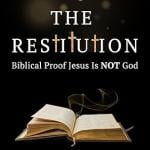
 I have been blogging about the Roman Catholic Church’s Pope Leo XIV being in Iznik, Turkey, this weekend celebrating the 1,700th anniversary of the Nicene Council and its Nicene Creed. The Church has regard this council as the First Ecumenical Council, the first of seven, and its one-page document the Nicene Creed as the greatest of all the Catholic Church’s documents were produced. As a preparation for what follows herein, see yesterday’s post entitled: “The Nicene Council Occurred 1,700 Years Ago and Here’s Why.” Here is the excerpt entitled “The Nicene Creed” in my book, The Restitution: Biblical Proof Jesus Is Not God, but without the footnote references:
The Nicene Creed
The Nicene Council drafted a dogmatic statement about one page in length called the Nicene Creed. A creed is a statement of belief that often serves as a test of orthodoxy, meaning “right opinion.” The Nicene Creed declared that the Son of God was “begotten not made.” This language was intended as an ontological statement affirming eternal generation. But this creed’s most important christological proposition was that it declared that Jesus Christ was “very God of very God,” meaning “fully God of fully God” or “truly God of truly God.” This language was inserted to oppose the Arian teaching of the inferiority of the Son, which Arians supported mostly by citing Jn 14.28. R.P.C. Hanson informs that the Nicene Creed “was constructed as a deliberately anti-Arian document.”
Such language seems strange to us moderns. But for those ancients, the words “very God” (Gr. alethinon theon) referred to a popular Hellenistic concept which had predated Christianity. Centuries earlier, Greeks employed alethinon theon to distinguish a primary god from lesser gods. Origen had even employed this word in his commentary on the Gospel of John to explain that the Father is exclusively “Very God” in distinction from Christ, whom we have already seen he regarded as essentially a lesser God/god. Thus, the Nicene fathers departed from Origen’s teaching, as well as that of their apologist predecessors, in styling Christ as “very God.”
This Nicene debate therefore was largely a semantical disagreement. The creed’s framers originally had intended to be guided by a principle followed previously in the Apostles’ Creed. It was that any binding credal formula must not include unscriptural language. The reason given was that unscriptural words suggest that they are based upon unscriptural concepts. But traditionalist and patristic authority J.N.D. Kelly observes concerning this principle, that it “was only abandoned when it was seen that every conceivable text or biblical turn of phrase could be ingeniously distorted by the Arians to look like evidence in support of their speculations.”
Debate ensued primarily because the word homoousios was introduced into the creed. By applying it to Jesus, it rendered Him as being of the “same substance” (Gr. homo=same; ousia=substance) with the Father. But at that time, ousia was capable of a variety of meanings, e.g., “being,” “essence,” or “reality,” which were discussed. What the creed’s framers meant by homoousios was “consubstantiality,” i.e., that Jesus and the Father are united in a common substance or nature. R.P.C. Hanson alleges,
considerable confusion existed about the use of the terms hypostasis and ousia at the period when the Arian Controversy broke out…. The search for the Christian doctrine of God in the fourth century was in fact complicated and exasperated by semantic confusion, so that people holding different views were using the same words as those who opposed them, but unawares, giving them different meanings from those applied to them by those opponents…. the word hypostasis and the word ousia had pretty well the same meaning. They did not mean, and should not be translated, ‘person’ and ‘substance,’ as they were used when at last the confusion was cleared up and these two distinct meanings were permanently attached to these words in theology which dealt with the doctrine of God.
Nowadays, the doctrine of the Trinity is generally defined succinctly in English as three Persons in one essence or substance. Hanson says this does not reflect the Nicene Creed’s wording even though it is so claimed. He informs concerning the Greek word for person, “The word prosopon does not figure prominently in the Arian Controversy…. To denote that which God is as Three in distinction to what he is as One, the word might have been helpful in avoiding misunderstandings.” But he explains it was also used to mean “appearance,” which could suggest Sabellianism, so it had to be avoided. And he claims that in the West, the Latin word for person, persona, was similarly inadequate.
A middle party also formed that was led by Eusebius, the famed church historian and Bishop of Caesarea in Palestine. This group of bishops was unjustly labeled the “semi-Arian” party when, in fact, its intended purpose was to serve as a mediating influence in the controversy. These bishops did, however, side with the Arians in objecting to unscriptural language in the creed. Both this middle party and the Arians assented to designating Jesus as homoiousios, meaning “similar” or “like substance” with the Father.
Thus, this disagreement at Nicaea centered mostly on the words homoousios and homoiousios, a difference of only the letter “i.” Modern historian Edward Gibbon, in his highly-acclaimed seven-volume history of the Roman Empire, ridiculed this greatest of church controversies for hinging on only one letter in the Greek alphabet. He famously alleged, “the profane of every age have derided the furious contests which the difference of a single diphthong excited between the Homoousians and the Homoiousians.”
The problematic word ousia was also included in the Nicene Creed and applied to Jesus. But afterwards, the conflicting parties generally, but not officially, replaced it with the more precise word hypostasis, which means “subsistence,” i.e., that which underlies an object or person. For example, while the Arians rejected homoousios, arguing that it suggested Sabellianism, they approved of hypostasis as referring to two different modes of subsistence of the one indivisible whole, i.e., the two separate Persons, viz., God the Father and Jesus Christ, being the one indivisible Godhead.
The majority of the bishops at Nicea did not at first readily acquiesce to this strange terminology. Many worried about such Pauline, pastoral admonitions as to be “nourished on the words of the faith” and “retain the standard of sound words” (1 Tim 4.6; 2 Tim 1.13; cf. 2 Pt 2.3). They felt further discomfort by Paul’s warnings “not to wrangle about words, which is useless,” and anyone who “does not agree with sound words, those of our Lord Jesus Christ,… is conceited and understands nothing; but he has a morbid interest in controversial questions and disputes about words, out of which arise envy, strife” (2 Tim 2.14; 1 Tim 6.3-4). J.N.D. Kelly relates, “Only a comparatively small group,… welcomed the language of the creed…. [the majority] had no desire to saddled with an un-Scriptural term.”
At first, Emperor Constantine remained neutral in this dispute, often associating with the middle party. But seeing the obstinacy of the anti-Arian party to yield any ground whatsoever, and for the sake of ecclesiastical well-being and political expediency, he shifted his allegiance to them. The emperor then sought to assuage the fears of the dissenting bishops by redefining and minimizing the importance of homoousios and pressuring them to sign the creed. Actually, the crafty emperor approved of homoousios because its ambiguity enabled the creed’s wider endorsement. So much for politics!
Traditionalists have widely ignored Emperor Constantine’s political coercion at the Nicene Council. Instead, they have touted the Council’s unanimity, citing that all of its bishops, except Arius and his two bishop friends from Libya, signed the creed. Indeed they did, but under threat of imperial banishment! The emperor promptly expelled Arius and his two friends from the empire for refusing to sign the creed. Then he made it a capital crime, punishable by death, to possess any of Arius’ books. Officials afterwards collected all they could and burned them. Francis Young thus cautions, “The course of doctrinal development should never be studied in isolation from the historical context of the debates.” Indeed, that is the main reason for this lengthy chapter in this book.
To make matters worse, after dismissing the council the emperor sent a succession of edicts through his empire which served as imperial decrees establishing the validity of the Nicene Creed. In these edicts, the emperor states that the Nicene Creed is
a signal benefit from the divine providence, in that, being freed from all error, we acknowledge one and the same faith. Henceforth it will not be in the power of the devil to do any thing agains us; for all his insidious machinations are utterly removed…. Arius alone, who first sowed this evil among you,… was found to be overcome by diabolical are and influence. Let us receive, therefore, that doctrine [the creed] which was delivered by the Almighty. Let us return to our beloved brethren, from whom this shameless minister of sata has separated us…. this man, who is evidently an enemy of the truth,… For what was approved by three hundred bishops can only be considered as the pleasure of God…. For whatever is transacted in the holy councils of the bishops, is to be referred to the divine will…. [and] the cruelty of the devil is taken away by divine power through my instrumentality.
Many church congregations still regularly recite the Nicene Creed, but in an abbreviated form. The latter third of it—which heaps anathemas (a list of condemnations) on Arius and his followers as having no part in the Catholic (Universal) Church and thus deemed estranged from God and His salvation and condemned to hell—is not recited and thus remains unknown to most such church folk.
Interestingly, the Nicene Creed portrays only a Binitarian faith.99 The subject of the Holy Spirit was not even discussed by the Council. Throughout the 2nd and 3rd centuries, there existed no consensus of opinion among church fathers on the nature of the Holy Spirit. Some thought the Holy Spirit (Spirit of God) was merely an impersonal power or attribute of God. Others ascribed personality to the Holy Spirit. A few refused to speculate about the matter, refusing to go beyond the express declarations of Scripture. P. Schaff explains, “the doctrine of the Holy Spirit was far less developed, and until the middle of the fourth century was never a subject of special controversy.”100 At the time of the Nicene Council, the Church clearly had not developed what later became the doctrine of the Trinity. (See Appendix B: The Nature of the Holy Spirit.)
Previous Post
November 29, 2025
The Nicene Council Occurred 1,700 Years Ago and Here's Why
Next Post

December 1, 2025 Church Majority on Jesus Being God Doesn't Make it Right
Recent Comments
"Glen, you seem to be advocating a preterist viewpoint, with which I disagree." I'm a ..."
Family Estrangement Versus Honoring Father and ..."
"THESIS is a SCRIPTURE QUOTE.“Remember the predictions foretold by the holy prophets and by the ..."
Family Estrangement Versus Honoring Father and ..."
"How are they going to answer it. They don't have unlimited financial resources. They're trying ..."
Israeli-Palestinian Conflict Getting Much Worse
"...but isn't that an important question to answer?"
Israeli-Palestinian Conflict Getting Much Worse
Browse Our Archives
Select a Category Angels Billy Graham Blog Description Book Reviews Christian Living Christianity Christology Church History Current Events Deity of Christ? Disarmament Eschatology Evangelicalism Ezekiel 38-39 Film Reviews God Golf Gospel Harmonization Health History Holy Spirit Incarnation? Interview Islam Israeli-Palestinian Conflict Jesus Last Empire Literary Announcements Major Championship Winners Masters Monotheism My Books New Testament Old Testament Politics Primitive Weapons Ryder Cup Science Society of Biblical Literature The Bible The Restitution of Jesus Christ Trinitarianism Trinity? Uncategorized Unconditional Love? War on Terrorism
Select a Month October 2026 September 2026 August 2026 July 2026 June 2026 May 2026 April 2026 March 2026 February 2026 January 2026 December 2025 November 2025 October 2025 September 2025 August 2025 July 2025 June 2025 May 2025 April 2025 March 2025 February 2025 January 2025 December 2024 November 2024 October 2024 September 2024 August 2024 July 2024 June 2024 May 2024 April 2024 March 2024 February 2024 January 2024 December 2023 November 2023 October 2023 September 2023 August 2023 July 2023 June 2023 May 2023 April 2023 March 2023 February 2023 January 2023 December 2022 November 2022 October 2022 September 2022 August 2022 July 2022 June 2022 May 2022 April 2022 March 2022 February 2022 January 2022 December 2021 November 2021 October 2021 September 2021 August 2021 July 2021 June 2021 May 2021 April 2021 March 2021 February 2021 January 2021 December 2020 November 2020 October 2020 September 2020 August 2020 July 2020 June 2020 May 2020 April 2020 March 2020 February 2020 January 2020 December 2019 November 2019 October 2019 September 2019 August 2019 July 2019 June 2019 May 2019 April 2019 March 2019 February 2019 January 2019 December 2018 November 2018 October 2018 September 2018 August 2018 July 2018 June 2018 May 2018 April 2018 March 2018 February 2018 January 2018 December 2017 November 2017 October 2017 September 2017 August 2017 July 2017 June 2017 May 2017 April 2017 March 2017 February 2017 January 2017 December 2016 November 2016 October 2016 September 2016 August 2016 July 2016 June 2016 May 2016 April 2016 March 2016 February 2016 January 2016 December 2015 November 2015 October 2015 September 2015 August 2015 July 2015 June 2015 May 2015 April 2015 March 2015 February 2015 January 2015 December 2014 November 2014 October 2014 September 2014 July 2014 June 2014 May 2014 April 2014 March 2014 February 2014 January 2014 December 2013 November 2013 October 2013 September 2013 August 2013 July 2013 June 2013 May 2013 April 2013
Follow Us!
TAKE THE
Religious Wisdom Quiz
True or False: The fruit of the Spirit includes love, joy, peace, and twelve other qualities.
Select your answer to see how you score.
TRUE FALSE
Books by This Author Books by Kermit Zarley Blog
Related posts from Kermit Zarley Blog
Family Estrangement Versus Honoring Father and Mother

Christians Are Not Sexual Prudes as the Media...

Scottie Scheffler Wins the Tour Championship

Wyndam Clark Wins BMW Championship
TRENDING AT PATHEOS Progressive Christian

The Sermon on the Mount, Part I: Matthew...
The Sermon on the Mount, Part I (Matthew 4:12-5:12) St. Matthew moves...

What's up from Crossway: Reviewing some of their latest A few weeks...

Janie Learns the Way of the Cross: A...
Teaching children about Jesus' Passion can be challenging. Many parents and educators...

Looking For Good Catholic Writing - October 2026
He alone extends the heavens, and he walks upon the waves of...

In "Irreplaceable," our book on vocation and technology, Trevor Sutton and I...

I was strolling through the top floor of the brand new Parthenon...
view all Progressive Christian blogs
What Are Your Thoughts?leave a comment
Ad-Free & Subscriber Log-In Subscription Support
- About Us
- 2026 Calendar
- Videos
- Podcasts
- Library of World Religions
- Faith In Media Tracker
- Advertise With Us
- Write for Us
- Privacy Policy
- Terms of Service
- Do Not Sell My Data
- Contact Us
- Radiant Digital
- Manage Newsletter Subscriptions
- Unsubscribe From Notifications
- Sitemap
Copyright 2008-2026, Patheos. All rights reserved.
Subscription Support Ad-Free & Subscriber Log-In
Follow Patheos