
BuddhistCatholicContemplativeEvangelicalGeneral ChristianHinduJewishLatter-day SaintMuslimNew VisionsProgressive Christian
Beliefs
- Buddhist
- Catholic
- Contemplative
- Evangelical
- General Christian
- Hindu
- Jewish
- Latter-day Saint
- More Voices
- Muslim
- New Visions
- Pagan
- Progressive Christian
Topics
- Religion News
- Food and Religion
- Sports and Religion
- Religious Art
- Religious Music and Entertainment
- Religious Events
- History and Religion
- Style and Religion
- Politics and Religion
- Women in Religion
- Recreation Outdoors and Religion
- Business Finance and Religion
- Careers Workplace and Religion
- Education and Religion
- Family Parenting and Religion
- Health Fitness and Religion
- Home and Religion
- Relationships and Religion
- Technology and Religion
- Travel and Religion
Columnists
- Buddhist Columnists
- Business Finance and Religion Columnists
- Careers Workplace and Religion Columnists
- Catholic Columnists
- Contemplative Columnists
- Education and Religion Columnists
- Evangelists Columnists
- Family Parenting and Religion Columnists
- General Christian Columnists
- Health Fitness and Religion Columnists
- Hindu Columnists
- History and Religion Columnists
- Home and Religion Columnists
- Jewish Columnists
- More Voices Columnists
- Latter Day Columnists
- Muslim Columnists
- New Visions Columnists
- Nonreligious Columnists
- Pagan Columnists
- Politics and Religion Columnists
- Progressive Columnists
- Recreation Outdoors and Religion Columnists
- Relationships and Religion Columnists
- Religion News Columnists
- Religious Art Columnists
- Religious Events Columnists
- Religious Music and Entertainment Columnists
- Sports and Religion Columnists
- Style and Religion Columnists
- Technology and Religion Columnists
- Travel and Religion Columnists
- Women in Religion Columnists
Resource Library
- 2026 Calendar
- Library of World Religions
- The 100 Most Holy Places on Earth
- Patheos Answers
- Podcasts
- Videos
- Faith Leaders Database
- Anglican Episcopalian
- Bahai
- Baptist
- Buddhism
- Christianity
- Confucianism
- Eastern Orthodoxy
- Hinduism
- Holiness and Pentecostal
- ISKCON
- Islam
- Judaism
- Lutheran
- Methodist
- The Church of Jesus Christ of Latter-day Saints
- New Age
- Paganism
- Presbytarian and Reformed
- Protestantism
- Religion Behind the Scenes
- Roman Catholic
- Scientology
- Shia Islam
- Sikhism
- Sufism
- Sunni Islam
- Taoism
- Zen
- See all religions
Research Tools
 Ad-Free & Subscriber Log-In Subscription Support
Ad-Free & Subscriber Log-In Subscription Support
Follow Patheos 

- Trending:
- Forgiveness
- |
- Marriage
- |
- Consciousness
- |
- Death Penalty
- |
- Election
- |
- Halloween

-
Categories
-
Christian Living
-
Christology
-
Golf
-
My Books
- Home
- Progressive Christian
- Religion News
- Was Nicodemus Born Again?
Was Nicodemus Born Again?
Last updated on: October 17, 2021 at 11:33 pm by Kermit Zarley
Was Nicodemus Born Again? 2021-10-17T23:33:08-07:00 Kermit Zarley
Patheos Explore the world's faith through different perspectives on religion and spirituality! Patheos has the views of the prevalent religions and spiritualities of the world.
The Bible’s New Testament has three pericopees about a man named Nicodemus who had two interesting encounters with Jesus of Nazareth. All three episodes are in only one of the four NT gospels–the Gospel of John. I believe this alone suggests that the sovereign hand of God was revealed in these incidents. And when people read them, they often wonder if Nicodemus did what Jesus told him to do–be born again.
Nicodemus was a prominent Jewish man who came to Jesus one night, early in Jesus’ itinerant ministry. He came at night, apparently surreptitiously to avoid being known about it by his colleagues. For, Nicodemus was an important member of the religious council in Jerusalem, called the Sanhedrin. These seventy men controlled the religious life in Israel, especially all matters at the temple in Jerusalem. The Sanhedrin was the group that eventually had Jesus arrested, condemned him on the improper charge of blasphemy, and, according to some NT texts, pressured Governor Pontius Pilate of Judea to crucify him due to their jealousy of him (Matt. 27.18).
We read, “Now there was a Pharisee named Nicodemus, a leader of the Jews. He came to Jesus by night and said to him, ‘Rabbi, we know that you are a teacher who has come from God; for no one can do these signs that you do apart from the presence of God.’ Jesus answered him, ‘Very truly, I tell you, no one can see the kingdom of God without being born from above.’ Nicodemus said to Jesus, ‘How can anyone be born after having grown old? Can one enter a second time into the mother’s womb and be born?’ Jesus answered, ‘Very truly, I tell you, no one can enter the kingdom of God without being born of water and Spirit. What is born of the flesh is flesh, and what is born of the Spirit is spirit. Do not be astonished that I said to you, “You must be born from above.” The wind blows where it chooses, and you hear the sound of it, but you do not know where it comes from or where it goes. So it is with everyone who is born of the Spirit.’ Nicodemus said to him, ‘How can these things be?’ Jesus answered him, ‘Are you a teacher of Israel, and yet you do not understand these things?'” (John 3.1-10 NRSV).
Accordingly, Nicodemus, being a Pharisee and member of the Sanhedrin, appears to have been a noted Torah teacher in Israel even though this is not affirmed in any ancient, rabbinical writings. For Jesus really said to him, “Are you the teacher of Israel.”
Many English versions of the Bible, including the NRSV here, do not quite treat this text as it reads in the original Greek manuscripts. The word in the Greek text for teacher, here, is didaskolos, and it appears twice in this pericope. The first time is in v. 2, with Nicodemus saying to Jesus, “We know you are a teacher.” The NRSV has this right, “a teacher.” That is, since didaskolos does not have the article, ho, didaskolos is indefinite and therefore should be translated “a teacher.”
However, in John 3.10 the NRSV reads, “Are you a teacher of Israel, and yet you do not understand these things?” The Greek text here has the article, thus ho didaskolos, so it should be translated “the teacher.” The reason this is important is that it is often thought by Bible readers that Jesus introduced a new idea when he told this Torah teacher Nicodemus, “no one can see the kingdom of God without being born from above.” Many well-known English translations, such as the King James Version and the New International Version, translate Jesus latter clause “born again” instead of “born from above,” though both are correct translations. Yet Jesus was not introducing a new idea not found in the Jewish scriptures. That is why he later said to Nicodemus, “Are you a [read “the”] teacher of Israel, and yet you do not understand these things?”
This idea of being “born again” or “born from above” is very prominent in the prophetic writings of the Jewish Bible, in Jeremiah and Ezekiel, except that they do not use these expressions. Jeremiah says on behalf of God, “The days are surely coming, says the LORD, when I will make a new covenant with the house of Israel and the house of Judah. . . . I will put my law within them, and I will write it on their hearts” (Jeremiah 31.31, 33).
Ezekiel describes it this way, speaking on behalf of God, “I will give them one heart, and put a new spirit within them. I will remove the heart of stone from their flesh and give them a heart of flesh, so that they may follow my statues and keep my ordnances and obey them” (Eze 11.19-20). He later calls it “a new heart” and “a new spirit” (36.26).
So, when Jesus told Nicodemus he needed to be born again, Jesus was only alluding to these texts of Jeremiah and Ezekiel about getting a new heart and new spirit from God. The old covenant that God made with Israel through Moses gave them the Law, but it could not give them the Spirit by which to obey the Law more perfectly. That is the reason for the necessity of the new covenant by which a person becomes empowered by the Spirit of God.
Thus, Jesus was talking to Nicodemus about the new covenant. That is how we get two parts of the Christian Bible: Old Testament (=Covenant) and New Testament (=Covenant). Thus, Jesus came to begin the new covenant as a personal, inner transformation of the person by means of the Spirit of God.
Jesus had explained to Nicodemus that this personal, inner transformation occurs by “being born of water and Spirit.” There has been no consensus among Christians on what Jesus meant by this. The Catholic Church has interpreted it as water baptism, so that joining their church by means of water baptism is being born again. Many other Christians have believed it means merely a spiritual birth. But they have even disagreed about what the “water” means. Some say it metaphorically refers to the scriptures. I am persuaded that Jesus refers to breaking of a pregnant woman’s water just before she gives birth, so that Jesus means it literally as a reference to physical birth. Thus, he is further contrasting physical birth with spiritual birth. However, I am not contentious with by fellow brethren about the proper interpretation of water here.
But I do believe that Jesus does not mean born again is water baptism. This is similar to how Jews believed about being a child of God and thus being in God’s kingdom. They had the idea that if you were a Jew, that made you a child of God. Not quite. John the Baptist opposed this idea by saying, “Do not presume to say to yourselves,’We have Abraham as our ancestor’; for I tell you, God is able from these stones to raise up children to Abraham” (Matthew 3.9).
Jesus addressed this issue even further. We read in John about a later encounter he had with interlocutors, “They answered him, ‘Abraham is our father.’ Jesus said to them, ‘If you were Abraham’s children, you would be doing what Abraham did, but now you are trying to kill me, a man who has told you the truth that I heard from God. This is not what Abraham did. You are indeed doing what your father does. . . . You are from your father the devil, and you choose to do your father’s desires'” (John 8.39-41, 44).
So, the Johannine Jesus was speaking to both Nicodemus and these Jewish interlocutors spiritually rather than literally. That is, yes, they were literal descendants of Abraham, but the latter had proved from their actions that they were not spiritual children of Abraham.
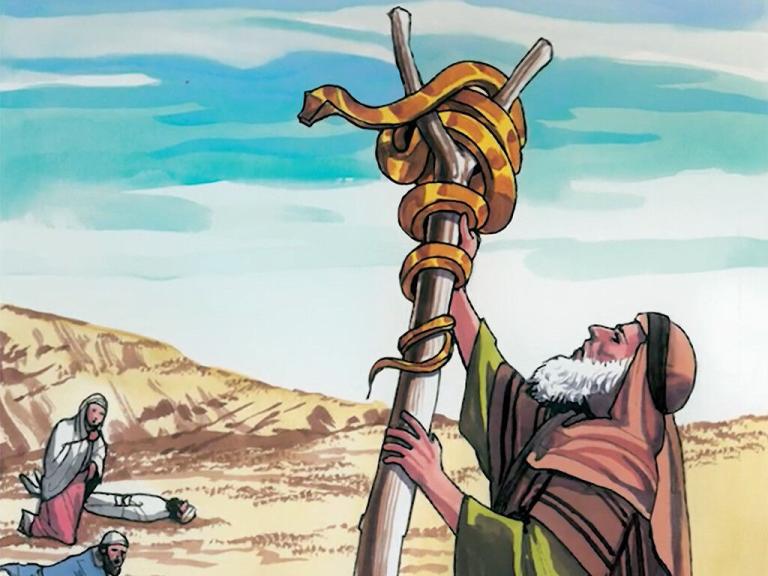
Right after Jesus told Nicodemus he needed to be born again, Jesus explained how that happens. He said, “just as Moses lifted up the serpent in the wilderness, so must the Son of Man be lifted up, that whoever believes in him may have eternal life” (John 3.14). Jesus often referred to himself as “the Son of Man,” alluding to Daniel 7.13-14. His mention of Moses regarded an incident involving poisonous snakes. We read, “The people spoke against God and against Moses, ‘Why have you brought us up out of Egypt to die in the wilderness? For there is no food and no water, and we detest this miserable food.’ Then the LORD sent poisonous serpents among the people, and they bit the people, so that many Israelites died. The people came to Moses and said, ‘We have sinned by speaking against the LORD and against you; pray to the LORD to take away the serpents from us.’ So Moses prayed for the people. And the LORD said to Moses, ‘Make a poisonous serpent, and set it on a pole; and everyone who is bitten shall look at it and live.’ So Moses made a serpent of bronze and put it upon a pole; and whenever a serpent bit someone, that person would look at the serpent of bronze and live” (Numbers 21.5-9).
So, when Jesus told Nicodemus that he, Jesus, would be lifted up, he was predicting his death by being crucified on a pole, that is, a cross. He meant that if Nicodemus believed that Jesus was then dying for his sins, Nicodemus would then be born again and inherit eternal, similar to the snake-bitten Israelites looking at the bronze snake on the pole and being healed of their poisonous snake bites.
The second Johannine pericope that involved Nicodemus was during a Feast of Tabernacles (Booths) at Jerusalem (John 7). The people at the temple were discussing about Jesus, whether or not he was the Messiah promised in their Scriptures. The religious authorities even sent the police to arrest Jesus, who had now arrived at the feast. Then we read, “Then the temple police went back to the chief priests and Pharisees, who asked them, ‘Why did you not arrest him?’ The police answered, ‘Never has anyone spoken like this!’ Then the Pharisees replied, ‘Surely you have not been deceived too, have you? Has any one of the authorities of of the Pharisees believed in him? But this crowd, which does not know the law–they are accursed.’ Nicodemus, who had gone to Jesus before, and who was one of them, asked, ‘Our law does not judge people without first giving them a hearing to find out what they are doing, does it?’ They replied, ‘Surely you are not also from Galilee, are? Search and you will see that no prophet is to arise from Galilee'” (John 7.45-52). So, at this point, Nicodemus was somewhat defending Jesus by pleading that he be given a just hearing.
When Jesus was crucified and died, his apostles deserted him out of fear. Right before it happened, Jesus had predicted to them privately that they would do that (Matthew 26.30-35). It was prophesied already by the prophet Zechariah as Jesus also said (Zechariah 13.7). Thus, these men were not there to try to care for Jesus’ deceased body. But that is reasonable since Roman authorities would have been on the look out a messianic uprising since many were questioning if Jesus was the Messiah, and there were rumors that he had said he would arise from the dead.
Besides, Jesus was condemned by Governor Pilate as a possible insurrectionist, since he had put on Jesus’ headboard on the cross, “The King of the Jews.” The Romans did not allow the crucified bodies of slaves and insurrectionists to have a proper burial. Rather, they were left on the cross for days to eaten by dogs and birds and their skeletal remains thrown into a common pit for such. However, there is evidence that the Romans allowed for a person of notoriety to request such a body. But to do so, that person likely would have to provide a suitable gravesite.
Nicodemus and Josephus of Arimathea were perfect for this, which I believe reveals God’s providence in the affair. Josephus was a rich man who owned a prepared tomb located nearby. We read of him, “Joseph of Arimathea, who was a disciple of Jesus, though a secret one because of fear of the Jews, asked Pilate to let him take away the body of Jesus. Pilate gave him permission; so he came and removed his body. Nicodemus, who had at first come to Jesus by night, also came, bringing a mixture of myrrh and aloes, weighing about a hundred pounds. They took the body of Jesus ad wrapped it with the spices in linen cloths, according to the burial custom of the Jews. Now there was garden in the place where he was crucified, and in the garden there was a new tomb in which ho one had ever been laid. . . . they laid Jesus there” (John 19.38-42).
So, was Nicodemus by now, like Joseph, a secret disciple of Jesus, having been born again? That is questionable. Days later, on the Day of Pentecost, the apostle Peter stood and preached to thousands of Jews at that festival, saying, “Jesus of Nazareth, a man attested to you by God with deeds of power, wonder, and signs that God did through among you, as you yourselves know–this man, handed over to you according to the definite plan and foreknowledge of God, you crucified and killed by the hands of those outside the law. But God raised him up, having freed him from death, . . . God has made him both Lord and Messiah, this Jesus whom you crucified. . . . Repent and be baptized every one of you in the name of Jesus Christ so that your sins may be forgiven” (Acts 2.22-24, 36, 38).
So, being water baptized would have served as a public confession of believing in Jesus. It was not that the water baptism brings about the forgiveness, the salvation, and the promise of eternal life. It merely attested to because the person had confessed to believe in Jesus. For the apostle Paul states the Christian gospel clearly in his Epistle to the Romans believers, “if you confess with your lips that Jesus is Lord and believe in your heart that God raised him from the dead, you will be saved” (Romans 10.9). It is belief in the heart and confession with the mouth that requires for salvation.
Did Nicodemus and Joseph of Arimathea eventually do that. I think most likely they did. But their courageous act in asking Governor Pilate for Jesus’ deceased body, laying it in a tomb sealed with a rock at its entrance, guarded by Roman guards so no one steal the body, and yet Jesus till arose from the dead to be seen by many of his disciples over the next forty days–all of that was God’s plan that involved Nicodemus and Joseph. Was Nicodemus born again by then? Caring for Jesus’ deceased body like that seems to me like a testimony to saving faith. What do you think?
Previous Post

October 17, 2021
Rory McIlroy Wins CJ Cup @ Summit
Next Post

October 18, 2021 Great American Colin Powell Has Died
Browse Our Archives
Select a Category Angels Billy Graham Blog Description Book Reviews Christian Living Christianity Christology Church History Current Events Deity of Christ? Disarmament Eschatology Evangelicalism Ezekiel 38-39 Film Reviews God Golf Gospel Harmonization Health History Holy Spirit Incarnation? Interview Islam Israeli-Palestinian Conflict Jesus Last Empire Literary Announcements Major Championship Winners Masters Monotheism My Books New Testament Old Testament Politics Primitive Weapons Ryder Cup Science Society of Biblical Literature The Bible The Restitution of Jesus Christ Trinitarianism Trinity? Uncategorized Unconditional Love? War on Terrorism
Select a Month October 2026 September 2026 August 2026 July 2026 June 2026 May 2026 April 2026 March 2026 February 2026 January 2026 December 2025 November 2025 October 2025 September 2025 August 2025 July 2025 June 2025 May 2025 April 2025 March 2025 February 2025 January 2025 December 2024 November 2024 October 2024 September 2024 August 2024 July 2024 June 2024 May 2024 April 2024 March 2024 February 2024 January 2024 December 2023 November 2023 October 2023 September 2023 August 2023 July 2023 June 2023 May 2023 April 2023 March 2023 February 2023 January 2023 December 2022 November 2022 October 2022 September 2022 August 2022 July 2022 June 2022 May 2022 April 2022 March 2022 February 2022 January 2022 December 2021 November 2021 October 2021 September 2021 August 2021 July 2021 June 2021 May 2021 April 2021 March 2021 February 2021 January 2021 December 2020 November 2020 October 2020 September 2020 August 2020 July 2020 June 2020 May 2020 April 2020 March 2020 February 2020 January 2020 December 2019 November 2019 October 2019 September 2019 August 2019 July 2019 June 2019 May 2019 April 2019 March 2019 February 2019 January 2019 December 2018 November 2018 October 2018 September 2018 August 2018 July 2018 June 2018 May 2018 April 2018 March 2018 February 2018 January 2018 December 2017 November 2017 October 2017 September 2017 August 2017 July 2017 June 2017 May 2017 April 2017 March 2017 February 2017 January 2017 December 2016 November 2016 October 2016 September 2016 August 2016 July 2016 June 2016 May 2016 April 2016 March 2016 February 2016 January 2016 December 2015 November 2015 October 2015 September 2015 August 2015 July 2015 June 2015 May 2015 April 2015 March 2015 February 2015 January 2015 December 2014 November 2014 October 2014 September 2014 July 2014 June 2014 May 2014 April 2014 March 2014 February 2014 January 2014 December 2013 November 2013 October 2013 September 2013 August 2013 July 2013 June 2013 May 2013 April 2013
Follow Us!
TAKE THE
Religious Wisdom Quiz
Do to others as you would have them do to ____.
Select your answer to see how you score.
Everyone Themselves You Others
Books by This Author Books by Kermit Zarley Blog
Related posts from Kermit Zarley Blog

Stephen Hawking Said "Losers" Boast about IQ—That's Trump

Trump Should Retake his Old Name Drumpf that...
Counting the Cost Before Going to War
Financial Disclosure: Trump Profits Billions as President
TRENDING AT PATHEOS Progressive Christian

When Halloween Unmasks Married Hearts
Written by Dr. David K. Ewen from Eternal Truth Bible College Behind...

Aristotle. He’s been called the father of logic, the father of the...

Methodist Central Hall and Westminster Abbey
Situated on the same square is Methodist Central Hall and Westminster Abbey. ...

57th Dove Awards Honor Dolly Parton, Crown New...
On gospel music’s biggest night, the 57th annual GMA Dove Awards honored...

The First Eucharistic Controversy: Christ’s Real Presence
For Catholics, the Eucharist is the source and summit of the Christian...

What a Stop Sign Can Teach Us About...
How to Make a Decision When You Can't Hear God Main point:...
view all Progressive Christian blogs
Ad-Free & Subscriber Log-In Subscription Support
- About Us
- 2026 Calendar
- Videos
- Podcasts
- Library of World Religions
- Faith In Media Tracker
- Advertise With Us
- Write for Us
- Privacy Policy
- Terms of Service
- Do Not Sell My Data
- Contact Us
- Radiant Digital
- Manage Newsletter Subscriptions
- Unsubscribe From Notifications
- Sitemap
Copyright 2008-2026, Patheos. All rights reserved.
Subscription Support Ad-Free & Subscriber Log-In
Follow Patheos