
BuddhistCatholicContemplativeEvangelicalGeneral ChristianHinduJewishLatter-day SaintMuslimNew VisionsProgressive Christian
Beliefs
- Buddhist
- Catholic
- Contemplative
- Evangelical
- General Christian
- Hindu
- Jewish
- Latter-day Saint
- More Voices
- Muslim
- New Visions
- Pagan
- Progressive Christian
Topics
- Religion News
- Food and Religion
- Sports and Religion
- Religious Art
- Religious Music and Entertainment
- Religious Events
- History and Religion
- Style and Religion
- Politics and Religion
- Women in Religion
- Recreation Outdoors and Religion
- Business Finance and Religion
- Careers Workplace and Religion
- Education and Religion
- Family Parenting and Religion
- Health Fitness and Religion
- Home and Religion
- Relationships and Religion
- Technology and Religion
- Travel and Religion
Columnists
- Buddhist Columnists
- Business Finance and Religion Columnists
- Careers Workplace and Religion Columnists
- Catholic Columnists
- Contemplative Columnists
- Education and Religion Columnists
- Evangelists Columnists
- Family Parenting and Religion Columnists
- General Christian Columnists
- Health Fitness and Religion Columnists
- Hindu Columnists
- History and Religion Columnists
- Home and Religion Columnists
- Jewish Columnists
- More Voices Columnists
- Latter Day Columnists
- Muslim Columnists
- New Visions Columnists
- Nonreligious Columnists
- Pagan Columnists
- Politics and Religion Columnists
- Progressive Columnists
- Recreation Outdoors and Religion Columnists
- Relationships and Religion Columnists
- Religion News Columnists
- Religious Art Columnists
- Religious Events Columnists
- Religious Music and Entertainment Columnists
- Sports and Religion Columnists
- Style and Religion Columnists
- Technology and Religion Columnists
- Travel and Religion Columnists
- Women in Religion Columnists
Resource Library
- 2026 Calendar
- Library of World Religions
- The 100 Most Holy Places on Earth
- Patheos Answers
- Podcasts
- Videos
- Faith Leaders Database
- Anglican Episcopalian
- Bahai
- Baptist
- Buddhism
- Christianity
- Confucianism
- Eastern Orthodoxy
- Hinduism
- Holiness and Pentecostal
- ISKCON
- Islam
- Judaism
- Lutheran
- Methodist
- The Church of Jesus Christ of Latter-day Saints
- New Age
- Paganism
- Presbytarian and Reformed
- Protestantism
- Religion Behind the Scenes
- Roman Catholic
- Scientology
- Shia Islam
- Sikhism
- Sufism
- Sunni Islam
- Taoism
- Zen
- See all religions
Research Tools
 Ad-Free & Subscriber Log-In Subscription Support
Ad-Free & Subscriber Log-In Subscription Support
Follow Patheos 

- Trending:
- Forgiveness
- |
- Marriage
- |
- Consciousness
- |
- Death Penalty
- |
- Election
- |
- Halloween

-
Categories
-
Christian Living
-
Christology
-
Golf
-
My Books
- Home
- Progressive Christian
- Religion News
- Talking About the Doctrine of the Trinity
Talking About the Doctrine of the Trinity
Last updated on: April 28, 2025 at 1:50 pm by Kermit Zarley
Talking About the Doctrine of the Trinity 2025-04-28T13:50:47-07:00 Kermit Zarley
Patheos Explore the world's faith through different perspectives on religion and spirituality! Patheos has the views of the prevalent religions and spiritualities of the world.
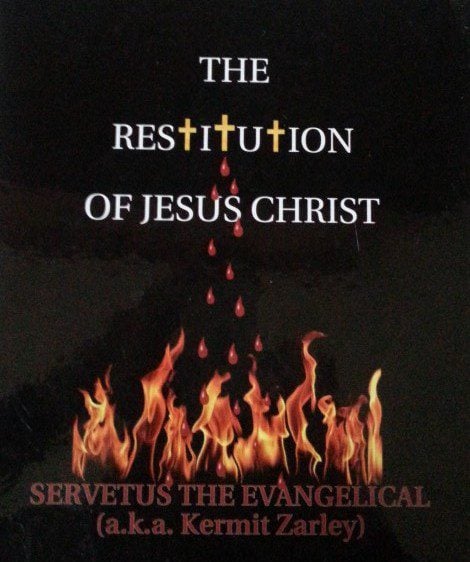
 As many people who read my blog know, I was a Trinitarian for twenty-two years. The church doctrine of the Trinity means that God is one essence existing as three co-equal and co-eternal Persons: the Father, the Son (Jesus Christ), and the Holy Spirit. I then read myself out of this in the Bible, entered into a deep investigation of the matter over the next 25+ years, and self-published a 600-page book about it in 2008 entitled The Restitution of Jesus Christ. (It can be purchased at my website kermitzarley.com.) In this book I cite over 400 authors, most of them being Bible scholars. This book is mostly about the Bible. I show that it identifies Jesus as a man and not God. To do this, I address thoroughly all of the critical Bible texts about this matter. Thus, the doctrine of the Trinity is only briefly addressed in this book. In the history of the development of Christian doctrine, the Catholic Church first established its assertion that Jesus is God, and its doctrine of the Trinity was formulated much later on this basis.
 The Unitarian movement emerged in Europe during the early 1600s as a result of Enlightenment and in opposition to Trinitarianism. Unitarians rightly claimed that the Bible only identifies the Father as God; thus, it does not identify Jesus as being fully God. But Unitarians did not agree on the subject of Jesus dying on the cross to atone for our sins. Most Christians, as I do, have claimed this teaching is absolutely essential to Christianity. And by the twentieth century, Unitarians had become Universalists.
There is a small but growing anti-Trinitarian movement of professing Christians who identify themselves mostly as Biblical Unitarians and fewer who identify as Christian Monotheists. The former are more centered on the Bible than earlier Unitarians were. The latter use their moniker to suggest that Trinitarianism is not genuine monotheism. I am sympathetic to this movement. Yet I prefer to call myself “a One God Christian.”
I wrote the following piece to help people in this movement as they discuss theology with Trinitarians. I encourage this be done rather than the two groups disassociating.
Who are we talking to? If we One God Christians talk to someone untaught, we should only present our viewpoint without mentioning Trinitarianism unless asked to do so. But if we talk to Trinitarians, who often don’t know their Trinitarianism that well, we should know enough about it to interact sufficiently with them. But we should understand that the main issue is not the doctrine of the Trinity; rather, it is whether or not the Bible says Jesus is God. Most historians relate that the doctrine of the Trinity was developed due to the previous Church dogma that Jesus is God. Many leading Trinitarian scholars now admit that the Bible does not teach the doctrine of the Trinity. They assert that it is a deduction from the Bible and admit that it was developed by post-apostolic church fathers over a period of more than 250 years. Some therefore concede that the Bible does not make belief in this doctrine a necessary requirement for salvation as the Catholic and Protestant churches have done. We should try to keep the conversation focused mostly on the Bible.
What is the doctrine of the Trinity? The doctrine of the Trinity is that God is one essence existing as three co-equal and co-eternal Persons: the Father, the Son, and the Holy Spirit. Some Trinitarians, especially Roman Catholics, add “consubstantiality,” which means “same substance.” These concepts were established by church fathers using certain words peculiar to their native Greek language. (The RCC put back “consubstantiality” into their mass in late 2011.) Only eight NT texts mention together God/the Father, the Son/Jesus/Jesus Christ, and the Spirit/Holy Spirit. None have information relating to the later church teaching of the Trinity, and they have several different orders of these three in which some do not mention God/the Father first. And of course, “trinity,” “three in one,” “three Persons” and the like are not in the Bible.
When did the doctrine of the Trinity originate? The above definition of the doctrine of the Trinity was not developed until the late fourth century. Many historians and Christian theologians erroneously claim that this standard church doctrine of the Trinity was established at the First Ecumenical Council, the Nicene Council, in 325. On the contrary, the nature of the Holy Spirit did not become a serious topic of discussion among church fathers until decades later, during the 360s and 370s. Thus, the Catholic Church officially established its doctrine of the Trinity at its Second Ecumenical Council which was held at Constantinople in 381. Before that, a few church fathers taught their own doctrine of the Trinity, but they were different than the doctrine of the Trinity which the Church made official in 381 and has prevailed ever since.
What is the main subject? Salvation! What is most important to inquirers is that they want to know how to be saved and whether or not they are saved. This involves God forgiving our sins and giving us eternal life. Here are the two main questions: Does the Bible say Jesus is God? Must a person believe Jesus is God in order to be saved?
Why is this subject so important? It is so important because the institutional church has made it important by declaring that a person must believe that Jesus is God in order to be saved. The Catholic Church decided this declaration at its Council of Nicaea in 325. This Council produced the Nicene Creed which proclaims that a person must believe that Jesus is “very God of very God,” meaning Jesus is just as much God as the Father is, or that person is “anathema”—condemned to hell. Now, Jesus said at the Last Supper that the most important thing for his disciples to do was to love one another. He said to them, “I give you a new commandment, that you love one another…. By this everyone will know that you are my disciples, if you have love for one another” (Jn 13.34-35). So, all Christians should try to understand what the Bible requires for salvation and thus what makes a person a disciple of Jesus. Loving the disciples of Jesus is the strongest testimony we can make to the world about the truth of our Lord Jesus Christ. Trinitarian Christians who reject us One God believers, deeming that we are not saved, will be ashamed about this at The Judgment. (Some of us One God Christians don’t call ourselves “unitarians” due to the use of this term in history. Most original Unitarians did not affirm Jesus dying for their sins, and modern Unitarians are universalists.)
What does the Bible say we must do to be saved? Main texts: Jn 3.3, 14; 12.44; Ac 16.30-31; Rom 10.9-10; 1 Cor 15.1-5; 1 Jn 5.1. Also, we are saved by believing in Jesus’ name, which in Hebrew is Yeshu(a): Jn 1.12; 2.23; 3.18; 1 Jn 5.13; 3.23. Yeshu(a) means “Yhwh saves.” So, Yhwh saves through Jesus of Nazareth. Yhwh is God’s name in the Hebrew Bible (OT). It can be pronounced Yahweh, Yahveh, or Yehvah.
Can Trinitarians Be Saved? Absolutely yes! Most of the above texts say people are saved by believing that Jesus is their Savior since he died on the cross for their sins and arose from the dead. Some Bible texts add that people are saved because they believe Jesus is the Christ, the Messiah of Israel, and that he is the Son of God. Most Trinitarians wrongly interpret Jesus being the Son of God to mean he is God. On the contrary, since the Bible identifies some men and angels as “sons of God,” Jesus being the Son of God just means that he had an extraordinary relationship with God. Plus, the Bible sometimes applies “Christ” and “Son of God” to Jesus interchangeably. Finally, a person must to some degree make Jesus “Lord” of their life by following him. Many Trinitarians believe all of this about Jesus and live a life honoring God, the Father, and Jesus.
How can we One God believers converse with Trinitarians on this subject? There are surely many different ways. One way is to ask, “Do you believe God is one person or more than one person?” If they say three persons, we could ask, “then do you believe Jesus is God?” After they say “yes,” we could respond, “then why don’t the gospels ever quote Jesus saying “I am God” or words to that effect? They might say Jesus claimed he is God in Jn 10.30 when he said, “I and the Father are one.” We should be prepared to prove how Jesus didn’t mean he was God in that text. We also could cite various NT passages which declare that only the Father is God, so that Jesus can’t be God, esp. Jn 17.3, 1 Cor 8.4-6, and Eph 4.4-6. We could include Mk 12.28-34 and Jn 5.43-44. Then, we could mention that Jesus worshipped this one God, calling him “my Father,” even “my God” (Mt 27.46/Mk 15.34/Ps 22.1; Jn 20.17; Rev 3.2, 12). We conclude saying Jesus isn’t God but he had a God—the Father. We could add Paul’s texts which declare “the God and Father of the/our Lord Jesus Christ” (Rom 15.6; 2 Cor 1.3; 11.31; Eph 1.3, cf. v. 17). The main texts knowledgeable Trinitarians cite are: Jn 1.1c; 1.18; 10.30; 20.28; Phil 2.5-11; Rom 9.5; Tit 2.13; 2 Th 1.12; Heb 1.8-10; 2 Pt 1.1; and 1 Jn 5.20. We should know these well and be able to explain them sufficiently in accordance with our viewpoint.
Previous Post

June 26, 2019
Did Donald Trump Say He Is Glad John McCain Is Dead or also in Hell?
Next Post
June 28, 2019 Robert Mueller Testifying Recalls Oral Tradition Versus Written Tradition
Recent Comments
"Glen, you seem to be advocating a preterist viewpoint, with which I disagree." I'm a ..."
Family Estrangement Versus Honoring Father and ..."
"THESIS is a SCRIPTURE QUOTE.“Remember the predictions foretold by the holy prophets and by the ..."
Family Estrangement Versus Honoring Father and ..."
"How are they going to answer it. They don't have unlimited financial resources. They're trying ..."
Israeli-Palestinian Conflict Getting Much Worse
"...but isn't that an important question to answer?"
Israeli-Palestinian Conflict Getting Much Worse
Browse Our Archives
Select a Category Angels Billy Graham Blog Description Book Reviews Christian Living Christianity Christology Church History Current Events Deity of Christ? Disarmament Eschatology Evangelicalism Ezekiel 38-39 Film Reviews God Golf Gospel Harmonization Health History Holy Spirit Incarnation? Interview Islam Israeli-Palestinian Conflict Jesus Last Empire Literary Announcements Major Championship Winners Masters Monotheism My Books New Testament Old Testament Politics Primitive Weapons Ryder Cup Science Society of Biblical Literature The Bible The Restitution of Jesus Christ Trinitarianism Trinity? Uncategorized Unconditional Love? War on Terrorism
Select a Month October 2026 September 2026 August 2026 July 2026 June 2026 May 2026 April 2026 March 2026 February 2026 January 2026 December 2025 November 2025 October 2025 September 2025 August 2025 July 2025 June 2025 May 2025 April 2025 March 2025 February 2025 January 2025 December 2024 November 2024 October 2024 September 2024 August 2024 July 2024 June 2024 May 2024 April 2024 March 2024 February 2024 January 2024 December 2023 November 2023 October 2023 September 2023 August 2023 July 2023 June 2023 May 2023 April 2023 March 2023 February 2023 January 2023 December 2022 November 2022 October 2022 September 2022 August 2022 July 2022 June 2022 May 2022 April 2022 March 2022 February 2022 January 2022 December 2021 November 2021 October 2021 September 2021 August 2021 July 2021 June 2021 May 2021 April 2021 March 2021 February 2021 January 2021 December 2020 November 2020 October 2020 September 2020 August 2020 July 2020 June 2020 May 2020 April 2020 March 2020 February 2020 January 2020 December 2019 November 2019 October 2019 September 2019 August 2019 July 2019 June 2019 May 2019 April 2019 March 2019 February 2019 January 2019 December 2018 November 2018 October 2018 September 2018 August 2018 July 2018 June 2018 May 2018 April 2018 March 2018 February 2018 January 2018 December 2017 November 2017 October 2017 September 2017 August 2017 July 2017 June 2017 May 2017 April 2017 March 2017 February 2017 January 2017 December 2016 November 2016 October 2016 September 2016 August 2016 July 2016 June 2016 May 2016 April 2016 March 2016 February 2016 January 2016 December 2015 November 2015 October 2015 September 2015 August 2015 July 2015 June 2015 May 2015 April 2015 March 2015 February 2015 January 2015 December 2014 November 2014 October 2014 September 2014 July 2014 June 2014 May 2014 April 2014 March 2014 February 2014 January 2014 December 2013 November 2013 October 2013 September 2013 August 2013 July 2013 June 2013 May 2013 April 2013
Follow Us!
TAKE THE
Religious Wisdom Quiz
What does "Beersheba" mean?
Select your answer to see how you score.
House of the King Blessed Field Valley of Water Well of the Oath
Books by This Author Books by Kermit Zarley Blog
Related posts from Kermit Zarley Blog

The Nicene Creed's Birthplace Is Found Buried in...

God Is the Father Alone, and Jesus Is...

New Book Affirms John's Gospel Is Historically Reliable

Did Jesus Literally Come Down from Heaven?
TRENDING AT PATHEOS Progressive Christian

In "Irreplaceable," our book on vocation and technology, Trevor Sutton and I...

I was strolling through the top floor of the brand new Parthenon...

What Does Gêvâh Mean For Kimberley Guifoyle &...
This week, a lot of the news is focused on Kimberly Guilfoyle....

INNER CIRCLE: Profound Mystery (Of Christ In All...
Ephesians 5:31-32 “For this reason, a man will leave his father and...

Do Not Rejoice When Your Enemy Falls: The...
Turning an execution into a public spectacle is a disturbing expression of...

'The Chosen' S6 Trailer: The Passion Gets Very...
Not many watching 'The Chosen' worry about spoilers, but just because they...
view all Progressive Christian blogs
What Are Your Thoughts?leave a comment
Ad-Free & Subscriber Log-In Subscription Support
- About Us
- 2026 Calendar
- Videos
- Podcasts
- Library of World Religions
- Faith In Media Tracker
- Advertise With Us
- Write for Us
- Privacy Policy
- Terms of Service
- Do Not Sell My Data
- Contact Us
- Radiant Digital
- Manage Newsletter Subscriptions
- Unsubscribe From Notifications
- Sitemap
Copyright 2008-2026, Patheos. All rights reserved.
Subscription Support Ad-Free & Subscriber Log-In
Follow Patheos