
BuddhistCatholicContemplativeEvangelicalGeneral ChristianHinduJewishLatter-day SaintMuslimNew VisionsProgressive Christian
Beliefs
- Buddhist
- Catholic
- Contemplative
- Evangelical
- General Christian
- Hindu
- Jewish
- Latter-day Saint
- More Voices
- Muslim
- New Visions
- Pagan
- Progressive Christian
Topics
- Religion News
- Food and Religion
- Sports and Religion
- Religious Art
- Religious Music and Entertainment
- Religious Events
- History and Religion
- Style and Religion
- Politics and Religion
- Women in Religion
- Recreation Outdoors and Religion
- Business Finance and Religion
- Careers Workplace and Religion
- Education and Religion
- Family Parenting and Religion
- Health Fitness and Religion
- Home and Religion
- Relationships and Religion
- Technology and Religion
- Travel and Religion
Columnists
- Buddhist Columnists
- Business Finance and Religion Columnists
- Careers Workplace and Religion Columnists
- Catholic Columnists
- Contemplative Columnists
- Education and Religion Columnists
- Evangelists Columnists
- Family Parenting and Religion Columnists
- General Christian Columnists
- Health Fitness and Religion Columnists
- Hindu Columnists
- History and Religion Columnists
- Home and Religion Columnists
- Jewish Columnists
- More Voices Columnists
- Latter Day Columnists
- Muslim Columnists
- New Visions Columnists
- Nonreligious Columnists
- Pagan Columnists
- Politics and Religion Columnists
- Progressive Columnists
- Recreation Outdoors and Religion Columnists
- Relationships and Religion Columnists
- Religion News Columnists
- Religious Art Columnists
- Religious Events Columnists
- Religious Music and Entertainment Columnists
- Sports and Religion Columnists
- Style and Religion Columnists
- Technology and Religion Columnists
- Travel and Religion Columnists
- Women in Religion Columnists
Resource Library
- 2026 Calendar
- Library of World Religions
- The 100 Most Holy Places on Earth
- Patheos Answers
- Podcasts
- Videos
- Faith Leaders Database
- Anglican Episcopalian
- Bahai
- Baptist
- Buddhism
- Christianity
- Confucianism
- Eastern Orthodoxy
- Hinduism
- Holiness and Pentecostal
- ISKCON
- Islam
- Judaism
- Lutheran
- Methodist
- The Church of Jesus Christ of Latter-day Saints
- New Age
- Paganism
- Presbytarian and Reformed
- Protestantism
- Religion Behind the Scenes
- Roman Catholic
- Scientology
- Shia Islam
- Sikhism
- Sufism
- Sunni Islam
- Taoism
- Zen
- See all religions
Research Tools
 Ad-Free & Subscriber Log-In Subscription Support
Ad-Free & Subscriber Log-In Subscription Support
Follow Patheos 

- Trending:
- Forgiveness
- |
- Marriage
- |
- Consciousness
- |
- Death Penalty
- |
- Election
- |
- Halloween

-
Categories
-
Christian Living
-
Christology
-
Golf
-
My Books
- Home
- Progressive Christian
- Religion News
- Did Jesus’ Authority to Forgive Sins Indicate He Was God?
Did Jesus’ Authority to Forgive Sins Indicate He Was God?
Last updated on: November 23, 2018 at 11:55 am by Kermit Zarley
Did Jesus’ Authority to Forgive Sins Indicate He Was God? 2018-11-23T11:55:10-07:00 Kermit Zarley
Patheos Explore the world's faith through different perspectives on religion and spirituality! Patheos has the views of the prevalent religions and spiritualities of the world.
The following is an excerpt from my book, The Restitution of Jesus Christ (2008):
During antiquity, both rabbinical theologians and Greek theistic philosophers taught that God possesses certain prerogatives that belong only to Him. Rabbis insisted that one of those prerogatives is the forgiveness of sins, and Christian traditionalists later accepted this axiom. They therefore asserted that since Jesus claimed the authority to forgive sins, and only God can forgive sins, this indicates that Jesus was God.
The synoptists report two instances in which Jesus verbally forgave someone’s sins that were not committed personally against Jesus. Only Luke relates one instance, in which a woman of ill repute anointed Jesus’ feet with perfume while she simultaneously wept profusely (Lk 7.36-50). Then Jesus said to her, “Your sins have been forgiven” (v. 48). Those present wondered to themselves, “Who is this man who even forgives sins?” (v. 49). A similar episode happened that is reported by all three synoptists, and their accounts 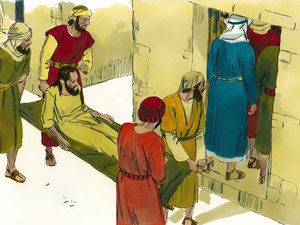 are more developed. Jesus healed a paralytic man who was let down through the roof in a house while he was lying helplessly on his bed-pallet (Mt 9.1-8; Mk 2.1-12; Lk 5.17-26). In Mark 2, the portion that pertains to Christology is as follows [in the New American Standard Bible]:
5 And Jesus seeing their faith said to the paralytic, “My son, your sins are forgiven.”
6 But there were some of the scribes sitting there and reasoning in their hearts,
7 “Why does this man speak that way? He is blaspheming; who can forgive sins but God alone?”
8 And immediately Jesus, aware in His spirit that they were reasoning that way within themselves, said to them, “Why are you reasoning about these things in your hearts?
9 “Which is easier, to say to the paralytic, ‘Your sins are forgiven;’ or to say, ‘Arise, and take up your pallet and walk?’
10 “But in order that you may know that the Son of Man has authority on earth to forgive sins”—He said to the paralytic—
11 “I say to you, rise, take up your pallet and go home.”
12 And he rose and immediately took up the pallet and went out in the sight of all; so that they were all amazed and were glorifying God, saying, “We have never seen anything like this.”
Scribes were the biblical scholars of that time, the recognized authorities in interpreting the Law of Moses. Luke more specifically identifies “Pharisees and teachers of the law sitting there” (Lk 5.17). Jesus no doubt posed His question for the benefit of the crowd, which would have been aware of the traditional precept behind the scribes’ thinking. The common answer to Jesus’ question would be that it would be impossible for anyone to heal a paralytic; if Jesus healed him, it would seem to demonstrate that He had the authority to forgive the man’s sins as well. In Judaism, lameness and sins were thought to be inter-related (e.g., Jn 5.14; 9.2), and so were healing and divine salvation, which includes divine forgiveness (e.g., Isa 35.4-5).
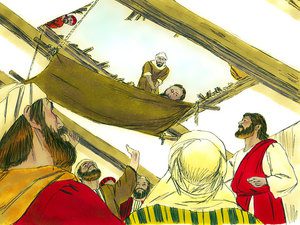 These scribes inwardly accused Jesus of blasphemy because of their tradition that the authority to forgive sins in a final sense is a prerogative that belongs only to God. Judaism had determined that even the promised Messiah could not forgive sins. So, these scribes took Jesus’ assertion as an affront to God’s majesty, if not an implied claim to be God. In the Torah, insulting God’s dignity was the primary basis of blasphemy.
Christian traditionalists have usually agreed with these Jewish scribes, and their tradition, that only God can forgive sins. And they have further alleged that Jesus’ claim to forgive sins was an indirect claim to be God. But were these scribes right, that only God can forgive sins and that if anyone else professes to do so it is blasphemy? E.P. Sanders claims that “such a pronouncement would not be regarded as blasphemy by any known Jewish law or by any known interpretation.”[1] If Sanders is correct, that must be why this accusation was never made later, at Jesus’ examination before the Sanhedrin.
 Jesus’ announcement of forgiveness, in Mk 2.5, is in the passive voice and thus is somewhat ambiguous.[2] Indeed, the scribes seem to have been rather perplexed as to what Jesus meant. Did He mean that God had forgiven the paralytic and that Jesus was merely exercising His prophetic office by announcing that fact? That is what the prophet Nathan did when he said to penitent King David, “The LORD also has taken away your sin” (2 Sam 12.13). However, in v. 10 Jesus made it perfectly clear that He possessed authority to forgive sins. Surely, any such decision on His part would not be contrary to the divine will but commensurate with it. Indeed, the Johannine Jesus explained, “if I do judge, My judgment is true; for I am not alone in it, but I and He who sent Me” (Jn 8.16).
 In addition, when Jesus healed the paralytic the attending crowd responded by “glorifying God” (Mk 2.12; Lk 5.25-26). This does not mean that they glorified Jesus as God. Matthew explains, “But when the multitudes saw this, they were filled with awe, and glorified God, who had given such authority to men” (Mt 9.8). In other words, the people glorified God because they rightly recognized that God had given Jesus authority to heal as well as to forgive sins. And it is evident from the last clause that this was Matthew’s understanding as well. Traditionalist M.M.B. Turner further explains, “the significance which Jesus attaches to his pronouncement of forgiveness and the corroborating miracle, is not that he shares the divine essence but rather that he already has the authority of the Son of man to execute God’s judgment (Mk 2:10).”[3]
This probably was the first time during Jesus’ public ministry that He claimed authority to forgive sins. But it was not His last. At least two more times Jesus expressly claimed authority to judge on judgment day (e.g., Mt 16.27; 25.31-46). Surely such authority includes the right to do so prior to that time, e.g., at that moment when the paralytic was brought to Him. Besides, the Johannine Jesus seems to have not restricted His authority to forgive only on judgment day because He announced, “For not even the Father [alone] judges anyone, but He has given all judgment to the Son” (Jn 5.22).
Furthermore, the authority to forgive sins in a final sense is a prerogative that God has delegated to others besides Jesus. And when He has done so, the recipients of such authority have not been perceived as being God.[4] The best OT example is “the angel of the LORD.” God had instructed the wandering Israelites regarding this patron angel, “Be on your guard before him and obey his voice; do not be rebellious toward him, for he will not pardon your transgression” (Ex 23.21). The implication is that the Angel of the LORD has authority to forgive Israel’s sins.
[See a large section in RJC in which I claim that “the angel of the LORD” in Ex 23.20-23 and 32.2 is not God himself, as many have believed, but an actual angel, that is, the guardian angel of Israel, who is Michael the archangel as in Daniel 10.13, 21 and 12.1.]
Also, Jesus’ instructions to His disciples about binding and loosing allude to a networking of forgiveness between God and men. The first time this occurred was when Jesus gave Peter the keys of the kingdom of God and told him that he would be the first of the apostles to open and close the door(s) to the kingdom. In other words, whatever Peter chose to bind or loose on earth would be bound or loosed in heaven, with heaven being a euphemism meaning that God would approve of it (Mt 16.19; cf. 18.18). The second time this occurred, Jesus was more specific. It seems to have involved, among other things, both forgiving sin and refusing to forgive sin by calling down judgment from heaven. For, Matthew records that this promise of Jesus was given in the context of forgiveness (Mt 18.15-17, 21-35). [See my 2015 book, Solving the Samaritan Riddle: Peter’s Kingdom Keys Explain Spirit Baptism.]
Jesus made this even clearer during one of His post-resurrection appearances, when He mysteriously breathed the Holy Spirit onto His disciples. Then He said to them, “If you forgive the sins of any, their sins have been forgiven them; if you retain the sins of any, they have been retained” (Jn 20.23). R.E. Brown illuminates the meaning of the first clause by paraphrasing it, “When you forgive men’s sins, at that moment God forgives those sins and they remain forgiven.”[5] This bestowal of the Holy Spirit as well as Jesus’ associated proclamation about the authority to forgive sins represents the transference of power and authority from Jesus unto His disciples. The result, of course, is a continuation of Jesus’ ministry on earth following His ascension into heaven.
It must therefore be concluded that if God grants authority to forgive sins to angels or men, and it does not indicate that they are God, Jesus’ authority to forgive sins does not necessarily imply that He is God either. Neither does Jesus’ authority to judge on the day of judgment necessarily make Him God. And this prerogative does not belong to Jesus inherently but has been granted to Him by the Father (Jn 5.22, 27; 8.16).
Finally, when church fathers interpreted that Jesus forgiving sins, in Mk 2.5-7, means that He was God, they contradicted another aspect of their theology. They insisted that the prerogative to forgive sins belongs only to deity and thus Jesus’ divine nature. Yet Jesus had said that the reason He possessed this authority to forgive sins was that He was “the Son of Man.” Church fathers, and many subsequent traditionalists, believed that Jesus’ status as the Son of Man referred exclusively to His human nature.
[1] E.P. Sanders, The Historical Figure of Jesus, 213.
[2] Dieter Zeller, “Jesus,” in DDD 468.
[3] M.M.B. Turner, “The Spirit of Christ and Christology,” 171.
[4] See D. Cupitt, Jesus and the Gospel of God, 16-17.
[5] R.E. Brown, John (xiii-xxi), 1024.
…………….
To see a list of titles of 130+ posts (2-3 pages) that are about Jesus not being God in the Bible, with a few about God not being a Trinity, at Kermit Zarley Blog click “Chistology” in the header bar. Most are condensations of my book, The Restitution of Jesus Christ. See my website servetustheevangelical.com, which is all about this book, with reviews, etc. Learn about my books and purchase them at kermitzarley.com. I was a Trinitarian for 22 years before reading myself out of it in the Bible.
The Restitution of Jesus Christ
Previous Post

March 23, 2017
Which Came First: Paul's Letters or the Synoptic Gospels?
Next Post

March 26, 2017 Dustin Johnson Wins Three-in-a-Row
Browse Our Archives
Select a Category Angels Billy Graham Blog Description Book Reviews Christian Living Christianity Christology Church History Current Events Deity of Christ? Disarmament Eschatology Evangelicalism Ezekiel 38-39 Film Reviews God Golf Gospel Harmonization Health History Holy Spirit Incarnation? Interview Islam Israeli-Palestinian Conflict Jesus Last Empire Literary Announcements Major Championship Winners Masters Monotheism My Books New Testament Old Testament Politics Primitive Weapons Ryder Cup Science Society of Biblical Literature The Bible The Restitution of Jesus Christ Trinitarianism Trinity? Uncategorized Unconditional Love? War on Terrorism
Select a Month October 2026 September 2026 August 2026 July 2026 June 2026 May 2026 April 2026 March 2026 February 2026 January 2026 December 2025 November 2025 October 2025 September 2025 August 2025 July 2025 June 2025 May 2025 April 2025 March 2025 February 2025 January 2025 December 2024 November 2024 October 2024 September 2024 August 2024 July 2024 June 2024 May 2024 April 2024 March 2024 February 2024 January 2024 December 2023 November 2023 October 2023 September 2023 August 2023 July 2023 June 2023 May 2023 April 2023 March 2023 February 2023 January 2023 December 2022 November 2022 October 2022 September 2022 August 2022 July 2022 June 2022 May 2022 April 2022 March 2022 February 2022 January 2022 December 2021 November 2021 October 2021 September 2021 August 2021 July 2021 June 2021 May 2021 April 2021 March 2021 February 2021 January 2021 December 2020 November 2020 October 2020 September 2020 August 2020 July 2020 June 2020 May 2020 April 2020 March 2020 February 2020 January 2020 December 2019 November 2019 October 2019 September 2019 August 2019 July 2019 June 2019 May 2019 April 2019 March 2019 February 2019 January 2019 December 2018 November 2018 October 2018 September 2018 August 2018 July 2018 June 2018 May 2018 April 2018 March 2018 February 2018 January 2018 December 2017 November 2017 October 2017 September 2017 August 2017 July 2017 June 2017 May 2017 April 2017 March 2017 February 2017 January 2017 December 2016 November 2016 October 2016 September 2016 August 2016 July 2016 June 2016 May 2016 April 2016 March 2016 February 2016 January 2016 December 2015 November 2015 October 2015 September 2015 August 2015 July 2015 June 2015 May 2015 April 2015 March 2015 February 2015 January 2015 December 2014 November 2014 October 2014 September 2014 July 2014 June 2014 May 2014 April 2014 March 2014 February 2014 January 2014 December 2013 November 2013 October 2013 September 2013 August 2013 July 2013 June 2013 May 2013 April 2013
Follow Us!
TAKE THE
Religious Wisdom Quiz
How many chapters are in Proverbs?
Select your answer to see how you score.
50 27 22 31
Books by This Author Books by Kermit Zarley Blog
Related posts from Kermit Zarley Blog

The Nicene Creed's Birthplace Is Found Buried in...

Stephen Hawking Said "Losers" Boast about IQ—That's Trump

Trump Should Retake his Old Name Drumpf that...
Counting the Cost Before Going to War
TRENDING AT PATHEOS Progressive Christian

The Sermon on the Mount, Part I: Matthew...
The Sermon on the Mount, Part I (Matthew 4:12-5:12) St. Matthew moves...

What's up from Crossway: Reviewing some of their latest A few weeks...

Janie Learns the Way of the Cross: A...
Teaching children about Jesus' Passion can be challenging. Many parents and educators...

Looking For Good Catholic Writing - October 2026
He alone extends the heavens, and he walks upon the waves of...

In "Irreplaceable," our book on vocation and technology, Trevor Sutton and I...

I was strolling through the top floor of the brand new Parthenon...
view all Progressive Christian blogs
Ad-Free & Subscriber Log-In Subscription Support
- About Us
- 2026 Calendar
- Videos
- Podcasts
- Library of World Religions
- Faith In Media Tracker
- Advertise With Us
- Write for Us
- Privacy Policy
- Terms of Service
- Do Not Sell My Data
- Contact Us
- Radiant Digital
- Manage Newsletter Subscriptions
- Unsubscribe From Notifications
- Sitemap
Copyright 2008-2026, Patheos. All rights reserved.
Subscription Support Ad-Free & Subscriber Log-In
Follow Patheos