
BuddhistCatholicContemplativeEvangelicalGeneral ChristianHinduJewishLatter-day SaintMuslimNew VisionsProgressive Christian
Beliefs
- Buddhist
- Catholic
- Contemplative
- Evangelical
- General Christian
- Hindu
- Jewish
- Latter-day Saint
- More Voices
- Muslim
- New Visions
- Pagan
- Progressive Christian
Topics
- Religion News
- Food and Religion
- Sports and Religion
- Religious Art
- Religious Music and Entertainment
- Religious Events
- History and Religion
- Style and Religion
- Politics and Religion
- Women in Religion
- Recreation Outdoors and Religion
- Business Finance and Religion
- Careers Workplace and Religion
- Education and Religion
- Family Parenting and Religion
- Health Fitness and Religion
- Home and Religion
- Relationships and Religion
- Technology and Religion
- Travel and Religion
Columnists
- Buddhist Columnists
- Business Finance and Religion Columnists
- Careers Workplace and Religion Columnists
- Catholic Columnists
- Contemplative Columnists
- Education and Religion Columnists
- Evangelists Columnists
- Family Parenting and Religion Columnists
- General Christian Columnists
- Health Fitness and Religion Columnists
- Hindu Columnists
- History and Religion Columnists
- Home and Religion Columnists
- Jewish Columnists
- More Voices Columnists
- Latter Day Columnists
- Muslim Columnists
- New Visions Columnists
- Nonreligious Columnists
- Pagan Columnists
- Politics and Religion Columnists
- Progressive Columnists
- Recreation Outdoors and Religion Columnists
- Relationships and Religion Columnists
- Religion News Columnists
- Religious Art Columnists
- Religious Events Columnists
- Religious Music and Entertainment Columnists
- Sports and Religion Columnists
- Style and Religion Columnists
- Technology and Religion Columnists
- Travel and Religion Columnists
- Women in Religion Columnists
Resource Library
- 2026 Calendar
- Library of World Religions
- The 100 Most Holy Places on Earth
- Patheos Answers
- Podcasts
- Videos
- Faith Leaders Database
- Anglican Episcopalian
- Bahai
- Baptist
- Buddhism
- Christianity
- Confucianism
- Eastern Orthodoxy
- Hinduism
- Holiness and Pentecostal
- ISKCON
- Islam
- Judaism
- Lutheran
- Methodist
- The Church of Jesus Christ of Latter-day Saints
- New Age
- Paganism
- Presbytarian and Reformed
- Protestantism
- Religion Behind the Scenes
- Roman Catholic
- Scientology
- Shia Islam
- Sikhism
- Sufism
- Sunni Islam
- Taoism
- Zen
- See all religions
Research Tools
 Ad-Free & Subscriber Log-In Subscription Support
Follow Patheos 

- Trending:
- Advent
- |
- Forgiveness
- |
- Thanksgiving
- |
- Election
- |
- Seasonal Holidays
- |
- Marriage

-
Categories
-
Christian Living
-
Christology
-
Golf
-
My Books
- Home
- Progressive Christian
- Religion News
- Which Came First: Paul’s Letters or the Synoptic Gospels?
Which Came First: Paul’s Letters or the Synoptic Gospels?
Last updated on: March 23, 2017 at 11:49 pm by Kermit Zarley
Which Came First: Paul’s Letters or the Synoptic Gospels? 2017-03-23T23:49:54-07:00 Kermit Zarley
Patheos Explore the world's faith through different perspectives on religion and spirituality! Patheos has the views of the prevalent religions and spiritualities of the world.
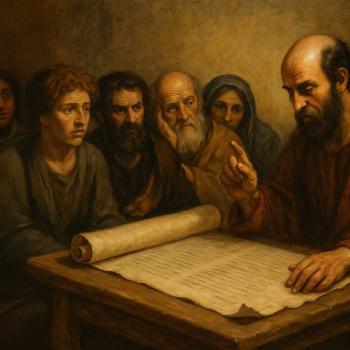
All New Testament (NT) scholars agree that the Apostle Paul’s undisputed letters therein were written before the synoptic gospels (Matthew, Mark, and Luke) were written. I certainly don’t disagree with this, especially since I have no expertise on it. But what really came first, meaning the content of these documents? If the content of the synoptic gospels is based largely on oral tradition, as I think it is–so that those authors were not original in what they wrote but merely reported oral tradition established quite early and perhaps some non-extant, written tradition–then are NT scholars right in saying Paul’s content in his letters is antecedent to any parallel content in the synoptics? I think the answer has to be “no.” But granted, there isn’t a lot of parallel content between these two types of documents.
Now, I realize that one of the synoptic gospels is the Gospel of Matthew and that Matthew was one of Jesus’ chosen apostles. Thus, one would think that much of that gospel represented Matthew’s own recall of Jesus’ words and deeds that Matthew witnessed. But NT scholars tell us that the NT gospels originally did not have these titles, so that they were added later. If so, how can we be sure they were added by those gospel authors themselves? Furthermore, the gospels of Matthew, Mark, and John do not inform us about who wrote them. This silence suggests that at least the gospels of Matthew, Mark, and Luke are more properly identified as compilations of already established sources.
In fact, that is what Luke (a Gentile?) expressly says of his gospel. In his prologue he states, “many have undertaken to set down an orderly account of the events that have been fulfilled among us, just as they were handed on to us by those who from the beginning were eyewitnesses and servants of the word” (Luke 1.1-2). Luke’s first clause, here, refers to some people who had written these things, and Luke’s second clause refers to earlier eyewitnesses who had “handed on to us,” surely meaning orally and probably meaning established oral tradition. Luke adds, “I decided, after investigating everything carefully from the very first, to write an orderly account” (v. 3). He likely means that most of what he wrote in his gospel was oral and written tradition that he gathered.
As for the Gospel of Matthew, many scholars think it was produced by a church community, perhaps at Antioch, and that Matthew was counted among its members so that he verified most if not all of its content.
Concerning the Gospel of Mark, according to early church tradition it was written by John Mark who accompanied Paul and Barnabas in ministry and was a relative of Barnabas (Acts 12.25; Colossians 4.10). Early church father Papias wrote that this John Mark authored the Gospel of Mark while accompanying the Apostle Peter on missionary journeys in Italy, listening to Peter’s sermons. I have doubts about that due to some things in that gospel. But even if true, Mark could have compared what Peter said with already established oral tradition. And there are other similar scenarios that are possible.
I think it helps NT gospel readers a lot to understand what likely happened after the Christ event. Jesus’ disciples were discouraged when he was executed. But then they discovered Sunday morning that his body was missing from the tomb. Then he literally appeared to them hours later and multiple times over a period of the next forty days. Nothing else can explain how they then became emboldened to go out into the world and preach this gospel of the risen Jesus, even forfeiting their lives to death in doing so.
But even before that world evangelistic program got cranking, the disciples who had witnessed Jesus must have gathered together in various locales to reminisce, thus remembering what he did and said. And they would have been scouring what we Christians call the Old Testament, trying to understand how Jesus as the promised Messiah of Israel had to die, which was completely foreign to what they had been taught in their Jewish religious tradition. In doing so, these early disciples of Jesus created what scholars call “the first Jesus traditions.” I think this is the main, original source of the NT gospels. And for me, this concept makes it much easier to trust the content of these gospels rather than attributing each of them to a single author. That is, I can much more easily believe what a group of eyewitnesses recollect together about events than I can a single person. Sure, some readers will say that I’m not considering how the Holy Spirit would be involved, such as Jesus stated in John 14.26: “the Holy Spirit, whom the Father will send in my name, will teach you everything, and remind you of all that I have said to you.” No, I am. I think the establishment of oral tradition was the divine program and that it was engineered by God’s Spirit.
Regardless of how the synoptic gospels were authored or compiled, if we accept all of the ten New Testament letters that are internally attributed to Paul, biblical scholars tell us that these letters span a time period of approximately 50-65 CE. But it is most likely that Jewish-Christian communities had already created solid oral tradition about Jesus, which surely included much reminiscing by Jesus’ selected apostles, prior to 50 CE. If so, that means content in the synoptic gospels originated prior to similar content in Paul’s letters. This way of looking at this NT written evidence therefore disregards the mode of communication–whether by written form or oral form–and only regards the origin of the communication itself.
In conclusion, concerning any parallel content in the synoptic gospels and Paul’s letters, the former really came first since it was based mostly on earlier oral tradition, which Paul sometimes used too.
Previous Post

March 21, 2017
Saint Luke Did Not Believe Jesus Was God
Next Post

March 24, 2017 Did Jesus' Authority to Forgive Sins Indicate He Was God?
Browse Our Archives
Select a Category Angels Billy Graham Blog Description Book Reviews Christian Living Christianity Christology Church History Current Events Deity of Christ? Disarmament Eschatology Evangelicalism Ezekiel 38-39 Film Reviews God Golf Gospel Harmonization Health History Holy Spirit Incarnation? Interview Islam Israeli-Palestinian Conflict Jesus Last Empire Literary Announcements Major Championship Winners Masters Monotheism My Books New Testament Old Testament Politics Primitive Weapons Ryder Cup Science Society of Biblical Literature The Bible The Restitution of Jesus Christ Trinitarianism Trinity? Uncategorized Unconditional Love? War on Terrorism
Select a Month November 2026 October 2026 September 2026 August 2026 July 2026 June 2026 May 2026 April 2026 March 2026 February 2026 January 2026 December 2025 November 2025 October 2025 September 2025 August 2025 July 2025 June 2025 May 2025 April 2025 March 2025 February 2025 January 2025 December 2024 November 2024 October 2024 September 2024 August 2024 July 2024 June 2024 May 2024 April 2024 March 2024 February 2024 January 2024 December 2023 November 2023 October 2023 September 2023 August 2023 July 2023 June 2023 May 2023 April 2023 March 2023 February 2023 January 2023 December 2022 November 2022 October 2022 September 2022 August 2022 July 2022 June 2022 May 2022 April 2022 March 2022 February 2022 January 2022 December 2021 November 2021 October 2021 September 2021 August 2021 July 2021 June 2021 May 2021 April 2021 March 2021 February 2021 January 2021 December 2020 November 2020 October 2020 September 2020 August 2020 July 2020 June 2020 May 2020 April 2020 March 2020 February 2020 January 2020 December 2019 November 2019 October 2019 September 2019 August 2019 July 2019 June 2019 May 2019 April 2019 March 2019 February 2019 January 2019 December 2018 November 2018 October 2018 September 2018 August 2018 July 2018 June 2018 May 2018 April 2018 March 2018 February 2018 January 2018 December 2017 November 2017 October 2017 September 2017 August 2017 July 2017 June 2017 May 2017 April 2017 March 2017 February 2017 January 2017 December 2016 November 2016 October 2016 September 2016 August 2016 July 2016 June 2016 May 2016 April 2016 March 2016 February 2016 January 2016 December 2015 November 2015 October 2015 September 2015 August 2015 July 2015 June 2015 May 2015 April 2015 March 2015 February 2015 January 2015 December 2014 November 2014 October 2014 September 2014 July 2014 June 2014 May 2014 April 2014 March 2014 February 2014 January 2014 December 2013 November 2013 October 2013 September 2013 August 2013 July 2013 June 2013 May 2013 April 2013
Follow Us!
TAKE THE
Religious Wisdom Quiz
Which prophet's wife died as a sign to Israel, and he was told not to mourn?
Select your answer to see how you score.
Amos Obadiah Ezekiel Daniel
Books by This Author Books by Kermit Zarley Blog
Related posts from Kermit Zarley Blog

What Is "Easy Believism" that Is Rampant in...
When Romans 13 Meets Tyranny: Interpreting Obedience

Trump's "America First" Policy May Make "America Last"
Is "the Word" in John 1.1-3 an "it"...
TRENDING AT PATHEOS Progressive Christian

In 1939, President Franklin D. Roosevelt moved Thanksgiving from November 30 to...

Reasons for Restraint: Ricardo Gonzalez, Florida and Dec...
The Morning of January 3 I begin with the dead. On the...

I published this column for Thanksgiving 2012 in the Deseret News....

For many years, Catholicism has been caught up in division over the...

'Statements of Faith' never get shorter
Nothing demonstrates a conservative commitment to faith and faithfulness like a "statement...

Michele's Reviews - Future Grace by John Piper
In God's Place, at God's Pace, by Future Grace Impatience is...
view all Progressive Christian blogs
Ad-Free & Subscriber Log-In Subscription Support
- About Us
- 2026 Calendar
- Videos
- Podcasts
- Library of World Religions
- Faith In Media Tracker
- Advertise With Us
- Write for Us
- Privacy Policy
- Terms of Service
- Do Not Sell My Data
- Contact Us
- Radiant Digital
- Manage Newsletter Subscriptions
- Unsubscribe From Notifications
- Sitemap
Copyright 2008-2026, Patheos, part of the Radiant Digital network of media brands. All rights reserved.
Subscription Support Ad-Free & Subscriber Log-In
Follow Patheos