
BuddhistCatholicContemplativeEvangelicalGeneral ChristianHinduJewishLatter-day SaintMuslimNew VisionsProgressive Christian
Beliefs
- Buddhist
- Catholic
- Contemplative
- Evangelical
- General Christian
- Hindu
- Jewish
- Latter-day Saint
- More Voices
- Muslim
- New Visions
- Pagan
- Progressive Christian
Topics
- Religion News
- Food and Religion
- Sports and Religion
- Religious Art
- Religious Music and Entertainment
- Religious Events
- History and Religion
- Style and Religion
- Politics and Religion
- Women in Religion
- Recreation Outdoors and Religion
- Business Finance and Religion
- Careers Workplace and Religion
- Education and Religion
- Family Parenting and Religion
- Health Fitness and Religion
- Home and Religion
- Relationships and Religion
- Technology and Religion
- Travel and Religion
Columnists
- Buddhist Columnists
- Business Finance and Religion Columnists
- Careers Workplace and Religion Columnists
- Catholic Columnists
- Contemplative Columnists
- Education and Religion Columnists
- Evangelists Columnists
- Family Parenting and Religion Columnists
- General Christian Columnists
- Health Fitness and Religion Columnists
- Hindu Columnists
- History and Religion Columnists
- Home and Religion Columnists
- Jewish Columnists
- More Voices Columnists
- Latter Day Columnists
- Muslim Columnists
- New Visions Columnists
- Nonreligious Columnists
- Pagan Columnists
- Politics and Religion Columnists
- Progressive Columnists
- Recreation Outdoors and Religion Columnists
- Relationships and Religion Columnists
- Religion News Columnists
- Religious Art Columnists
- Religious Events Columnists
- Religious Music and Entertainment Columnists
- Sports and Religion Columnists
- Style and Religion Columnists
- Technology and Religion Columnists
- Travel and Religion Columnists
- Women in Religion Columnists
Resource Library
- 2026 Calendar
- Library of World Religions
- The 100 Most Holy Places on Earth
- Patheos Answers
- Podcasts
- Videos
- Faith Leaders Database
- Anglican Episcopalian
- Bahai
- Baptist
- Buddhism
- Christianity
- Confucianism
- Eastern Orthodoxy
- Hinduism
- Holiness and Pentecostal
- ISKCON
- Islam
- Judaism
- Lutheran
- Methodist
- The Church of Jesus Christ of Latter-day Saints
- New Age
- Paganism
- Presbytarian and Reformed
- Protestantism
- Religion Behind the Scenes
- Roman Catholic
- Scientology
- Shia Islam
- Sikhism
- Sufism
- Sunni Islam
- Taoism
- Zen
- See all religions
Research Tools
 Ad-Free & Subscriber Log-In Subscription Support
Ad-Free & Subscriber Log-In Subscription Support
Follow Patheos 

- Trending:
- Forgiveness
- |
- Marriage
- |
- Consciousness
- |
- Death Penalty
- |
- Election
- |
- Halloween

-
Categories
-
Christian Living
-
Christology
-
Golf
-
My Books
- Home
- Progressive Christian
- Religion News
- Review of Lee Strobel’s book, “The Case for Christ:” Part 1 of 2
Review of Lee Strobel’s book, “The Case for Christ:” Part 1 of 2
Last updated on: November 15, 2018 at 5:09 pm by Kermit Zarley
Review of Lee Strobel’s book, “The Case for Christ:” Part 1 of 2 2018-11-15T17:09:05-07:00 Kermit Zarley
Patheos Explore the world's faith through different perspectives on religion and spirituality! Patheos has the views of the prevalent religions and spiritualities of the world.
 Lee Strobel is a 64-year old, very successful, apologist author of books on Christian faith. But it wasn’t always so. He graduated from Harvard Law School and then was a journalist for 14 years at The Chicago Tribune newspaper. In Strobel’s most popular book, The Case for Christ (1998, Zondervan, p 13), he relates, “For much of my life I was a skeptic. In fact, I considered myself an atheist…. As for Jesus, didn’t you know that he never claimed to be God? He was a revolutionary, a sage, an iconoclastic Jew–but God?… As far as I was concerned, the case was closed. There was enough proof for me to rest easy with the conclusion that the divinity of Jesus was nothing more than the fanciful invention of superstitious people.”
Then Lee Strobel came to a place in his life where he looked more deeply into the identity of Jesus of Nazareth. But Strobel began this spiritual quest from the wrong premise–whether or not Jesus is God. He should have begun his journey with the question of whether or not Jesus was Israel’s Messiah sent by God to die for our sins on the cross and arise from the dead, thereby making himself available to us as our Savior from sin by God forgiving us and giving us eternal salvation. That is what the New Testament is all about.
But no, Strobel was converted and went way beyond these New Testament precepts to proclaim that Jesus is God. Of course, it is interesting to learn stories of people who were atheists and then converted to faith in Jesus. But faith in Jesus as Savior is not the same as believing Jesus is God.
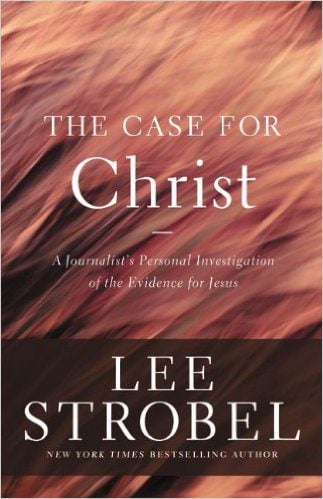 Strobel’s bestseller, The Case for Christ, is like C. S. Lewis’ book, Mere Christianity. The primary thrust of both books is their authors assert that Jesus claimed to be God and is God. But then, they are only espousing what the post-apostolic, institutional church has said. If you go by the New Testament, I think that is wrong.
Just for starters, check these out: (1) Jesus never claims to be God in any of his New Testament gospel sayings; (2) Jesus clearly embraced Jewish monotheism, that God, whom Jesus called “Father,” is numerically one, thus a single person (e.g., John 5.44; 17.3; Mark 12.28-34); (3) Jesus said, “The Father is greater than I” (John 14.28); (4) the two times when Jesus was accused of making himself God or equal with God, he denied it (John 5.18-47; 10.30-38); (5) at Jesus’ hearing before the Sanhedrin, he was’t accused of ever claiming to be God; (6) in all of the evangelistic sermons and statements in the book of Acts, nothing is said about Jesus being God; (7) and there is no discussion or argument recorded in the New Testament about whether or not Jesus is God. All of this indicates that it is highly questionable that the New Testament ever says Jesus is God. Many of the few biblical texts that scholars put forth as evidence that Jesus is God have grammatical difficulties and therefore likely do not say Jesus is God.
As with Strobel, so with me–it wasn’t always so. I was a Trinitarian Christian for 22 years and involved in ministry on the PGA Tour for seventeen years. Then I had a eureka moment one day while reading Jesus Olivet Discourse that changed my theology and life forever. See “At Forty Years Old I Best Saw the Light–Trinity Doctrine No Longer Seemed Right.”
Like the good journalist that Strobel was, he crafted his book The Case for Christ based on interviews he conducted with thirteen of illustrious Evangelical scholars in the U.S. academy. They include Craig Blomberg, Bruce Metzger, Edwin Yamauchi, Gregory Boyd, Ben Witherington, Don Carson, William Lane Craig, and Gary Habermas. I respect all of these men and have many of their books in my library. Yet I think they are wrong to have followed church fathers on this topic, claiming Jesus is God.
William Lane Craig, who appears often on television, has become the most prominent apologist for Christian faith in the U.S. In Strobel’s interview with Dr. Craig, he quotes him as saying (p. 30), “‘Son of Man’ is often thought to indicate the humanity of Jesus, just as the reflex expression ‘Son of God’ indicates his divinity. In fact, just the opposite is true. The Son of Man was a divine figure in the Old Testament book of Daniel who would come at the end of the world to judge mankind and rule forever. Thus, the claim to be the Son of Man would be in effect a claim to divinity.”
I disagree. Daniel relates his vision about “one like a son of man, coming with the clouds of heaven,” approaching the enthroned God in heaven, and being given a great kingdom of people (Daniel 7.13-14 NIV). There is nothing in this text indicating this Son of Man is God. Quite the contrary, the Bible repeatedly says there is numerically one God, whom it often identifies as “the Most High.” And Jesus often alluded to this Daniel text when he constantly identified himself as the Son of Man. And clouds certainly don’t indicate deity, as some scholars claim, since believers will be resurrected in the future and “be caught up in the clouds” as well (1 Thessalonians 4.17).
In Strobel’s interview of Dr. Craig Blomberg (p. 29), the latter cites Jesus saying “I am” in John 8.58 as evidence of Jesus indirectly claiming to be God. Blomberg and many others make this assertion by connecting this “I am” (Greek ego eimi) with that said by God in Exodus 3.14. But God only means by it that he is “The LORD,” which he says in v. 15 and is Yahweh (Hebrew YHWH), God’s name. (Bible translation tradition never transliterates God’s name, YHWH, but renders it “the LORD.”) Most New Testament scholars say Jesus never claimed to be Yahweh. Regardless, Jesus likely meant in John 8.58 that he ranks superior to Moses. (See my Restitution of Jesus Christ book on this.)
Strobel also quotes Blomberg saying (p. 30), “Jesus claims to forgive sins in the synoptics, and that’s something only God can do.” Blomberg refers to Mark 2.10 and Matt. 9.5. But later, when Jesus was accused of claiming to be “equal to God” (John 5.18), he extensively denied it (vv. 19-47). He therein said of himself as the Son, “For just as the Father has life in himself, so he has granted the Son also to have life in himself; and he has given him authority to execute judgement, because he is the Son of Man” (vv. 26-27). So, God gave Jesus the authority to judge by either forgiving sins or not forgiving sins. If Jesus was God, the authority to forgive sins would be intrinsic to his nature so that he would not have had to be given this authority.
In Strobel’s interview of my friend Ben Witherington, Lee said to the good Doctor (p. 135), “‘Certainly you can’t say that Jesus’ miracles establish that he thought he was God.’ I said, ‘since later his own disciples went out and did the same things–and certainly they weren’t making claims of deity.'”
Ben answered, “No–to Jesus, his miracles are a sign indicating the coming of the kingdom of God.” That is quite right. But in one of my previous posts, entitled “Ben Witherington Entangles Himself by Deifying Jesus,” I mention that Ben gave a lecture, now online, in which I say Ben “cites the Devil’s temptation of Jesus to turn stones into bread, recorded in Matt. 4.3 and Luke 4.3. Ben says the Devil would not have tempted Jesus like that unless he was God because only God could do such a miracle.”
WOW! I must say, Ben, I was shocked by this from a scholar of your stature. Many Christians throughout the ages have thought likewise, that Jesus was God because he did miracles, and many have thought this since Jesus arose from the dead. But so many Bible scholars of various stripes have rightly alleged that this kind of thinking is so short sighted. Prophets and Jesus’ apostles did miracles, and all of God’s people will arise from the dead to receive immortal bodies at the resurrection at the end of the age; yet none of these things prove that any of these people were God. So, I’m only saying the same thing in that post that Strobel said to Witherington, with which he agreed. I don’t know if Ben realizes that he made a contradiction between these two statements.
But Strobel makes the same contradiction in some statements of his own in The Case for Christ. He had earlier stated with approval concerning Jesus’ resurrection (p. 35), “The Resurrection–which is cited by Christians as the crowning confirmation of Jesus’ divinity.” Strobel later says (p. 206), “The Resurrection is the supreme identification of Jesus’ divine identity.” Both statements contradict what Lee said to Ben, above.
As Strobel concludes his book he says (p. 262), “Jesus backed up his claim to being God through miraculous claims of healing,… and with his own resurrection, which was the final authentication of his identity.” Again, this is a clear contradiction to what Strobel earlier writes that he said to Witherington. Now, Strobel is not the first to say Jesus’ resurrection proves he was God; many Christians have erroneously thought that. But it is shallow thinking. The Bible proclaims that all of God’s people who have died will arise on Resurrection Day, and no one thinks that will prove they all are Gods.
N. T. (Tom) Wright does well in attempting to correct this misconception in his book, The Challenge of Jesus. He says, (p. 130), “A serious problem that needs addressing … is that the resurrection [of Jesus] has from fairly early on in the church been regarded as the proof of Jesus’ divinity.” Wright also explains (p. 108), “Again and again one hears it suggested that the resurrection somehow proves Jesus’ divinity, so that to affirm or deny the one is to affirm or deny the other.” Wright calls this a “mistake.” He adds, “Nothing in the Jewish expectation of resurrection indicates that anyone would conclude that, faced with someone alive again with a new sort of life following death, such a person must be in some sense divine. To the contrary: resurrection was what was supposed to happen to all the dead, or at least all the righteous dead, and there was no suggestion that this would simultaneously constitute divinization.”
C. S. Lewis, whom I otherwise much respect, commits the same errors in his bestseller Mere Christianity. Both he and Strobel assert in these books, which have been their most successful, that Jesus even claimed to be God. Yet it is astonishing that both authors never try to prove it. Thus, they don’t even cite and discuss any New Testament gospel sayings of Jesus in which they believe he claimed to be God. At least one would think Jesus’ saying in John 10.30 would be cited–“I and the Father are one”–since some church fathers wrongly asserted that Jesus therein claimed to be God.
I don’t see how such successful authors get away with such an assertion without being challenged to defend what is a very serious declaration–that Jesus claimed to be God. No, he did not, that is, if you believe the Bible! Even the leading evangelical, New Testament scholars, e.g., James D. G. Dunn and Tom Wright, now admit not only that Jesus never claimed to be God; they say he never believed he was God. See these posts:
“Tom Wright Says Jesus Didn’t Know He Was God”
“Does Tom Wright Believe Jesus Is God”
“Review of Tom Wright’s ‘Jesus and the Identity of God‘”
“Review of Jimmy Dunn’s Book, ‘Did the First Christians Worship Jesus?‘”
Finally, to see how weak Stroebel and his interviewees are on proving from scripture that Jesus is God, The Case for Christ does not even have a Scripture Index.
In conclusion, Jesus was a perfectly righteous man sent by God to die for our sins on the cross, and God proved it by raising him from the dead. That is the message of the New Testament that we Christians should proclaim to the world and not mix it with the error, adopted by church fathers who were influenced by Hellenism, that Jesus is God and that God is three persons.
(See Part 2 of this review, posted on May 7, 2017, by clicking here.)
(To see a titled list of over seventy, two-three page posts (easily accessible) about the Bible not saying Jesus is God, click here.)
Previous Post

January 26, 2017
Do President Donald Trump and Steve Bannon Believe in Our Democracy?
Next Post

January 29, 2017 The Doomsday Clock Moves Closer to Midnight
Browse Our Archives
Select a Category Angels Billy Graham Blog Description Book Reviews Christian Living Christianity Christology Church History Current Events Deity of Christ? Disarmament Eschatology Evangelicalism Ezekiel 38-39 Film Reviews God Golf Gospel Harmonization Health History Holy Spirit Incarnation? Interview Islam Israeli-Palestinian Conflict Jesus Last Empire Literary Announcements Major Championship Winners Masters Monotheism My Books New Testament Old Testament Politics Primitive Weapons Ryder Cup Science Society of Biblical Literature The Bible The Restitution of Jesus Christ Trinitarianism Trinity? Uncategorized Unconditional Love? War on Terrorism
Select a Month October 2026 September 2026 August 2026 July 2026 June 2026 May 2026 April 2026 March 2026 February 2026 January 2026 December 2025 November 2025 October 2025 September 2025 August 2025 July 2025 June 2025 May 2025 April 2025 March 2025 February 2025 January 2025 December 2024 November 2024 October 2024 September 2024 August 2024 July 2024 June 2024 May 2024 April 2024 March 2024 February 2024 January 2024 December 2023 November 2023 October 2023 September 2023 August 2023 July 2023 June 2023 May 2023 April 2023 March 2023 February 2023 January 2023 December 2022 November 2022 October 2022 September 2022 August 2022 July 2022 June 2022 May 2022 April 2022 March 2022 February 2022 January 2022 December 2021 November 2021 October 2021 September 2021 August 2021 July 2021 June 2021 May 2021 April 2021 March 2021 February 2021 January 2021 December 2020 November 2020 October 2020 September 2020 August 2020 July 2020 June 2020 May 2020 April 2020 March 2020 February 2020 January 2020 December 2019 November 2019 October 2019 September 2019 August 2019 July 2019 June 2019 May 2019 April 2019 March 2019 February 2019 January 2019 December 2018 November 2018 October 2018 September 2018 August 2018 July 2018 June 2018 May 2018 April 2018 March 2018 February 2018 January 2018 December 2017 November 2017 October 2017 September 2017 August 2017 July 2017 June 2017 May 2017 April 2017 March 2017 February 2017 January 2017 December 2016 November 2016 October 2016 September 2016 August 2016 July 2016 June 2016 May 2016 April 2016 March 2016 February 2016 January 2016 December 2015 November 2015 October 2015 September 2015 August 2015 July 2015 June 2015 May 2015 April 2015 March 2015 February 2015 January 2015 December 2014 November 2014 October 2014 September 2014 July 2014 June 2014 May 2014 April 2014 March 2014 February 2014 January 2014 December 2013 November 2013 October 2013 September 2013 August 2013 July 2013 June 2013 May 2013 April 2013
Follow Us!
TAKE THE
Religious Wisdom Quiz
Who tricked Isaac into giving him Esau's blessing?
Select your answer to see how you score.
Jacob Rebekah Laban Leah
Books by This Author Books by Kermit Zarley Blog
Related posts from Kermit Zarley Blog

New Book Affirms John's Gospel Is Historically Reliable

The Irony of Celebrating the Nicene Creed in...
New Book a Powerful Witness that Science Indicates...

Misbehavior of Ryder Cup Fans in New York...
TRENDING AT PATHEOS Progressive Christian

The Sermon on the Mount, Part I: Matthew...
The Sermon on the Mount, Part I (Matthew 4:12-5:12) St. Matthew moves...

What's up from Crossway: Reviewing some of their latest A few weeks...

Janie Learns the Way of the Cross: A...
Teaching children about Jesus' Passion can be challenging. Many parents and educators...

Looking For Good Catholic Writing - October 2026
He alone extends the heavens, and he walks upon the waves of...

In "Irreplaceable," our book on vocation and technology, Trevor Sutton and I...

I was strolling through the top floor of the brand new Parthenon...
view all Progressive Christian blogs
Ad-Free & Subscriber Log-In Subscription Support
- About Us
- 2026 Calendar
- Videos
- Podcasts
- Library of World Religions
- Faith In Media Tracker
- Advertise With Us
- Write for Us
- Privacy Policy
- Terms of Service
- Do Not Sell My Data
- Contact Us
- Radiant Digital
- Manage Newsletter Subscriptions
- Unsubscribe From Notifications
- Sitemap
Copyright 2008-2026, Patheos. All rights reserved.
Subscription Support Ad-Free & Subscriber Log-In
Follow Patheos