
BuddhistCatholicContemplativeEvangelicalGeneral ChristianHinduJewishLatter-day SaintMuslimNew VisionsProgressive Christian
Beliefs
- Buddhist
- Catholic
- Contemplative
- Evangelical
- General Christian
- Hindu
- Jewish
- Latter-day Saint
- More Voices
- Muslim
- New Visions
- Pagan
- Progressive Christian
Topics
- Religion News
- Food and Religion
- Sports and Religion
- Religious Art
- Religious Music and Entertainment
- Religious Events
- History and Religion
- Style and Religion
- Politics and Religion
- Women in Religion
- Recreation Outdoors and Religion
- Business Finance and Religion
- Careers Workplace and Religion
- Education and Religion
- Family Parenting and Religion
- Health Fitness and Religion
- Home and Religion
- Relationships and Religion
- Technology and Religion
- Travel and Religion
Columnists
- Buddhist Columnists
- Business Finance and Religion Columnists
- Careers Workplace and Religion Columnists
- Catholic Columnists
- Contemplative Columnists
- Education and Religion Columnists
- Evangelists Columnists
- Family Parenting and Religion Columnists
- General Christian Columnists
- Health Fitness and Religion Columnists
- Hindu Columnists
- History and Religion Columnists
- Home and Religion Columnists
- Jewish Columnists
- More Voices Columnists
- Latter Day Columnists
- Muslim Columnists
- New Visions Columnists
- Nonreligious Columnists
- Pagan Columnists
- Politics and Religion Columnists
- Progressive Columnists
- Recreation Outdoors and Religion Columnists
- Relationships and Religion Columnists
- Religion News Columnists
- Religious Art Columnists
- Religious Events Columnists
- Religious Music and Entertainment Columnists
- Sports and Religion Columnists
- Style and Religion Columnists
- Technology and Religion Columnists
- Travel and Religion Columnists
- Women in Religion Columnists
Resource Library
- 2026 Calendar
- Library of World Religions
- The 100 Most Holy Places on Earth
- Patheos Answers
- Podcasts
- Videos
- Faith Leaders Database
- Anglican Episcopalian
- Bahai
- Baptist
- Buddhism
- Christianity
- Confucianism
- Eastern Orthodoxy
- Hinduism
- Holiness and Pentecostal
- ISKCON
- Islam
- Judaism
- Lutheran
- Methodist
- The Church of Jesus Christ of Latter-day Saints
- New Age
- Paganism
- Presbytarian and Reformed
- Protestantism
- Religion Behind the Scenes
- Roman Catholic
- Scientology
- Shia Islam
- Sikhism
- Sufism
- Sunni Islam
- Taoism
- Zen
- See all religions
Research Tools
 Ad-Free & Subscriber Log-In Subscription Support
Ad-Free & Subscriber Log-In Subscription Support
Follow Patheos 

- Trending:
- Forgiveness
- |
- Marriage
- |
- Consciousness
- |
- Death Penalty
- |
- Election
- |
- Halloween

-
Categories
-
Christian Living
-
Christology
-
Golf
-
My Books
- Home
- Progressive Christian
- Religion News
- Review of J. Richard Middleton’s book “A New Heaven and a New Earth”
Review of J. Richard Middleton’s book “A New Heaven and a New Earth”
Last updated on: August 29, 2016 at 10:53 am by Kermit Zarley
Review of J. Richard Middleton’s book “A New Heaven and a New Earth” 2016-08-29T10:53:39-07:00 Kermit Zarley
Patheos Explore the world's faith through different perspectives on religion and spirituality! Patheos has the views of the prevalent religions and spiritualities of the world.
Dr. J. Richard Middleton is professor of Biblical Worldview and Exegesis at Northeastern Seminary in Rochester, New York. He is the author of A New Heaven and a New Earth: Reclaiming Biblical Eschatology (Grand Rapids: Baker Academic, 2014, pp. 332). It has received critical acclaim and has stellar endorsements, including from Walter Brueggemann and Donald A. Hagner. One of them says, “this sorely needed volume is the best book of its kind.” In 2014, it received the Word Guild Award as the best book in biblical studies that year.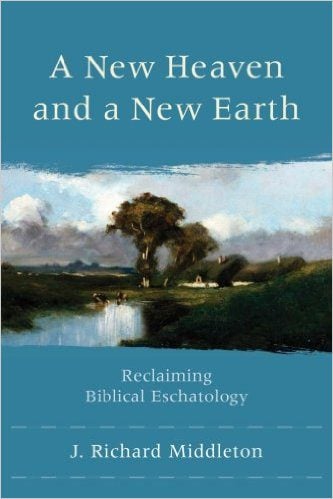
I have specialized in the study of biblical eschatology for over fifty years. So, I am always delighted to read a good book on this genre. And I was especially interested in this one because its title indicates that it is about an important subject in eschatology that one of its endorsements says is “a key biblical theme that is all too often neglected in academic circles.” Yet this book’s subject matter is the eternal destiny of the saints, which should be of interest to all of them.
I like this book even though I disagree with a few of its minor points. Middleton is a good researcher and knows the secondary literature on this subject (although there isn’t that much). Yet you wouldn’t know it at first glance since Baker Academic didn’t require Middleton to furnish a bibliography or author index, which is not very academic. The authorial style is quite accessible. However, Middleton commits the bane of scholars with too much prose material in footnotes. Chicago Manual of Style recommends against this, even for academicians.
I will only do here a partial review of A New Heaven and a New Earth. I fully subscribe to Middleton’s primary thesis in this book. It is that nearly all Christians believe heaven is their eternal destiny, whereas the Bible teaches to the contrary, that God’s people will live on a transformed earth. John, the author of Revelation, says, “I saw a new heaven and a new earth; for the first heaven and the first earth had passed away, and the sea was no more. And I saw the holy city, the new Jerusalem, coming down out of heaven from God” (Rev 21.1-2). I think the “sea” being “no more” indicates its saltwater will be replaced with freshwater. Saltwater obviously has its limitations: it cannot be used for drinking or for growing crops.
Middleton also does not address the difference between the singular for “heaven” in Revelation and its plural in Isaiah: “a/the new heavens and a/the new earth” (Isaiah 65.17; 66.22 NRSV). These three texts are the Bible’s only mention of this expression. The singular in Revelation has led some to think it refers to the heaven where God dwells whereas these two Isaiah texts seem to refer to the heavens of the universe, thus referring to all of God’s creation. But “the first heaven and the first earth” in Rev 21.1 clearly refer to original creation.
(The Hebrew word for “heaven” is shamayim. Its plural ending, yim, is like elohim, the Hebrew word for “God/God,” in that it can mean either singular or plural. In both Isaiah 65.17 and 66.22 in MT, the adjectives “new” that modify “heaven” are plural but singular modifying “earth.” So, in both Isaiah texts, shamayim must be understood in the plural, signifying “the heavens” of the universe. However, the LXX does render “heaven” in both Isaiah texts in the singular.)
Middleton rightly says this coming down of new Jerusalem from heaven will occur at the yet future eschaton, when God establishes “a new heaven and a new earth” (v. 1). However, Middleton does not make a distinction between the heaven where God dwells and the heavens of creation. This omission allows Middleton to say (pp. 71-72, “Heaven was never part of God’s purposes for humanity in the beginning of the story and has no intrinsic role as the final destiny of human salvation.” I don’t think that is quite right, which will become evident as I proceed. Middleton continues, “In Scripture the term ‘heaven’ (or the ‘heavens’) represents, first of all, part of the created universe…. the creator has chosen to dwell within the created universe…. this transcendent part of the created order is pictured as the location of God’s throne room.”
If so, where was God, not to mention angels, before or when he created the universe? I think this question and science’s discovery of big bang require God being outside the universe. So, Middleton does not distinguish between “the heavens,” referring to creation, and “the heaven” where God dwells. This is a difficulty in scripture. The New Testament (NT) sometimes refers to “the heavens” of creation with the singular (Gr. ouranos). But I think the heavens of creation should be distinguished from God’s abode in heaven. When Jesus said to pray, “Our Father, who is in heaven,” and “Your will be done, on earth as it is in heaven” (Matt. 6.9-10), he must have meant heaven in distinction from the heavens of the universe. Thus, I accept the old three-tiered concept of heaven literally above the cosmos as the best fit with scripture.
Middleton assumes that the new Jerusalem will be on earth, so he doesn’t discuss alternative views. I contend that can’t happen for various reasons, one being its size. Revelation 21.16 says, “The city lies foursquare, it length the same as its width;… fifteen hundred miles; its length and width, and height are equal.” Like most commentators on Revelation, Middleton (pp. 170-71) interprets this description as cube-shaped, with the height and each side 1,500 miles long. Such a monstrosity not only seems bazaar for the shape of a city, but it would not fit present earth. Biblical prophecies of a renovated or transformed earth in the eschaton (not another created earth that replaces it) indicate that the new earth will be comparable to its present size.
Middleton and commentators on Revelation should know that ancient cities were measured by their circumference. Thus, “three days” in Jonah 3.3 make no sense unless they are understood as how long it took to walk the circumference of ancient Ninevah. In my book, Warrior from Heaven (p. 213), I explain concerning new Jerusalem “It is a great and high mountain that is much more massive than earthly Jerusalem. New Jerusalem is shaped foursquare at its bottom, with each side being 375 miles long, making its perimeter measure 1,500 miles. Not only is the city’s length and width equal, so is its height. But this does not mean the city is cube-shaped; rather, it is shaped like a mountain, with its peak rising up at its center to measure 375 miles high.” (See my post, “Will Holy New Jerusalem Be Cube-Shaped?”)
John the Revelator only says the new Jerusalem comes down out of heaven; he does not say where it locates. Thus, it is an assumption to say it be on earth. Due partly to its huge size, I speculate that new Jerusalem will hover over earth, with both connected by a stairway/ramp which Jesus symbolizes by joining God’s heavenly city with renovated earth (Genesis 278.17; John 1.51). In fact, the size and perhaps the shape of the base of new Jerusalem approximates the entire promised land on earth. Perhaps it will serve as a canopy to protect the promised land from sunlight. Another reason is that scripture says of the earth, “day and night, shall not cease” (Genesis 8.22), whereas in new Jerusalem, “there will be no more night” (Rev 22.5). Thus, I distinguish between the Jerusalem on the new earth and new Jerusalem “above” (Galatians 4.26). Ezekiel 48.16 says the circumference of that earthly Jerusalem will measure about six miles. See my Warrior from Heaven, p. 181.)
I further concur with Middleton in his saying (p. 174), “we have to get rid of the unbiblical idea of ‘going to heaven’ as our final destiny.” Middleton (pp. 132-36) rightly says that at death, human souls go to Sheol, not heaven, to await resurrection. Middleton (pp. 131-54) emphasizes the importance of the resurrection of God’s people and says Jesus’ resurrection parallels the future transformation of heaven(s) and earth. He (pp. 227-31) later well states that the two main biblical texts that Christians cite to support their view of going to heaven when they die—2 Corinthians 5.1-8 and Philippians 1.21-23—do not teach that.
Middleton sometimes seems influenced by Tom (N. T.) Wright in his emphasis on God’s future return to Zion with a de-emphasis, if not ridicule, of Christ’s second coming. For example, he states (p. 222), “First Thessalonians 4:13-18 is the classic ‘rapture’ text. However, it does not intend to teach some esoteric doctrine about the second coming.” Heh, let’s ignore the Dispensationalists favorite term “rapture” for this text. Paul says therein of dead saints, “through Jesus, God will bring with him those who have died” (1 Thess. 4.14). Paul means Jesus’ yet future return, which Christians have well termed “the second coming of Christ,” when “the dead in Christ will rise first” (v. 16). Middleton then says (p. 225), “The text is not about removal of believers from earth at all.”
On the contrary, Paul teaches in 1 Thes 4.13-18 what Jesus taught in his Olivet Discourse and John 11.25-26 since Paul says, “by the word of the Lord” (v. 15). Jesus had said, “the Son of Man will appear in heaven” (Matt. 24.30). (Here is an example of the Greek word ouranon being in the singular, yet referring to the heavens of the cosmos.) Jesus adds concerning himself as Son of Man, “he will send out his angels with a loud trumpet call, and they will gather his elect from the four winds, from one end of heaven to the other” (v. 31). This is the same trumpet Paul mentions in 1 Thes 4.16. How did those elect get in the sky? God raised them from the dead, as Paul says, and further raised them into the sky all over the earth. The angels then gather them together, which I believe is over earthly Jerusalem because Jesus will descend from there to destroy his enemies and deliver Jews there from annihilation begun by the nations militaries headed by the Antichrist.
Middleton often characterizes his view of a future, transformed heaven(s) and earth, with believers living on earth in Jesus’ kingdom, as a “holistic eschatology.” I concur. In a large appendix (pp. 283-312), he rightly documents how early church fathers taught this, but Augustine, especially in City of God, taught otherwise, that Jesus’ promised kingdom had been fully realized in the church, thus departing from the scriptural view of God’s transformation of heaven(s) and earth in what is still future for us, when God’s kingdom on earth with be fully consummated at Jesus’ return.
Overall, I recommend Middleton’s A New Heaven and a New Earth. It will stimulate the thinking of Bible students, especially those who cherish the Bible’s eschatological teachings.
Previous Post

August 19, 2016
Lock Up the USA Olympic Swimmers Until They Confess
Next Post
August 21, 2016 Unofficial Status of Some PGA Tour Tournaments
Browse Our Archives
Select a Category Angels Billy Graham Blog Description Book Reviews Christian Living Christianity Christology Church History Current Events Deity of Christ? Disarmament Eschatology Evangelicalism Ezekiel 38-39 Film Reviews God Golf Gospel Harmonization Health History Holy Spirit Incarnation? Interview Islam Israeli-Palestinian Conflict Jesus Last Empire Literary Announcements Major Championship Winners Masters Monotheism My Books New Testament Old Testament Politics Primitive Weapons Ryder Cup Science Society of Biblical Literature The Bible The Restitution of Jesus Christ Trinitarianism Trinity? Uncategorized Unconditional Love? War on Terrorism
Select a Month October 2026 September 2026 August 2026 July 2026 June 2026 May 2026 April 2026 March 2026 February 2026 January 2026 December 2025 November 2025 October 2025 September 2025 August 2025 July 2025 June 2025 May 2025 April 2025 March 2025 February 2025 January 2025 December 2024 November 2024 October 2024 September 2024 August 2024 July 2024 June 2024 May 2024 April 2024 March 2024 February 2024 January 2024 December 2023 November 2023 October 2023 September 2023 August 2023 July 2023 June 2023 May 2023 April 2023 March 2023 February 2023 January 2023 December 2022 November 2022 October 2022 September 2022 August 2022 July 2022 June 2022 May 2022 April 2022 March 2022 February 2022 January 2022 December 2021 November 2021 October 2021 September 2021 August 2021 July 2021 June 2021 May 2021 April 2021 March 2021 February 2021 January 2021 December 2020 November 2020 October 2020 September 2020 August 2020 July 2020 June 2020 May 2020 April 2020 March 2020 February 2020 January 2020 December 2019 November 2019 October 2019 September 2019 August 2019 July 2019 June 2019 May 2019 April 2019 March 2019 February 2019 January 2019 December 2018 November 2018 October 2018 September 2018 August 2018 July 2018 June 2018 May 2018 April 2018 March 2018 February 2018 January 2018 December 2017 November 2017 October 2017 September 2017 August 2017 July 2017 June 2017 May 2017 April 2017 March 2017 February 2017 January 2017 December 2016 November 2016 October 2016 September 2016 August 2016 July 2016 June 2016 May 2016 April 2016 March 2016 February 2016 January 2016 December 2015 November 2015 October 2015 September 2015 August 2015 July 2015 June 2015 May 2015 April 2015 March 2015 February 2015 January 2015 December 2014 November 2014 October 2014 September 2014 July 2014 June 2014 May 2014 April 2014 March 2014 February 2014 January 2014 December 2013 November 2013 October 2013 September 2013 August 2013 July 2013 June 2013 May 2013 April 2013
Follow Us!
TAKE THE
Religious Wisdom Quiz
How many people did Jesus feed with five loaves and two fish?
Select your answer to see how you score.
About 7000 About 12 About 5000 men About 100
Books by This Author Books by Kermit Zarley Blog
Related posts from Kermit Zarley Blog

New Book Affirms John's Gospel Is Historically Reliable

The U.S. Military Is Being Ill-Taught Iran War...

Study Says Universe Will End in a Big...

Trump Is Still Talking about Going to Heaven
TRENDING AT PATHEOS Progressive Christian

The Sermon on the Mount, Part I: Matthew...
The Sermon on the Mount, Part I (Matthew 4:12-5:12) St. Matthew moves...

What's up from Crossway: Reviewing some of their latest A few weeks...

Janie Learns the Way of the Cross: A...
Teaching children about Jesus' Passion can be challenging. Many parents and educators...

Looking For Good Catholic Writing - October 2026
He alone extends the heavens, and he walks upon the waves of...

In "Irreplaceable," our book on vocation and technology, Trevor Sutton and I...

I was strolling through the top floor of the brand new Parthenon...
view all Progressive Christian blogs
Ad-Free & Subscriber Log-In Subscription Support
- About Us
- 2026 Calendar
- Videos
- Podcasts
- Library of World Religions
- Faith In Media Tracker
- Advertise With Us
- Write for Us
- Privacy Policy
- Terms of Service
- Do Not Sell My Data
- Contact Us
- Radiant Digital
- Manage Newsletter Subscriptions
- Unsubscribe From Notifications
- Sitemap
Copyright 2008-2026, Patheos. All rights reserved.
Subscription Support Ad-Free & Subscriber Log-In
Follow Patheos