
BuddhistCatholicContemplativeEvangelicalGeneral ChristianHinduJewishLatter-day SaintMuslimNew VisionsProgressive Christian
Beliefs
- Buddhist
- Catholic
- Contemplative
- Evangelical
- General Christian
- Hindu
- Jewish
- Latter-day Saint
- More Voices
- Muslim
- New Visions
- Pagan
- Progressive Christian
Topics
- Religion News
- Food and Religion
- Sports and Religion
- Religious Art
- Religious Music and Entertainment
- Religious Events
- History and Religion
- Style and Religion
- Politics and Religion
- Women in Religion
- Recreation Outdoors and Religion
- Business Finance and Religion
- Careers Workplace and Religion
- Education and Religion
- Family Parenting and Religion
- Health Fitness and Religion
- Home and Religion
- Relationships and Religion
- Technology and Religion
- Travel and Religion
Columnists
- Buddhist Columnists
- Business Finance and Religion Columnists
- Careers Workplace and Religion Columnists
- Catholic Columnists
- Contemplative Columnists
- Education and Religion Columnists
- Evangelists Columnists
- Family Parenting and Religion Columnists
- General Christian Columnists
- Health Fitness and Religion Columnists
- Hindu Columnists
- History and Religion Columnists
- Home and Religion Columnists
- Jewish Columnists
- More Voices Columnists
- Latter Day Columnists
- Muslim Columnists
- New Visions Columnists
- Nonreligious Columnists
- Pagan Columnists
- Politics and Religion Columnists
- Progressive Columnists
- Recreation Outdoors and Religion Columnists
- Relationships and Religion Columnists
- Religion News Columnists
- Religious Art Columnists
- Religious Events Columnists
- Religious Music and Entertainment Columnists
- Sports and Religion Columnists
- Style and Religion Columnists
- Technology and Religion Columnists
- Travel and Religion Columnists
- Women in Religion Columnists
Resource Library
- 2026 Calendar
- Library of World Religions
- The 100 Most Holy Places on Earth
- Patheos Answers
- Podcasts
- Videos
- Faith Leaders Database
- Anglican Episcopalian
- Bahai
- Baptist
- Buddhism
- Christianity
- Confucianism
- Eastern Orthodoxy
- Hinduism
- Holiness and Pentecostal
- ISKCON
- Islam
- Judaism
- Lutheran
- Methodist
- The Church of Jesus Christ of Latter-day Saints
- New Age
- Paganism
- Presbytarian and Reformed
- Protestantism
- Religion Behind the Scenes
- Roman Catholic
- Scientology
- Shia Islam
- Sikhism
- Sufism
- Sunni Islam
- Taoism
- Zen
- See all religions
Research Tools
 Ad-Free & Subscriber Log-In Subscription Support
Ad-Free & Subscriber Log-In Subscription Support
Follow Patheos 

- Trending:
- Forgiveness
- |
- Marriage
- |
- Consciousness
- |
- Death Penalty
- |
- Election
- |
- Halloween

-
Categories
-
Christian Living
-
Christology
-
Golf
-
My Books
- Home
- Progressive Christian
- Religion News
- Review of Ben Witherington’s Book, “The Problem with Evangelical Theology”
Review of Ben Witherington’s Book, “The Problem with Evangelical Theology”
Last updated on: October 8, 2021 at 8:07 pm by Kermit Zarley
Review of Ben Witherington’s Book, “The Problem with Evangelical Theology” 2021-10-08T20:07:20-07:00 Kermit Zarley
Patheos Explore the world's faith through different perspectives on religion and spirituality! Patheos has the views of the prevalent religions and spiritualities of the world.
(All scriptures references are taken from the New Revised Standard Version.)
 Ben Witherington III is a New Testament professor at Asbury Theological Seminary. It is an Evangelical, Wesleyan school located in Wilmore, Kentucky, near Lexington. Ben is a leading New Testament scholar and a prolific author, with many theological books to his credit.
I know the friendly Dr. Witherington, who likes to play golf. Last November, I was rooming with my close friend Professor Scot McKnight at the Annual Meeting of the Society of Biblical Literature. Scot arranged for us to have dinner with Ben Witherington one evening. I was disappointed when Ben had to cancel at the last minute since he wasn’t feeling well.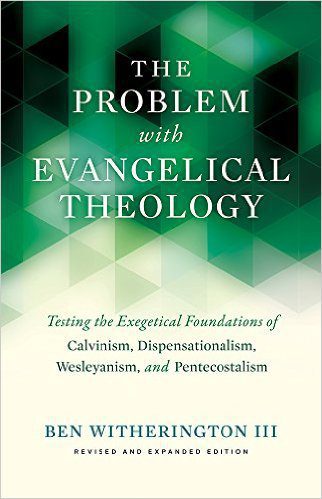
In 2005, Baylor University Press published Ben Witherington’s The Problem with Evangelical Theology: Testing the Exegetical Foundations of Calvinism, Dispensationalism, Wesleyanism, and Pentecostalism. In early 2016, Baylor Press released a “revised and expanded edition” of this book that is 333 pages in length with fine print. It is a comprehensive overview of these four strands of evangelical theology, with Witherington’s constant assessment of them.
This is an excellent book. I found myself constantly agreeing with Ben about his theological assessments. Both of us are evangelicals, though many would now deny this of me. It’s because the main theological difference I have with Ben, and most Christians, is that he is Trinitarian and I am a former Trinitarian. (See my book The Restitution of Jesus Christ at kermitzarley.com.)
The Problem with Evangelical Theology consists of five parts and fifteen chapters. The first four parts address the four, prominent evangelical theologies: Reformed, Dispensational, Wesleyan, and Pentecostal. As for me, I have a Wesleyan background and am a former Dispensationalist. And I have several relatives who are/were Wesleyan or Pentecostal.
I am surprised that Witherington, being Arminian-Wesleyan in theology, rarely mentions Jacob Arminius. But I guess that’s sort of old hat. It is especially noticeable in his chapter 2, when Ben at length says Roman 7 is about Paul’s pre-Christian life, with which I agree, rather than the common view of it that Christians have held, as did Augustine and Luther, that it is about Paul’s Christian life of struggling with sin. Arminius, in his three-volume theology, devotes his entire second volume to arguing this view of Romans 7 that Witherington adopts. In this chapter, Ben does a good and thorough job of explaining Paul’s critical use of the personal pronoun “I” (pp. 19-34). I found it interesting how Ben connects much of Reformed theology with what I agree are excesses that Augustine taught that were sharpened in his debate with Pelagius. Ben asserts, “Augustine and Luther were wrong about the bondage of the will” (p. 19).
In chapter 3, Ben Witherington interacts with Dr. James D. G. Dunn on Paul’s “works of the law” and thus what NT scholars now call “the new perspective on Paul” (coined by Dunn, pp. 45-51).
One issue in this book that is of considerable importance to me is so-called “eternal security.” Being formerly Dispensational, I was taught “once saved, always saved.” But early in my theological education, I became concerned how Dispensationalists of others often ignored the several NT texts warning professing Christians of the need to continue in faith and Christian living in order to secure eternal life for themselves. Many of these I call “the if passages” (e.g., John 8.31; Ephesians 4.21-14; Colossian 1.23; Romans 11.22; 1 Corinthians 15.2; Hebrews 2.2-3; 3.6, 14; 10.26-29; 12.25; 1 John 2.24; cf. John 3.36; 15.2, 6; Galatians 5.4; Hebrews 5.9; 1 John 2.3-4). So, these NT texts teach that a truly saved person will persevere, thus endure, in faith to the end of his/her life (e.g., Matthew 10.22; 24.13). Ben has a quotable remark about this in his saying, “One is not eternally secure until one is securely in eternity” (p. 155). While I accept this statement, I think we Christians can have a God-inspired confidence that we will persevere, which Reformed theologians often call “the perseverance of the saints.”
To me, this subject about eternal security is about getting the right balance. I still lean toward the view that a truly born again Christian will not depart from the faith and thereby lose her/his salvation. When it seems to us that a friend, relative, or acquaintance has done this, my view is that such a person was not really saved in the first place. However, I have had friends who have done this, and it is pretty hard from me to conclude that they never were Christians.
Eternal security arouses questions about election and predestination. In disagreement with Reformed Theology on the this subject, Witherington approvingly quotes C. K. Barrett, “election does not take place . . . . arbitrarily or fortuitously; it takes place always and only in Christ. They are elect who are in him . . . (cf. Gal3:29). It is failure to remember this that causes confusion over Paul’s doctrine of election and predestination” (p. 155). I like this too. I think Witherington does a terrific job in his chapter 4 of explaining Paul’s view he sets forth in Romans 9-11 about God’s election and predestination (pp. 53-80)—that it is not arbitrary as the Reformers taught.
BTW, I regard it as unconscionable for a Bible teacher to teach some theological position and then ignore critical texts that seem to oppose his/her teaching on that subject. No leading biblical scholars do this. In my opinion, those who do so are not good and just at their craft. To love your neighbor as yourself includes at least hearing his opposing view and responding to it.
In chapter 5, Ben teaches on mostly Paul’s instruction of the place of men and women in the church (pp. 81-105). Complementarianism has become a big issue in evangelical theology in recent times. I’m not sure of myself on some of these issues; so I’m quite open to learning here.
Chapter 6 is mostly about the origins of Dispensationalism (pp. 109-24). I can speak with some knowledge on this subject. Ben doesn’t always get this history correct.
First, on p. 109 Ben says Dispensationalism “apparently arose to prominence in response to a vision.” He means the vision Margaret McDonald, a member of Edward Irving’s church, supposedly had of a pre-tribulational rapture of the church. This is a double error: (1) J. N. Darby is the father of Dispensationalism, which he developed over several years, and it had nothing to do with McDonald’s vision, and (2) this old view that Margaret McDonald espoused pretribulationalism, and that it is the source of Darby’s pretribulationalism, is now regarded unanimously by historians of the Plymouth Brethren as erroneous.
Second, Ben says “Darby concluded that God had divided all of history into seven distinct Dispensations or ages” (p. 111). If my memory is correct, Darby settled on four dispensations. Such confusion is due to the fact that C. I. Scofield, in his later and very popular Scofield Reference Bible, advocates seven dispensations. (I wore out an Old and New Scofield.) Yet Ben is fair in stateing, “To their credit, Dispensationalists recognized rightly that the NT has a profoundly eschatological orientation and much to say about the future, and indeed even a good deal of OT prophecy seems to have not yet been fulfilled” (p. 112).
Third, Ben says Darby “was to become the founder of the Plymouth Brethren” (p. 110). On the contrary, this movement was started in Plymouth by thee men in 1827-28, and I think two were Croats and Croix. B. W. Newton was then a Plymouth resident matriculating at Oxford. When home, he attended these private meetings that centered on “the Lord’s supper.” Newton then invited another Oxford student and friend, J. N. Darby, to attend these meetings. Darby’s home was Dublin, Ireland, where a similar meeting soon emerged. Since the “assembly” at Plymouth was larger and more prominent, the eventual movement took the name Plymouth Brethren. Newton and Darby then became the two most prominent Bible teachers of this movement until 1945, when there was a split. Darby then became the founder of the Exclusive Brethren, so that it is quite incorrect to call him the founder of the Plymouth Brethren.
Witherington concludes this chapter 6 with some of his interpretations of the endtimes. He says, “There will be no final great battle between human forces called Armageddon, . . . This makes all speculation about some great Middle Eastern war between human combatants not only otiose, but odious, since in fact the NT suggests a different end-game scenario involving direct divine intervention” (p. 123). Wow! I strongly disagree with that? See my book, Warrior from Heaven (2009). Wesleyans are not known for their eschatology. Nevertheless, I really like Witherington’s book, Jesus, Paul and the End of the World, and I plan to review it as well.
The NT confirms the strong OT prediction that the Messiah literally will come at the end of days to deliver Israel from complete annihilation. That is why Jews never accepted Jesus as their Messiah. Their failure was in not realizing that the messianic motif could be compatible with others in the OT, such as Isaiah’s suffering servant (Isaiah 42-55), both of which Jesus will fulfill due to two comings.
Let’s first examine the OT. Isaiah indicates that Messiah will be a warrior king who will deliver Israel from its enemies by saying of the “branch,” whom Jews always have rightly identified as the Messiah, that he “shall strike the earth with the rod of his mouth and with the breath of his lips he shall kill the wicked” one (Isaiah 11.14), who is the Antichrist. The Apostle Paul confirms this in 2 Thessalonians 2.8. And King David writes, “Why do the nations conspire, and the peoples plot in vain?” (Psalm 2.1). What do they plot? “The kings of the earth set themselves, and the rulers take counsel together, against the LORD [God the Father], and his anointed [=Messiah], saying, ‘Let us burst their bonds asunder, and cast their cords from us’” (v. 3). Then David says the LORD laughs at them and declares, “I have set my king on Zion, my holy hill” (v. 6), referring to Jesus’ second coming. Zechariah the Prophet describes this endtimes scene in which all the militaries of the world’s nations will gather into the land of Israel to annihilate the tiny nation of Israel (Zechariah 12.1-9). He adds, “Then the LORD will go forth and fight against those nations . . . On that day his feet shall stand on the Mount of Olives” (Zechariah 14.4), referring to his agent “my shepherd,” who is Jesus (Zechariah 13.7-9; cf. John 15; Acts 1.11).
But David’s even more vivid psalm, the most quoted in the NT and applied to Jesus, that presents this same endtimes scenario is Psalm 110.1-3. It reads, “The LORD [God the Father] says to my lord [Jesus], ‘Sit at my right hand,’” referring to Jesus heavenly ascension. Then David adds, “until I make your enemies your footstool. The LORD sends out from Zion your mighty scepter. Rule in the midst of your foes. Your people [surviving Israeli Jewish men] will offer themselves willingly on the day you lead your forces on the holy mountains. . . . The LORD is at your right hand; he will shatter kings on the day of his wrath.” Zechariah says the LORD [YHWH=God the Father] will do so by empowering King Messiah Jesus and those volunteer Jews (Zechariah 10.3-6; 12.3-9). So, it is both God and surviving, Israeli, Jewish men led by Jesus who will fight against these nations’ militaries and soundly defeat them (14.3-14).
Or let’s take the NT, as Ben offers. He obviously, and I think wrongly, must interpret Revelation 19.11-16 non-literally. It says Jesus, as “King of kings and Lord and lords,” will depart heaven and return to earth as a mighty warrior, leading “the armies of heaven,” God’s angelic “host,” in doing tremendous battle at the endtimes. It is not called “the battle of Armageddon,” which is a misnomer, but the “battle on the great day of God the Almighty” (Revelation 16.14-16). Those hostile kings of the nations will merely meet at Harmegedon to plan strategy for annihilating Israel, and the center of this conflict will be Jerusalem and its Mount Zion.
In chapter 7, Ben addresses the Dispensationalists’ key doctrine in their eschatological scheme—the pretribulational rapture of the church to heaven seven years prior to Jesus returning to earth to establish his millennial kingdom. I disagree with Ben that those “taken” in Matthew 24.40 are taken in judgment (p. 126). Even Dispensationalists disagree about this, though most say, as I believe, that they are the saints whereas Hal Lindsey agrees with Ben. But I agree wholeheartedly with Ben that Jesus and the apostles did not teach that the parousia (Gr. word for “presence,” used to refer to Jesus’ second coming) was imminent. And Ben and I disagree with Dispensationalists saying the pretrib rapture is imminent.
As a former Dispensationalist, I believed in their teaching that what they call “the rapture of the church” has always been imminent, meaning it could occur at any time. But I changed in 1971 and have thereafter been a historic posttribulationalist, which I think Ben is, meaning that Jesus will only come back one time, and this at “the end of days,” thus at the end of the tribulation.
I am surprised at the novel interpretation (which I had never heard or read) that Ben takes of the important eschatological text Dan 7.13-14. Without identifying “one like a son of man,” Ben says he “comes with the clouds to meet the Almighty on earth for the day of judgment” (p. 131). On the contrary, Jesus constantly called himself “the Son of Man” and thereby identified himself as that figure in Dan 7.13-14. Plus, this text is the main biblical source for his kingdom teaching. And Jesus further alluded to this shortly before his arrest by telling a parable about himself by saying, “A nobleman went to a distant country to get royal power for himself and then return” (Luke 19.12).
Although Ben and I agree about posttribulationalism, to me he appears to err by saying, “1 Thessalonians 4:14-30 is not about the rapture” (p. 132). Ben later concludes, “If there is no rapture, much of the Dispensational system falls down like a house of cards” (p. 143). We need to be clear here, that “rapture” refers to the taking up, not to pretribulationalism. This text does not say when these saints will be taken up in relation to the final tribulation. I think a comparison of it with Jesus’ Olivet Discourse shows that this taking up, which I accept as calling it “rapture,” is posttribulational. And I don’t think Ben and so many commentators are right in saying the saints, here, go up to escort Jesus to earth as was an ancient custom for kings returning as war victors to their people (p. 133).
I commend Ben for concluding, “Here is where I say that we must be thankful to Dispensationalists for putting eschatology and especially the return of Christ back on the front burner in the last century and a half, and for arguing long, and correctly, that Revelation 20 is after all about a millennial reign of Christ on earth The early church prior to Augustine knew this” (p. 144).
Sometimes in Witherington’s book he states his belief in Classical Incarnation with which I also strongly disagree. On pp. 152-53, he mentions such critical texts to this subject as Romans 9.5, Philippians 2.5-11, and Romans 10.9 compared with Joel 3.5, and then asserts, “Paul has christologically redefined how he understands monotheism” (p. 153). Ben thus adopts the same view that Larry Hurtado and Richard Bauckham are so well known for advocating, that Paul splits the Shema in 1 Corinthians 8.4-6 and Ephesians 4.4-6. I regard this as impossible because, if true, Paul would have encountered so much opposition for such a view from both Jews and Jewish Christians that it could not have escaped mention in Acts or Paul’s NT letters. And it would have been a colossal change from his previous monotheistic stance as a Pharisee that he would not have avoided mentioning this. So, I think this interpretation of the NT data–that Jesus is both man and God–is eisegetical, not exegetical. But this is a complicated subject since many of the critical NT texts on this subject must be considered in their original Greek.
In chapters 9-11, Ben critiques John Wesley’s synthetic theology, and I think he is fair in doing so. He says due to Wesley’s positive thinking, he wrongly adopted a form of postmillennialism (p. 188), which was indeed popular in his time. Ben explains, “Wesley never did emphasize future eschatology to the degree the NT does, and this is a weakness in Wesleyan theology then and now, for which Dispensationalism more than overcompensates” (p. 197). I agree with Ben that Wesley’s great contribution is his spirit of evangelism, love, and exhortation to overcome sin in Christian living, but that he merely went too far with “entire sanctification” (pp. 213-21).
In Ben’s brief treatment of Pentecostalism (pp. 225-37), he makes an interesting statement about the newly-risen Jesus saying to his disciples on the first Easter evening as he breathed upon them, “Receive the Holy Spirit” (John 20.22). Ben says, there is no evidence whatsoever that the Spirit was actually received in the upper room at Easter. The proper way to read that story is that Jesus is performing a prophetic sign act, promising and reassuring that the Paraclete will come when he [Jesus] goes back to heaven” (p. 227).
Witherington thinks Pentecostal Gordon Fee (one of Ben’s teachers) is right in saying tongues today “is a gift for private prayer,” and Fee “is absolutely correct that I Corinthians 13:1 suggests glossolalia is an angelic language” (p. 235).
Some other points Ben makes in this book with which I agree:
- The Wesleyan-Holiness Movement went too far with its “entire sanctification” (pp. 215-21).
- Pentecostals err with their doctrine of subsequence regarding Spirit baptism (pp. 226-34).
- Dispensationalists err in asserting there are two peoples of God—Israel and church (p. 5).
- Cessationists err in denying many spiritual gifts as in the NT, such as tongues (pp. 234-37).
- “Water” in John 3.5 refers to a woman’s water issuing, signifying birth is near (pp. 200, 212).
I love an attitude Ben espouses, that Bible students should have “a generosity of spirit, and willingness to listen and learn that you might be wrong in your interpretation of the NT. . . . Theologizing should be a collegial, community activity, not shots fired in anger or anxiety from our private citadels” (pp. 266-67).
Despite some disagreements I have with this book, which all book reviewers usually have in reviewing books, I highly recommend this book for students of evangelical theology and Bible.
Previous Post

April 10, 2016
Danny Willett Wins the 2016 Masters as Jordan Spieth Collapses
Next Post
April 18, 2016 A New Nuclear Arms Race in Space?
Browse Our Archives
Select a Category Angels Billy Graham Blog Description Book Reviews Christian Living Christianity Christology Church History Current Events Deity of Christ? Disarmament Eschatology Evangelicalism Ezekiel 38-39 Film Reviews God Golf Gospel Harmonization Health History Holy Spirit Incarnation? Interview Islam Israeli-Palestinian Conflict Jesus Last Empire Literary Announcements Major Championship Winners Masters Monotheism My Books New Testament Old Testament Politics Primitive Weapons Ryder Cup Science Society of Biblical Literature The Bible The Restitution of Jesus Christ Trinitarianism Trinity? Uncategorized Unconditional Love? War on Terrorism
Select a Month October 2026 September 2026 August 2026 July 2026 June 2026 May 2026 April 2026 March 2026 February 2026 January 2026 December 2025 November 2025 October 2025 September 2025 August 2025 July 2025 June 2025 May 2025 April 2025 March 2025 February 2025 January 2025 December 2024 November 2024 October 2024 September 2024 August 2024 July 2024 June 2024 May 2024 April 2024 March 2024 February 2024 January 2024 December 2023 November 2023 October 2023 September 2023 August 2023 July 2023 June 2023 May 2023 April 2023 March 2023 February 2023 January 2023 December 2022 November 2022 October 2022 September 2022 August 2022 July 2022 June 2022 May 2022 April 2022 March 2022 February 2022 January 2022 December 2021 November 2021 October 2021 September 2021 August 2021 July 2021 June 2021 May 2021 April 2021 March 2021 February 2021 January 2021 December 2020 November 2020 October 2020 September 2020 August 2020 July 2020 June 2020 May 2020 April 2020 March 2020 February 2020 January 2020 December 2019 November 2019 October 2019 September 2019 August 2019 July 2019 June 2019 May 2019 April 2019 March 2019 February 2019 January 2019 December 2018 November 2018 October 2018 September 2018 August 2018 July 2018 June 2018 May 2018 April 2018 March 2018 February 2018 January 2018 December 2017 November 2017 October 2017 September 2017 August 2017 July 2017 June 2017 May 2017 April 2017 March 2017 February 2017 January 2017 December 2016 November 2016 October 2016 September 2016 August 2016 July 2016 June 2016 May 2016 April 2016 March 2016 February 2016 January 2016 December 2015 November 2015 October 2015 September 2015 August 2015 July 2015 June 2015 May 2015 April 2015 March 2015 February 2015 January 2015 December 2014 November 2014 October 2014 September 2014 July 2014 June 2014 May 2014 April 2014 March 2014 February 2014 January 2014 December 2013 November 2013 October 2013 September 2013 August 2013 July 2013 June 2013 May 2013 April 2013
Follow Us!
TAKE THE
Religious Wisdom Quiz
What does Jesus say will set you free?
Select your answer to see how you score.
Fame Power Money The truth
Books by This Author Books by Kermit Zarley Blog
Related posts from Kermit Zarley Blog

New Book Affirms John's Gospel Is Historically Reliable
New Book a Powerful Witness that Science Indicates...

Misbehavior of Ryder Cup Fans in New York...

My New Book about the Christian Movement on...
TRENDING AT PATHEOS Progressive Christian

In "Irreplaceable," our book on vocation and technology, Trevor Sutton and I...

I was strolling through the top floor of the brand new Parthenon...

What Does Gêvâh Mean For Kimberley Guifoyle &...
This week, a lot of the news is focused on Kimberly Guilfoyle....

INNER CIRCLE: Profound Mystery (Of Christ In All...
Ephesians 5:31-32 “For this reason, a man will leave his father and...

Do Not Rejoice When Your Enemy Falls: The...
Turning an execution into a public spectacle is a disturbing expression of...

'The Chosen' S6 Trailer: The Passion Gets Very...
Not many watching 'The Chosen' worry about spoilers, but just because they...
view all Progressive Christian blogs
Ad-Free & Subscriber Log-In Subscription Support
- About Us
- 2026 Calendar
- Videos
- Podcasts
- Library of World Religions
- Faith In Media Tracker
- Advertise With Us
- Write for Us
- Privacy Policy
- Terms of Service
- Do Not Sell My Data
- Contact Us
- Radiant Digital
- Manage Newsletter Subscriptions
- Unsubscribe From Notifications
- Sitemap
Copyright 2008-2026, Patheos. All rights reserved.
Subscription Support Ad-Free & Subscriber Log-In
Follow Patheos