
BuddhistCatholicContemplativeEvangelicalGeneral ChristianHinduJewishLatter-day SaintMuslimNew VisionsProgressive Christian
Beliefs
- Buddhist
- Catholic
- Contemplative
- Evangelical
- General Christian
- Hindu
- Jewish
- Latter-day Saint
- More Voices
- Muslim
- New Visions
- Pagan
- Progressive Christian
Topics
- Religion News
- Food and Religion
- Sports and Religion
- Religious Art
- Religious Music and Entertainment
- Religious Events
- History and Religion
- Style and Religion
- Politics and Religion
- Women in Religion
- Recreation Outdoors and Religion
- Business Finance and Religion
- Careers Workplace and Religion
- Education and Religion
- Family Parenting and Religion
- Health Fitness and Religion
- Home and Religion
- Relationships and Religion
- Technology and Religion
- Travel and Religion
Columnists
- Buddhist Columnists
- Business Finance and Religion Columnists
- Careers Workplace and Religion Columnists
- Catholic Columnists
- Contemplative Columnists
- Education and Religion Columnists
- Evangelists Columnists
- Family Parenting and Religion Columnists
- General Christian Columnists
- Health Fitness and Religion Columnists
- Hindu Columnists
- History and Religion Columnists
- Home and Religion Columnists
- Jewish Columnists
- More Voices Columnists
- Latter Day Columnists
- Muslim Columnists
- New Visions Columnists
- Nonreligious Columnists
- Pagan Columnists
- Politics and Religion Columnists
- Progressive Columnists
- Recreation Outdoors and Religion Columnists
- Relationships and Religion Columnists
- Religion News Columnists
- Religious Art Columnists
- Religious Events Columnists
- Religious Music and Entertainment Columnists
- Sports and Religion Columnists
- Style and Religion Columnists
- Technology and Religion Columnists
- Travel and Religion Columnists
- Women in Religion Columnists
Resource Library
- 2026 Calendar
- Library of World Religions
- The 100 Most Holy Places on Earth
- Patheos Answers
- Podcasts
- Videos
- Faith Leaders Database
- Anglican Episcopalian
- Bahai
- Baptist
- Buddhism
- Christianity
- Confucianism
- Eastern Orthodoxy
- Hinduism
- Holiness and Pentecostal
- ISKCON
- Islam
- Judaism
- Lutheran
- Methodist
- The Church of Jesus Christ of Latter-day Saints
- New Age
- Paganism
- Presbytarian and Reformed
- Protestantism
- Religion Behind the Scenes
- Roman Catholic
- Scientology
- Shia Islam
- Sikhism
- Sufism
- Sunni Islam
- Taoism
- Zen
- See all religions
Research Tools
 Ad-Free & Subscriber Log-In Subscription Support
Ad-Free & Subscriber Log-In Subscription Support
Follow Patheos 

- Trending:
- Forgiveness
- |
- Marriage
- |
- Consciousness
- |
- Death Penalty
- |
- Election
- |
- Halloween

-
Categories
-
Christian Living
-
Christology
-
Golf
-
My Books
- Home
- Progressive Christian
- Religion News
- Review of Bart Ehrman’s Book–How Jesus Became God–Part 1 of 3
Review of Bart Ehrman’s Book–How Jesus Became God–Part 1 of 3
Last updated on: September 2, 2016 at 5:04 pm by Kermit Zarley
Review of Bart Ehrman’s Book–How Jesus Became God–Part 1 of 3 2016-09-02T17:04:55-07:00 Kermit Zarley
Patheos Explore the world's faith through different perspectives on religion and spirituality! Patheos has the views of the prevalent religions and spiritualities of the world.
Author: Bart D. Ehrman, professor of New Testament and Early Christianity at the University of North Carolina, Chapel Hill
Title: How Jesus Became God: The Exaltation of a Jewish Preacher from Galilee
Publisher and Date: HarperOne, 2014. Page length: 404 pp.
All Scripture references are from the NRSV unless otherwise noted.
Part 1
 Dr. Bart Ehrman is probably the most successful author of theological books in America. He has five New York Times bestsellers including this one, How Jesus Became God: The Exaltation of a Jewish Preacher from Galilee. Ehrman is a lucid writer who is easy to read. Thus, several of his books are trade books.
There is so much in this book by Dr. Ehrman that I want to address. So, this review will be lengthy, thus in three parts, for two reasons. First, this book is an important effort to refute the good news about Jesus. Second, I wrote a 600-page book on this subject–whether or not Jesus is God. It is titled The Restitution of Jesus Christ. It is much more thorough regarding Scripture than Ehrman’s book, and I cite over 400 scholars in it. Ehrman doesn’t cite many scholars because his is a trade book–being for general readers. Ehrman and I agree that Jesus never thought he was God or claimed to be God, but that’s about all we agree about on the subject of Jesus’ identity and his mission.
Bart Ehrman and I are members of the Society of Biblical Literature (SBL). I first met him at SBL’s Annual Meeting in 2010. In 2008, I had self-published my RJC book anonymously under the pseudonym Servetus the Evangelical. Right before meeting Dr. Ehrman I had publicly revealed myself as the author of this book. So, I told Bart briefly about it and asked if I could send him a copy. He gave me his card and said I could. But he added that he likely would not have time to look at it. I lost his card and didn’t bother to get his address and send it to him. Little did I know that about this time he had decided that he was going to write this book, How Jesus Became God. My book biblically challenges the post-apostolic church dogma that Jesus is God while affirming every other major church teaching about Jesus.
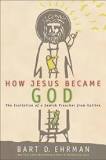 The Annual Meeting of SBL is always the weekend before Thanksgiving. At the 2014 meeting, I attended a 2.5 hour session in which six panelists critiqued this book, How Jesus Became God, and Ehrman was present, responding. The panelists were David Capes, James McGrath, Michael Bird, Dale Martin, Craig Evans, and Larry Hurtado. During the intermission, I told Ehrman I wished I had sent him my book.
Dr. Bart Ehrman is a historian who is professedly agnostic, yet he is a professor of the New Testament and Early Christianity. This scenario is not so strange anymore since American secular education now realizes the importance of the Bible for a fully-rounded education in the humanities.
Dr. Ehrman writes in this book about having been an evangelical Christian in his teens. He graduated from the fundamentalist Moody Bible Institute. While getting his PhD (1985) at Princeton Seminary, he says (p. 86), “I had begun to entertain doubts about some of the most fundamental aspects of the faith, including the question of the divinity of Jesus. During those intervening years I had come to realized that Jesus is hardly ever, if at all, explicitly called God in the New Testament … only in the Gospel of John.”
Ehrman begins his Introduction by saying (p. 3), “The idea that Jesus is God … was the view of the very earliest Christians soon after Jesus’s death.” I strongly disagree. I show in 322 pages in my RJC book that nowhere does the NT declare that Jesus is God, and I treat the critical biblical texts in depth. Ehrman further surmises (p. 6) “how Jesus came to be considered God. The short answer is that it all had to do with his follower’s belief that he had been raised from the dead.” WOW!
This is the thesis of Ehrman’s book, How Jesus Became God. Some Christians have also believed this. But it is irrational and antithetical to Judaism. Thus, it is highly unlikely that the early Jewish Christians believed that. Tom (N.T.) Wright and other leading NT scholars have convincingly refuted this argument. Most Jews during Jesus’ time, including him and his contemporaries, the Pharisees and Essenes, believed in the future resurrection of God’s people, and they certainly did not think that would make them gods.
On April 7, 2014, National Public Radio (NPR) published an online interview with Dr. Bart Erhman about How Jesus Became God. Here is an excerpt from Ehrman’s remarks in this interview:
During his lifetime, Jesus himself didn’t call himself God and didn’t consider himself God, and … none of his disciples had any inkling at all that he was God. …
During his lifetime, Jesus himself didn’t call himself God and didn’t consider himself God, and … none of his disciples had any inkling at all that he was God.
You do find Jesus calling himself God in the, or the last Gospel. Jesus says things like, “Before Abraham was, I am.” And, “I and the Father are one,” and, “If you’ve seen me, you’ve seen the Father.” These are all statements you find only in the Gospel of John, and that’s striking because we have earlier gospels and we have the writings of Paul, and in none of them is there any indication that Jesus said such things.
I think it’s completely implausible that Matthew, Mark and Luke would not mention that Jesus called himself God if that’s what he was declaring about himself. That would be a rather important point to make. This is not an unusual view amongst scholars; it’s simply the view that the Gospel of John is providing a theological understanding of Jesus that is not what was historically accurate.
This is indeed what Ehrman says in this book. Thus, he takes the typical position of historical-critical scholars about Jesus and the NT gospels. They correctly state that, according to the synoptic gospels, Jesus did not believe he was God or say he was God, and his early disciples didn’t believe he was God either. But Ehrman errs in saying the Gospel of John identifies Jesus as God. (See pp. 124-25, 248). About Ehrmans’ quotes of Jesus in John 8.58, Jesus therein didn’t mean he preexisted but that he was superior to Abraham. The prior context of John 10.30 shows that Jesus meant he and the Father work together in unity as “one,” not that they are one in essence as some church fathers asserted. (Cf. “one” in John 17.11, 22-23). And Jesus saying, “Whoever has seen me has seen the Father” (John 14.9), does not mean he is God or the Father since he then explained it to mean, “I am in the Father and the Father is in me” (v. 11; cf. 10.38). Scholars call this the Mutual Indwellling, and many people have confused it with Jesus being identified as God. Yet Ehrman is right in saying that if Jesus publicly said he was God, Matthew, Mark, and Luke would have mentioned it in their gospels. Moreover, Jews would have argued with him about it far more than that he was the Messiah. Ehrman rightly says later that being a Jew (p. 98), “Jesus would have believed that there was one true God.”
As stated above, Ehrman says that right after Jesus’ death, the early Jewish Christians began to believe that Jesus was God. On the contrary, I maintain that the NT does not say Jesus was God, so that it was not until the second century, after the apostolic era and the writing of the NT, that some Christians began to say Jesus was/is God. But for the next two centuries they said his divinity/deity was less than that of the Father, making Jesus essentially subordinate to God. It was not until the Nicene Creed, in 325, that Christians declared Jesus is God just as much as the Father is. And only in the latter half of the fourth century did Catholic Church officials construct the doctrine of the Trinity that we know about today.
(Many Christians, theologians, and historians wrongly claim that the doctrine of the Trinity was established at the Nicene Council. It’s because the creed often recited in churches is said to be the Nicene Creed, whereas it is the Nicene-Constantinopolitan Creed of 381 that is almost always recited. It is a modification of the Nicene Creed, and part of that modification is that it includes the Trinity teaching.)
In Chapter 1, Ehrman gives mythological examples in the Hellenistic world during the early Christian era of men being divinized and gods becoming men to rightly show that this environment made it easier for Gentile Christians to think of Jesus as God. Bart well states (p. 43), “How could Jesus be God and God be God and yet there be only one God? That, in part, is the question that drives this book.”
In Chapter 2, Ehrman says again of early Christians (p. 49-50), “How could they say that Jesus was God and still claim that there was only one God. If God was God and Jesus was God, doesn’t that make two Gods?” Indeed. And I am surprised Ehrman fails to mention that both the Ebonite and Nazarene sects of early Jewish Christians lodged this argument. It was Gentile Christians in the next century, such as Ignatius, who started saying Jesus is God. When they did, critics accused them of believing in two gods. But Ehrman says (p. 49) that he was enlightened to learn that “Christians were calling Jesus God” in “competition” with “the Romans calling the emperor God.” Maybe in the second century, but not the first century as Ehrman claims.
Then Mr. Ehrman takes the same line as traditionalists Larry Hurtado and Richard Bauckham. They say there were Jews in the Second Temple period who believed the souls of men could ascend to heaven and return with secret knowledge or men themselves could become angels or divine. (I refer to Christians who believe Jesus is God as “traditionalists.”) Indeed there were, but rabbis have always said they were on the fringe and thus not in mainstream Judaism. Heh, “two Jews, three opinions.”
Ehrman says (p. 61), “Larry Hurtado states a key thesis: ‘I propose the view that the principal angel speculation and other types of divine agency thinking … provided the earliest Christians with a basic scheme for accommodating the resurrected Christ next to God without having to depart from their monotheistic tradition.’” I don’t think that is stated properly. Larry means “Christ next to God as his equal.” I certainly believe Jesus sits next to God on his throne in heaven. In my RJC book, I oppose what Larry means here and cite him about it. I discussed this with him when he was our keynote speaker at the Kermit Zarley Lectures at North Park University in 2008. Years later I sent him my book, but never heard from him.
In Chapter 3, Ehrman errs like so many NT scholars, including some Christian scholars, by alleging (p. 102, 105), “Jesus is portrayed in our earliest Gospels, the Synoptics, as being an apocalypticist anticipating the imminent end of the age … within in his own generation before his disciples had all died, what was one to think a generation later when in fact it had not arrived? One might conclude that Jesus was wrong.” Jesus was indeed an apocalypticist. But Matthew 24.36/Mark 13.32 show that he did not know when he would return, so that he could not have believed that it would be soon. I have an unpublished book manuscript in my STILL HERE series about this subject.
Although it is not part of Ehrman’s thesis, like other scholars he wrongly asserts (p. 118), “Jesus did not think that the future kingdom was going to be won by a political struggle or a military engagement per se.” On the contrary, the Old Testament says the Messiah will militarily deliver Israel from extinction at the end of days (e.g., Isaiah 9.1-6; 11.1-4; cf. Isaiah 63.1-6 with Revelation 14.20; 19.15; Micah 4.11—5.5). Orthodox Jews have always rightly believed this. It’s just that Jesus will do this at his second coming. My STILL HERE book, Warrior from Heaven, is all about this subject.
Society of Biblical Literature
Previous Post

January 16, 2015
The Pope Is Right about Freedom of Expression
Next Post
January 26, 2015 Oral Tradition: How We Got the Synoptic Gospels
Browse Our Archives
Select a Category Angels Billy Graham Blog Description Book Reviews Christian Living Christianity Christology Church History Current Events Deity of Christ? Disarmament Eschatology Evangelicalism Ezekiel 38-39 Film Reviews God Golf Gospel Harmonization Health History Holy Spirit Incarnation? Interview Islam Israeli-Palestinian Conflict Jesus Last Empire Literary Announcements Major Championship Winners Masters Monotheism My Books New Testament Old Testament Politics Primitive Weapons Ryder Cup Science Society of Biblical Literature The Bible The Restitution of Jesus Christ Trinitarianism Trinity? Uncategorized Unconditional Love? War on Terrorism
Select a Month October 2026 September 2026 August 2026 July 2026 June 2026 May 2026 April 2026 March 2026 February 2026 January 2026 December 2025 November 2025 October 2025 September 2025 August 2025 July 2025 June 2025 May 2025 April 2025 March 2025 February 2025 January 2025 December 2024 November 2024 October 2024 September 2024 August 2024 July 2024 June 2024 May 2024 April 2024 March 2024 February 2024 January 2024 December 2023 November 2023 October 2023 September 2023 August 2023 July 2023 June 2023 May 2023 April 2023 March 2023 February 2023 January 2023 December 2022 November 2022 October 2022 September 2022 August 2022 July 2022 June 2022 May 2022 April 2022 March 2022 February 2022 January 2022 December 2021 November 2021 October 2021 September 2021 August 2021 July 2021 June 2021 May 2021 April 2021 March 2021 February 2021 January 2021 December 2020 November 2020 October 2020 September 2020 August 2020 July 2020 June 2020 May 2020 April 2020 March 2020 February 2020 January 2020 December 2019 November 2019 October 2019 September 2019 August 2019 July 2019 June 2019 May 2019 April 2019 March 2019 February 2019 January 2019 December 2018 November 2018 October 2018 September 2018 August 2018 July 2018 June 2018 May 2018 April 2018 March 2018 February 2018 January 2018 December 2017 November 2017 October 2017 September 2017 August 2017 July 2017 June 2017 May 2017 April 2017 March 2017 February 2017 January 2017 December 2016 November 2016 October 2016 September 2016 August 2016 July 2016 June 2016 May 2016 April 2016 March 2016 February 2016 January 2016 December 2015 November 2015 October 2015 September 2015 August 2015 July 2015 June 2015 May 2015 April 2015 March 2015 February 2015 January 2015 December 2014 November 2014 October 2014 September 2014 July 2014 June 2014 May 2014 April 2014 March 2014 February 2014 January 2014 December 2013 November 2013 October 2013 September 2013 August 2013 July 2013 June 2013 May 2013 April 2013
Follow Us!
TAKE THE
Religious Wisdom Quiz
Who was thrown into a pit by his jealous brothers?
Select your answer to see how you score.
Peter David Moses Joseph
Books by This Author Books by Kermit Zarley Blog
Related posts from Kermit Zarley Blog

The Nicene Creed's Birthplace Is Found Buried in...

New Book Affirms John's Gospel Is Historically Reliable

The Irony of Celebrating the Nicene Creed in...
Today is the 1,700th Anniversary of the Nicene...
TRENDING AT PATHEOS Progressive Christian

A new article, written by Jeff Lindsay and Gale L. Pooley,...

Swimfan: Forgotten Aughts Pleasures
This is a recovery effort. In 2002, My Big Fat Greek Wedding...

Top Three Anti-Catholic Lies About Catholicism
This is my initial transcript for the video, "THE 3 WORST...

Pope Leo Celebrates Mass for Nurses & Docs...
I don't have any idea how he did it, but Pope Leo...

The Sermon on the Mount, Part I: Matthew...
The Sermon on the Mount, Part I (Matthew 4:12-5:12) St. Matthew moves...

What's up from Crossway: Reviewing some of their latest A few weeks...
view all Progressive Christian blogs
Ad-Free & Subscriber Log-In Subscription Support
- About Us
- 2026 Calendar
- Videos
- Podcasts
- Library of World Religions
- Faith In Media Tracker
- Advertise With Us
- Write for Us
- Privacy Policy
- Terms of Service
- Do Not Sell My Data
- Contact Us
- Radiant Digital
- Manage Newsletter Subscriptions
- Unsubscribe From Notifications
- Sitemap
Copyright 2008-2026, Patheos. All rights reserved.
Subscription Support Ad-Free & Subscriber Log-In
Follow Patheos