
BuddhistCatholicContemplativeEvangelicalGeneral ChristianHinduJewishLatter-day SaintMuslimNew VisionsProgressive Christian
Beliefs
- Buddhist
- Catholic
- Contemplative
- Evangelical
- General Christian
- Hindu
- Jewish
- Latter-day Saint
- More Voices
- Muslim
- New Visions
- Pagan
- Progressive Christian
Topics
- Religion News
- Food and Religion
- Sports and Religion
- Religious Art
- Religious Music and Entertainment
- Religious Events
- History and Religion
- Style and Religion
- Politics and Religion
- Women in Religion
- Recreation Outdoors and Religion
- Business Finance and Religion
- Careers Workplace and Religion
- Education and Religion
- Family Parenting and Religion
- Health Fitness and Religion
- Home and Religion
- Relationships and Religion
- Technology and Religion
- Travel and Religion
Columnists
- Buddhist Columnists
- Business Finance and Religion Columnists
- Careers Workplace and Religion Columnists
- Catholic Columnists
- Contemplative Columnists
- Education and Religion Columnists
- Evangelists Columnists
- Family Parenting and Religion Columnists
- General Christian Columnists
- Health Fitness and Religion Columnists
- Hindu Columnists
- History and Religion Columnists
- Home and Religion Columnists
- Jewish Columnists
- More Voices Columnists
- Latter Day Columnists
- Muslim Columnists
- New Visions Columnists
- Nonreligious Columnists
- Pagan Columnists
- Politics and Religion Columnists
- Progressive Columnists
- Recreation Outdoors and Religion Columnists
- Relationships and Religion Columnists
- Religion News Columnists
- Religious Art Columnists
- Religious Events Columnists
- Religious Music and Entertainment Columnists
- Sports and Religion Columnists
- Style and Religion Columnists
- Technology and Religion Columnists
- Travel and Religion Columnists
- Women in Religion Columnists
Resource Library
- 2026 Calendar
- Library of World Religions
- The 100 Most Holy Places on Earth
- Patheos Answers
- Podcasts
- Videos
- Faith Leaders Database
- Anglican Episcopalian
- Bahai
- Baptist
- Buddhism
- Christianity
- Confucianism
- Eastern Orthodoxy
- Hinduism
- Holiness and Pentecostal
- ISKCON
- Islam
- Judaism
- Lutheran
- Methodist
- The Church of Jesus Christ of Latter-day Saints
- New Age
- Paganism
- Presbytarian and Reformed
- Protestantism
- Religion Behind the Scenes
- Roman Catholic
- Scientology
- Shia Islam
- Sikhism
- Sufism
- Sunni Islam
- Taoism
- Zen
- See all religions
Research Tools
 Ad-Free & Subscriber Log-In Subscription Support
Follow Patheos 

- Trending:
- Advent
- |
- Forgiveness
- |
- Thanksgiving
- |
- Election
- |
- Seasonal Holidays
- |
- Marriage

-
Categories
-
Christian Living
-
Christology
-
Golf
-
My Books
- Home
- Progressive Christian
- Religion News
- Review of Dunn’s Book, Did the First Christians Worship Jesus?
Review of Dunn’s Book, Did the First Christians Worship Jesus?
Last updated on: September 2, 2016 at 5:49 pm by Kermit Zarley
Review of Dunn’s Book, Did the First Christians Worship Jesus? 2016-09-02T17:49:17-07:00 Kermit Zarley
Patheos Explore the world's faith through different perspectives on religion and spirituality! Patheos has the views of the prevalent religions and spiritualities of the world.
 James D.G. Dunn authored the important and accessible book, Did the First Christians Worship Jesus?: The New Testament Evidence (WJK, 2010, 176 pp., paperback). He is a leading New Testament scholar and generally regarded as the world’s foremost authority on Christology. That’s mostly due to his more dense book, Christology in the Making (1980/1996).
Did the First Christians Worship Jesu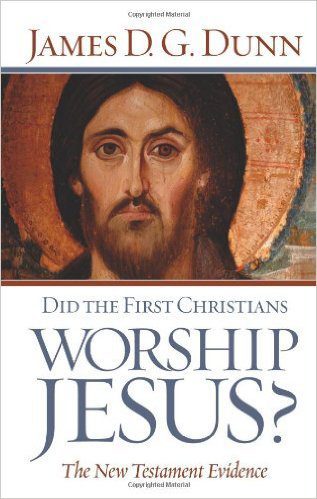 s? is a rather provocative book for a moderately-conservative, evangelical scholar of Dunn’s stature. In his previous books, he has embraced the traditional view that Jesus is God and God is triune. So, Dunn accepts the idea of a later, developed, high Christology, endorsing the classical doctrine of Incarnation—that God became the man Jesus. But Dunn doesn’t think the earliest Christians believed that. He says, “Did the first Christians worship Jesus?… No, by and large the first Christians did not worship Jesus as such” (p. 150). He adds, “So our central question can indeed be answered negatively, and perhaps it should be” (151). Dunn earlier says of Jesus, “He was not to be worshipped as wholly God or fully identified with God…. only God, only the one God, is to be worshipped” (146).
At this point, most Christians will exclaim “foul ball” or the like. Why? Since the 4th century, the church has proclaimed that Jesus is fully God as well as fully man and that he must be worshipped as God. Those who don’t, the church deems them non-Christian.
Dunn introduces this book by explaining that two of his colleagues and dialogue partners to whom he dedicates the book—Richard Bauckham and Larry Hurtado—assert that the early Christians worshipped Jesus as God. Dunn states, “I am concerned to ensure that the whole picture is brought into view, and that texts,… are not neglected” (4). Thus, this book is partially an attempt to balance, if not correct, their views.
In chapter one, Dunn explores Bible words usually translated “worship.” He says both the Hebrew shachah and the Greek proskuneo refer mostly to the physical act of bowing down either as prostration or genuflection. He cites Bible reports of people doing such acts toward some object, such as God, a human superior, such as a king, or Jesus. Regarding our English word “worship,” which conveys an attitude and therefore not an act, Dunn observes of the New Testament (NT), “Christian tradition envisaged different grades or degrees of worship” (18). He concludes, “Cultic worship and service (latreuein, latreia) as such is never offered to Christ, and other worship terms are used only in relation to God … the most common words for praise and thanksgiving (eucharistein), they too are never offered to Christ” (27).
In chapter two, Dunn analyzes the practice of worship reported in the Bible. He lists four elements of early Christian worship: prayer, hymns, sacred times, and giving alms (30). He explains that even though it is legitimate to petition Jesus for help (35), “(T)the most explicit prayer language is used exclusively of prayer to God” (37). He also relates that the NT contains hymns which he contends, in apparent opposition to Hurtado, “are canticles in praise of God, not Christ” (40). And he says the New Testament (NT) contains “Christ hymns,” such as in Phil 2.5-11 and Col 1.15-20, explaining that “they are hymns to God, praising God for Christ” (41).
Chapter three is a response to the thesis of Bauckham and Hurtado, who say Jewish monotheism of Second Temple Judaism was not strict but provided a bridge to enable the early Christians to worship Jesus, indicating they viewed him as God. Dunn treats God’s angels, Spirit, Wisdom, Word, and exalted humans to show, “(I)in no case was the thought of worshipping other than God entertained.” Thus, “Second Temple Judaism … provided no precedent to which the first Christians could appeal” to worship Jesus as God (90). Dunn later questions the utility of Bauckham’s coined and repeated expression “divine identity” (141-144). Dunn obviously disagrees with Bauckham and Hurtado by contending that Christian worship of Jesus and a high Christology are late first century developments, a view his PhD professor C.F.D. Moule popularized.
In chapter four, Dunn addresses the hot topic: “Was Jesus a monotheist?”[1] Dunn seems equivocal by answering, “at least initially with a straight ‘Yes.’ Jesus was a monotheist; he confessed God as one…. He worshipped this God alone” (101). If “initially,” did Jesus change later? In the sub-title, “Jesus is Lord”—a litmus test for early Christians, but later Christians equated it with “Jesus is God”—Dunn states, as in his The Theology of Paul the Apostle (254), “the kyrios [lord] title is not so much a way of identifying Jesus with [=as] God, as a way of distinguishing Jesus from God” (110). Does Dunn contradict himself on this important point by stating in his introduction, “Jesus as Lord,…avers a divine status for Jesus” (3)?
Chapter four’s sub-title is “Jesus as god/God?” Dunn begins, “In some ways this is the most difficult issue: that in the New Testament Jesus is sometimes called ‘god,’ or should we say ‘God’? If ‘god,’ is not that a step towards polytheism—Jesus was a second god beside the creator God? If ‘God,’ then how are we to make sense of the first Christians’ clear memory that Jesus called for worship to be given only to God, and himself regularly prayed to God as his God and Father?” (132.) Dunn has this sub-title here (132) and in his The Theology of Paul the Apostle (252); in neither case, I think, does he provide a clear answer. Does it indicate uncertainty? Nonetheless, Dunn well states here, “Jesus Christ [is] seen more as … God manifesting himself in and through Jesus, than as God or a god as such” (133). Dunn adds, “Jesus was God, in that he made God known,… but he was not God in himself” (135). While Dunn is known for not affirming much of the Fourth Gospel as authentic, he says of John 10.30-38 that Jesus denies the charge he makes himself God (135n93). Yet, Dunn just wrote, “The book of Revelation … its affirmation of the deity of Christ is unqualified” (130).
In Dunn’s previous writings, like many New Testament scholars he believes (1) the Gospel of John was written in the 90s, (2) it identifies Jesus as God, and (3) this does not reflect the belief of the earliest Christians. Here, Dunn perceives “the attribution of the title ‘God/god’ to Jesus in John’s gospel” (134). In Christology in the Making, Dunn states concerning John 1.14 (compared with v. 1c), “Here we have an explicit statement of incarnation, the first, and indeed only such statement in the NT” (241). But in this book Dunn writes, “Jesus is not the God of Israel. He is not the Father. He is not Yahweh” (142). This will provoke most Christians because they are taught the doctrine of the Trinity, that Jesus is God, the God of Israel, and thus Yahweh. (Of course, Trinitarians agree that Jesus is not the Father, whereas United Pentecostals believe he is.) Dunn says the early Christians “recognized that God was still Jesus’ God, even the God of Jesus as Lord” (145). Dunn adds, “if Jesus is God he is not YHWH“ (144). “If Jesus is God”?
I count it a privilege to be a friend of Dr. Dunn, whom his friends call “Jimmy.” Nowadays, I sometimes wonder if he is almost in a place, theologically, that I was years ago. After being a Trinitarian Christian for twenty-two years, I decided that the doctrine of the Trinity is not in the Bible and thus it is wrong. But what was I to believe in its place? I concluded that the God of Israel is only the Father, whose name is YHWH. But who was and is Jesus? I undertook an in-depth study about it, devouring hundreds of books, many written by scholars like Jimmy Dunn. At first I was perplexed, thinking the NT occasionally calls Jesus “God.” But after five years, I became convinced that the NT nowhere identifies Jesus as God. And it took me another five years to conclude that the NT doesn’t say Jesus literally preexisted. In those ten years, I felt enlightened yet uncomfortable since I believed, like the Apologists, in two gods, a belief I now call “big God, little God.” I was much relieved when I came to understand that in the NT only the Father is God, so that Jesus is fully human and not God, and that he never actually preexisted.
Not so with Dunn. At the Annual Meeting of the Society of Biblical Literature in 2009, I heard him speak on his book Unity and Diversity in the New Testament (dedicated to Moule). He said that on the basis of the NT “it is not possible to view a single, unified Christian theology in the first century.” I respect Jimmy Dunn so much, but I’m not convinced of this. Years earlier, in 2000, he explained his view to me. I don’t think Jimmy has significantly changed his Christology in Did the First Christians; rather, it’s a matter of emphasis.
However, Jimmy’s conclusions in this book are unequivocal and hard hitting about not giving God the Father his due, similar to one author who wrote about the “Forgotten Father.” Dunn rightly implies that Christianity errs in being mostly christocentric instead of theocentric. What harm is there in doing that and thus worshipping Jesus as God? Dunn answers astutely, “Christian worship can deteriorate into what may be called Jesus-olatry…. I use the term ‘Jesus-olatry’ as in an important sense parallel or even close to ‘idolatry’…. The danger of Jesus-olatry is … that Jesus has been substituted for God…. Jesus is absorbing the worship due to God alone…. The worship due to God is stopping at Jesus.” (147). Right on! When I was a Trinitarian, I think I did that.
[For further reading about this book by Dunn, see my friend Scot McKnight’s post on Monday entitled “Jesus: when was he first worshipped?” here at patheos.com at his Jesus Creed blog. He briefly reviews this book. Dunn was McKnight’s PhD supervisor. Dunn was the first guest lecturer, in 2000, at the annual Kermit Zarley Lectures at North Park University in Chicago, which McKnight created and directed.]
[1] Technically, calling early Christians monotheists is anachronistic since the term “monotheism” was coined by philosopher Henry More in the seventeenth century. Trinitarians claim to be monotheists; but many religious Jews and all Muslims allege they are polytheists.
Previous Post

September 12, 2013
Is America Exceptional?
Next Post
September 17, 2013 Billy Casper (Part 1)
Browse Our Archives
Select a Category Angels Billy Graham Blog Description Book Reviews Christian Living Christianity Christology Church History Current Events Deity of Christ? Disarmament Eschatology Evangelicalism Ezekiel 38-39 Film Reviews God Golf Gospel Harmonization Health History Holy Spirit Incarnation? Interview Islam Israeli-Palestinian Conflict Jesus Last Empire Literary Announcements Major Championship Winners Masters Monotheism My Books New Testament Old Testament Politics Primitive Weapons Ryder Cup Science Society of Biblical Literature The Bible The Restitution of Jesus Christ Trinitarianism Trinity? Uncategorized Unconditional Love? War on Terrorism
Select a Month November 2026 October 2026 September 2026 August 2026 July 2026 June 2026 May 2026 April 2026 March 2026 February 2026 January 2026 December 2025 November 2025 October 2025 September 2025 August 2025 July 2025 June 2025 May 2025 April 2025 March 2025 February 2025 January 2025 December 2024 November 2024 October 2024 September 2024 August 2024 July 2024 June 2024 May 2024 April 2024 March 2024 February 2024 January 2024 December 2023 November 2023 October 2023 September 2023 August 2023 July 2023 June 2023 May 2023 April 2023 March 2023 February 2023 January 2023 December 2022 November 2022 October 2022 September 2022 August 2022 July 2022 June 2022 May 2022 April 2022 March 2022 February 2022 January 2022 December 2021 November 2021 October 2021 September 2021 August 2021 July 2021 June 2021 May 2021 April 2021 March 2021 February 2021 January 2021 December 2020 November 2020 October 2020 September 2020 August 2020 July 2020 June 2020 May 2020 April 2020 March 2020 February 2020 January 2020 December 2019 November 2019 October 2019 September 2019 August 2019 July 2019 June 2019 May 2019 April 2019 March 2019 February 2019 January 2019 December 2018 November 2018 October 2018 September 2018 August 2018 July 2018 June 2018 May 2018 April 2018 March 2018 February 2018 January 2018 December 2017 November 2017 October 2017 September 2017 August 2017 July 2017 June 2017 May 2017 April 2017 March 2017 February 2017 January 2017 December 2016 November 2016 October 2016 September 2016 August 2016 July 2016 June 2016 May 2016 April 2016 March 2016 February 2016 January 2016 December 2015 November 2015 October 2015 September 2015 August 2015 July 2015 June 2015 May 2015 April 2015 March 2015 February 2015 January 2015 December 2014 November 2014 October 2014 September 2014 July 2014 June 2014 May 2014 April 2014 March 2014 February 2014 January 2014 December 2013 November 2013 October 2013 September 2013 August 2013 July 2013 June 2013 May 2013 April 2013
Follow Us!
TAKE THE
Religious Wisdom Quiz
What does Jesus say about judging others?
Select your answer to see how you score.
Judge harshly Seek revenge Do not judge Judge by appearance
Books by This Author Books by Kermit Zarley Blog
Related posts from Kermit Zarley Blog
New Book Affirms John's Gospel Is Historically Reliable
New Book a Powerful Witness that Science Indicates...

Misbehavior of Ryder Cup Fans in New York...

My New Book about the Christian Movement on...
TRENDING AT PATHEOS Progressive Christian

"Why Do Churches Talk So Much About Money?"
If you were inclined to do so, you could probably find any...

Watch and Pray: On Mark 13:33-37
Jesus said to his disciples: “Be watchful! Be alert! You do not...

Debate on Purgatory & Biblical Evidences for It
This is from a combox on my video channel, Catholic Bible Highlights....

Set the table for the coming King
On Thursday we visited my sister-in-law for Thanksgiving, and throughout the entire...

If I Stop Becoming, Will I Disappear?
(At our most recent half day Zen retreat, Dr Chris Hoff, a...

A Modest Proposal for President Trump
Trump should just quit the loser Republicans who failed him so badly...
view all Progressive Christian blogs
Ad-Free & Subscriber Log-In Subscription Support
- About Us
- 2026 Calendar
- Videos
- Podcasts
- Library of World Religions
- Faith In Media Tracker
- Advertise With Us
- Write for Us
- Privacy Policy
- Terms of Service
- Do Not Sell My Data
- Contact Us
- Radiant Digital
- Manage Newsletter Subscriptions
- Unsubscribe From Notifications
- Sitemap
Copyright 2008-2026, Patheos, part of the Radiant Digital network of media brands. All rights reserved.
Subscription Support Ad-Free & Subscriber Log-In
Follow Patheos