
BuddhistCatholicContemplativeEvangelicalGeneral ChristianHinduJewishLatter-day SaintMuslimNew VisionsProgressive Christian
Beliefs
- Buddhist
- Catholic
- Contemplative
- Evangelical
- General Christian
- Hindu
- Jewish
- Latter-day Saint
- More Voices
- Muslim
- New Visions
- Pagan
- Progressive Christian
Topics
- Religion News
- Food and Religion
- Sports and Religion
- Religious Art
- Religious Music and Entertainment
- Religious Events
- History and Religion
- Style and Religion
- Politics and Religion
- Women in Religion
- Recreation Outdoors and Religion
- Business Finance and Religion
- Careers Workplace and Religion
- Education and Religion
- Family Parenting and Religion
- Health Fitness and Religion
- Home and Religion
- Relationships and Religion
- Technology and Religion
- Travel and Religion
Columnists
- Buddhist Columnists
- Business Finance and Religion Columnists
- Careers Workplace and Religion Columnists
- Catholic Columnists
- Contemplative Columnists
- Education and Religion Columnists
- Evangelists Columnists
- Family Parenting and Religion Columnists
- General Christian Columnists
- Health Fitness and Religion Columnists
- Hindu Columnists
- History and Religion Columnists
- Home and Religion Columnists
- Jewish Columnists
- More Voices Columnists
- Latter Day Columnists
- Muslim Columnists
- New Visions Columnists
- Nonreligious Columnists
- Pagan Columnists
- Politics and Religion Columnists
- Progressive Columnists
- Recreation Outdoors and Religion Columnists
- Relationships and Religion Columnists
- Religion News Columnists
- Religious Art Columnists
- Religious Events Columnists
- Religious Music and Entertainment Columnists
- Sports and Religion Columnists
- Style and Religion Columnists
- Technology and Religion Columnists
- Travel and Religion Columnists
- Women in Religion Columnists
Resource Library
- 2026 Calendar
- Library of World Religions
- The 100 Most Holy Places on Earth
- Patheos Answers
- Podcasts
- Videos
- Faith Leaders Database
- Anglican Episcopalian
- Bahai
- Baptist
- Buddhism
- Christianity
- Confucianism
- Eastern Orthodoxy
- Hinduism
- Holiness and Pentecostal
- ISKCON
- Islam
- Judaism
- Lutheran
- Methodist
- The Church of Jesus Christ of Latter-day Saints
- New Age
- Paganism
- Presbytarian and Reformed
- Protestantism
- Religion Behind the Scenes
- Roman Catholic
- Scientology
- Shia Islam
- Sikhism
- Sufism
- Sunni Islam
- Taoism
- Zen
- See all religions
Research Tools
 Ad-Free & Subscriber Log-In Subscription Support
Follow Patheos 

- Trending:
- Advent
- |
- Forgiveness
- |
- Thanksgiving
- |
- Election
- |
- Seasonal Holidays
- |
- Marriage

-
Categories
-
Christian Living
-
Christology
-
Golf
-
My Books
- Home
- Progressive Christian
- Religion News
- Your Gospel of John Says “the Word Was God,” But that Translation Is Really Quite Odd
Your Gospel of John Says “the Word Was God,” But that Translation Is Really Quite Odd
Last updated on: April 28, 2025 at 11:46 am by Kermit Zarley
Your Gospel of John Says “the Word Was God,” But that Translation Is Really Quite Odd 2025-04-28T11:46:15-07:00 Kermit Zarley
Patheos Explore the world's faith through different perspectives on religion and spirituality! Patheos has the views of the prevalent religions and spiritualities of the world.
Throughout church history, almost all New Testament (NT) scholars have insisted there are two primary NT passages that identify Jesus as “God.” These are John 1.1c (“and the Word was God”) and John 20.28 (“my Lord and my God”).*
In this article we will consider only John 1.1c. (Click here to see the post about John 20.28.) This brief third clause in John 1.1 has caused Christians to believe Jesus is God more than any other Bible text. But that is because the traditional translation of it is about the only one known and most Bible readers don’t know biblical Greek, so they don’t know about the important grammatical issues that enable other translations.
The Gospel of John begins with a prologue consisting of eighteen verses. It serves as an outline for this gospel. So, many of the prologue’s clauses link to portions in the text.
Most modern English Bible versions translate John 1.1 as it appears in the King James Version (KJV). It reads, “In the beginning was the Word, and the Word was with God, and the Word was God.” The first problem that surfaces from this reading is that “the Word” being with God appears incongruous with “the Word” actually being God.
Traditionalists (those who believe Jesus is God) assert that this prologue calls Jesus “God” by comparing John 1.1c with v. 14, which reads, “And the Word became flesh and lived among us,” referring to the man Jesus Christ. So, traditionalists reason as follows: (1) the Word was God, (2) the Word became Jesus Christ, (3) so Jesus Christ is God. But the third clause in the first sentence of John 1.1 in the Greek text contains complex grammatical issues that affect how it should be translated and therefore what it means.
First, the Greek text of John 1.1c reads kai theos en ho logos. This literally translates, “and god was the word.” It is because the Greek word theos (god) appears before the word logos (word). Because of this word order, and prior to the KJV, translated in 1611, several prior, important translators—including Wycliffe, Coverdale, Bishop, and Luther—translated John 1.1c, “and God was the w/Word(e).” (Incidentally, during the early centuries of Christianity, the Greek language had only uncials (capital letters), with no upper and lower case as we have. So, capitalization in English Bibles is interpretation.)
But the main grammatical problem in John 1.1c is that theos is anarthrous (without the article; Gr. ho = Eng. “the”) whereas theos is articular (ton theon, with the article) in the previous clause, that is, John 1.1b. A noun with an article usually makes it definite, such as “the god/God,” whereas an anarthrous noun usually makes it indefinite, such as “a god.” That is why the Jehovah Witnesses insist that John 1.1c be translated, “and the Word was a god.”
Due to this grammatical difficulty in John 1.1c, a few distinguished Greek scholars treat its anarthrous theos as qualitative. They usually render the phrase adjectively as follows: “and the Word was divine.” But this translation seems unwarranted since, if the author had wished to so describe the logos, he likely would have used the Greek word for divine, which is theios. Thus, it does not appear that “divine” is a suitable translation in John 1.1c.
In the twentieth century, a sharp debate arose among NT scholars about anarthrous nouns in the Greek NT, especially in John 1.1c. This debate centered on two journal articles that were published in the most prestigious theological journal in the world–the Journal of Biblical Literature (JBL)–but a generation apart.
This debate first arose in a 1933 JBL article written by Professor Ernest C. Colwell of the University of Chicago wherein he tried to establish a new Greek rule of grammar. He claimed that “a definite predicate nominative has the article when it follows the verb; it does not have the article when it precedes the verb.” In saying this, he was attempting to support the traditional translation of John 1.1c. Traditionalists ever since have cited his proposition, calling it the “Colwell Rule.” Yet Colwell himself admitted that the exception to his rule was that the context could demand otherwise.
In a 1973 JBL article, Philip B. Harner wrote, “Colwell was almost entirely concerned with the question whether anarthrous predicate nouns were definite or indefinite, and he did not discuss at any length the problem of their qualitative significance.” Harner shows in this article that when an anarthrous predicate noun precedes the verb, as in John 1.1c, it has a distinctly qualitative force that is more prominent than either its definiteness or indefiniteness. Harner therefore concludes, “In John 1.1 I think that the qualitative force of the predicate is so prominent that the noun cannot be regarded as definite.” Thus, he renders theos in John 1.1c as qualitative.
So, according to Harner’s analysis the traditional translation of John 1.1c (“and the Word was God”) is incorrect. To date, despite Greek grammarian Daniel B. Wallace’s objections, Harner’s determinations have not been thwarted by scholars in general. Rather, an increasing number of scholars have endorsed his compelling argument and consequently have abandoned the traditional translation of John 1.1c.
Harner ends his article by endorsing the New English Bible (NEB) translation of John 1.1c. It reads, “and what God was, the Word was.” This means the Word, which later became Jesus of Nazareth according to v. 14, was exactly like God without being God. This translation treats the anarthrous theos as adjectival, thus qualitative, without translating it “divine.” This rendering corresponds well with the last clause in Hebrews 1.3. It reads, “He [Jesus] is the radiance of His [God’s] glory and the exact representation of His [God’s] nature.”
Finally, this NEB translation of John 1.1c—“and what God was, the Word was”—links to the following sayings of Jesus in the Gospel of John:
- “the Father is in Me, and I in the Father” (John 10.38, cf. 30).
- “And he who beholds Me beholds the One who sent Me” (John 12.45).
- “He who has seen Me has seen the Father” (John 14.9).
- “I am in the Father, and the Father is in Me” (2x in John 14.10-11; cf. v. 20).
- “Thomas answered and said to Him, ‘My Lord and my God’” (John 20.28).
Finally, Jesus’ words in John 14.9, “He who has seen Me has seen the Father,” explain John 1.1c best of all.
What do some leading New Testament scholars say about this? Marinus de Jonge explains, “The author of this Prologue clearly wants to identify ‘the Word’ and God as closely as possible without infringing the belief in the One God.” And William Barclay characteristically sums it up so well, “When John said the word was God he was not saying that Jesus was identical with God; he was saying that Jesus was so perfectly the same as God in mind, in heart, in being that in him we perfectly see what God is like.”
In my book, The Restitution of Jesus Christ (2008), I devote twelve pages to an full examination of John 1.1c. In doing so, I cite twenty-six distinguished Bible scholars and their works.
* All scripture quotations are from the New Revised Standard Version (NRSV) of the Bible unless otherwise indicated.
…………….
To see a list of titles of 130+ posts (2-3 pages) that are about Jesus not being God in the Bible, with a few about God not being a Trinity, at Kermit Zarley Blog click “Chistology” in the header bar. Most are condensations of my book, The Restitution of Jesus Christ. See my website servetustheevangelical.com, which is all about this book, with reviews, etc. Learn about my books and purchase them at kermitzarley.com. I was a Trinitarian for 22 years before reading myself out of it in the Bible.
Previous Post

July 17, 2013
Karsten Solheim (Part 1)
Next Post
July 20, 2013 I Agree with Helen Thomas--"Jews Should Get the Hell Out of Palestine"
Recent Comments
"Interesting. Much truth there, Herm, which is close to my nickname Kerm."
Why’d God Put that Good and ..."
"Genesis chapter one was clearly conceived by a different author than chapter two. Though chapter ..."
Why’d God Put that Good and ..."
"The story of Adam and Eve is so misunderstood. The one thing missing in the ..."
Why’d God Put that Good and ..."
"Democrats won but Democrats have not changed the ideology of Republicans. The examination of down ..."
Evangelicals Helped Trump Ruin the Republican ..."
Browse Our Archives
Select a Category Angels Billy Graham Blog Description Book Reviews Christian Living Christianity Christology Church History Current Events Deity of Christ? Disarmament Eschatology Evangelicalism Ezekiel 38-39 Film Reviews God Golf Gospel Harmonization Health History Holy Spirit Incarnation? Interview Islam Israeli-Palestinian Conflict Jesus Last Empire Literary Announcements Major Championship Winners Masters Monotheism My Books New Testament Old Testament Politics Primitive Weapons Ryder Cup Science Society of Biblical Literature The Bible The Restitution of Jesus Christ Trinitarianism Trinity? Uncategorized Unconditional Love? War on Terrorism
Select a Month November 2026 October 2026 September 2026 August 2026 July 2026 June 2026 May 2026 April 2026 March 2026 February 2026 January 2026 December 2025 November 2025 October 2025 September 2025 August 2025 July 2025 June 2025 May 2025 April 2025 March 2025 February 2025 January 2025 December 2024 November 2024 October 2024 September 2024 August 2024 July 2024 June 2024 May 2024 April 2024 March 2024 February 2024 January 2024 December 2023 November 2023 October 2023 September 2023 August 2023 July 2023 June 2023 May 2023 April 2023 March 2023 February 2023 January 2023 December 2022 November 2022 October 2022 September 2022 August 2022 July 2022 June 2022 May 2022 April 2022 March 2022 February 2022 January 2022 December 2021 November 2021 October 2021 September 2021 August 2021 July 2021 June 2021 May 2021 April 2021 March 2021 February 2021 January 2021 December 2020 November 2020 October 2020 September 2020 August 2020 July 2020 June 2020 May 2020 April 2020 March 2020 February 2020 January 2020 December 2019 November 2019 October 2019 September 2019 August 2019 July 2019 June 2019 May 2019 April 2019 March 2019 February 2019 January 2019 December 2018 November 2018 October 2018 September 2018 August 2018 July 2018 June 2018 May 2018 April 2018 March 2018 February 2018 January 2018 December 2017 November 2017 October 2017 September 2017 August 2017 July 2017 June 2017 May 2017 April 2017 March 2017 February 2017 January 2017 December 2016 November 2016 October 2016 September 2016 August 2016 July 2016 June 2016 May 2016 April 2016 March 2016 February 2016 January 2016 December 2015 November 2015 October 2015 September 2015 August 2015 July 2015 June 2015 May 2015 April 2015 March 2015 February 2015 January 2015 December 2014 November 2014 October 2014 September 2014 July 2014 June 2014 May 2014 April 2014 March 2014 February 2014 January 2014 December 2013 November 2013 October 2013 September 2013 August 2013 July 2013 June 2013 May 2013 April 2013
Follow Us!
TAKE THE
Religious Wisdom Quiz
Who was promised descendants as numerous as the stars?
Select your answer to see how you score.
Moses Jacob David Abraham
Books by This Author Books by Kermit Zarley Blog
Related posts from Kermit Zarley Blog
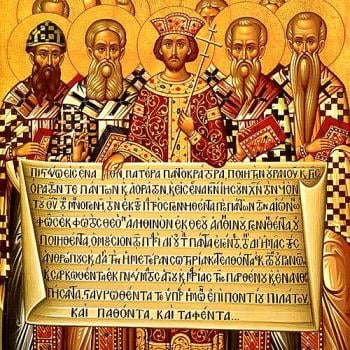
The Nicene Creed's Birthplace Is Found Buried in...

God Is the Father Alone, and Jesus Is...
Did Jesus Literally Come Down from Heaven?

Today is the 1,700th Anniversary of the Nicene...
TRENDING AT PATHEOS Progressive Christian

Debate on Purgatory & Biblical Evidences for It
This is from a combox on my video channel, Catholic Bible Highlights....

Set the table for the coming King
On Thursday we visited my sister-in-law for Thanksgiving, and throughout the entire...

If I Stop Becoming, Will I Disappear?
(At our most recent half day Zen retreat, Dr Chris Hoff, a...

A Modest Proposal for President Trump
Trump should just quit the loser Republicans who failed him so badly...
Praise and Thanks As Natural as Breathing
This week I had the privilege of sitting down with Deacon Tom...

Jesus is Coming with Glory and Power
https://www.youtube.com/watch?v=_lt60EDHOQ4&list=RD_lt60EDHOQ4&start_radio=1
view all Progressive Christian blogs
What Are Your Thoughts?leave a comment
Ad-Free & Subscriber Log-In Subscription Support
- About Us
- 2026 Calendar
- Videos
- Podcasts
- Library of World Religions
- Faith In Media Tracker
- Advertise With Us
- Write for Us
- Privacy Policy
- Terms of Service
- Do Not Sell My Data
- Contact Us
- Radiant Digital
- Manage Newsletter Subscriptions
- Unsubscribe From Notifications
- Sitemap
Copyright 2008-2026, Patheos, part of the Radiant Digital network of media brands. All rights reserved.
Subscription Support Ad-Free & Subscriber Log-In
Follow Patheos