
BuddhistCatholicContemplativeEvangelicalGeneral ChristianHinduJewishLatter-day SaintMuslimNew VisionsProgressive Christian
Beliefs
- Buddhist
- Catholic
- Contemplative
- Evangelical
- General Christian
- Hindu
- Jewish
- Latter-day Saint
- More Voices
- Muslim
- New Visions
- Pagan
- Progressive Christian
Topics
- Religion News
- Food and Religion
- Sports and Religion
- Religious Art
- Religious Music and Entertainment
- Religious Events
- History and Religion
- Style and Religion
- Politics and Religion
- Women in Religion
- Recreation Outdoors and Religion
- Business Finance and Religion
- Careers Workplace and Religion
- Education and Religion
- Family Parenting and Religion
- Health Fitness and Religion
- Home and Religion
- Relationships and Religion
- Technology and Religion
- Travel and Religion
Columnists
- Buddhist Columnists
- Business Finance and Religion Columnists
- Careers Workplace and Religion Columnists
- Catholic Columnists
- Contemplative Columnists
- Education and Religion Columnists
- Evangelists Columnists
- Family Parenting and Religion Columnists
- General Christian Columnists
- Health Fitness and Religion Columnists
- Hindu Columnists
- History and Religion Columnists
- Home and Religion Columnists
- Jewish Columnists
- More Voices Columnists
- Latter Day Columnists
- Muslim Columnists
- New Visions Columnists
- Nonreligious Columnists
- Pagan Columnists
- Politics and Religion Columnists
- Progressive Columnists
- Recreation Outdoors and Religion Columnists
- Relationships and Religion Columnists
- Religion News Columnists
- Religious Art Columnists
- Religious Events Columnists
- Religious Music and Entertainment Columnists
- Sports and Religion Columnists
- Style and Religion Columnists
- Technology and Religion Columnists
- Travel and Religion Columnists
- Women in Religion Columnists
Resource Library
- 2026 Calendar
- Library of World Religions
- The 100 Most Holy Places on Earth
- Patheos Answers
- Podcasts
- Videos
- Faith Leaders Database
- Anglican Episcopalian
- Bahai
- Baptist
- Buddhism
- Christianity
- Confucianism
- Eastern Orthodoxy
- Hinduism
- Holiness and Pentecostal
- ISKCON
- Islam
- Judaism
- Lutheran
- Methodist
- The Church of Jesus Christ of Latter-day Saints
- New Age
- Paganism
- Presbytarian and Reformed
- Protestantism
- Religion Behind the Scenes
- Roman Catholic
- Scientology
- Shia Islam
- Sikhism
- Sufism
- Sunni Islam
- Taoism
- Zen
- See all religions
Research Tools
 Ad-Free & Subscriber Log-In Subscription Support
Ad-Free & Subscriber Log-In Subscription Support
Follow Patheos 

- Trending:
- Forgiveness
- |
- Marriage
- |
- Consciousness
- |
- Death Penalty
- |
- Election
- |
- Halloween

- Home
- Progressive Christian
- Jesus and Marx: Where They Both Agree
Jesus and Marx: Where They Both Agree
Last updated on: March 11, 2026 at 5:48 pm by Keith Giles
Jesus and Marx: Where They Both Agree 2026-03-09T18:04:41+00:00 Keith Giles
Patheos Explore the world's faith through different perspectives on religion and spirituality! Patheos has the views of the prevalent religions and spiritualities of the world.

IMAGE: Keith Giles
Few figures in modern history provoke stronger reactions than Jesus of Nazareth and Karl Marx. One is the central figure of Christianity, a first-century Jewish teacher executed by the Roman Empire. The other is a 19th-century philosopher whose writings reshaped political thought and inspired revolutions around the world.
At first glance, comparing them might seem absurd.
Jesus preached about the Kingdom of God, forgiveness, and love for enemies. Marx analyzed industrial capitalism, class struggle, and the exploitation of labor.
One spoke in parables; the other wrote dense economic theory.
Yet many thinkers—religious and secular alike—have noticed striking overlaps between their critiques of society, particularly when it comes to poverty, inequality, and systems of power.
Sadly, their similarities are often misunderstood. Many critics assume Marxism simply cares about authoritarian communism or violent revolution. Likewise, many wrongly assume that Jesus endorsed the economic systems that dominate modern society.
Both miss the deeper connections.
To understand the relationship between Jesus and Marx, we need to examine three things:
- What Marxism actually is (and what it isn’t)
- Where Jesus and Marx converge in their critiques of society
- Where their visions ultimately diverge
What Marxism Actually Is (and What It Isn’t)
Public discourse often treats “Marxism” as a catch-all insult. Political figures frequently lump together Marxism, socialism, communism, liberalism, and even basic welfare policies as if they were all interchangeable concepts.
But Marxism, properly understood, is something much more specific.
As philosopher Michael Burns explains, Marxism is best understood not as a rigid political program but as a method of analysis. As Burns explains, “Marxism is a set of tools for analyzing why things are the way they are… especially how capitalism works and how it shapes human life.”
The truth is, Karl Marx was not primarily a revolutionary organizer or political leader. In fact, he spent much of his life writing, researching, and living on financial support from his wealthy friend Friedrich Engels. His focus was to analyze the dramatic economic changes of the 19th century, especially industrial capitalism.
Why? Because factories were transforming society:
- Workers labored long hours in dangerous conditions
- Wages were low
- Wealth was concentrated in the hands of factory owners
Marx wanted to understand why this system worked the way it did, and what its inherent flaws were. At the heart of his analysis was a simple observation: economic systems shape human life.
These economic systems determine:
- How we work
- How wealth is distributed
- How power structures operate
- How people relate to each other
In Marx’s view, capitalism produced a profound form of alienation as workers became disconnected from the products they created, the work itself, other workers, and, ultimately, their own humanity.
Under this capitalist system, work was no longer an expression of human creativity, it became merely a means of survival.
This diagnosis forms the core of Marxism.
More importantly, Marx was not calling for a revolution. Instead, he argued that contradictions within capitalism itself would eventually produce social upheaval.
In other words, the system would generate tensions that could not be sustained indefinitely.
He wasn’t saying that workers under Capitalism should rebel. He was saying that, eventually, Capitalism itself would create the conditions wherein revolution was the only possible recourse.
Jesus and His Critique of Systems that Oppress the Poor
The strongest connection between Jesus and Marx lies in their shared focus on economic injustice.
Both were deeply concerned with systems that enriched the powerful while crushing the vulnerable.
Jesus, like every other Jewish person in First Century Palestine, lived under Roman occupation in a highly unequal economic system.
Heavy taxation, land concentration, and imperial control pushed many people into poverty. Fishermen, farmers, and artisans struggled simply to survive…which is why when Jesus invites Peter, James, and John, to leave their nets and follow him, they don’t hesitate for an instant.
Jesus frequently addressed this economic oppression. His teachings include things like, “Blessed are the poor,” and “Woe to you who are rich.” Jesus commanded his followers to forgive debts. He told stories about radical generosity (The Good Samaritan) and economic reversal (The Rich man and Lazarus).
Because of these radical economic teachings, the earliest Christian communities even experimented with a form of communal sharing. As described in the book of Acts, believers pooled resources so that “there was no one in need among them.”
This echoes Marx’s famous line: “From each according to his ability, to each according to his need.”
Although their ideas emerged in different contexts, the ethical impulses of Jesus and Marx are very similar: human communities should care for one another rather than allow a select handful of people to accumulate all the wealth.
Marx and Industrial Capitalism
In his day, Marx saw industrial capitalism creating new forms of inequality. Factory owners accumulated enormous wealth while workers remained trapped in poverty. The system rewarded profit rather than human well-being. Marx’s critique centered on the structure of this economic system itself.
For him, inequality was not merely the result of individual greed, but the natural outcome of an economic system designed around profit and accumulation.
In that sense, both Jesus and Marx were confronting systems, not just individual moral failures.
Capitalism as a Kind of Religion
One of the most fascinating insights of comparing Marx and Jesus is the idea that capitalism functions almost like a theological system. Marx himself suggested something similar when he wrote about the “fetishism of commodities.”
Modern consumer culture encourages people to believe that meaning and identity come from consumption. Instead of defining ourselves by what we create or contribute to society, we define ourselves by what we buy. That means our modern identity often revolves around brands. When people pay large amounts of money for clothing simply because it carries a particular logo, the brand becomes part of their identity.
In that sense, Capitalism offers its own version of transcendence:
- Fulfillment through Consumption
- Economic growth as the ultimate measure of success
- Market functions as the final authority
This is precisely why critiques of Capitalism can provoke such strong reactions, because, for many people, the system feels as unquestionable as a religious belief.
Where Jesus and Marx Differ
Despite their similarities, Jesus and Marx ultimately diverge in important ways.
Jesus grounded his vision in the Kingdom of God, a spiritual reality that transcends political systems, while Marx believed that human beings themselves possessed the ability to transform society.
In Marx’s view, liberation would come through human action and historical change, not divine intervention.
Although, you could argue that the “Divine Intervention” takes place when people are transformed from the inside out and begin to live in ways that defy the status quo.
Jesus emphasized personal transformation. His message focused on repentance (metanoia – thinking differently), forgiveness, and spiritual renewal. In this model, social change would emerge as people embraced a new way of living.
Marx focused on structural transformation. He believed economic systems shape human consciousness. In his model, change required altering the structures of power and production.
Another major difference concerns the way Marx and Jesus defined revolution.
Although Marx predicted revolutionary upheaval, he did not necessarily prescribe violent revolt in the simplistic way many critics assume.
Still, Marxist movements historically embraced revolutionary struggle.
In contrast, Jesus consistently rejected violence. His response to oppression emphasized nonviolence, forgiveness, and sacrificial love. Even when confronted with crucifixion by Imperial powers, Jesus refused to retaliate.
Why Is Marxism So Misunderstood?
In modern political discourse, Marxism is often caricatured. Many critics equate it automatically with Stalinism, authoritarianism, and totalitarian governments.
But these perspectives reflect recent historical interpretations and do not take into account the full scope of Marx’s ideas.
Much of the hostility toward Marxism in the United States also emerged during the Cold War, when political leaders framed communism as the ultimate enemy. Religious rhetoric often reinforced this narrative.
Yet ironically, many of the values critics label “Marxist” (things like caring for the poor, economic justice, and communal responsibility), are deeply rooted in the biblical tradition itself.
Deeper Questions
Ultimately, the comparison between Jesus and Marx forces us to ask, “What kind of society allows human beings to flourish?”
Both thinkers recognized a troubling reality: Economic systems often prioritize power and profit over human dignity.
Yes, their responses differed.
Jesus called for spiritual transformation and radical compassion. Marx called for structural analysis and systemic change.
But both challenged the assumption that the existing order was inevitable.
Perhaps the most important similarity between Jesus and Marx is this: Both of them force us to question the status quo.
Jesus questioned the religious and economic structures of his time. Marx questioned the economic assumptions of modern capitalism.
In both cases, the result was controversy and sometimes violent hostility. But the questions they raised remain relevant.
If anything, growing inequality, corporate concentration of wealth, and global economic instability have made their ideas even more urgent.
Whether one approaches these questions through theology, philosophy, or politics, the challenge remains the same: How should human beings organize society so that everyone can live with dignity?
Jesus and Marx offered different answers. But both insisted that the status quo was not good enough.
The system cannot continue as it is. It’s time to rethink our way of being in the world.
It’s time for a revolution.
Do you agree?
**
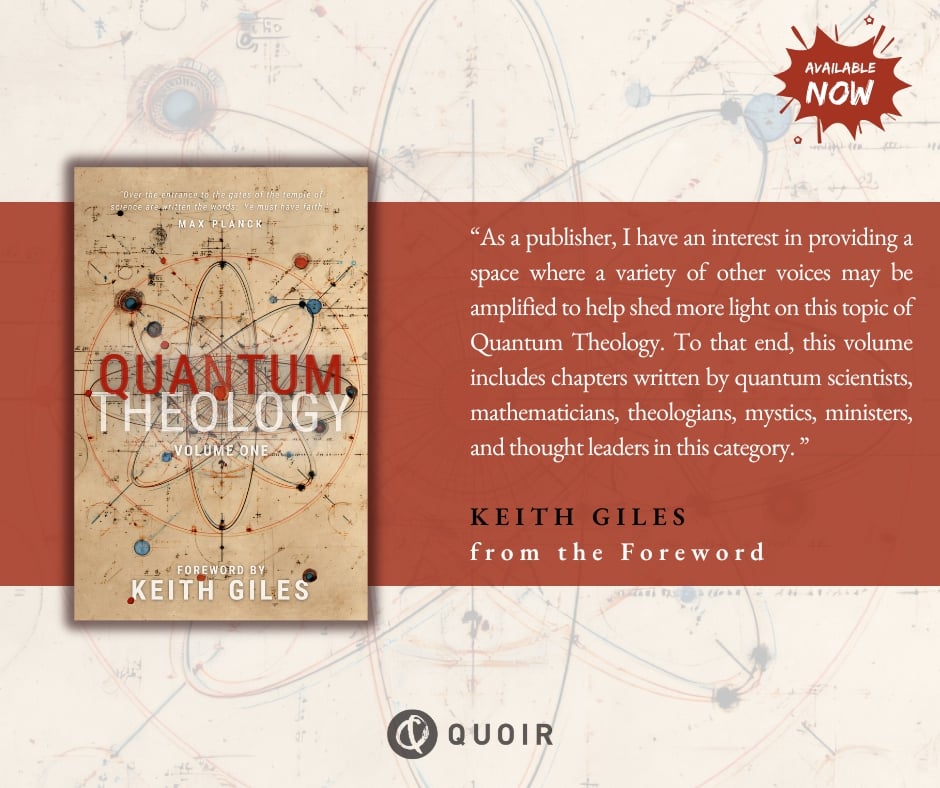
Quantum Theology: Volume One brings together an extraordinary and diverse group of scientists, mathematicians, theologians, mystics, authors, and cultural commentators to explore one of the most provocative conversations of our time: What happens when Quantum Physics and Theology begin to overlap?
Edited and curated by author Keith Giles, this book explores the intersection between science and faith.
My book, “The Quantum Gospel of Mary and the Lost Gospel of Truth” is now available on Amazon.
The book from Keith Giles, “The Quantum Sayings of Jesus: Decoding the Lost Gospel of Thomas” is available now on Amazon. Order HERE>
Keith Giles is the best-selling author of the Jesus Un series. He has been interviewed on CNN with Anderson Cooper, Coast to Coast Radio with George Noory, USA Today, BuzzFeed, and John Fugelsang’s “Tell Me Everything.” He co-hosts The Heretic Happy Hour Podcast and his solo podcast, Second Cup With Keith which are both available on Spotify, Amazon, Apple, Podbean or wherever you find great podcasts.
Previous Post

March 6, 2026
INNER CIRCLE: Awakening To Reality
Next Post

March 13, 2026 INNER CIRCLE: Nothing Shall Separate Us
Recent Comments
"Googled: “In psychology and everyday language, intelligence is the capacity to learn, understand, reason, think ..."
"It's so weird to me how anyone thinks that getting basic income is in any ..."
"Sounds very much like what Pope Leo wrote in Magnifica Humanitas - a lot of ..."
"As it is written in the canonical Gospels:But as many as received Him, to them ..."
INNER CIRCLE: God’s Transcending Love
Browse Our Archives
Select a Category Art Biblicism Christian Politics Cosmic Christ Deconstruction Discipleship Dispensationalism Divine Unity Ekklesia End Time Stuff Eschatology Evergreen Following Jesus Gender General Christian Topics Gnostics God's Love Gospel of Judas Gospel of Mary Gospel of Philip Gospel of the Kingdom Gospel of Thomas Gospel of Truth Hell Historical Jesus Inner Circle Investigative Reporting Islam LGBTQ Issues Marriage Mental/Emotional Health Mystery Non-Duality Philosophy Podcast Poetry Politics Poverty Preemptive Love Prophecy Psychology Quantum Theology Racism Reconstruction Satire Sex Technology Theology Uncategorized Universalism
Select a Month October 2026 September 2026 August 2026 July 2026 June 2026 May 2026 April 2026 March 2026 February 2026 January 2026 December 2025 November 2025 October 2025 September 2025 August 2025 July 2025 June 2025 May 2025 April 2025 March 2025 February 2025 January 2025 December 2024 November 2024 October 2024 September 2024 August 2024 July 2024 June 2024 May 2024 April 2024 March 2024 February 2024 January 2024 December 2023 November 2023 October 2023 September 2023 August 2023 July 2023 June 2023 May 2023 April 2023 March 2023 February 2023 January 2023 December 2022 November 2022 October 2022 September 2022 August 2022 July 2022 June 2022 May 2022 April 2022 March 2022 February 2022 January 2022 December 2021 November 2021 October 2021 September 2021 August 2021 July 2021 June 2021 May 2021 April 2021 March 2021 February 2021 January 2021 December 2020 November 2020 October 2020 September 2020 August 2020 July 2020 June 2020 May 2020 April 2020 March 2020 February 2020 January 2020 December 2019 November 2019 October 2019 September 2019 August 2019 July 2019 June 2019 May 2019 April 2019 March 2019 February 2019 January 2019 December 2018 November 2018 October 2018 September 2018 August 2018 July 2018 June 2018 May 2018 April 2018 March 2018 February 2018 January 2018 December 2017 November 2017
Follow Us!
TAKE THE
Religious Wisdom Quiz
Which sea did Moses cross in the Exodus story?
Select your answer to see how you score.
Dead Sea Sea of Galilee Red Sea Caspian Sea
Books by This Author Books by Keith Giles
Related posts from Keith Giles

INNER CIRCLE: Profound Mystery (Of Christ In All...

AI Is A Gateway to the Welfare State

INNER CIRCLE: Awaken the Sleeper

INNER CIRCLE: In Every Respect
TRENDING AT PATHEOS Progressive Christian

In "Irreplaceable," our book on vocation and technology, Trevor Sutton and I...

I was strolling through the top floor of the brand new Parthenon...

What Does Gêvâh Mean For Kimberley Guifoyle &...
This week, a lot of the news is focused on Kimberly Guilfoyle....

INNER CIRCLE: Profound Mystery (Of Christ In All...
Ephesians 5:31-32 “For this reason, a man will leave his father and...

Do Not Rejoice When Your Enemy Falls: The...
Turning an execution into a public spectacle is a disturbing expression of...

'The Chosen' S6 Trailer: The Passion Gets Very...
Not many watching 'The Chosen' worry about spoilers, but just because they...
view all Progressive Christian blogs
What Are Your Thoughts?leave a comment
Ad-Free & Subscriber Log-In Subscription Support
- About Us
- 2026 Calendar
- Videos
- Podcasts
- Library of World Religions
- Faith In Media Tracker
- Advertise With Us
- Write for Us
- Privacy Policy
- Terms of Service
- Do Not Sell My Data
- Contact Us
- Radiant Digital
- Manage Newsletter Subscriptions
- Unsubscribe From Notifications
- Sitemap
Copyright 2008-2026, Patheos. All rights reserved.
Subscription Support Ad-Free & Subscriber Log-In
Follow Patheos