
BuddhistCatholicContemplativeEvangelicalGeneral ChristianHinduJewishLatter-day SaintMuslimNew VisionsProgressive Christian
Beliefs
- Buddhist
- Catholic
- Contemplative
- Evangelical
- General Christian
- Hindu
- Jewish
- Latter-day Saint
- More Voices
- Muslim
- New Visions
- Pagan
- Progressive Christian
Topics
- Religion News
- Food and Religion
- Sports and Religion
- Religious Art
- Religious Music and Entertainment
- Religious Events
- History and Religion
- Style and Religion
- Politics and Religion
- Women in Religion
- Recreation Outdoors and Religion
- Business Finance and Religion
- Careers Workplace and Religion
- Education and Religion
- Family Parenting and Religion
- Health Fitness and Religion
- Home and Religion
- Relationships and Religion
- Technology and Religion
- Travel and Religion
Columnists
- Buddhist Columnists
- Business Finance and Religion Columnists
- Careers Workplace and Religion Columnists
- Catholic Columnists
- Contemplative Columnists
- Education and Religion Columnists
- Evangelists Columnists
- Family Parenting and Religion Columnists
- General Christian Columnists
- Health Fitness and Religion Columnists
- Hindu Columnists
- History and Religion Columnists
- Home and Religion Columnists
- Jewish Columnists
- More Voices Columnists
- Latter Day Columnists
- Muslim Columnists
- New Visions Columnists
- Nonreligious Columnists
- Pagan Columnists
- Politics and Religion Columnists
- Progressive Columnists
- Recreation Outdoors and Religion Columnists
- Relationships and Religion Columnists
- Religion News Columnists
- Religious Art Columnists
- Religious Events Columnists
- Religious Music and Entertainment Columnists
- Sports and Religion Columnists
- Style and Religion Columnists
- Technology and Religion Columnists
- Travel and Religion Columnists
- Women in Religion Columnists
Resource Library
- 2026 Calendar
- Library of World Religions
- The 100 Most Holy Places on Earth
- Patheos Answers
- Podcasts
- Videos
- Faith Leaders Database
- Anglican Episcopalian
- Bahai
- Baptist
- Buddhism
- Christianity
- Confucianism
- Eastern Orthodoxy
- Hinduism
- Holiness and Pentecostal
- ISKCON
- Islam
- Judaism
- Lutheran
- Methodist
- The Church of Jesus Christ of Latter-day Saints
- New Age
- Paganism
- Presbytarian and Reformed
- Protestantism
- Religion Behind the Scenes
- Roman Catholic
- Scientology
- Shia Islam
- Sikhism
- Sufism
- Sunni Islam
- Taoism
- Zen
- See all religions
Research Tools
 Ad-Free & Subscriber Log-In Subscription Support
Ad-Free & Subscriber Log-In Subscription Support
Follow Patheos 

- Trending:
- Forgiveness
- |
- Marriage
- |
- Consciousness
- |
- Death Penalty
- |
- Election
- |
- Halloween

- Home
- Progressive Christian
- INNER CIRCLE: The Problem with Paul
INNER CIRCLE: The Problem with Paul
Last updated on: February 6, 2026 at 4:02 pm by Keith Giles
INNER CIRCLE: The Problem with Paul 2026-02-06T16:02:06+00:00 Keith Giles
Patheos Explore the world's faith through different perspectives on religion and spirituality! Patheos has the views of the prevalent religions and spiritualities of the world.

IMAGE: Keith Giles
The problem with Paul is that there is more than one problem with Paul. Some people can’t get beyond his apparent misogyny and homophobia. Others can’t reconcile his message with what Jesus says in the Sermon on the Mount. Still others take issue with his treatment of the other Apostles who, unlike him, actually knew Jesus and spent three years under his teaching. Many are surprised when they realize that Paul never met Jesus and almost never quotes the teachings of Jesus in his letters to the Church.
So, where to begin?
First, I want to address the charge that Paul was somehow an agent of the Roman Empire who was given the task of corrupting the true message of Jesus in order to make people more compliant with Roman rule.
Certainly, we can point to passages like Romans 13 where Paul seems to suggest that Christians should not rock the boat, pay their taxes, and learn to think of the Roman Empire as “God’s servant,” but there are several problems with this theory.
First, if Paul was Rome’s attempt to turn Christians around to support the Roman Empire, it failed for the first 300 years or so. Every single one of the early Church Fathers from the First Century and into the reign of Constantine resisted Roman rule, and many went to their deaths refusing to pledge allegiance to Caesar or the Empire.
Secondly, if there was a conspiracy to hijack the Christian movement and shift it away from the focus on Jesus, this also failed because Paul’s letters were written prior to any of the Gospels found in the New Testament. So, even if Paul was a Roman agent of chaos, his letters failed to move anyone away from the words or teachings of Jesus – at least in those early centuries of the Christian movement – as evidenced by the writings of the Church Fathers, who all appealed to the teachings of Christ when it came to resisting the Empire.
Now, I will say that later theologians did use the writings of Paul to subvert the teachings of Jesus in ways that shifted the focus away from the “Way” of Jesus – love, forgiveness, mercy, compassion, etc. – and deeper into the theology of atonement, sin management, guilt, shame, and submission to the Empire.
This is not to suggest that Paul wasn’t confused about some things when it came to Jesus. I think a strong case can be made that, at least earlier in his ministry, Paul was still grappling with questions of theology that Jesus really never addressed. Perhaps this is because Paul was “a Pharisee of Pharisees” who had a lot of theological baggage to unpack when it came to defining – and later redefining – who Jesus was and what his message was all about.
This also brings up something else about Paul that we should admit: He was a human being just like you and me. That means he could be wrong about some things. It also means he could change his mind about things over time and revise his understanding based on a variety of factors. Like we all do.
Missing Context
We should also admit that Paul didn’t think he was writing Scripture when he sat down to answer a question from believers in Corinth, or Galatia, or Thessalonica. He might have been horrified to know that, a few hundred years later, his letters to these scattered churches would be elevated to the same level as Genesis, Exodus, and Isaiah in the hearts and minds of believers who couldn’t read Greek and who didn’t understand the context of the teachings. Many of Paul’s letters are responses to letters written to him by those churches. We don’t have those letters, so we don’t have the full context of the conversation. We can only hear one side and not the other. We also don’t realize that, often, Paul will quote back to the churches something they wrote to him in their letter before he responds to the statement. Those portions of Paul’s letters are not Paul’s words, but without the original letters, we cannot always guess which sections are Paul’s thoughts and which sections are his quotations of their letters.
See the problem?
It gets worse. Because sometimes Paul uses an argumentation device called “Prosopopeia” (as he does in his letter to the Romans) wherein he writes as if he is in a debate with an imaginary opponent and then refutes those arguments later in the text. If we don’t realize he’s doing this, and if we don’t know which sections are written in the voice of the imaginary opponent, then we will mistakenly attribute ideas to Paul that he most certainly would not have agreed with.
But, that’s not all.
Missing Words
Several of Paul’s letters have been poorly translated for us into English. Sometimes these translations leave out words or change the meaning of the words to fit specific doctrinal beliefs. Some examples are the word “exomologeo” in the epistle to the Philippians which means “to gladly confess.” Yet, translators have left out the “gladly” in order to advance the narrative that when “every knee will bow and every tongue confess that Jesus Christ is Lord…” the confession would be made as if through gritted teeth rather than through tears of joy or celebration. Why change that? Because the implication that every single person will one day joyfully confess that Jesus is Lord suggests that perhaps everyone will be saved in the end. Especially when compared to another verse written by Paul in Romans which says, “If you declare with your mouth, ‘Jesus is Lord,’ and believe in your heart that God raised him from the dead, you will be saved.” (Romans 10:9) Since the idea of Universal Reconciliation isn’t acceptable to Christians who believe in Eternal Conscious Torment, the word “gladly” had to be scrubbed from our English Translations in order to preserve the notion that only the righteous will be saved while all the rest of those “sinners” in the world will suffer eternal damnation.
There are other examples, but you get the point. Getting to the root of Paul’s teachings can be challenging because our English Translations of his writings have been manipulated in several cases to obscure the true meaning of his words.
Mistaken Identity
The other problem with Paul is that some of the letters in the New Testament that are attributed to him were not written by him. This is called “Pseudepigrapha.”
The textbook definition of Pseudepigrapha is:
“Spurious or pseudonymous writings ascribed to various biblical patriarchs and prophets but composed within approximately 200 years of the birth of Jesus Christ.”
The texts that most scholars agree were not written by Paul include:
- Ephesians
- Colossians
- 2 Thessalonians
- 1 Timothy
- 2 Timothy
- Titus
Scholars are sharply divided on whether or not Colossians and 2 Thessalonians are genuine, but when it comes to Ephesians and the so-called “Pastoral Epistles” – that would be 1 and 2 Timothy, and Titus – most critical scholars have no trouble labeling them as pseudepigraphical works.
I know. It’s hard to take. Breathe deep.
By the way, no one knows who wrote either 1 Peter or 2 Peter, but the one thing almost every New Testament scholar agrees on is this: It wasn’t the disciple known as Simon Peter.
So, what are we to do with this information? Do we throw out these letters and excise them from our New Testament? Or, is there another way to respond that helps us make sense of how we should read them?
Here’s what I suggest: Read those disputed texts with one eye towards the teachings of Jesus. If what you read aligns with what Jesus taught, then take it to heart. But, if something doesn’t resonate with the teachings of Christ, then you are free to reject that teaching. By the way, I think we should do this with everything in the Bible. Not just these disputed letters, but the accepted letters of Paul as well as the Isaiah, and Jeremiah, and Deuteronomy, etc.
This is what it means to read the Scriptures through the lens of Christ. If we can learn to do this, we will never have to reconcile passages where God commands the slaughter of pregnant women, or the taking of teenage girls as sexual slaves, or the complete genocide of an entire nation. If those passages don’t sound like Jesus, we know that they were not written under the inspiration of Christ.
Interestingly, if we do this when we read some of Paul’s disputed letters – like Ephesians and Colossians for example – we find that much of what is found there resonates entirely with the teachings of Christ. So, whoever wrote it, we can safely receive those teachings with gladness because we know those teachings are inspired.
For example, when we read in Colossians that “we are all one in Christ” (Col. 3:11) we can say “Amen!” and when we read in Ephesians the words that “Christ fills everything in every way,” we can receive those teachings with gladness.
What’s With Paul and Women?
Let’s address the charge that Paul hated women.
Without a doubt, several passages in Paul’s letters have been used to justify the subjugation of women in the church. But, on closer inspection, those “clobber passages” may not actually be saying what we’ve been told they’re saying.
For example, the passage in 1 Corinthians where we read “Women should keep silent in the church. They are not allowed to speak, but must be in submission as the Law says” (13:34-35), we can not only reject those teachings as they do not align with the way Jesus treated women, we can also reject them on the basis that the Law of Moses does not forbid women to speak, and since Paul was a “Pharisee of Pharisees” he would have known this. If he knew this wasn’t in the Law, then Paul wouldn’t have said this to the church in Corinth. But, someone at the church in Corinth may have written this to Paul in the letter they sent to him. If so, then it would make sense that, in response to that statement, Paul would have written back saying:
“What?! Did the word of God originate with you? Or are you the only people it has reached? If anyone thinks they are a prophet or otherwise gifted by the Spirit, let them acknowledge that what I am writing to you is the Lord’s command. But if anyone ignores this, they will themselves be ignored. Therefore, my brothers and sisters, be eager to prophesy, and do not forbid speaking in tongues.” (vs. 36-40, emphasis mine)
Note that the first exclamation “What?!” is left out of most English Translations. But by adding it back in, Paul’s response to the erroneous notion that the Law forbids women to speak is clear. Then, he urges the church in Corinth to “acknowledge that what I am writing to you is the Lord’s command…”, and what has he just written to them in the preceding pages? The idea that everyone – men and women alike – can prophesy in the church. This means that Paul affirms that women have the right to speak in the church, and to teach alongside the men. This is also why he concludes that section by reminding them that everyone should “be eager to prophesy and (to) not forbid speaking in tongues,” which would also entail women speaking out in the congregation.
Note: For a more complete handling of Paul and Women, please see my book, Jesus Unbound: Liberating the Word of God From the Bible.
Problematic Paul
So, there are many objections from a variety of people when it comes to embracing the Apostle Paul. I don’t believe I have exhausted the topic here, but I do hope that I have made a case for Paul’s fallibility, as well as all the many ways Paul’s teachings have been mistranslated, misunderstood, and misattributed to enforce ideas that he himself would have never agreed to.
Not that Paul had it all right. Not that he didn’t have some residual legalism in his bones, or that he didn’t have some lingering patriarchy in his mind. I’ll concede that he was human, and that he, like all of us, had blind spots and weaknesses galore.
But, so did Martin Luther King, and Gandhi, and Mother Teresa, and Black Elk, and Rumi, and on and on and on. So, if we don’t demand that most of our other sources of wisdom adhere to a standard of perfection, then let’s try to give Paul a little break in those areas. He really does have some wonderful things to teach us; things that point us to our shared divinity and our shared humanity; things that can help us to break our addiction to the “Us vs Them” narrative that is, quite literally, killing us all.
So, as we move forward in this book and begin to look at the good things Paul said about our Oneness with God and with all humanity, let’s try to have grace for some of the places where he didn’t always get it right.
**
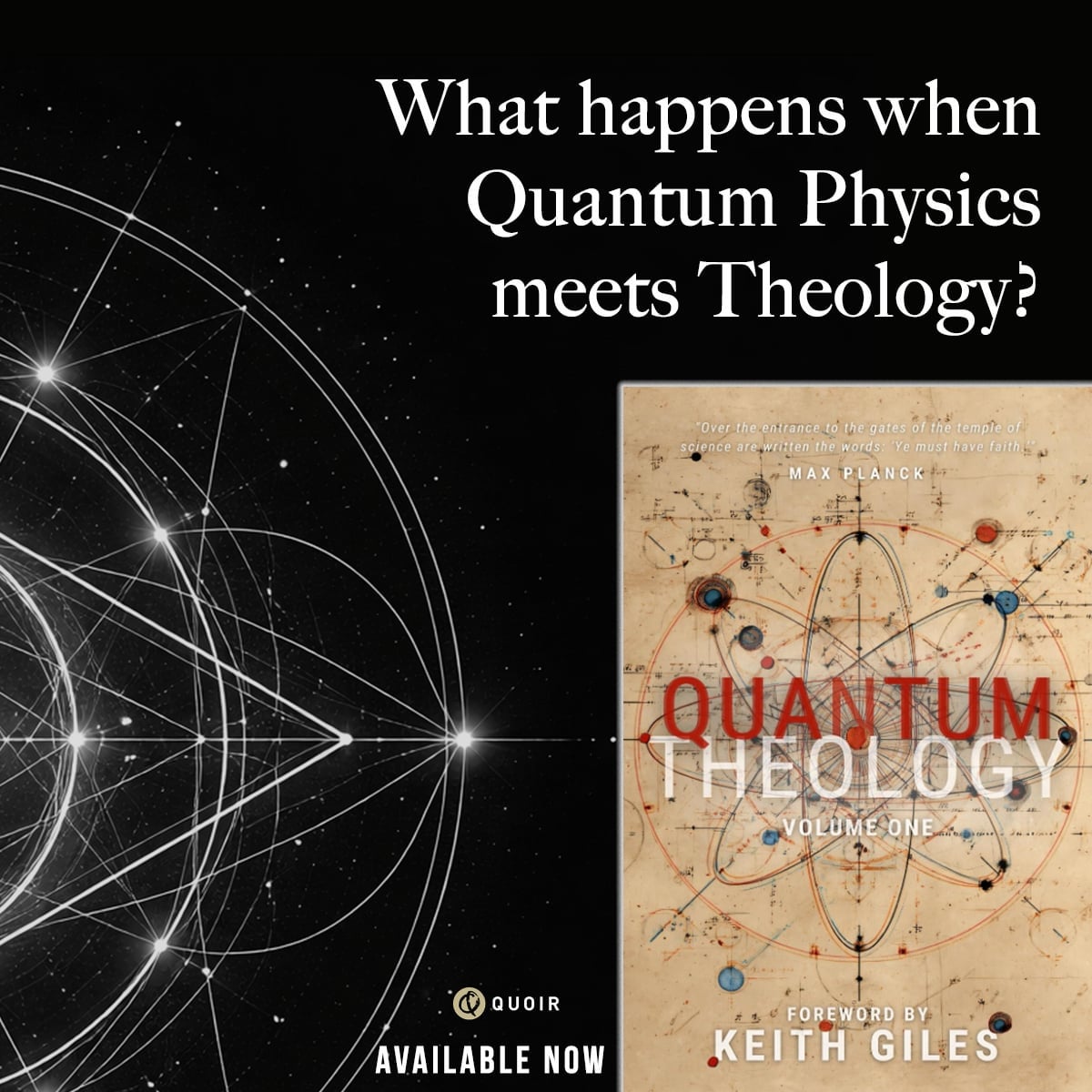
I’m very proud to have edited and written the Foreword for this amazing new book releasing Tuesday, February 17th from Quoir Publishing. This book features contributions from Quantum Scientists, Mathematicians, Mystics, Theologians, and Authors who are all captivated by the concepts found in Quantum Physics and how those ideas challenge the religious power structures and compliment the mystics at the same time.
This book features chapters from people like: Dr. Steve McVey, Brandy Anderson, Dr. Jenny Lorraine Nielsen, Mo Thomas, Nish Dubashia, Mary Terhune, Stuart Delony, Eric English, and many more!
Grab your copy HERE>
My book, “The Quantum Gospel of Mary and the Lost Gospel of Truth” is now available on Amazon.
The book from Keith Giles, “The Quantum Sayings of Jesus: Decoding the Lost Gospel of Thomas” is available now on Amazon. Order HERE>
Keith Giles is the best-selling author of the Jesus Un series. He has been interviewed on CNN with Anderson Cooper, Coast to Coast Radio with George Noory, USA Today, BuzzFeed, and John Fugelsang’s “Tell Me Everything.” He co-hosts The Heretic Happy Hour Podcast and his solo podcast, Second Cup With Keith which are both available on Spotify, Amazon, Apple, Podbean or wherever you find great podcasts.
Previous Post

February 2, 2026
The Story of US
Next Post

February 12, 2026 Welcome To The Second Axial Age: Will We Survive?
Recent Comments
"Googled: “In psychology and everyday language, intelligence is the capacity to learn, understand, reason, think ..."
"It's so weird to me how anyone thinks that getting basic income is in any ..."
"Sounds very much like what Pope Leo wrote in Magnifica Humanitas - a lot of ..."
"As it is written in the canonical Gospels:But as many as received Him, to them ..."
INNER CIRCLE: God’s Transcending Love
Browse Our Archives
Select a Category Art Biblicism Christian Politics Cosmic Christ Deconstruction Discipleship Dispensationalism Divine Unity Ekklesia End Time Stuff Eschatology Evergreen Following Jesus Gender General Christian Topics Gnostics God's Love Gospel of Judas Gospel of Mary Gospel of Philip Gospel of the Kingdom Gospel of Thomas Gospel of Truth Hell Historical Jesus Inner Circle Investigative Reporting Islam LGBTQ Issues Marriage Mental/Emotional Health Mystery Non-Duality Philosophy Podcast Poetry Politics Poverty Preemptive Love Prophecy Psychology Quantum Theology Racism Reconstruction Satire Sex Technology Theology Uncategorized Universalism
Select a Month October 2026 September 2026 August 2026 July 2026 June 2026 May 2026 April 2026 March 2026 February 2026 January 2026 December 2025 November 2025 October 2025 September 2025 August 2025 July 2025 June 2025 May 2025 April 2025 March 2025 February 2025 January 2025 December 2024 November 2024 October 2024 September 2024 August 2024 July 2024 June 2024 May 2024 April 2024 March 2024 February 2024 January 2024 December 2023 November 2023 October 2023 September 2023 August 2023 July 2023 June 2023 May 2023 April 2023 March 2023 February 2023 January 2023 December 2022 November 2022 October 2022 September 2022 August 2022 July 2022 June 2022 May 2022 April 2022 March 2022 February 2022 January 2022 December 2021 November 2021 October 2021 September 2021 August 2021 July 2021 June 2021 May 2021 April 2021 March 2021 February 2021 January 2021 December 2020 November 2020 October 2020 September 2020 August 2020 July 2020 June 2020 May 2020 April 2020 March 2020 February 2020 January 2020 December 2019 November 2019 October 2019 September 2019 August 2019 July 2019 June 2019 May 2019 April 2019 March 2019 February 2019 January 2019 December 2018 November 2018 October 2018 September 2018 August 2018 July 2018 June 2018 May 2018 April 2018 March 2018 February 2018 January 2018 December 2017 November 2017
Follow Us!
TAKE THE
Religious Wisdom Quiz
Which prophet predicted an outpouring of God's Spirit in the last days?
Select your answer to see how you score.
Micah Daniel Joel Ezekiel
Books by This Author Books by Keith Giles
Related posts from Keith Giles

INNER CIRCLE: Profound Mystery (Of Christ In All...

INNER CIRCLE: Awaken the Sleeper

INNER CIRCLE: In Every Respect

TRENDING AT PATHEOS Progressive Christian

I was strolling through the top floor of the brand new Parthenon...

What Does Gêvâh Mean For Kimberley Guifoyle &...
This week, a lot of the news is focused on Kimberly Guilfoyle....

INNER CIRCLE: Profound Mystery (Of Christ In All...
Ephesians 5:31-32 “For this reason, a man will leave his father and...

Do Not Rejoice When Your Enemy Falls: The...
Turning an execution into a public spectacle is a disturbing expression of...

'The Chosen' S6 Trailer: The Passion Gets Very...
Not many watching 'The Chosen' worry about spoilers, but just because they...

The purpose-driven labor priest
A labor activist reads Rick Warren and it gets me wondering about...
view all Progressive Christian blogs
What Are Your Thoughts?leave a comment
Ad-Free & Subscriber Log-In Subscription Support
- About Us
- 2026 Calendar
- Videos
- Podcasts
- Library of World Religions
- Faith In Media Tracker
- Advertise With Us
- Write for Us
- Privacy Policy
- Terms of Service
- Do Not Sell My Data
- Contact Us
- Radiant Digital
- Manage Newsletter Subscriptions
- Unsubscribe From Notifications
- Sitemap
Copyright 2008-2026, Patheos. All rights reserved.
Subscription Support Ad-Free & Subscriber Log-In
Follow Patheos