
BuddhistCatholicContemplativeEvangelicalGeneral ChristianHinduJewishLatter-day SaintMuslimNew VisionsProgressive Christian
Beliefs
- Buddhist
- Catholic
- Contemplative
- Evangelical
- General Christian
- Hindu
- Jewish
- Latter-day Saint
- More Voices
- Muslim
- New Visions
- Pagan
- Progressive Christian
Topics
- Religion News
- Food and Religion
- Sports and Religion
- Religious Art
- Religious Music and Entertainment
- Religious Events
- History and Religion
- Style and Religion
- Politics and Religion
- Women in Religion
- Recreation Outdoors and Religion
- Business Finance and Religion
- Careers Workplace and Religion
- Education and Religion
- Family Parenting and Religion
- Health Fitness and Religion
- Home and Religion
- Relationships and Religion
- Technology and Religion
- Travel and Religion
Columnists
- Buddhist Columnists
- Business Finance and Religion Columnists
- Careers Workplace and Religion Columnists
- Catholic Columnists
- Contemplative Columnists
- Education and Religion Columnists
- Evangelists Columnists
- Family Parenting and Religion Columnists
- General Christian Columnists
- Health Fitness and Religion Columnists
- Hindu Columnists
- History and Religion Columnists
- Home and Religion Columnists
- Jewish Columnists
- More Voices Columnists
- Latter Day Columnists
- Muslim Columnists
- New Visions Columnists
- Nonreligious Columnists
- Pagan Columnists
- Politics and Religion Columnists
- Progressive Columnists
- Recreation Outdoors and Religion Columnists
- Relationships and Religion Columnists
- Religion News Columnists
- Religious Art Columnists
- Religious Events Columnists
- Religious Music and Entertainment Columnists
- Sports and Religion Columnists
- Style and Religion Columnists
- Technology and Religion Columnists
- Travel and Religion Columnists
- Women in Religion Columnists
Resource Library
- 2026 Calendar
- Library of World Religions
- The 100 Most Holy Places on Earth
- Patheos Answers
- Podcasts
- Videos
- Faith Leaders Database
- Anglican Episcopalian
- Bahai
- Baptist
- Buddhism
- Christianity
- Confucianism
- Eastern Orthodoxy
- Hinduism
- Holiness and Pentecostal
- ISKCON
- Islam
- Judaism
- Lutheran
- Methodist
- The Church of Jesus Christ of Latter-day Saints
- New Age
- Paganism
- Presbytarian and Reformed
- Protestantism
- Religion Behind the Scenes
- Roman Catholic
- Scientology
- Shia Islam
- Sikhism
- Sufism
- Sunni Islam
- Taoism
- Zen
- See all religions
Research Tools
 Ad-Free & Subscriber Log-In Subscription Support
Ad-Free & Subscriber Log-In Subscription Support
Follow Patheos 

- Trending:
- Forgiveness
- |
- Marriage
- |
- Consciousness
- |
- Death Penalty
- |
- Election
- |
- Halloween

- Home
- Progressive Christian
- Why Paul Literally Reads Scripture Allegorically
Why Paul Literally Reads Scripture Allegorically
Last updated on: June 18, 2025 at 3:42 pm by Keith Giles
Why Paul Literally Reads Scripture Allegorically 2025-06-18T15:42:28+00:00 Keith Giles
Patheos Explore the world's faith through different perspectives on religion and spirituality! Patheos has the views of the prevalent religions and spiritualities of the world.
[Guest Post by Richard Murray]
Those who say we are not to allegorize the Old Testament “missed the memo” from the New Testament which says that is exactly what we ARE to do— allegorize the Old Testament with the love and light of Christ.
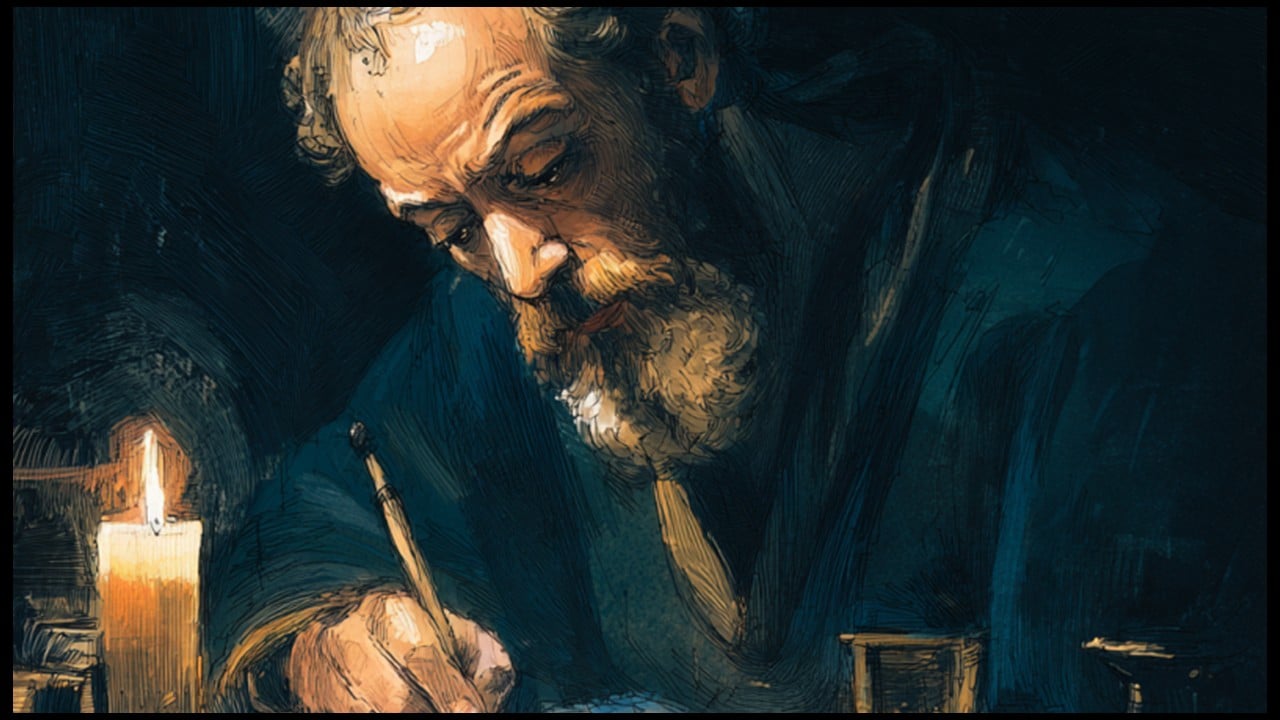
The Apostle Paul LITERALLY (and ironically) told us to ALLEGORIZE, and showed us how we could ALLEGORIZE the Old Testament “letter” into the New Testament “Spirit.”
“Allegory is language that says one thing and means either something MORE than what it says or something OTHER than what it says.” (Theologian R.A. Norris, in his article on “Allegory” in THE WESTMINSTER HANDBOOK TO ORIGEN)
Allegory has been defined by Bishop Marsh, in accordance with its etymology, as “a representation of one thing which is intended to excite the representation of another thing.”
So, when allegorizing the Old Testament, the “another thing” is always some aspect of Jesus and His coming kingdom. All such allegories find their rest in Christ.
This is why I have coined the term “Christo-allegory” to describe the process of allegorizing Old Testament Scriptures into Christological meaning.
The very first usage by a Christian of the concept of allegory was not some New Age kook, or some modern liberal theologian (as many seem to inexplicably think).
It was the apostle Paul who first used and modeled the term in its Christian application. So, if we have a problem with Old Testament allegory, our problem is with Paul, Peter, and the early church fathers, not to mention Jesus. But let’s start with Paul’s explicit usage the term “allegory.”
“Now THIS (the Old Testament narrative of Sarah and Hagar) may be interpreted ALLEGORICALLY (Greek “allegoria”): these women are two covenants. One is from Mount Sinai, bearing children for slavery; she is Hagar. Now Hagar is Mount Sinai in Arabia; she corresponds to the present Jerusalem, for she is in slavery with her children. But the Jerusalem above is free, and she is our mother.
“For it is written, ‘Rejoice, O barren one who does not bear; break forth and cry aloud, you who are not in labor! For the children of the desolate one will be more than those of the one who has a husband.’ Now you, brothers, like Isaac, are children of promise. But just as at that time he who was born according to the flesh persecuted him who was born according to the Spirit, so also it is now.
“But what does the Scripture say? “Cast out the slave woman and her son, for the son of the slave woman shall not inherit with the son of the free woman.”
So, brothers, we are not children of the slave but of the free woman.” – Galatians 4:24-31
We mustn’t miss the importance of what Paul did here. Nobody for a second thinks the Mosaic writer’s original intent or immediate context, when writing this narrative a thousand years earlier, meant it ever to be read as an allegory for the Old and New Covenants.
As Patristic Scholar David Bentley Hart recently said:
“Really, when did Paul not allegorize the Old Testament? As should be obvious, Paul frequently allegorizes Hebrew scripture; the ‘spiritual reading’ of scripture typical of the Church Fathers of the early centuries was not their invention, nor just something borrowed from pagan culture, but was already a widely accepted hermeneutical practice among Jewish scholars. So it is not anachronistic to read Paul here as saying that the stories he is repeating are not accurate historical accounts of actual events, but allegorical tales composed for the edification of readers….. Again, one should not assume that Paul does not mean precisely what he says, and takes the tale to be essentially (not merely secondarily) allegorical. His interpretative habits are rarely literalist.”
[The New Testament: A Translation (2017), David Bentley Hart, pg. 336, 376].
I am convinced that when Peter said that some of Paul’s writings were difficult to grasp, at least one thing to which he was referring was his heavy use of allegory in updating Old Testament imagery with the better light of the New Testament.
When Paul read the Old Testament:
— EXTERNAL circumcision became “nothing,”
— EXTERNAL temple descriptions became entirely symbolic,
— EXTERNAL animal sacrifices became meaningless rituals,
— EXTERNAL narratives of Israel’s journey became allegories of Christ.
Paul used Scripture to go INTERNAL:
— INTERNAL heart-circumcision now became “everything,”
— INTERNAL temple dynamics now say WE are the living temples of God,
— INTERNAL sacrifices of self-will are what WE offer to God’s purging fire,
— INTERNAL human processes are now explained by reinterpreting Israel’s history as allegorical archetypes of our human condition today, here, and now.
When the apostle Paul cited Old Testament Scriptures, he usually expanded them to either mean something MORE or something OTHER than what they literally said.
Paul displayed this dynamic when he rescued the concept of circumcision by transfiguring it FROM an empty and meaningless external Old Testament ritual TO the New Testament reality of the internal spiritual transformation of the heart.
“Circumcision is nothing, and uncircumcision is nothing, but the keeping of the commandments of God.” 1 Cor. 7:19.
“For in Jesus Christ neither circumcision availeth any thing, nor uncircumcision; but faith which works by love.” Gal. 5:6.
“But he is a Jew, who is one inwardly; and circumcision is that of the heart, in the spirit, and not in the letter; whose praise is not of men, but of God.” Rom. 2:29.
Below are other New Testament passages using this same allegorical dynamic.
Galatians 4:21-31 (The “allegorical” reading of the Old Testament here is both modeled and approved by Paul, as he completely reinterprets the meaning of the story of Abraham, Isaac, Hagar and Ishmael to refer rather to the current relationship between Old and New Covenants).
1 Corinthians 10:1-11 (Paul “allegorizes” the whole Exodus journey of Israel as a type of the Christian walk, reading it non-literally in other words).
2 Corinthians 3:6-18 (Paul here says we are to be “ministers of the New Covenant, not of the letter, for the LETTER KILLS, but of the Spirit, for the Spirit gives life,” and that Moses, as a symbol of Old Testament understanding, “veiled” the true meaning of OT Scripture by reading it with blind literalism).
Hebrews 8:1-5 (The voluminous OT passages about the “tabernacle” and “priesthood” and “sacrifices” are all “shadows of heavenly things” rather than literal realities on earth).
Hebrews 10:1 (Here, we see the law itself is to be read allegorically: “the law, having a shadow of good things to come, and NOT the very image of the things”).
Colossians 2:17 (The OT festivals, holy days and dietary laws are all symbolic prefigurements called “shadows” of “the body of Christ” to come, again not the literal thing itself but a prophetic allegory of the Kingdom of God).
Matthew 11:13 (“ALL the OT law and prophets prophesied until John the Baptist,” the clear implication being that the OT is one big prophetic allegory of Christ to come).
Luke 11:27 (“ALL” the OT Scriptures, when properly read, speak ONLY of Christ).
Paul also transformed the Sabbath from a “letter of the law” weekly ritual to an ongoing lifestyle state of being. Heb. 4:1-11.
Paul (and Peter)both renovated Old Testament dietary laws by integrating faith and thanksgiving into the true spiritual diet. (Acts. 11:5-10; Rom. 14:1-23; 1 Tim. 4:3-4).
In 1 Cor. 14:21, Paul took an Old Testament passage which on its face had nothing to do with New Testament tongues (Is. 28:11-12), and transformed, enhanced and enriched it to make it a prophetic passage for the spiritual gift of tongues.
In Acts 2, Peter did the same thing in taking Joel 2:28-29 and excavating, renovating and elevating it to prophesy the coming of the Holy Spirit at Pentecost. It is beyond dispute that the Old Testament scholars of their day would have accused Paul and Peter (and the other New Testament writers) of butchering and misusing scriptures. They didn’t see that the Old Testament scriptures needed to be transformed, enhanced and enriched.
But, as much as Paul loved and modeled Old Testament allegory (“and really when did Paul not allegorize”— Patristic Scholar David Bentley Hart), it was Jesus who FIRST modeled the idea.
While Paul is readily seen as an allegorist, Jesus Himself is frequently overlooked in this area.
In point of fact, Jesus frequently allegorized the Old Testament. Using key imagery from Old Testament passages which were ONLY seen as literal, He would then usurp their literal meaning into an allegorical application toward Himself.
He referred to Himself ALLEGORICALLY as the Temple of God (John 2:19-22), the true manna from heaven (John 6:50), Jacob’s supernatural ladder between heaven and earth (John 1:51), the sign of Jonah (Matthew 12:38-40), the great shepherd of Psalm 23 (John 10:11), etc.
God revealed Himself as the great “I Am” In Exodus 3 with Moses at the Burning Bush. Jesus refers to Himself as the “I Am” on at least eight separate occasions, thus now personifying the Burning Bush allegory. In each of those eight occasions, the wording in the original Greek is the same. Jesus refers to Himself not simply as “I am” but literally as “I, I Am”. The phrase could be legitimately translated as “I and I alone” or “I and no one else”. The words He chose are emphatic.
The Emmaus Road experience, in fact, gives us express commission to Christo-allegorize Old Testament Scripture.
“And beginning from Moses and from all the prophets, He (Christ) INTERPRETED to them in ALL THE SCRIPTURES the things concerning himself….And their eyes were opened, and they knew him; and he vanished out of their sight. And they said one to another, Was not our heart burning within us, while he spake to us in the way, while he opened to us the scriptures?…. And he said unto them , These are the words which I spake unto you , while I was yet with you , that all things must be fulfilled , which were written in the law of Moses , and in the prophets , and in the psalms , concerning me . Then opened He their understanding , that they might understand the scriptures….” (Luke 24:26-27, 31-32, 44-45)
Now, we know that Jesus is LITERALLY nowhere explicitly to be found by name in the Old Testament. But, ALLEGORICALLY, He is everywhere to be found.
Jesus allegorized the Scriptures to these two highly blessed disciples. And their hearts burned within them as they finally understood the true import of the Old Testament. And so can ours as we allow the Spirit to quicken the treasure trove of allegorical/Christological subtext of Scripture.
**
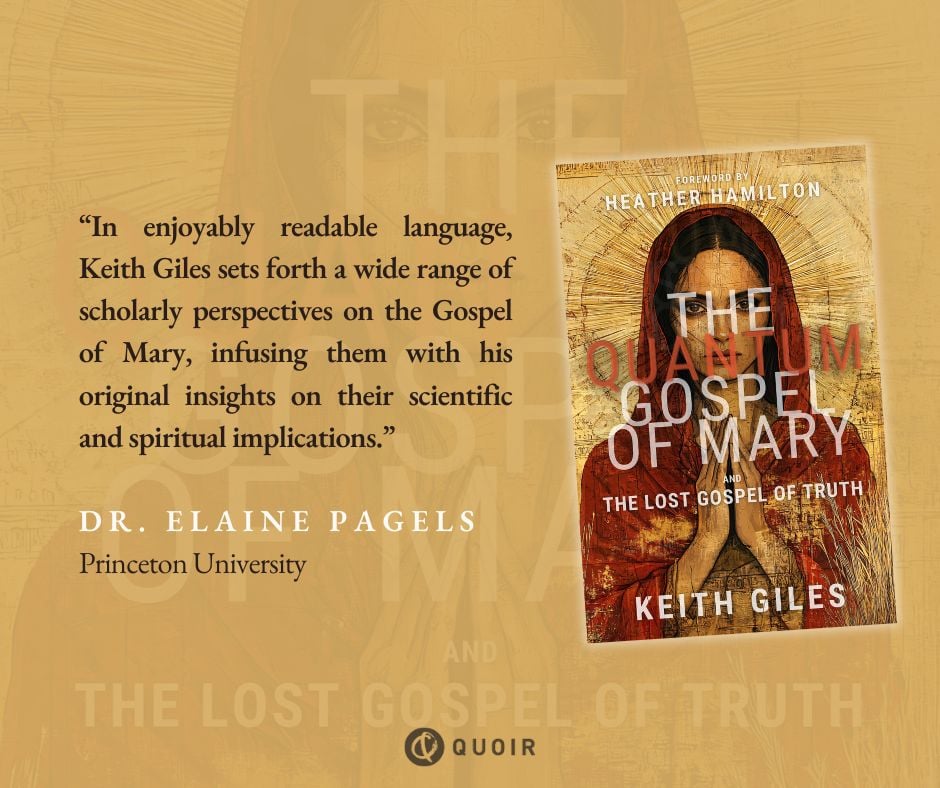
The new book, “The Quantum Gospel of Mary and the Lost Gospel of Truth”is now available on Amazon.The book from Keith Giles, “The Quantum Sayings of Jesus: Decoding the Lost Gospel of Thomas” is available now on Amazon. Order HERE>*Keith Giles is the best-selling author of the Jesus Un series. He has been interviewed on CNN with Anderson Cooper, Coast to Coast Radio with George Noory, USA Today, BuzzFeed, and John Fugelsang’s “Tell Me Everything.”*He co-hosts The Heretic Happy Hour Podcastand his solo podcast, Second Cup With Keith which are both available on Spotify, Amazon, Apple, Podbean or wherever you find great podcasts.
Previous Post

June 13, 2025
INNER CIRCLE: Conceived By A Kiss
Next Post

June 20, 2025 INNER CIRCLE: A Great Mystery
Recent Comments
"Googled: “In psychology and everyday language, intelligence is the capacity to learn, understand, reason, think ..."
"It's so weird to me how anyone thinks that getting basic income is in any ..."
"Sounds very much like what Pope Leo wrote in Magnifica Humanitas - a lot of ..."
"As it is written in the canonical Gospels:But as many as received Him, to them ..."
INNER CIRCLE: God’s Transcending Love
Browse Our Archives
Select a Category Art Biblicism Christian Politics Cosmic Christ Deconstruction Discipleship Dispensationalism Divine Unity Ekklesia End Time Stuff Eschatology Evergreen Following Jesus Gender General Christian Topics Gnostics God's Love Gospel of Judas Gospel of Mary Gospel of Philip Gospel of the Kingdom Gospel of Thomas Gospel of Truth Hell Historical Jesus Inner Circle Investigative Reporting Islam LGBTQ Issues Marriage Mental/Emotional Health Mystery Non-Duality Philosophy Podcast Poetry Politics Poverty Preemptive Love Prophecy Psychology Quantum Theology Racism Reconstruction Satire Sex Technology Theology Uncategorized Universalism
Select a Month October 2026 September 2026 August 2026 July 2026 June 2026 May 2026 April 2026 March 2026 February 2026 January 2026 December 2025 November 2025 October 2025 September 2025 August 2025 July 2025 June 2025 May 2025 April 2025 March 2025 February 2025 January 2025 December 2024 November 2024 October 2024 September 2024 August 2024 July 2024 June 2024 May 2024 April 2024 March 2024 February 2024 January 2024 December 2023 November 2023 October 2023 September 2023 August 2023 July 2023 June 2023 May 2023 April 2023 March 2023 February 2023 January 2023 December 2022 November 2022 October 2022 September 2022 August 2022 July 2022 June 2022 May 2022 April 2022 March 2022 February 2022 January 2022 December 2021 November 2021 October 2021 September 2021 August 2021 July 2021 June 2021 May 2021 April 2021 March 2021 February 2021 January 2021 December 2020 November 2020 October 2020 September 2020 August 2020 July 2020 June 2020 May 2020 April 2020 March 2020 February 2020 January 2020 December 2019 November 2019 October 2019 September 2019 August 2019 July 2019 June 2019 May 2019 April 2019 March 2019 February 2019 January 2019 December 2018 November 2018 October 2018 September 2018 August 2018 July 2018 June 2018 May 2018 April 2018 March 2018 February 2018 January 2018 December 2017 November 2017
Follow Us!
TAKE THE
Religious Wisdom Quiz
Who built the ark to survive the flood?
Select your answer to see how you score.
Elijah Moses Abraham Noah
Books by This Author Books by Keith Giles
Related posts from Keith Giles

INNER CIRCLE: Profound Mystery (Of Christ In All...

INNER CIRCLE: Awaken the Sleeper

INNER CIRCLE: In Every Respect

TRENDING AT PATHEOS Progressive Christian

I was strolling through the top floor of the brand new Parthenon...

What Does Gêvâh Mean For Kimberley Guifoyle &...
This week, a lot of the news is focused on Kimberly Guilfoyle....

INNER CIRCLE: Profound Mystery (Of Christ In All...
Ephesians 5:31-32 “For this reason, a man will leave his father and...

Do Not Rejoice When Your Enemy Falls: The...
Turning an execution into a public spectacle is a disturbing expression of...

'The Chosen' S6 Trailer: The Passion Gets Very...
Not many watching 'The Chosen' worry about spoilers, but just because they...

The purpose-driven labor priest
A labor activist reads Rick Warren and it gets me wondering about...
view all Progressive Christian blogs
What Are Your Thoughts?leave a comment
Ad-Free & Subscriber Log-In Subscription Support
- About Us
- 2026 Calendar
- Videos
- Podcasts
- Library of World Religions
- Faith In Media Tracker
- Advertise With Us
- Write for Us
- Privacy Policy
- Terms of Service
- Do Not Sell My Data
- Contact Us
- Radiant Digital
- Manage Newsletter Subscriptions
- Unsubscribe From Notifications
- Sitemap
Copyright 2008-2026, Patheos. All rights reserved.
Subscription Support Ad-Free & Subscriber Log-In
Follow Patheos