
BuddhistCatholicContemplativeEvangelicalGeneral ChristianHinduJewishLatter-day SaintMuslimNew VisionsProgressive Christian
Beliefs
- Buddhist
- Catholic
- Contemplative
- Evangelical
- General Christian
- Hindu
- Jewish
- Latter-day Saint
- More Voices
- Muslim
- New Visions
- Pagan
- Progressive Christian
Topics
- Religion News
- Food and Religion
- Sports and Religion
- Religious Art
- Religious Music and Entertainment
- Religious Events
- History and Religion
- Style and Religion
- Politics and Religion
- Women in Religion
- Recreation Outdoors and Religion
- Business Finance and Religion
- Careers Workplace and Religion
- Education and Religion
- Family Parenting and Religion
- Health Fitness and Religion
- Home and Religion
- Relationships and Religion
- Technology and Religion
- Travel and Religion
Columnists
- Buddhist Columnists
- Business Finance and Religion Columnists
- Careers Workplace and Religion Columnists
- Catholic Columnists
- Contemplative Columnists
- Education and Religion Columnists
- Evangelists Columnists
- Family Parenting and Religion Columnists
- General Christian Columnists
- Health Fitness and Religion Columnists
- Hindu Columnists
- History and Religion Columnists
- Home and Religion Columnists
- Jewish Columnists
- More Voices Columnists
- Latter Day Columnists
- Muslim Columnists
- New Visions Columnists
- Nonreligious Columnists
- Pagan Columnists
- Politics and Religion Columnists
- Progressive Columnists
- Recreation Outdoors and Religion Columnists
- Relationships and Religion Columnists
- Religion News Columnists
- Religious Art Columnists
- Religious Events Columnists
- Religious Music and Entertainment Columnists
- Sports and Religion Columnists
- Style and Religion Columnists
- Technology and Religion Columnists
- Travel and Religion Columnists
- Women in Religion Columnists
Resource Library
- 2026 Calendar
- Library of World Religions
- The 100 Most Holy Places on Earth
- Patheos Answers
- Podcasts
- Videos
- Faith Leaders Database
- Anglican Episcopalian
- Bahai
- Baptist
- Buddhism
- Christianity
- Confucianism
- Eastern Orthodoxy
- Hinduism
- Holiness and Pentecostal
- ISKCON
- Islam
- Judaism
- Lutheran
- Methodist
- The Church of Jesus Christ of Latter-day Saints
- New Age
- Paganism
- Presbytarian and Reformed
- Protestantism
- Religion Behind the Scenes
- Roman Catholic
- Scientology
- Shia Islam
- Sikhism
- Sufism
- Sunni Islam
- Taoism
- Zen
- See all religions
Research Tools
 Ad-Free & Subscriber Log-In Subscription Support
Ad-Free & Subscriber Log-In Subscription Support
Follow Patheos 

- Trending:
- Forgiveness
- |
- Marriage
- |
- Consciousness
- |
- Death Penalty
- |
- Election
- |
- Halloween

- Home
- Progressive Christian
- INNER CIRCLE: The Gospel of Judas
INNER CIRCLE: The Gospel of Judas
Last updated on: February 26, 2025 at 4:28 pm by Keith Giles
INNER CIRCLE: The Gospel of Judas 2025-02-26T16:28:25+00:00 Keith Giles
Patheos Explore the world's faith through different perspectives on religion and spirituality! Patheos has the views of the prevalent religions and spiritualities of the world.

IMAGE: Keith Giles
It may come as a shock to some of you, but the Gospel of Judas is a real thing.
It’s an ancient text discovered in the 1970s, hidden away in Egypt for over 1,600 years, and finally brought into the public eye in 2006.
Unlike Matthew, Mark, Luke, and John, this gospel paints Judas Iscariot—the guy we all know as the ultimate betrayer—in a very different light. Instead of the villain who sold Jesus out for thirty pieces of silver, the Gospel of Judas says Judas was actually in on the plan. In fact, according to this text, Jesus asked Judas to turn Him in.
But that’s just the beginning.
A Different Jesus
The Jesus we meet in this text is nothing like the Jesus of the four canonical Gospels.
For starters, he laughs—a lot. Not the warm, loving Jesus-loves-you kind of laugh, but more of a cryptic, I-know-something-you-don’t kind of laugh.
Jesus also spends a lot of time telling His disciples they don’t really get it. He hints at deeper, hidden truths—stuff about the material world being a mistake, the human body being a prison, and the true God being beyond what anyone can possibly imagine.
In this gospel, Jesus tells Judas that by “betraying” Him, he will actually free Jesus from His physical body, allowing Him to return to the divine realm.
So, Judas isn’t the bad guy here—he’s the hero.
Comparisons To Other Gospels
Let’s be real—this version of Jesus doesn’t exactly line up with the one we know from Matthew, Mark, Luke, and John, or even the Gospels of Thomas, Mary or Philip.
Here’s how he’s different:
- Jesus and the Cross – In the canonical Gospels, Jesus willingly goes to the cross, understanding it as part of God’s plan for redemption. He prays in the Garden of Gethsemane, surrenders to God’s will, and dies for the sins of humanity. But in Judas, Jesus sees the crucifixion as an escape from the flawed physical world. It’s not about atonement—it’s about liberation. In the Gospels of Mary, Thomas and Philip, the crucifixion isn’t really mentioned or discussed at all.
- Judas: Traitor or Trusted Friend? – In Matthew, Mark, and Luke, Judas is the betrayer who sells Jesus out for money. In John’s Gospel, he’s straight-up called a devil. But in Judas, he’s the only disciple who actually understands what Jesus is really about. Instead of betraying Jesus, he’s obeying Him. Judas makes no appearance in the Nag Hammadi Gospels, or the Gospel of Mary.
- Who’s Really in Charge? – The four Gospels portray Jesus as bringing the Kingdom of God to earth—healing the sick, forgiving sins, and teaching radical love. In Judas, Jesus seems less concerned with this world and more focused on escaping it. This lines up with a Gnostic worldview, which sees the physical world as a mistake and the true God as totally separate from it. Again, in Mary, Thomas and Philip, death isn’t seen as an escape or a spiritual promotion. These texts speak about awakening to the spiritual reality of Divine Oneness and Connection in this life, rather than in the next.
Is It Legit?
Well, that depends on what you mean by “legit.” Historically speaking, the Gospel of Judas was written at least a hundred years – or more – after Jesus walked the earth.
That means it almost certainly was NOT written by Judas himself—more likely, it was written by a group of Gnostic Christians who had a very different take on Jesus than the early church.
Here’s the biggest thing: Judas isn’t just a different perspective on the same Jesus. It’s a whole different worldview.
The Gospel of Judas is less about a God who loves and redeems his creation and more about a hidden knowledge (or gnosis) that helps a few enlightened people escape it. That’s a pretty big shift from the Canonical and Valentinian texts.
What Do We Do with This?
The Gospel of Judas is fascinating, no doubt about it. It challenges us to think about the different ways early Christians understood Jesus. But does it replace the Jesus of the four Gospels? Not really.
If anything, it reminds us that from the very beginning, people have wrestled with who Jesus really is. And maybe that’s not a bad thing.
Maybe, instead of running from these kinds of discoveries, we lean in—asking better questions, searching for deeper truth, and remembering that Jesus is always bigger than we think He is.
Where I see value in studying the Gospel of Judas is not about whether or not it was written by Judas. [It wasn’t]. Or in whether or not it provides an accurate record of what Jesus said or did. [It probably doesn’t].
But what does seem interesting about the Gospel of Judas is what it tells us about what some early Christians thought about the Jesus story and how they interpreted his teachings, his life, and the religion that came after him.
In fact, I think the most important thing about the Gospel of Judas is the fact that it’s a strong rebuke of the Christianity that people [mostly men] created around Jesus and how that faith mostly subverted his actual message.
So, don’t read the Gospel of Judas as an historical document about the life of Jesus. Don’t study it to learn some secret teachings of Jesus that may have been suppressed by the early Church. But, if you read this text, read it because you’re curious about how some dissenting voices in the Third Century started to challenge the popular narratives about Jesus, and his crucifixion, and about how religious movements in general quite often miss the point.
It’s why other revolutionary figures like Martin Luther King, Jr. and Ghandi, and even C.S. Lewis and George MacDonald have societies and narratives created about them that bear little-to-no resemblance to who they actually were or what they actually said.
Religious movements look for ways to weaponize and exploit certain statements and events in the live of their heroes, and by doing so they quite often obscure the true, raw and messy aspects of that person.
What we end up with is an homogenized version of the person and not the radical, difficult and sometimes offensive human being whose voice challenged the status quo in ways that most of us would rather not admit.
In other words, when the revolutionary radical becomes the mascot for the Empire, you know you’ve missed the entire point.
So, the Gospel of Judas can be a wake up call for the Orthodox Christians who prefer a Jesus who is pious, and holy, and super-human. It presents a more nuanced view of Jesus as someone who was snarky, sarcastic, and mysterious in ways that many Christians today cannot even begin to imagine.
The Gospel of Judas gives us a more human Jesus who burped, farted, sweated and had bad breath. It’s a Jesus we can relate to. It’s a Jesus who mocks the religious zealots and inspires radicals to challenge the system, betray the norms, and kill their gurus and Messiahs.
Is it true? Yes, it speaks truth that may take us time to unravel. But, no, it’s not true in any historical sense. But, then again, how true are the Gospels we find in the Canon? How true is the version of Jesus we prefer as compared to the real human being who walked the sands of Palestine almost 2,000 years ago?
The truth is…we may never know. And maybe that’s okay.
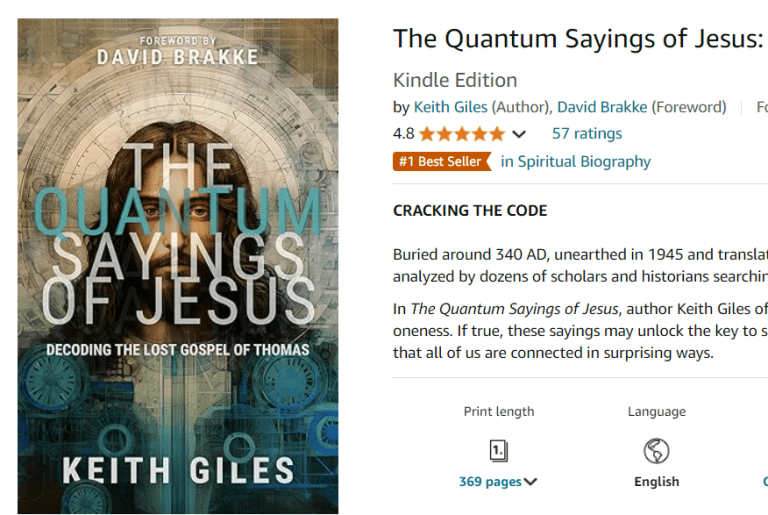
The newest book from Keith Giles, “The Quantum Sayings of Jesus: Decoding the Lost Gospel of Thomas” is available now on Amazon. Order HERE>
Keith Giles is the best-selling author of the Jesus Un series. He has appeared on CNN, USA Today, BuzzFeed, and John Fugelsang’s “Tell Me Everything.”
He co-hosts The Heretic Happy Hour Podcast and his solo podcast, Second Cup With Keith which are both available on Spotify, Amazon, Apple, Podbean or wherever you find great podcasts.
Previous Post

February 17, 2025
Why Posting on Social Media Won't Change Anything
Next Post

February 25, 2025 The Power of Empathy: How Understanding Can Change the World
Recent Comments
"Googled: “In psychology and everyday language, intelligence is the capacity to learn, understand, reason, think ..."
"It's so weird to me how anyone thinks that getting basic income is in any ..."
"Sounds very much like what Pope Leo wrote in Magnifica Humanitas - a lot of ..."
"As it is written in the canonical Gospels:But as many as received Him, to them ..."
INNER CIRCLE: God’s Transcending Love
Browse Our Archives
Select a Category Art Biblicism Christian Politics Cosmic Christ Deconstruction Discipleship Dispensationalism Divine Unity Ekklesia End Time Stuff Eschatology Evergreen Following Jesus Gender General Christian Topics Gnostics God's Love Gospel of Judas Gospel of Mary Gospel of Philip Gospel of the Kingdom Gospel of Thomas Gospel of Truth Hell Historical Jesus Inner Circle Investigative Reporting Islam LGBTQ Issues Marriage Mental/Emotional Health Mystery Non-Duality Philosophy Podcast Poetry Politics Poverty Preemptive Love Prophecy Psychology Quantum Theology Racism Reconstruction Satire Sex Technology Theology Uncategorized Universalism
Select a Month October 2026 September 2026 August 2026 July 2026 June 2026 May 2026 April 2026 March 2026 February 2026 January 2026 December 2025 November 2025 October 2025 September 2025 August 2025 July 2025 June 2025 May 2025 April 2025 March 2025 February 2025 January 2025 December 2024 November 2024 October 2024 September 2024 August 2024 July 2024 June 2024 May 2024 April 2024 March 2024 February 2024 January 2024 December 2023 November 2023 October 2023 September 2023 August 2023 July 2023 June 2023 May 2023 April 2023 March 2023 February 2023 January 2023 December 2022 November 2022 October 2022 September 2022 August 2022 July 2022 June 2022 May 2022 April 2022 March 2022 February 2022 January 2022 December 2021 November 2021 October 2021 September 2021 August 2021 July 2021 June 2021 May 2021 April 2021 March 2021 February 2021 January 2021 December 2020 November 2020 October 2020 September 2020 August 2020 July 2020 June 2020 May 2020 April 2020 March 2020 February 2020 January 2020 December 2019 November 2019 October 2019 September 2019 August 2019 July 2019 June 2019 May 2019 April 2019 March 2019 February 2019 January 2019 December 2018 November 2018 October 2018 September 2018 August 2018 July 2018 June 2018 May 2018 April 2018 March 2018 February 2018 January 2018 December 2017 November 2017
Follow Us!
TAKE THE
Religious Wisdom Quiz
How old was Abraham when Sarah died?
Select your answer to see how you score.
147 years 137 years 117 years 127 years
Books by This Author Books by Keith Giles
Related posts from Keith Giles

INNER CIRCLE: Profound Mystery (Of Christ In All...

INNER CIRCLE: Awaken the Sleeper

INNER CIRCLE: In Every Respect

TRENDING AT PATHEOS Progressive Christian

I was strolling through the top floor of the brand new Parthenon...

What Does Gêvâh Mean For Kimberley Guifoyle &...
This week, a lot of the news is focused on Kimberly Guilfoyle....

INNER CIRCLE: Profound Mystery (Of Christ In All...
Ephesians 5:31-32 “For this reason, a man will leave his father and...

Do Not Rejoice When Your Enemy Falls: The...
Turning an execution into a public spectacle is a disturbing expression of...

'The Chosen' S6 Trailer: The Passion Gets Very...
Not many watching 'The Chosen' worry about spoilers, but just because they...

The purpose-driven labor priest
A labor activist reads Rick Warren and it gets me wondering about...
view all Progressive Christian blogs
What Are Your Thoughts?leave a comment
Ad-Free & Subscriber Log-In Subscription Support
- About Us
- 2026 Calendar
- Videos
- Podcasts
- Library of World Religions
- Faith In Media Tracker
- Advertise With Us
- Write for Us
- Privacy Policy
- Terms of Service
- Do Not Sell My Data
- Contact Us
- Radiant Digital
- Manage Newsletter Subscriptions
- Unsubscribe From Notifications
- Sitemap
Copyright 2008-2026, Patheos. All rights reserved.
Subscription Support Ad-Free & Subscriber Log-In
Follow Patheos