
BuddhistCatholicContemplativeEvangelicalGeneral ChristianHinduJewishLatter-day SaintMuslimNew VisionsProgressive Christian
Beliefs
- Buddhist
- Catholic
- Contemplative
- Evangelical
- General Christian
- Hindu
- Jewish
- Latter-day Saint
- More Voices
- Muslim
- New Visions
- Pagan
- Progressive Christian
Topics
- Religion News
- Food and Religion
- Sports and Religion
- Religious Art
- Religious Music and Entertainment
- Religious Events
- History and Religion
- Style and Religion
- Politics and Religion
- Women in Religion
- Recreation Outdoors and Religion
- Business Finance and Religion
- Careers Workplace and Religion
- Education and Religion
- Family Parenting and Religion
- Health Fitness and Religion
- Home and Religion
- Relationships and Religion
- Technology and Religion
- Travel and Religion
Columnists
- Buddhist Columnists
- Business Finance and Religion Columnists
- Careers Workplace and Religion Columnists
- Catholic Columnists
- Contemplative Columnists
- Education and Religion Columnists
- Evangelists Columnists
- Family Parenting and Religion Columnists
- General Christian Columnists
- Health Fitness and Religion Columnists
- Hindu Columnists
- History and Religion Columnists
- Home and Religion Columnists
- Jewish Columnists
- More Voices Columnists
- Latter Day Columnists
- Muslim Columnists
- New Visions Columnists
- Nonreligious Columnists
- Pagan Columnists
- Politics and Religion Columnists
- Progressive Columnists
- Recreation Outdoors and Religion Columnists
- Relationships and Religion Columnists
- Religion News Columnists
- Religious Art Columnists
- Religious Events Columnists
- Religious Music and Entertainment Columnists
- Sports and Religion Columnists
- Style and Religion Columnists
- Technology and Religion Columnists
- Travel and Religion Columnists
- Women in Religion Columnists
Resource Library
- 2026 Calendar
- Library of World Religions
- The 100 Most Holy Places on Earth
- Patheos Answers
- Podcasts
- Videos
- Faith Leaders Database
- Anglican Episcopalian
- Bahai
- Baptist
- Buddhism
- Christianity
- Confucianism
- Eastern Orthodoxy
- Hinduism
- Holiness and Pentecostal
- ISKCON
- Islam
- Judaism
- Lutheran
- Methodist
- The Church of Jesus Christ of Latter-day Saints
- New Age
- Paganism
- Presbytarian and Reformed
- Protestantism
- Religion Behind the Scenes
- Roman Catholic
- Scientology
- Shia Islam
- Sikhism
- Sufism
- Sunni Islam
- Taoism
- Zen
- See all religions
Research Tools
 Ad-Free & Subscriber Log-In Subscription Support
Follow Patheos 

- Trending:
- Advent
- |
- Forgiveness
- |
- Thanksgiving
- |
- Election
- |
- Seasonal Holidays
- |
- Marriage

- Home
- Progressive Christian
- INNER CIRCLE: Introducing the Gospel of Philip
INNER CIRCLE: Introducing the Gospel of Philip
Last updated on: February 26, 2025 at 4:29 pm by Keith Giles
INNER CIRCLE: Introducing the Gospel of Philip 2025-02-26T16:29:26+00:00 Keith Giles
Patheos Explore the world's faith through different perspectives on religion and spirituality! Patheos has the views of the prevalent religions and spiritualities of the world.

The lost Gospel of Philip, like the Gospel of Thomas, the Gospel of Mary and the Gospel of Truth, is a text that is shrouded in mystery. Before its discovery at Nag Hammadi, Egypt in 1945, we barely knew of its existence, and like those other lost gospels, it contains mystical wisdom from early Christian sources that had long been suppressed by the proto-orthodox Christians.
Unlike those other gospels, however, the Gospel of Philip touches on some topics that are not addressed in those Valentinian texts, such as the Bridal Chamber, the Virgin Birth, Baptism, Spiritual Transformation, and the Resurrection of the dead. It also provides more insights into the relationship between Jesus and Mary Magdalene and attempts to clarify what it truly means to become a follower of Jesus.
When Was It Written?
Some scholars date the Gospel of Philip to around the Third Century. One argument for an earlier date is that it appears to have several ideas in common with the Gospel of Thomas which was dated to as early as 60 AD, but until earlier copies are discovered we cannot say for certain. But most agree that it should be considered a Third-Century text.
Thematically, the Gospel of Philip may have been assembled from a variety of earlier Valentinan Christian writings on various sacraments, especially the sacrament of marriage.
Although there is little consensus regarding the geographical origins of this gospel, many scholars suggest that that it most likely originates from the region of Antioch, and if so, then it was almost certainly associated with Valentinian devotee, Axionicus of Antioch and his faith community.
Sayings of Jesus
The text of this Gospel contains a total of 17 sayings attributed to Jesus. Nine of those sayings are also found in some form in the New Testament Gospels, and two of the sayings here are related to similar sayings in the Gospel of Thomas. This leaves six sayings of Jesus that are unique to the Gospel of Philip.
The single copy of the Gospel of Philip that we have was written in Coptic and found in the same codex alongside the Gospel of Thomas at Nag Hammadi. Wesley W. Isenberg, the original editor and translator of the text, believes the new sayings of Jesus found here should be understood from a Gnostic perspective, although later scholars such as Dr. Elaine Pagels and Martha Lee Turner, disagree and argue that the Gospel of Philip should be understood as a Valentinian text that fits more closely with the Gospel of Thomas, the Gospel of Truth and the Gospel of Mary.
Experiential Christianity
As read through the lens of Divine Unity, the Gospel of Philip is focused on our spiritual connection with God. To this end, many of the themes found here dealing with marriage and the bridal chamber are best understood as metaphors for that spiritual union between God and Humanity.
Other scholars, such as Marvin W. Meyer, suggest that the Gospel of Philip is best understood through the lens of Christ. According to Meyer, without Jesus, the rituals, mysteries and metaphors mentioned in the Gospel of Philip have no context and that many quotations from this text only make sense when Christ is the central focus.
Why Is It Significant?
The Gospel of Philip is worth our time and attention primarily because it gives us yet another glimpse into the beliefs and teachings of Valentinus and of the Valentinian Christians who were seen as such a threat to the proto-orthodox Christians of the early Church.
We may not always agree with what we read in this text, and we may not always fully understand everything that is being communicated within these pages. But with our understanding of other suppressed gospels such as the Gospel of Thomas, the Gospel of Mary and the Gospel of Truth, we can begin to notice similarities of thought and connect the dots on how these Valentinians understood the teachings of Jesus and what it meant for them to follow in his path.
NEXT WEEK: Chapter 1 of the Gospel of Philip
**
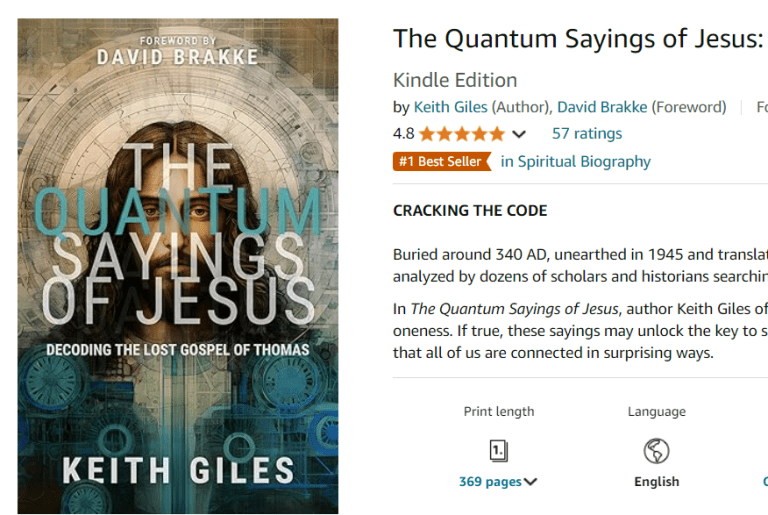
The newest book from Keith Giles, “The Quantum Sayings of Jesus: Decoding the Lost Gospel of Thomas” is available now on Amazon. Order HERE>
Keith Giles is the best-selling author of the Jesus Un series. He has appeared on CNN with Anderson Cooper, Coast To Coast Radio with George Noory, USA Today, BuzzFeed, and John Fugelsang’s “Tell Me Everything.”
He co-hosts The Heretic Happy Hour Podcast and his solo podcast, Second Cup With Keith which are both available on Spotify, Amazon, Apple, Podbean or wherever you find great podcasts.
Previous Post

February 11, 2025
The Quantum Gospel of Philip
Next Post

February 17, 2025 Why Posting on Social Media Won't Change Anything
Recent Comments
"Simple truth, regardless of religion or no religion, is in everyone. This was revealed to ..."
INNER CIRCLE: The Mystery Revealed
""We are all filled with the fullness of Christ, who fills everything in every way."Could ..."
INNER CIRCLE: The Fullness Made Full
"The Anointed One within me today clears up all mysteries as I mature as a ..."
INNER CIRCLE: The Mystery Revealed
"But Paul rejected the Jewish Christians (under James) who were the originals. In Acts, Luke ..."
INNER CIRCLE: Those Who Divide
Browse Our Archives
Select a Category Art Biblicism Christian Politics Cosmic Christ Deconstruction Discipleship Dispensationalism Divine Unity Ekklesia End Time Stuff Eschatology Evergreen Following Jesus Gender General Christian Topics Gnostics God's Love Gospel of Judas Gospel of Mary Gospel of Philip Gospel of the Kingdom Gospel of Thomas Gospel of Truth Hell Historical Jesus Inner Circle Investigative Reporting Islam LGBTQ Issues Marriage Mental/Emotional Health Mystery Non-Duality Philosophy Podcast Poetry Politics Poverty Preemptive Love Prophecy Psychology Quantum Theology Racism Reconstruction Satire Sex Technology Theology Uncategorized Universalism
Select a Month November 2026 October 2026 September 2026 August 2026 July 2026 June 2026 May 2026 April 2026 March 2026 February 2026 January 2026 December 2025 November 2025 October 2025 September 2025 August 2025 July 2025 June 2025 May 2025 April 2025 March 2025 February 2025 January 2025 December 2024 November 2024 October 2024 September 2024 August 2024 July 2024 June 2024 May 2024 April 2024 March 2024 February 2024 January 2024 December 2023 November 2023 October 2023 September 2023 August 2023 July 2023 June 2023 May 2023 April 2023 March 2023 February 2023 January 2023 December 2022 November 2022 October 2022 September 2022 August 2022 July 2022 June 2022 May 2022 April 2022 March 2022 February 2022 January 2022 December 2021 November 2021 October 2021 September 2021 August 2021 July 2021 June 2021 May 2021 April 2021 March 2021 February 2021 January 2021 December 2020 November 2020 October 2020 September 2020 August 2020 July 2020 June 2020 May 2020 April 2020 March 2020 February 2020 January 2020 December 2019 November 2019 October 2019 September 2019 August 2019 July 2019 June 2019 May 2019 April 2019 March 2019 February 2019 January 2019 December 2018 November 2018 October 2018 September 2018 August 2018 July 2018 June 2018 May 2018 April 2018 March 2018 February 2018 January 2018 December 2017 November 2017
Follow Us!
TAKE THE
Religious Wisdom Quiz
Which Christian tradition developed the doctrine of the Holy Trinity most systematically?
Select your answer to see how you score.
Pentecostalism Jehovah's Witnesses Nicene Christianity Quakerism
Books by This Author Books by Keith Giles
Related posts from Keith Giles
INNER CIRCLE: Christ In Everyone


INNER CIRCLE: The Fullness Made Full
INNER CIRCLE: The Mystery Revealed
TRENDING AT PATHEOS Progressive Christian

Here are two Thanksgiving columns that I originally wrote for the...

Book III, Chapter 3: Christ "Classic" (Matt. 9:9-34)
Book III, Chapter 3: Christ "Classic" (Matt. 9:9-34) In honor of tomorrow's...

Jesus explicitly mentions the book of Jonah twice, but he retells the...

Peggy Sue Got Married: Coppola’s Always Been Like...
I enjoyed Megalopolis (2024). It’s a mess, but I enjoyed it. The...

My dissertation The Place of Mysticism in the Late Middle Ages concerns...

God and the Contingency of This World
The great Catholic philosopher Aquinas and the great Lutheran philosopher Leibniz developed...
view all Progressive Christian blogs
What Are Your Thoughts?leave a comment
Ad-Free & Subscriber Log-In Subscription Support
- About Us
- 2026 Calendar
- Videos
- Podcasts
- Library of World Religions
- Faith In Media Tracker
- Advertise With Us
- Write for Us
- Privacy Policy
- Terms of Service
- Do Not Sell My Data
- Contact Us
- Radiant Digital
- Manage Newsletter Subscriptions
- Unsubscribe From Notifications
- Sitemap
Copyright 2008-2026, Patheos, part of the Radiant Digital network of media brands. All rights reserved.
Subscription Support Ad-Free & Subscriber Log-In
Follow Patheos