
BuddhistCatholicContemplativeEvangelicalGeneral ChristianHinduJewishLatter-day SaintMuslimNew VisionsProgressive Christian
Beliefs
- Buddhist
- Catholic
- Contemplative
- Evangelical
- General Christian
- Hindu
- Jewish
- Latter-day Saint
- More Voices
- Muslim
- New Visions
- Pagan
- Progressive Christian
Topics
- Religion News
- Food and Religion
- Sports and Religion
- Religious Art
- Religious Music and Entertainment
- Religious Events
- History and Religion
- Style and Religion
- Politics and Religion
- Women in Religion
- Recreation Outdoors and Religion
- Business Finance and Religion
- Careers Workplace and Religion
- Education and Religion
- Family Parenting and Religion
- Health Fitness and Religion
- Home and Religion
- Relationships and Religion
- Technology and Religion
- Travel and Religion
Columnists
- Buddhist Columnists
- Business Finance and Religion Columnists
- Careers Workplace and Religion Columnists
- Catholic Columnists
- Contemplative Columnists
- Education and Religion Columnists
- Evangelists Columnists
- Family Parenting and Religion Columnists
- General Christian Columnists
- Health Fitness and Religion Columnists
- Hindu Columnists
- History and Religion Columnists
- Home and Religion Columnists
- Jewish Columnists
- More Voices Columnists
- Latter Day Columnists
- Muslim Columnists
- New Visions Columnists
- Nonreligious Columnists
- Pagan Columnists
- Politics and Religion Columnists
- Progressive Columnists
- Recreation Outdoors and Religion Columnists
- Relationships and Religion Columnists
- Religion News Columnists
- Religious Art Columnists
- Religious Events Columnists
- Religious Music and Entertainment Columnists
- Sports and Religion Columnists
- Style and Religion Columnists
- Technology and Religion Columnists
- Travel and Religion Columnists
- Women in Religion Columnists
Resource Library
- 2026 Calendar
- Library of World Religions
- The 100 Most Holy Places on Earth
- Patheos Answers
- Podcasts
- Videos
- Faith Leaders Database
- Anglican Episcopalian
- Bahai
- Baptist
- Buddhism
- Christianity
- Confucianism
- Eastern Orthodoxy
- Hinduism
- Holiness and Pentecostal
- ISKCON
- Islam
- Judaism
- Lutheran
- Methodist
- The Church of Jesus Christ of Latter-day Saints
- New Age
- Paganism
- Presbytarian and Reformed
- Protestantism
- Religion Behind the Scenes
- Roman Catholic
- Scientology
- Shia Islam
- Sikhism
- Sufism
- Sunni Islam
- Taoism
- Zen
- See all religions
Research Tools
 Ad-Free & Subscriber Log-In Subscription Support
Ad-Free & Subscriber Log-In Subscription Support
Follow Patheos 

- Trending:
- Forgiveness
- |
- Marriage
- |
- Consciousness
- |
- Death Penalty
- |
- Election
- |
- Halloween

- Home
- Progressive Christian
- INNER CIRCLE: Being Made Male?
INNER CIRCLE: Being Made Male?
Last updated on: January 24, 2025 at 6:51 pm by Keith Giles
INNER CIRCLE: Being Made Male? 2025-01-24T18:51:12+00:00 Keith Giles
Patheos Explore the world's faith through different perspectives on religion and spirituality! Patheos has the views of the prevalent religions and spiritualities of the world.

IMAGE: Keith Giles
Some translators of Mary’s Gospel render the passage in the Gospel of Mary above not as “…let us praise his greatness, for he has prepared us and made us humans,” but rather as Mary saying that Jesus has “made us male.”
If we accept this perspective of the text, what does it mean? Are we to believe that Mary is suggesting to the other disciples that Jesus made all of them – and her – male?!
One scholar suggests that ancient concepts of male and female were quite unlike ours today. In fact, our modern views of gender roles, egalitarianism and equality of the sexes might even prevent us from fully comprehending what is being communicated in many early Christian texts.
As scholar Blossom Stefaniw points out in her article, Becoming Men, Staying Women: Gender Ambivalence in Christian Apocryphal Texts and Contexts:
“There is no need to look for egalitarianism or feminism or even chauvinism in Apocryphal texts- these were not the categories in which the writers lived and wrote. Instead, a more basic task must first be performed, namely that of discovering some of the categories and assumptions which did inform these texts. This can be done by examining the motif of gender ambivalence and explicating the ideas and beliefs which motivate it.”[1]
“…One could object that ‘gender’ is just as anachronistic a category to use in interpreting the Apocrypha as are terms like feminism or chauvinism…I seek to employ this term in a flexible manner, taking account of the fact that ‘femaleness’ and ‘maleness’ had a different conceptual content in tire cultures under examination here.”[2]
Also, when it comes to examples where women are made male, we need to understand in what way this concept is intended to be understood:
“…The characterization of women as male or manly is here termed ‘gender ambivalence’ because, as will be seen, the individuals thus described are not portrayed as physically changing from one sex to another nor are they ever completely seen as having changed from one gender to the other socially. In this context it is certainly more accurate to speak of ambivalence than equality, because women who are said to have been made men or to have taken on manly attributes are not subsequently completely removed from the social category ‘woman’; they are seen, and treated, as men in some ways and as women in others, so that the issue of gender is never neutralized nor is a differentiation of status or authority permanently suspended.”[3]
In other words, being “made male” is not literally suggesting that a woman must be transformed into a man in order to become worthy of authority in the Christian community. If that were the case, then why would the other men mentioned in the Gospel of Mary need to be “made into men”? Aren’t they already male? Does Jesus need to make them even more male than they already are?
Stefaniw sees this phrase as a code for something based not in gender but in terms of accepted roles that ancient Christians understood as being inherently “male” or “female.” As she explains regarding Mary’s statement that Jesus has “made us male”:
“…Mary manifests a liminal role of gender ambivalence: on the one hand, she claims to have been made male (like the other disciples, the brethren) and takes this as a standard for her mentality in regard to spiritual things, but on the other hand she remains a woman socially inasmuch as her claim to authority is immediately negated and her only legitimacy comes through attachment to men. The Mary of this text is actively male and passively female, male in the way she acts and female in the way she is treated. Also, her ‘being made male’ is not absolute, conclusive, or consistent, so that in fact she has not really been made male, but only pushed into an ambivalent, paradoxical, liminal space, where both female and male categories are applied to the same individual, where male gender is (partially) attributed to her but female sex remains and influences the degree to which she is able to exercise spiritual authority within the group.”[4]
“So in this passage, we see the idea of a woman (and men as well) being made a man in the context of some manner of spiritual ideal but in the social context of a group, when it comes to questions of religious authority and leadership, Mary is again treated in a way that keeps her within the boundaries of femaleness. Here is a case of Mary staying a woman in terms of her social role, but becoming a man in terms of how her spiritual development is described…”[5]
“What we have been seeing in these texts is thus truly gender ambivalence and not gender transference, integration or neutralization, and if anything resembling equality was even potentially involved, none of this complicated gender-bookkeeping would be occurring at all.”[6]
So, being made a male in this context has less to do with gender and more to do with one’s role in a social environment. It’s more about who has spiritual authority and the assumption that men have it and women, sadly, do not. Therefore, Jesus has to make Mary – a woman – male in some esoteric way that allows her to operate as a male in this spiritual context. But this doesn’t make her male in any other way. She is still, at her core, a woman without equality in the company of men.
According to the general scientific community of the early Church, women and men were seen as nearly the same, except for a few minor differences in genitalia. As Stefaniw explains, “…a woman is almost a man, but not quite. A woman, biologically, is trying to be a man, but unfortunately has her reproductive organs on inside out. She is physically the same as a man, except in those strange areas where she diverts from the norm.”[7]
Being “made male”, then, is more about helping women to move closer to male perfection, and specifically, away from the physical realm and closer to the spiritual one, as women were seen as mainly useful for bearing children or sexual intercourse, and men had access to higher pursuits such as philosophy and religion.
Steaniw, once again, explains that “…women, by definition particularly physical and fleshly human beings, were in no fit state to be in positions of religious influence or authority (especially if they maintained female reproductive functions and the social roles of wife and mother), in a culture where the attainment of spiritual authority is closely associated with freedom from the body.”[8]
To our modern ears, all of this seems archaic, misogynistic and counter-intuitive. Not only does this not align with our assumptions about the differences between men and women, most of us today are more likely to assume that women are the more spiritually sensitive ones while the men are largely oblivious to such things.
Nevertheless, in a world where maleness was understood as a prerequisite for attaining spiritual wisdom and operating with spiritual authority, women had to overcome this assumption somehow, and the solution – as bizarre as it may sound to us today – was to re-classify certain women who exhibited unusual spiritual wisdom as male. Or, as Stefaniw says, “…the culture bent but did not break the assumption that women are not and cannot be spiritual beings, such that those individuals who gained spiritual respect were re-categorized as men. Whatever one may feel about the ethical value of this tendency, it was indeed an ingenious solution to the problem posed by women taking on spiritual authority.”[9]
[1] From the article, Becoming Men, Staying Women: Gender Ambivalence in Christian Apocryphal Texts and Contexts by Blossom Stefaniw, Sage Journals, April 14, 2010.
IBID
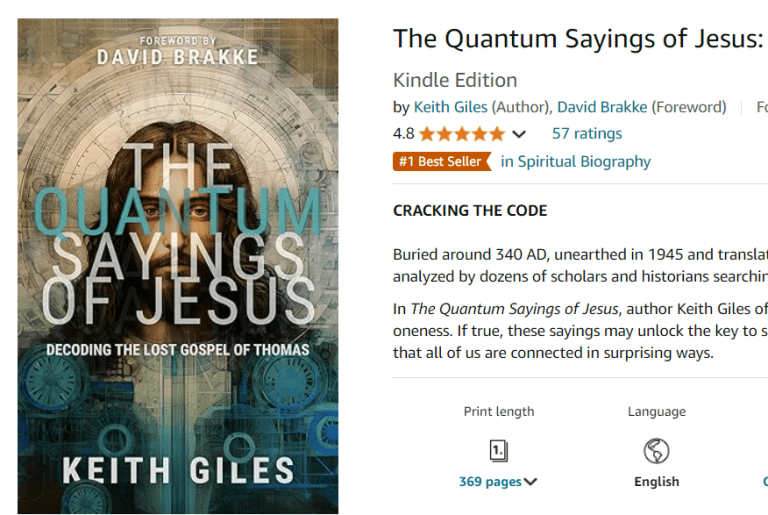
The newest book from Keith Giles, “The Quantum Sayings of Jesus: Decoding the Lost Gospel of Thomas” is available now on Amazon. Order HERE>
Keith Giles is the best-selling author of the Jesus Un series. He has appeared on CNN, USA Today, BuzzFeed, and John Fugelsang’s “Tell Me Everything.”
He co-hosts The Heretic Happy Hour Podcast and his solo podcast, Second Cup With Keith which are both available on Spotify, Amazon, Apple, Podbean or wherever you find your podcast fix.
Previous Post

January 23, 2025
The Gospel According to David Lynch
Next Post

January 27, 2025 Shining Your Light In The Face of Fascism
Recent Comments
"Googled: “In psychology and everyday language, intelligence is the capacity to learn, understand, reason, think ..."
"It's so weird to me how anyone thinks that getting basic income is in any ..."
"Sounds very much like what Pope Leo wrote in Magnifica Humanitas - a lot of ..."
"As it is written in the canonical Gospels:But as many as received Him, to them ..."
INNER CIRCLE: God’s Transcending Love
Browse Our Archives
Select a Category Art Biblicism Christian Politics Cosmic Christ Deconstruction Discipleship Dispensationalism Divine Unity Ekklesia End Time Stuff Eschatology Evergreen Following Jesus Gender General Christian Topics Gnostics God's Love Gospel of Judas Gospel of Mary Gospel of Philip Gospel of the Kingdom Gospel of Thomas Gospel of Truth Hell Historical Jesus Inner Circle Investigative Reporting Islam LGBTQ Issues Marriage Mental/Emotional Health Mystery Non-Duality Philosophy Podcast Poetry Politics Poverty Preemptive Love Prophecy Psychology Quantum Theology Racism Reconstruction Satire Sex Technology Theology Uncategorized Universalism
Select a Month October 2026 September 2026 August 2026 July 2026 June 2026 May 2026 April 2026 March 2026 February 2026 January 2026 December 2025 November 2025 October 2025 September 2025 August 2025 July 2025 June 2025 May 2025 April 2025 March 2025 February 2025 January 2025 December 2024 November 2024 October 2024 September 2024 August 2024 July 2024 June 2024 May 2024 April 2024 March 2024 February 2024 January 2024 December 2023 November 2023 October 2023 September 2023 August 2023 July 2023 June 2023 May 2023 April 2023 March 2023 February 2023 January 2023 December 2022 November 2022 October 2022 September 2022 August 2022 July 2022 June 2022 May 2022 April 2022 March 2022 February 2022 January 2022 December 2021 November 2021 October 2021 September 2021 August 2021 July 2021 June 2021 May 2021 April 2021 March 2021 February 2021 January 2021 December 2020 November 2020 October 2020 September 2020 August 2020 July 2020 June 2020 May 2020 April 2020 March 2020 February 2020 January 2020 December 2019 November 2019 October 2019 September 2019 August 2019 July 2019 June 2019 May 2019 April 2019 March 2019 February 2019 January 2019 December 2018 November 2018 October 2018 September 2018 August 2018 July 2018 June 2018 May 2018 April 2018 March 2018 February 2018 January 2018 December 2017 November 2017
Follow Us!
TAKE THE
Religious Wisdom Quiz
According to 1 Peter, what covers over a multitude of sins?
Select your answer to see how you score.
Prayer Faith Love Repentance
Books by This Author Books by Keith Giles
Related posts from Keith Giles

INNER CIRCLE: Profound Mystery (Of Christ In All...

INNER CIRCLE: Awaken the Sleeper

INNER CIRCLE: In Every Respect

TRENDING AT PATHEOS Progressive Christian

Swimfan: Forgotten Aughts Pleasures
This is a recovery effort. In 2002, My Big Fat Greek Wedding...

Top Three Anti-Catholic Lies About Catholicism
This is my initial transcript for the video, "THE 3 WORST...

Pope Leo Celebrates Mass for Nurses & Docs...
I don't have any idea how he did it, but Pope Leo...

The Sermon on the Mount, Part I: Matthew...
The Sermon on the Mount, Part I (Matthew 4:12-5:12) St. Matthew moves...

What's up from Crossway: Reviewing some of their latest A few weeks...

Janie Learns the Way of the Cross: A...
Teaching children about Jesus' Passion can be challenging. Many parents and educators...
view all Progressive Christian blogs
What Are Your Thoughts?leave a comment
Ad-Free & Subscriber Log-In Subscription Support
- About Us
- 2026 Calendar
- Videos
- Podcasts
- Library of World Religions
- Faith In Media Tracker
- Advertise With Us
- Write for Us
- Privacy Policy
- Terms of Service
- Do Not Sell My Data
- Contact Us
- Radiant Digital
- Manage Newsletter Subscriptions
- Unsubscribe From Notifications
- Sitemap
Copyright 2008-2026, Patheos. All rights reserved.
Subscription Support Ad-Free & Subscriber Log-In
Follow Patheos