
BuddhistCatholicContemplativeEvangelicalGeneral ChristianHinduJewishLatter-day SaintMuslimNew VisionsProgressive Christian
Beliefs
- Buddhist
- Catholic
- Contemplative
- Evangelical
- General Christian
- Hindu
- Jewish
- Latter-day Saint
- More Voices
- Muslim
- New Visions
- Pagan
- Progressive Christian
Topics
- Religion News
- Food and Religion
- Sports and Religion
- Religious Art
- Religious Music and Entertainment
- Religious Events
- History and Religion
- Style and Religion
- Politics and Religion
- Women in Religion
- Recreation Outdoors and Religion
- Business Finance and Religion
- Careers Workplace and Religion
- Education and Religion
- Family Parenting and Religion
- Health Fitness and Religion
- Home and Religion
- Relationships and Religion
- Technology and Religion
- Travel and Religion
Columnists
- Buddhist Columnists
- Business Finance and Religion Columnists
- Careers Workplace and Religion Columnists
- Catholic Columnists
- Contemplative Columnists
- Education and Religion Columnists
- Evangelists Columnists
- Family Parenting and Religion Columnists
- General Christian Columnists
- Health Fitness and Religion Columnists
- Hindu Columnists
- History and Religion Columnists
- Home and Religion Columnists
- Jewish Columnists
- More Voices Columnists
- Latter Day Columnists
- Muslim Columnists
- New Visions Columnists
- Nonreligious Columnists
- Pagan Columnists
- Politics and Religion Columnists
- Progressive Columnists
- Recreation Outdoors and Religion Columnists
- Relationships and Religion Columnists
- Religion News Columnists
- Religious Art Columnists
- Religious Events Columnists
- Religious Music and Entertainment Columnists
- Sports and Religion Columnists
- Style and Religion Columnists
- Technology and Religion Columnists
- Travel and Religion Columnists
- Women in Religion Columnists
Resource Library
- 2026 Calendar
- Library of World Religions
- The 100 Most Holy Places on Earth
- Patheos Answers
- Podcasts
- Videos
- Faith Leaders Database
- Anglican Episcopalian
- Bahai
- Baptist
- Buddhism
- Christianity
- Confucianism
- Eastern Orthodoxy
- Hinduism
- Holiness and Pentecostal
- ISKCON
- Islam
- Judaism
- Lutheran
- Methodist
- The Church of Jesus Christ of Latter-day Saints
- New Age
- Paganism
- Presbytarian and Reformed
- Protestantism
- Religion Behind the Scenes
- Roman Catholic
- Scientology
- Shia Islam
- Sikhism
- Sufism
- Sunni Islam
- Taoism
- Zen
- See all religions
Research Tools
 Ad-Free & Subscriber Log-In Subscription Support
Ad-Free & Subscriber Log-In Subscription Support
Follow Patheos 

- Trending:
- Forgiveness
- |
- Marriage
- |
- Consciousness
- |
- Death Penalty
- |
- Election
- |
- Halloween

- Home
- Progressive Christian
- INNER CIRCLE: The Missing Pages of Mary’s Gospel
INNER CIRCLE: The Missing Pages of Mary’s Gospel
Last updated on: December 27, 2024 at 2:23 am by Keith Giles
INNER CIRCLE: The Missing Pages of Mary’s Gospel 2024-12-19T22:51:13+00:00 Keith Giles
Patheos Explore the world's faith through different perspectives on religion and spirituality! Patheos has the views of the prevalent religions and spiritualities of the world.
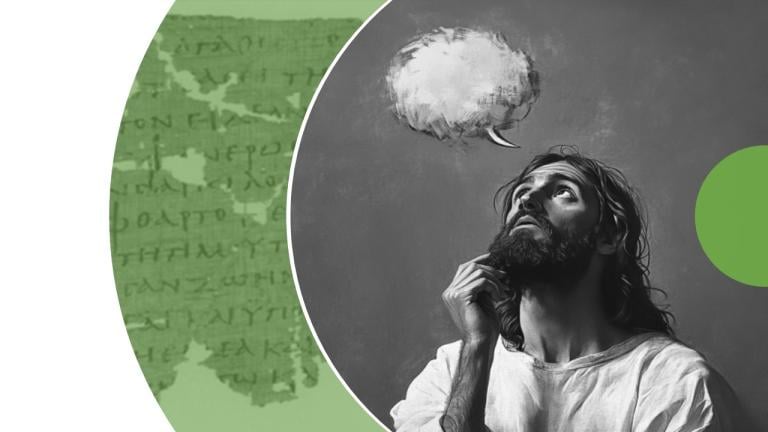
IMAGE: Keith Giles
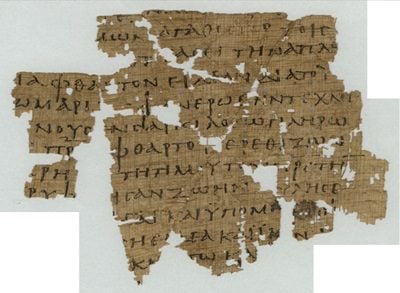
“…good Father…introduces (?) the simple and incorruptible form. Therefore, I say, Mary: I showed myself as the artificer of mind in the logos made flesh filled with the incorruptible Father, awakening through my kindness the hidden life of the Father…form and…””…will fall on the earth. [John] said: “I bathe you with water, but a man will come and will bathe you with fire and spirit.” Therefore, I say to you, Mary: seek to mix water and fire and you will no longer appear as an image of flesh, but an image of the eternal incorruptible light, bringing together for you, Mary, intellectual spirits from the two intertwined and dissolved elements.’” [P. Oxy 5577]
Since the publication of P. Oxy 5577 above, noted scholars such as Elizabeth (Libbie) Schrader Polczer and Sarah Parkhouse have published academic articles suggesting that it might be a fragment from the missing pages of the Gospel of Mary.
This fragment, recently translated in 2023, is dated to the fourth century and is very similar in content to a description of the Valentinian “Heavenly Bridal Chamber” concept which is preserved for us in the writings of opponents like Irenaeus who, as we know, was writing in the second century.
Therefore, these ideas in the fragment above are consistent with other known second-century Christian writings such as we find in the Gospel of Mary, (also dated to the second century).
So, if this is the case, then what are the clues that connect it to the Gospel of Mary?
One obvious connection between this fragment and the Gospel of Mary is the mention of the mind at the very beginning where Jesus says, “Therefore, I say, Mary: I showed myself as the artificer of mind in the logos made flesh…”
The section in the Gospel of Mary just before the pages are removed contains a dialog between Jesus and Mary where he tells her: “For where the mind is, there is the treasure.” This certainly feels like a continuation of that same conversation about the mind, doesn’t it? And the very last sentence in the Gospel of Mary preceding the missing pages says this:
“The Savior answered and said, ‘One does not see with the soul or with the spirit, but the mind which is between the two sees the vision…”
So, if we can assume that have, indeed, found a missing section of those censored pages from Mary’s Gospel, what, if anything, can we learn from this fragment? Let’s take a closer look.
Does P. Oxy 5577 Fit With Mary’s Gospel?
The fragment begins at the end of a sentence which says: “…good Father…introduces (?) the simple and incorruptible form.” This doesn’t give us a lot to go on. We can make an educated guess that what Jesus is referring to is his own incarnation.
Especially based on what comes next: “Therefore, I say, Mary: I showed myself as the artificer of mind in the logos made flesh filled with the incorruptible Father…”
This gives us a clue that Jesus is explaining to Mary the nature of the mystery of his incarnation. Not merely of the logos [as we read in the first chapter of John’s Gospel], but as the “artificer of mind in the logos made flesh” and “filled with the incorruptible Father.”
What does it mean when Jesus identifies himself as “the artificer of mind”? Is he saying that he created the mind? Or, is he saying that he has shown himself to be a master craftsman of the mind?
Either translation works, and so either Jesus is claiming to be the One who created Consciousness, or he is simply saying that he has “shown himself” [or proven himself] as one who has “mastered the art of the mind in the logos made flesh [which is] filled with the incorruptible Father.”
Proto-Orthodox Christians interpreted these sayings as being uniquely about the person of Jesus. Valentinian Christians [and some Gnostic Christians] took these sayings to mean that Jesus realized he was already the incarnation of the logos who was filled with the pure light of the Father, just like everyone else. In other words, Jesus awakened to his shared Divinity and shared Humanity and then did all he could to wake others up to this same reality.
This is why some Christians read verses in the Gospel of John as being only about Jesus while others read those same statements as being universal to all of us.
For example, when Jesus says to his disciples: “In that day you will realize that I am in the Father, and you are in me and I am in you,” he wasn’t speaking only of himself. He was trying to tell them that one day they would have the same realization that he was having: That they were in the Father and in one another, too.
The idea of Jesus awakening to this realization carries on into this P. Oxy 5577 fragment which says: “…awakening through my kindness the hidden life of the Father…[and] form…”.
Enter John the Baptist
The fragment continues with a reference to John the Baptist as it says: “[fire?]…will fall on the earth. [John] said: “I bathe you with water, but a man will come and will bathe you with fire and spirit.”
This section is almost a verbatim quote from the Gospel of Matthew where John says:
“I indeed baptize you in water unto repentance: but he that cometh after me is mightier than I, whose shoes I am not worthy to bear: he shall baptize you in the Holy Spirit and in fire” [Matt. 3:11]
So, from this reference, we can surmise that Jesus might be speaking of fire falling on the earth just before he quotes John the Baptist’s famous line about Jesus coming to baptize [bathe] us “with fire and spirit.” But, what do these metaphors point to? What is meant by being bathed “with fire and spirit”?
Again, it depends on who you ask. Proto-Orthodox Christians might have said this was a reference to God’s wrath [the fire] and God’s mercy [the Spirit]. Others might have said that the fire was a reference to purification [as when those who pass through the fire are refined as gold and silver], and that the Spirit was a reference to Pentecost where God poured out His Spirit on all flesh: young and old, male and female, etc.
The Valentinian Perspective
From a Valentinian point of view, being bathed in fire and spirit might be a reference to something found in yet another lost Gospel, as Sarah Parkhouse writes:
“The most relevant intertextual connection to the mixing of fire and water is in the Gospel of Philip, which reads that “it is from water and fire that the soul and spirit came into being” (67,2–3) and that “through water and fire everything is purified, the revealed by means of the revealed, the hidden by means of the hidden” (57,22–23), possibly referring to a ritual context.” [1]
So, for those of us seeking to understand the true meaning of these words, it is most likely that being bathed in fire and spirit is a reference to water and fire being mixed to create the soul and the spirit, and the idea of purification of them both. This leads us directly into the final sentence of P. Oxy 5577 which says:
“Therefore, I say to you, Mary: seek to mix water and fire and you will no longer appear as an image of flesh, but an image of the eternal incorruptible light, bringing together for you, Mary, intellectual spirits from the two intertwined and dissolved elements.’”
Do you see it? Jesus urges Mary to “mix water and fire” – this is a direct parallel to what the Gospel of Philip says about how soul and spirit were created. When Mary does this, Jesus says that she “will no longer appear as an image of flesh, but [as] an image of the eternal incorruptible light.” This same “incorruptible light” that Mary transforms into is analogous to how Jesus describes himself earlier in this fragment as “…the artificer of mind in the logos made flesh filled with the incorruptible Father.”
In other words, what has happened to Jesus can and will happen to Mary, and to any of us who find ourselves “awakening…[to] the hidden life of the Father,” which is already alive within us.
[1] See “Papyrus Oxyrhynchus 5577”, compiled by Sarah Parkhouse, North American Society for the Study of Christian Apocryphal Literature [NASSCAL], April 2024. https://www.nasscal.com/e-clavis-christian-apocrypha/papyrus-oxyrhynchus-5577/
**

Excited to announce the new weekly online course I’ll be co-hosting with artist/musician Angie Von Slaughter starting Wednesday, January 8th.
Are you a creative person who struggles to find new ideas? Or maybe you’ve got too many ideas but you just don’t know how to get started? This course is a Live Online Zoom call where we gather with other artists to explore creativity and share exercises and prompts to help us unlock our creativity together.
Register now and save 20% off for a limited time only>
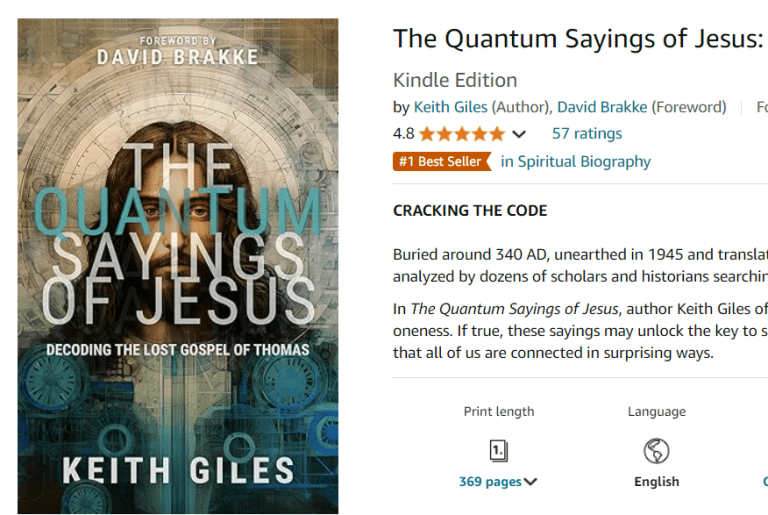
The newest book from Keith Giles, “The Quantum Sayings of Jesus: Decoding the Lost Gospel of Thomas” is available now on Amazon. Order HERE>
Keith Giles is the best-selling author of the Jesus Un series. He has appeared on CNN, USA Today, BuzzFeed, and John Fugelsang’s “Tell Me Everything.”
He co-hosts The Heretic Happy Hour Podcast and his solo podcast, Second Cup With Keith which are both available on Spotify, Amazon, Apple, Podbean or wherever you find your podcast fix.
Previous Post

December 23, 2024
Our Cosmic Blind Spots
Next Post

December 30, 2024 How To Have A Hopeful New Year
Recent Comments
"Googled: “In psychology and everyday language, intelligence is the capacity to learn, understand, reason, think ..."
"It's so weird to me how anyone thinks that getting basic income is in any ..."
"Sounds very much like what Pope Leo wrote in Magnifica Humanitas - a lot of ..."
"As it is written in the canonical Gospels:But as many as received Him, to them ..."
INNER CIRCLE: God’s Transcending Love
Browse Our Archives
Select a Category Art Biblicism Christian Politics Cosmic Christ Deconstruction Discipleship Dispensationalism Divine Unity Ekklesia End Time Stuff Eschatology Evergreen Following Jesus Gender General Christian Topics Gnostics God's Love Gospel of Judas Gospel of Mary Gospel of Philip Gospel of the Kingdom Gospel of Thomas Gospel of Truth Hell Historical Jesus Inner Circle Investigative Reporting Islam LGBTQ Issues Marriage Mental/Emotional Health Mystery Non-Duality Philosophy Podcast Poetry Politics Poverty Preemptive Love Prophecy Psychology Quantum Theology Racism Reconstruction Satire Sex Technology Theology Uncategorized Universalism
Select a Month October 2026 September 2026 August 2026 July 2026 June 2026 May 2026 April 2026 March 2026 February 2026 January 2026 December 2025 November 2025 October 2025 September 2025 August 2025 July 2025 June 2025 May 2025 April 2025 March 2025 February 2025 January 2025 December 2024 November 2024 October 2024 September 2024 August 2024 July 2024 June 2024 May 2024 April 2024 March 2024 February 2024 January 2024 December 2023 November 2023 October 2023 September 2023 August 2023 July 2023 June 2023 May 2023 April 2023 March 2023 February 2023 January 2023 December 2022 November 2022 October 2022 September 2022 August 2022 July 2022 June 2022 May 2022 April 2022 March 2022 February 2022 January 2022 December 2021 November 2021 October 2021 September 2021 August 2021 July 2021 June 2021 May 2021 April 2021 March 2021 February 2021 January 2021 December 2020 November 2020 October 2020 September 2020 August 2020 July 2020 June 2020 May 2020 April 2020 March 2020 February 2020 January 2020 December 2019 November 2019 October 2019 September 2019 August 2019 July 2019 June 2019 May 2019 April 2019 March 2019 February 2019 January 2019 December 2018 November 2018 October 2018 September 2018 August 2018 July 2018 June 2018 May 2018 April 2018 March 2018 February 2018 January 2018 December 2017 November 2017
Follow Us!
TAKE THE
Religious Wisdom Quiz
Which letter has the "armor of God" passage?
Select your answer to see how you score.
Ephesians Philippians 2 Timothy Colossians
Books by This Author Books by Keith Giles
Related posts from Keith Giles

INNER CIRCLE: Profound Mystery (Of Christ In All...

INNER CIRCLE: Awaken the Sleeper

INNER CIRCLE: In Every Respect

TRENDING AT PATHEOS Progressive Christian

The Dangers of Gradual Accommodation (Winking at Sin)
Recently, the “law of gradualness” resurfaced during the opening of a weeklong,...

The Iron Gates and the Lion of the...
Yesterday, I didn't finish my report about, well, yesterday. So I'll...

Dolly Parton’s Last Song Wins Dove Award with...
Bluegrass band The Grascals, speaking on the red carpet at the 57th...

The Image: On the Horror of Capitalism and...
The Image Then went the Pharisees, and took counsel how they might...

We are approaching the date of our new American national holiday: October...

Letters on Living the Faith by C.S. Lewis
Most of us met C.S. Lewis as a public intellectual. Mere Christianity....
view all Progressive Christian blogs
What Are Your Thoughts?leave a comment
Ad-Free & Subscriber Log-In Subscription Support
- About Us
- 2026 Calendar
- Videos
- Podcasts
- Library of World Religions
- Faith In Media Tracker
- Advertise With Us
- Write for Us
- Privacy Policy
- Terms of Service
- Do Not Sell My Data
- Contact Us
- Radiant Digital
- Manage Newsletter Subscriptions
- Unsubscribe From Notifications
- Sitemap
Copyright 2008-2026, Patheos. All rights reserved.
Subscription Support Ad-Free & Subscriber Log-In
Follow Patheos