
BuddhistCatholicContemplativeEvangelicalGeneral ChristianHinduJewishLatter-day SaintMuslimNew VisionsProgressive Christian
Beliefs
- Buddhist
- Catholic
- Contemplative
- Evangelical
- General Christian
- Hindu
- Jewish
- Latter-day Saint
- More Voices
- Muslim
- New Visions
- Pagan
- Progressive Christian
Topics
- Religion News
- Food and Religion
- Sports and Religion
- Religious Art
- Religious Music and Entertainment
- Religious Events
- History and Religion
- Style and Religion
- Politics and Religion
- Women in Religion
- Recreation Outdoors and Religion
- Business Finance and Religion
- Careers Workplace and Religion
- Education and Religion
- Family Parenting and Religion
- Health Fitness and Religion
- Home and Religion
- Relationships and Religion
- Technology and Religion
- Travel and Religion
Columnists
- Buddhist Columnists
- Business Finance and Religion Columnists
- Careers Workplace and Religion Columnists
- Catholic Columnists
- Contemplative Columnists
- Education and Religion Columnists
- Evangelists Columnists
- Family Parenting and Religion Columnists
- General Christian Columnists
- Health Fitness and Religion Columnists
- Hindu Columnists
- History and Religion Columnists
- Home and Religion Columnists
- Jewish Columnists
- More Voices Columnists
- Latter Day Columnists
- Muslim Columnists
- New Visions Columnists
- Nonreligious Columnists
- Pagan Columnists
- Politics and Religion Columnists
- Progressive Columnists
- Recreation Outdoors and Religion Columnists
- Relationships and Religion Columnists
- Religion News Columnists
- Religious Art Columnists
- Religious Events Columnists
- Religious Music and Entertainment Columnists
- Sports and Religion Columnists
- Style and Religion Columnists
- Technology and Religion Columnists
- Travel and Religion Columnists
- Women in Religion Columnists
Resource Library
- 2026 Calendar
- Library of World Religions
- The 100 Most Holy Places on Earth
- Patheos Answers
- Podcasts
- Videos
- Faith Leaders Database
- Anglican Episcopalian
- Bahai
- Baptist
- Buddhism
- Christianity
- Confucianism
- Eastern Orthodoxy
- Hinduism
- Holiness and Pentecostal
- ISKCON
- Islam
- Judaism
- Lutheran
- Methodist
- The Church of Jesus Christ of Latter-day Saints
- New Age
- Paganism
- Presbytarian and Reformed
- Protestantism
- Religion Behind the Scenes
- Roman Catholic
- Scientology
- Shia Islam
- Sikhism
- Sufism
- Sunni Islam
- Taoism
- Zen
- See all religions
Research Tools
 Ad-Free & Subscriber Log-In Subscription Support
Ad-Free & Subscriber Log-In Subscription Support
Follow Patheos 

- Trending:
- Forgiveness
- |
- Marriage
- |
- Consciousness
- |
- Death Penalty
- |
- Election
- |
- Halloween

- Home
- Progressive Christian
- Women in Religion
- INNER CIRCLE: Mary’s Vision Revealed
INNER CIRCLE: Mary’s Vision Revealed
Last updated on: December 20, 2024 at 2:02 am by Keith Giles
INNER CIRCLE: Mary’s Vision Revealed 2024-12-18T22:06:25+00:00 Keith Giles
Patheos Explore the world's faith through different perspectives on religion and spirituality! Patheos has the views of the prevalent religions and spiritualities of the world.

IMAGE: Keith Giles
“Peter said to Mary, ‘Sister, we know that the Savior loved you more than the rest of the women. Tell us the words of the Savior which you remember, which you know and we do not, nor have we heard them.’ Mary answered and said, ‘What is hidden from you I will tell you.’ And she began to say to them these words. ‘I,’ she said, ‘I saw the Lord in a vision and I said to him, ‘Lord, I saw you today in a vision.’ He answered and said to me, ‘Blessed are you that you did not waver at seeing me. For where the mind is, there is the treasure.’ I said to him, ‘Lord, now, does one who sees the vision see it with the soul or with the spirit?’ The Savior answered and said, ‘One does not see with the soul or with the spirit, but the mind which is between the two sees the vision, [and] it…’” [The Gospel of Mary, Chapters 6-7]
[pages 11 – 14 are missing from the manuscript]
When Peter first asks Mary to share what she has heard from Jesus, he comes in humility and seems to have a genuine curiosity. His later response to what she tells the disciples betrays his true lack of interest in what she has to say to them. But, for now, he allows Mary to answer his question and begin speaking.
Sadly, the bulk of what she has to say has been lost to us. Either by an intentional act of censorship or from an accidental loss of integrity in the ancient text, we cannot know for certain. But, as noted scholar Elizabeth Schrader Polczer says, “The first few pages of the Gospel of Mary are missing but that’s not that uncommon. When you have a document from the fifth century, oftentimes those first pages are missing…what’s a little bit strange is that pages 11 through 14 have been removed.”[1]
Before we look into the mysterious contents of those missing pages, let’s first examine what takes place here just before their removal. Mary responds to Peter’s question and begins to share what she saw and heard from Jesus. The reference here to Mary “[seeing] the Lord in a vision” is a direct reference to what we read in the Gospel of John where it says that, at the resurrection, Mary saw Jesus at the tomb [see the Gospel of John, 20:14-17] and then ran to the disciples to report to them what she had seen, saying, “And she told them that he had said these things to her.” [v. 18]
If this reference is intentional [and some scholars believe that it is not an accidental reference], then what we can see is that those early [second century] believers who wrote the Gospel of Mary considered the resurrection encounter with Jesus to be a vision and not an appearance of Jesus in a physical body. Keep in mind that the Gospel of Mary is conservatively dated at around the second century as compared to the fourth century for the Gospel of John. So, the earlier view of those second-century followers of Christ was that the resurrection appearances of Jesus were a vision, which is significant. Even the Apostle Paul, when recounting his encounter with the resurrected Christ, admits that he saw something no one else saw and heard a voice that no one else could hear. This is consistent with a vision, and not with the appearance of a physical person.
So, after Mary tells the disciples that she has seen Jesus in a vision, she goes on to recount her conversation with Jesus [presumably at a later date] about the nature of that vision. First, Jesus commends her and blesses her “because [she] didn’t waiver at the sight of [him],” adding, “For where the mind is, there is the treasure.”
This saying from Mary’s Gospel corresponds slightly with another saying from Jesus in the canonical Gospels where he says:
“Do not lay up treasures for yourselves on earth, where moth and rust destroy and where thieves break in and steal, but lay up for yourselves treasures in heaven where neither moth nor rust destroys and where thieves do not break in and steal. For where your treasure is, there your heart will be also.” [Matthew 6:19-21, emphasis added]
However, in this Gospel, the saying is: “For where [your] mind is, there is [your] treasure.”
Can we reconcile these two sayings? Are they each separate sayings that apply in two different scenarios? Or was one saying transposed into the other? Honestly, we can’t say. Unless we had earlier copies of both Gospels to compare, we can’t really know the answers. However, we can assume the possibility that both sayings originate with Jesus simply because the words of Mary are not recorded for us in those other Gospel accounts. It is only in this Gospel of Mary that the Magdalene is given a voice, even if that voice is largely silenced by some unknown editor immediately after she begins to share her revelation with us.
In Matthew’s Gospel, the location of your treasure [in heaven or earth] reveals the location of your heart. But in Mary’s Gospel, it is the mind that becomes the treasure. Heaven and earth have nothing to do with it. So, the point here seems to be that the mind itself – whether in this life or the next – is to be valued and treasured above the rest. This has much to do with the earlier teachings about the Child of Humanity and the question of whether matter can be destroyed. Our bodies may wear out and die, but our minds – our true selves – cannot. We are eternal beings having a temporary physical experience.
This question of the mind comes up again immediately after this statement from Jesus when Mary asks:
“Lord, now, does one who sees the vision see it with the soul or with the spirit?” The Savior answered and said, “One does not see with the soul or with the spirit, but the mind which is between the two sees the vision…”
Mary has seen a vision of the resurrected Christ in her mind. This is not to diminish her vision or her experience in any way. On the contrary, according to Jesus, the mind is where our treasure is.
We might be tempted to detour her and explore the meaning and significance of the comparisons between the soul and the spirit and the mind, but that would be a distraction from what is really important in this text. Whether you see the soul and the spirit as interchangeable concepts, or if you see one as distinct from the other is of no importance. The mind is what matters here. The mind is where we see the vision of the resurrected Christ. The mind is the treasure.
“For as one thinks in his heart, so is he.” [Proverbs 23:7]
[1] As quoted from an interview with Elizabeth Schrader on the Heretic Happy Hour Podcast, Episode 193.
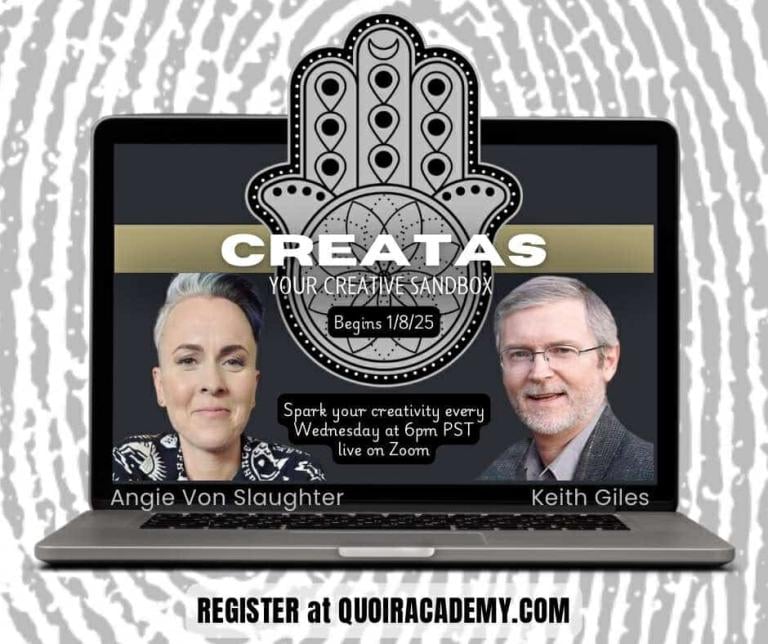
Excited to announce the new weekly online course I’ll be co-hosting with artist/musician Angie Von Slaughter starting Wednesday, January 8th.
Are you a creative person who struggles to find new ideas? Or maybe you’ve got too many ideas but you just don’t know how to get started? This course is a Live Online Zoom call where we gather with other artists to explore creativity and share exercises and prompts to help us unlock our creativity together.
Register now and save 20% off for a limited time only>
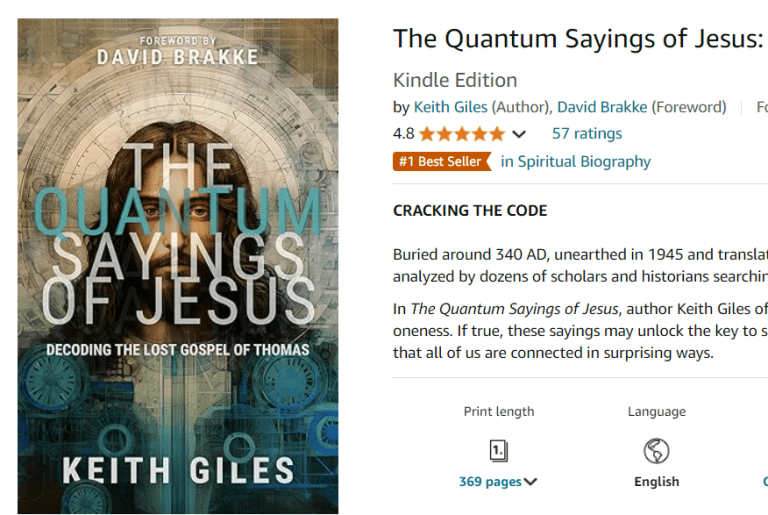
The newest book from Keith Giles, “The Quantum Sayings of Jesus: Decoding the Lost Gospel of Thomas” is available now on Amazon. Order HERE>
Keith Giles is the best-selling author of the Jesus Un series. He has appeared on CNN, USA Today, BuzzFeed, and John Fugelsang’s “Tell Me Everything.”
He co-hosts The Heretic Happy Hour Podcast and his solo podcast, Second Cup With Keith which are both available on Spotify, Amazon, Apple, Podbean or wherever you find your podcast fix.
Women in Religion
Previous Post

December 17, 2024
Everything Is Now
Next Post

December 23, 2024 Our Cosmic Blind Spots
Recent Comments
Browse Our Archives
Select a Category Art Biblicism Christian Politics Cosmic Christ Deconstruction Discipleship Dispensationalism Divine Unity Ekklesia End Time Stuff Eschatology Evergreen Following Jesus Gender General Christian Topics Gnostics God's Love Gospel of Judas Gospel of Mary Gospel of Philip Gospel of the Kingdom Gospel of Thomas Gospel of Truth Hell Historical Jesus Inner Circle Investigative Reporting Islam LGBTQ Issues Marriage Mental/Emotional Health Mystery Non-Duality Philosophy Podcast Poetry Politics Poverty Preemptive Love Prophecy Psychology Quantum Theology Racism Reconstruction Satire Sex Technology Theology Uncategorized Universalism
Select a Month October 2026 September 2026 August 2026 July 2026 June 2026 May 2026 April 2026 March 2026 February 2026 January 2026 December 2025 November 2025 October 2025 September 2025 August 2025 July 2025 June 2025 May 2025 April 2025 March 2025 February 2025 January 2025 December 2024 November 2024 October 2024 September 2024 August 2024 July 2024 June 2024 May 2024 April 2024 March 2024 February 2024 January 2024 December 2023 November 2023 October 2023 September 2023 August 2023 July 2023 June 2023 May 2023 April 2023 March 2023 February 2023 January 2023 December 2022 November 2022 October 2022 September 2022 August 2022 July 2022 June 2022 May 2022 April 2022 March 2022 February 2022 January 2022 December 2021 November 2021 October 2021 September 2021 August 2021 July 2021 June 2021 May 2021 April 2021 March 2021 February 2021 January 2021 December 2020 November 2020 October 2020 September 2020 August 2020 July 2020 June 2020 May 2020 April 2020 March 2020 February 2020 January 2020 December 2019 November 2019 October 2019 September 2019 August 2019 July 2019 June 2019 May 2019 April 2019 March 2019 February 2019 January 2019 December 2018 November 2018 October 2018 September 2018 August 2018 July 2018 June 2018 May 2018 April 2018 March 2018 February 2018 January 2018 December 2017 November 2017
Follow Us!
TAKE THE
Religious Wisdom Quiz
What did Jesus say to Lazarus to raise him?
Select your answer to see how you score.
Be healed! Live again! Awake! Lazarus, come out!
Books by This Author Books by Keith Giles
Related posts from Keith Giles

INNER CIRCLE: Profound Mystery (Of Christ In All...

INNER CIRCLE: Awaken the Sleeper

INNER CIRCLE: In Every Respect

TRENDING AT PATHEOS Progressive Christian

The First Eucharistic Controversy: Christ’s Real Presence
For Catholics, the Eucharist is the source and summit of the Christian...

How to Make a Decision When You Can't...
Main point: It’s much more valuable to stay close to God so...

Archdiocese Hosts Military Marriage Retreat in Germany
RASTATT, Germany — The transient military lifestyle, with its frequent deployments and...

Nearly every morning, I make the drive to Detroit with my high-school-age...

The Real AI Story Is Adoption Without Trust
Artificial intelligence has crossed a political threshold. It is no longer a...

A new article, written by Jeff Lindsay and Gale L. Pooley,...
view all Progressive Christian blogs
What Are Your Thoughts?leave a comment
Ad-Free & Subscriber Log-In Subscription Support
- About Us
- 2026 Calendar
- Videos
- Podcasts
- Library of World Religions
- Faith In Media Tracker
- Advertise With Us
- Write for Us
- Privacy Policy
- Terms of Service
- Do Not Sell My Data
- Contact Us
- Radiant Digital
- Manage Newsletter Subscriptions
- Unsubscribe From Notifications
- Sitemap
Copyright 2008-2026, Patheos. All rights reserved.
Subscription Support Ad-Free & Subscriber Log-In
Follow Patheos