
BuddhistCatholicContemplativeEvangelicalGeneral ChristianHinduJewishLatter-day SaintMuslimNew VisionsProgressive Christian
Beliefs
- Buddhist
- Catholic
- Contemplative
- Evangelical
- General Christian
- Hindu
- Jewish
- Latter-day Saint
- More Voices
- Muslim
- New Visions
- Pagan
- Progressive Christian
Topics
- Religion News
- Food and Religion
- Sports and Religion
- Religious Art
- Religious Music and Entertainment
- Religious Events
- History and Religion
- Style and Religion
- Politics and Religion
- Women in Religion
- Recreation Outdoors and Religion
- Business Finance and Religion
- Careers Workplace and Religion
- Education and Religion
- Family Parenting and Religion
- Health Fitness and Religion
- Home and Religion
- Relationships and Religion
- Technology and Religion
- Travel and Religion
Columnists
- Buddhist Columnists
- Business Finance and Religion Columnists
- Careers Workplace and Religion Columnists
- Catholic Columnists
- Contemplative Columnists
- Education and Religion Columnists
- Evangelists Columnists
- Family Parenting and Religion Columnists
- General Christian Columnists
- Health Fitness and Religion Columnists
- Hindu Columnists
- History and Religion Columnists
- Home and Religion Columnists
- Jewish Columnists
- More Voices Columnists
- Latter Day Columnists
- Muslim Columnists
- New Visions Columnists
- Nonreligious Columnists
- Pagan Columnists
- Politics and Religion Columnists
- Progressive Columnists
- Recreation Outdoors and Religion Columnists
- Relationships and Religion Columnists
- Religion News Columnists
- Religious Art Columnists
- Religious Events Columnists
- Religious Music and Entertainment Columnists
- Sports and Religion Columnists
- Style and Religion Columnists
- Technology and Religion Columnists
- Travel and Religion Columnists
- Women in Religion Columnists
Resource Library
- 2026 Calendar
- Library of World Religions
- The 100 Most Holy Places on Earth
- Patheos Answers
- Podcasts
- Videos
- Faith Leaders Database
- Anglican Episcopalian
- Bahai
- Baptist
- Buddhism
- Christianity
- Confucianism
- Eastern Orthodoxy
- Hinduism
- Holiness and Pentecostal
- ISKCON
- Islam
- Judaism
- Lutheran
- Methodist
- The Church of Jesus Christ of Latter-day Saints
- New Age
- Paganism
- Presbytarian and Reformed
- Protestantism
- Religion Behind the Scenes
- Roman Catholic
- Scientology
- Shia Islam
- Sikhism
- Sufism
- Sunni Islam
- Taoism
- Zen
- See all religions
Research Tools
 Ad-Free & Subscriber Log-In Subscription Support
Ad-Free & Subscriber Log-In Subscription Support
Follow Patheos 

- Trending:
- Forgiveness
- |
- Marriage
- |
- Consciousness
- |
- Death Penalty
- |
- Election
- |
- Halloween

- Home
- Progressive Christian
- Religious Art
- Where Do Ideas Come From?
Where Do Ideas Come From?
Last updated on: October 31, 2024 at 10:01 pm by Keith Giles
Where Do Ideas Come From? 2024-10-31T22:01:10+00:00 Keith Giles
Patheos Explore the world's faith through different perspectives on religion and spirituality! Patheos has the views of the prevalent religions and spiritualities of the world.

IMAGE: Pexels
Exploring Ideaspace: The Mysterious Realm of Collective Inspiration
When you delve into human history, a peculiar phenomenon known as “The Law of Dual Discovery” or “The Multiple Independent Discovery Effect” reveals itself. It’s this uncanny trend of two or more individuals, often separated by thousands of miles with no communication, making the same discoveries at nearly the same time. In 1922, William Ogburn and Dorothy Thomas famously compiled a list of 148 scientific discoveries that fit this pattern. From calculus to oxygen, and even the theory of evolution, multiple minds seem to latch onto the same concepts in tandem, suggesting that ideas may not come solely from within us. So, what’s going on here?
This strange synchronicity has stirred up some compelling theories, notably the concept of “Ideaspace.” If true, Ideaspace could be the mysterious source from which ideas emerge, a place accessed by the human mind through dreams or states of inspiration. The theory resembles an ancient concept, one that aligns closely with the visions of Plato and Carl Jung. Both philosophers proposed that there exists a realm outside ordinary perception—a dimension of perfect ideas, archetypes, and shared human symbols.
Ideaspace and the Collective Unconscious
Let’s start with Plato, who theorized about an Ideal Form, a realm where all true ideas exist unchanging. This realm held the “perfect” version of everything we experience in our material world. Later, psychologist Carl Jung explored a similar concept, the “Collective Unconscious.” According to Jung, the Collective Unconscious is the inherited reservoir of human experience, housing archetypes and universal symbols that influence us without our awareness. This concept suggests we’re not blank slates but instead are steeped in ancient, inherited memories that frame our conscious experience.
In Jung’s words, “the collective unconscious comprises in itself the psychic life of our ancestors right back to the earliest beginnings.” This mysterious mental layer may explain why certain ideas appear simultaneously across individuals and cultures. Perhaps these “primordial images” are what inspire multiple individuals at once to make strikingly similar discoveries. While it’s still up for debate whether Ideaspace and the Collective Unconscious are one and the same, the notion that we’re tapping into an unseen reservoir of ideas resonates with both.
The Mechanics of Ideaspace
But how exactly does one “tap into” Ideaspace? Science fiction writer Rudy Rucker offers a poetic analogy in his essay “Life as a Fractal in Hilbert Space.” He suggests that Ideaspace exists beyond waking reality, reachable only through imagination or dreams. According to Rucker, Ideaspace might operate like a broadcast frequency, a subtle wave accessible to minds tuned to receive it. When multiple minds hit the right “frequency,” they become conduits for the same concepts, bringing similar discoveries back to the real world.
To put it simply, when an idea is “ripe,” multiple people are bound to tune into it and bring it forth. It’s as if Ideaspace is always humming with possibility, waiting for the right minds to reach out and connect. This mystical notion aligns beautifully with the experiences of creatives like musician Jean Baptiste, who likens his creative flow to dipping into a “current of consciousness.” He feels that the music “is always there,” an endless stream of ideas ready to be grasped, where he can connect with something beyond himself and channel it to the audience.
A Divine Dance: Creativity and Ideaspace
Could it be that each time we open ourselves to creative inspiration, we are interacting with a dimension beyond ourselves? Baptiste describes this act as a “gift” to the audience, a moment of true freedom that allows him to move beyond judgment and ego. And isn’t this what artists, musicians, scientists, and innovators experience when they say ideas just “come” to them?
There’s a profound spiritual parallel here. If Ideaspace is real, perhaps it’s a way of glimpsing the Divine, a shared mind, or as some might call it, God. By setting aside personal expectations and surrendering to the flow of creativity, we engage with a force greater than our individual selves. Keith Giles, who often writes about spiritual concepts, might frame this act of surrender as a form of collaboration with the Spirit of Truth, a dance that transcends earthly confines and reaches toward the divine mystery itself.
The Mystery of Ideaspace
This idea—that ideas are neither isolated nor confined—invites a tantalizing question: where do ideas actually come from? Could Ideaspace be the mind of God, shared among us in fragments? It’s no wonder the theory of Ideaspace intrigues thinkers across disciplines, from philosophers to physicists. If this realm exists, it suggests that discovery is not only a product of human effort but also of universal timing and connectivity.
Imagine, then, that all of humanity is connected through an invisible web of shared thought, each of us a potential receiver for the next big idea waiting to break into consciousness. It’s a vision that gives creativity a much larger meaning, showing us that our individual contributions are part of a greater human tapestry. In the end, whether or not Ideaspace is scientifically provable may not matter as much as the wonder it inspires.
Conclusion: Embracing Ideaspace
What if Ideaspace exists? It challenges us to view our creative moments as a bridge to something greater, a shared reservoir of all human thought that reminds us of our interconnectedness. Perhaps, then, every great idea or discovery isn’t a result of personal genius but of attuning oneself to the divine symphony that has been playing since the dawn of time.
Isn’t it humbling to think that each inspiration, each breakthrough, is part of a larger, cosmic design? The next time you’re hit with a brilliant idea, consider it might just be your mind reaching into Ideaspace, plucking from a collective consciousness that has always existed. Embrace it, share it, and join the timeless dance of creativity that has connected humanity across millennia.
**
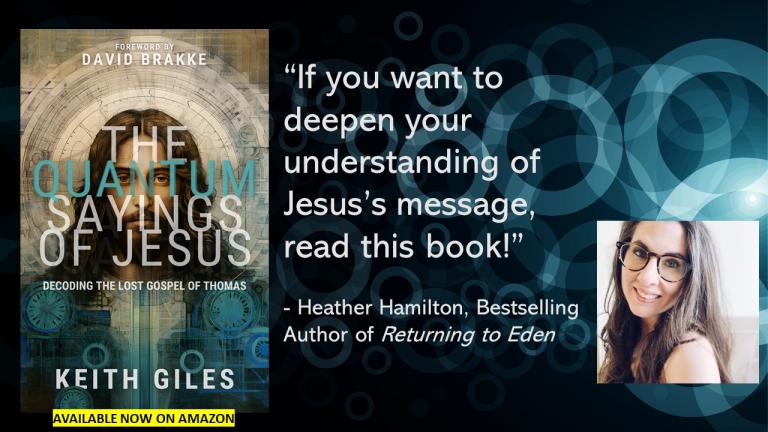
The newest book from Keith Giles, “The Quantum Sayings of Jesus: Decoding the Lost Gospel of Thomas” is available now on Amazon. Order HERE>
Keith Giles is the best-selling author of the Jesus Un series. He has appeared on CNN, USA Today, BuzzFeed, and John Fugelsang’s “Tell Me Everything.”
He co-hosts The Heretic Happy Hour Podcast and his solo podcast, Second Cup With Keith which are both available on Spotify, Amazon, Apple, Podbean or wherever you find your podcast fix.
Religious Art
History and Religion
Previous Post

October 28, 2024
The Divine Creative
Next Post

October 30, 2024 Welcome To The Noomasphere of Ideas
Recent Comments
"Googled: “In psychology and everyday language, intelligence is the capacity to learn, understand, reason, think ..."
"It's so weird to me how anyone thinks that getting basic income is in any ..."
"Sounds very much like what Pope Leo wrote in Magnifica Humanitas - a lot of ..."
"As it is written in the canonical Gospels:But as many as received Him, to them ..."
INNER CIRCLE: God’s Transcending Love
Browse Our Archives
Select a Category Art Biblicism Christian Politics Cosmic Christ Deconstruction Discipleship Dispensationalism Divine Unity Ekklesia End Time Stuff Eschatology Evergreen Following Jesus Gender General Christian Topics Gnostics God's Love Gospel of Judas Gospel of Mary Gospel of Philip Gospel of the Kingdom Gospel of Thomas Gospel of Truth Hell Historical Jesus Inner Circle Investigative Reporting Islam LGBTQ Issues Marriage Mental/Emotional Health Mystery Non-Duality Philosophy Podcast Poetry Politics Poverty Preemptive Love Prophecy Psychology Quantum Theology Racism Reconstruction Satire Sex Technology Theology Uncategorized Universalism
Select a Month October 2026 September 2026 August 2026 July 2026 June 2026 May 2026 April 2026 March 2026 February 2026 January 2026 December 2025 November 2025 October 2025 September 2025 August 2025 July 2025 June 2025 May 2025 April 2025 March 2025 February 2025 January 2025 December 2024 November 2024 October 2024 September 2024 August 2024 July 2024 June 2024 May 2024 April 2024 March 2024 February 2024 January 2024 December 2023 November 2023 October 2023 September 2023 August 2023 July 2023 June 2023 May 2023 April 2023 March 2023 February 2023 January 2023 December 2022 November 2022 October 2022 September 2022 August 2022 July 2022 June 2022 May 2022 April 2022 March 2022 February 2022 January 2022 December 2021 November 2021 October 2021 September 2021 August 2021 July 2021 June 2021 May 2021 April 2021 March 2021 February 2021 January 2021 December 2020 November 2020 October 2020 September 2020 August 2020 July 2020 June 2020 May 2020 April 2020 March 2020 February 2020 January 2020 December 2019 November 2019 October 2019 September 2019 August 2019 July 2019 June 2019 May 2019 April 2019 March 2019 February 2019 January 2019 December 2018 November 2018 October 2018 September 2018 August 2018 July 2018 June 2018 May 2018 April 2018 March 2018 February 2018 January 2018 December 2017 November 2017
Follow Us!
TAKE THE
Religious Wisdom Quiz
Which Christian principle is shown by the story of the widow's mite?
Select your answer to see how you score.
Never give Give only if rich Generosity from the heart Give to be seen
Books by This Author Books by Keith Giles
Related posts from Keith Giles

INNER CIRCLE: Profound Mystery (Of Christ In All...

INNER CIRCLE: Awaken the Sleeper

INNER CIRCLE: In Every Respect

TRENDING AT PATHEOS Progressive Christian

Catholic Evangelization: Sharing Your Faith Every Day
Welcome back to the Graceful Awakening mini-series called, “From Faith to Mission.” ...

The Pillar of the Boatmen: the Ancient Monument...
The Pillar of the Boatmen is a Romano-Gaulish sculpture that dates from...

In one sense walking into Westminster Abbey is like walking down the...

'Super Scam Me' Exposes AI Jon Bon Jovi...
Leslie Pickett believed she was in a relationship with Jon Bon Jovi....

The Brazilian Remake of Kendricks' 'Flywheel' Opens in...
“Flywheel,” the story that launched the Kendrick Brothers’ filmmaking career is getting...

The Dangers of Gradual Accommodation (Winking at Sin)
Recently, the “law of gradualness” resurfaced during the opening of a weeklong,...
view all Progressive Christian blogs
What Are Your Thoughts?leave a comment
Ad-Free & Subscriber Log-In Subscription Support
- About Us
- 2026 Calendar
- Videos
- Podcasts
- Library of World Religions
- Faith In Media Tracker
- Advertise With Us
- Write for Us
- Privacy Policy
- Terms of Service
- Do Not Sell My Data
- Contact Us
- Radiant Digital
- Manage Newsletter Subscriptions
- Unsubscribe From Notifications
- Sitemap
Copyright 2008-2026, Patheos. All rights reserved.
Subscription Support Ad-Free & Subscriber Log-In
Follow Patheos