
BuddhistCatholicContemplativeEvangelicalGeneral ChristianHinduJewishLatter-day SaintMuslimNew VisionsProgressive Christian
Beliefs
- Buddhist
- Catholic
- Contemplative
- Evangelical
- General Christian
- Hindu
- Jewish
- Latter-day Saint
- More Voices
- Muslim
- New Visions
- Pagan
- Progressive Christian
Topics
- Religion News
- Food and Religion
- Sports and Religion
- Religious Art
- Religious Music and Entertainment
- Religious Events
- History and Religion
- Style and Religion
- Politics and Religion
- Women in Religion
- Recreation Outdoors and Religion
- Business Finance and Religion
- Careers Workplace and Religion
- Education and Religion
- Family Parenting and Religion
- Health Fitness and Religion
- Home and Religion
- Relationships and Religion
- Technology and Religion
- Travel and Religion
Columnists
- Buddhist Columnists
- Business Finance and Religion Columnists
- Careers Workplace and Religion Columnists
- Catholic Columnists
- Contemplative Columnists
- Education and Religion Columnists
- Evangelists Columnists
- Family Parenting and Religion Columnists
- General Christian Columnists
- Health Fitness and Religion Columnists
- Hindu Columnists
- History and Religion Columnists
- Home and Religion Columnists
- Jewish Columnists
- More Voices Columnists
- Latter Day Columnists
- Muslim Columnists
- New Visions Columnists
- Nonreligious Columnists
- Pagan Columnists
- Politics and Religion Columnists
- Progressive Columnists
- Recreation Outdoors and Religion Columnists
- Relationships and Religion Columnists
- Religion News Columnists
- Religious Art Columnists
- Religious Events Columnists
- Religious Music and Entertainment Columnists
- Sports and Religion Columnists
- Style and Religion Columnists
- Technology and Religion Columnists
- Travel and Religion Columnists
- Women in Religion Columnists
Resource Library
- 2026 Calendar
- Library of World Religions
- The 100 Most Holy Places on Earth
- Patheos Answers
- Podcasts
- Videos
- Faith Leaders Database
- Anglican Episcopalian
- Bahai
- Baptist
- Buddhism
- Christianity
- Confucianism
- Eastern Orthodoxy
- Hinduism
- Holiness and Pentecostal
- ISKCON
- Islam
- Judaism
- Lutheran
- Methodist
- The Church of Jesus Christ of Latter-day Saints
- New Age
- Paganism
- Presbytarian and Reformed
- Protestantism
- Religion Behind the Scenes
- Roman Catholic
- Scientology
- Shia Islam
- Sikhism
- Sufism
- Sunni Islam
- Taoism
- Zen
- See all religions
Research Tools
 Ad-Free & Subscriber Log-In Subscription Support
Ad-Free & Subscriber Log-In Subscription Support
Follow Patheos 

- Trending:
- Forgiveness
- |
- Marriage
- |
- Consciousness
- |
- Death Penalty
- |
- Election
- |
- Halloween

- Home
- Progressive Christian
- Technology and Religion
- Welcome To The Noomasphere of Ideas
Welcome To The Noomasphere of Ideas
Last updated on: October 30, 2024 at 5:31 pm by Keith Giles
Welcome To The Noomasphere of Ideas 2024-10-30T17:31:18+00:00 Keith Giles
Patheos Explore the world's faith through different perspectives on religion and spirituality! Patheos has the views of the prevalent religions and spiritualities of the world.

Our Digital Mind and the Evolution of Ideas
We’re living in strange, exciting times. The internet has become an uncontainable beast, a force of culture and communication that’s impossible to ignore.
But more than that, it’s become a space where thoughts gather, where ideas take on lives of their own, and where people connect on levels that, just a few decades ago, would’ve seemed impossible.
Welcome to what we might call the “Noomasphere”—a place where the wisdom and whimsy of the human mind come together online. It’s where internet memes, philosophical reflections, and collective thoughts evolve in a space that’s not just about information but transformation.
So let’s dive into this Noomasphere and explore what it means for us, why it matters, and what happens when ideas collide and take on new lives.
The Roots of the Noomasphere
To understand the Noomasphere, we need to go back a little—to a term you may or may not have heard of: the noosphere. French philosopher Pierre Teilhard de Chardin came up with the term in the early 20th century, and it’s rooted in the Greek word nous, which means “mind” or “intellect.”
De Chardin saw the noosphere as a collective consciousness that we’re all part of. Imagine it like a layer of thought that hovers over the planet—a sort of mental atmosphere that we contribute to and draw from, where our collective knowledge, ideas, and dreams gather.
The noosphere was more of a philosophical idea, a thought experiment on the evolution of humanity and consciousness. But with the advent of the internet, we’ve turned this abstract concept into something tangible. Now, thanks to the web, we can see, interact with, and add to this “mind layer” in real time.
In the digital space, people around the world share their thoughts, dreams, and jokes faster than ever.
And this is where the Noomasphere comes in.
Memes: The DNA of Digital Thought
At the heart of the Noomasphere is a cultural phenomenon that feels as old as the internet itself: memes.
What is a meme, really? It’s an idea in its simplest form. It’s something that resonates so much with people that they feel compelled to share it, adapt it, or build upon it.
In fact, the term “meme” was coined by biologist Richard Dawkins in The Selfish Gene, not as a funny picture with text (though that’s how we know it now) but as a replicating idea.
Dawkins used it to describe cultural elements that spread and evolve, much like genes do.
So memes are the DNA of thought—they’re ideas that survive and adapt based on whether they resonate with us or not.
In the Noomasphere, memes are more than just a joke or a cute cat picture (though those are powerful too); they’re a way we collectively express, evolve, and solidify ideas.
Every time a meme takes off, it’s like the Noomasphere is breathing in the collective sigh of “yes, I feel that.” And as these memes bounce from person to person, they pick up nuances and mutate. They become commentary, they reflect political sentiments, they embody cultural trends. They remind us that ideas are alive.
When a meme resonates, it’s more than funny—it’s an idea that’s struck a chord with the Noomasphere.
The Idea Space: Where Ideas Are Born
Now let’s go deeper. Imagine that, beyond what we say or share online, there’s an entire space—a “realm of ideas,” if you will—where every thought and concept already exists in potential.
Some people call this the Idea Space, a sort of wellspring where every possibility exists, waiting to be drawn out by us.
Think of it as an invisible landscape filled with ideas, ripe for the picking, but only visible to those who pay attention.
Philosophers, writers, and artists have tapped into this space for centuries, but now, with the Noomasphere, more of us have access to it than ever.
What happens when we enter this Idea Space, consciously or unconsciously? We’re creating, connecting, and blending ideas that may never have encountered each other otherwise.
The Noomasphere is a direct extension of this, a kind of online conduit to the Idea Space where people across the globe can tap into thoughts that speak to them. And through this space, ideas don’t just come to life—they evolve, mutate, and adapt to fit the cultures and communities that interact with them.
The Noomasphere as a Collective Mind
Let’s step back for a moment and imagine the Noomasphere as a living ecosystem of thought. In it, communities, forums, and online platforms act as fertile ground where ideas grow, die, or become something altogether new.
This ecosystem is vast and complex, made up of countless contributions from people all over the world, each adding a unique perspective, insight, or creative twist. Every meme, every tweet, every shared post is a part of this bigger picture.
These communities can be places where we feel safe to share, connect, and discover new parts of ourselves. They’re incubators for ideas, where concepts grow and develop, building on each other.
When people gather around shared passions—art, technology, philosophy, social issues—they create something extraordinary. They create a movement, a network of thoughts that feels like a living organism.
And this is what makes the Noomasphere so alive: it’s constantly in motion, changing with every interaction and evolving as we evolve.
The Dark Side of the Noomasphere
But the Noomasphere, like any ecosystem, has its challenges. Ideas can be manipulated, distorted, or used in ways that don’t always serve the greater good. The very same memes that bring us together can also divide us.
Sometimes, misinformation spreads as quickly as truth, and the lines between reality and perception blur. The ideas that flow through the Noomasphere shape how we see the world, and while some help us grow, others can limit or mislead us. When we participate in this space, we need discernment to distinguish what’s helpful from what’s harmful.
There’s also the issue of ownership. In the Noomasphere, who really “owns” an idea? When you share a thought online, it quickly becomes public property. Ideas are no longer confined to their original creator; they belong to everyone, which can be both liberating and challenging.
It’s a reminder that in the Noomasphere, ideas aren’t static or personal; they’re part of something larger than us.
Why the Noomasphere Matters
So why does all this matter? Because the Noomasphere isn’t just about funny memes or deep philosophical discussions—it’s a reflection of our collective mind.
It’s where our ideas live, where they grow, and where they influence each other in ways that affect how we see the world and ourselves. It’s a reminder that we’re not isolated thinkers but part of a much larger, ever-evolving web of thought.
In this space, we’re connected by something bigger than ourselves. The Noomasphere is where we dream, where we express, where we challenge each other. It’s where ideas become more than just personal thoughts—they become part of a shared story, a story that each of us adds to every day. And in that shared story, we find a piece of ourselves, a reminder of our humanity, and the realization that maybe, just maybe, we’re more connected than we ever knew.
In the Noomasphere, ideas are living things. They grow and evolve, just like we do, shaped by every voice that dares to speak, every thought that dares to be shared.
So next time you post, share, or like, remember—you’re part of something much bigger than yourself.
Welcome to the Noomasphere.
**
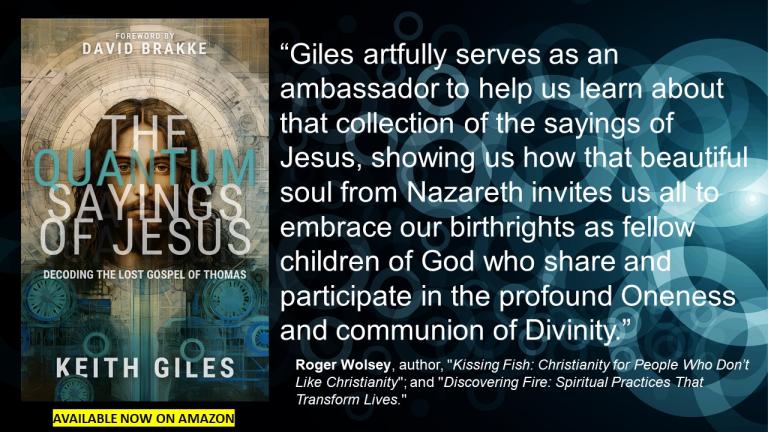
The newest book from Keith Giles, “The Quantum Sayings of Jesus: Decoding the Lost Gospel of Thomas” is available now on Amazon. Order HERE>
Keith Giles is the best-selling author of the Jesus Un series. He has appeared on CNN, USA Today, BuzzFeed, and John Fugelsang’s “Tell Me Everything.”
He co-hosts The Heretic Happy Hour Podcast and his solo podcast, Second Cup With Keith which are both available on Spotify, Amazon, Apple, Podbean or wherever you find your podcast fix.
Technology and Religion
Previous Post

October 29, 2024
Where Do Ideas Come From?
Next Post

October 31, 2024 How Spiral Dynamics Can Change Our World
Recent Comments
"Googled: “In psychology and everyday language, intelligence is the capacity to learn, understand, reason, think ..."
"It's so weird to me how anyone thinks that getting basic income is in any ..."
"Sounds very much like what Pope Leo wrote in Magnifica Humanitas - a lot of ..."
"As it is written in the canonical Gospels:But as many as received Him, to them ..."
INNER CIRCLE: God’s Transcending Love
Browse Our Archives
Select a Category Art Biblicism Christian Politics Cosmic Christ Deconstruction Discipleship Dispensationalism Divine Unity Ekklesia End Time Stuff Eschatology Evergreen Following Jesus Gender General Christian Topics Gnostics God's Love Gospel of Judas Gospel of Mary Gospel of Philip Gospel of the Kingdom Gospel of Thomas Gospel of Truth Hell Historical Jesus Inner Circle Investigative Reporting Islam LGBTQ Issues Marriage Mental/Emotional Health Mystery Non-Duality Philosophy Podcast Poetry Politics Poverty Preemptive Love Prophecy Psychology Quantum Theology Racism Reconstruction Satire Sex Technology Theology Uncategorized Universalism
Select a Month October 2026 September 2026 August 2026 July 2026 June 2026 May 2026 April 2026 March 2026 February 2026 January 2026 December 2025 November 2025 October 2025 September 2025 August 2025 July 2025 June 2025 May 2025 April 2025 March 2025 February 2025 January 2025 December 2024 November 2024 October 2024 September 2024 August 2024 July 2024 June 2024 May 2024 April 2024 March 2024 February 2024 January 2024 December 2023 November 2023 October 2023 September 2023 August 2023 July 2023 June 2023 May 2023 April 2023 March 2023 February 2023 January 2023 December 2022 November 2022 October 2022 September 2022 August 2022 July 2022 June 2022 May 2022 April 2022 March 2022 February 2022 January 2022 December 2021 November 2021 October 2021 September 2021 August 2021 July 2021 June 2021 May 2021 April 2021 March 2021 February 2021 January 2021 December 2020 November 2020 October 2020 September 2020 August 2020 July 2020 June 2020 May 2020 April 2020 March 2020 February 2020 January 2020 December 2019 November 2019 October 2019 September 2019 August 2019 July 2019 June 2019 May 2019 April 2019 March 2019 February 2019 January 2019 December 2018 November 2018 October 2018 September 2018 August 2018 July 2018 June 2018 May 2018 April 2018 March 2018 February 2018 January 2018 December 2017 November 2017
Follow Us!
TAKE THE
Religious Wisdom Quiz
True or False: In Luke's Gospel, the angels appeared to wealthy merchants to announce Jesus' birth.
Select your answer to see how you score.
FALSE TRUE
Books by This Author Books by Keith Giles
Related posts from Keith Giles

INNER CIRCLE: Profound Mystery (Of Christ In All...

INNER CIRCLE: Awaken the Sleeper

AI Is A Gateway to the Welfare State

INNER CIRCLE: In Every Respect
TRENDING AT PATHEOS Progressive Christian

Dolly Parton’s Last Song Wins Dove Award with...
Bluegrass band The Grascals, speaking on the red carpet at the 57th...

The Image: On the Horror of Capitalism and...
The Image Then went the Pharisees, and took counsel how they might...

We are approaching the date of our new American national holiday: October...

Letters on Living the Faith by C.S. Lewis
Most of us met C.S. Lewis as a public intellectual. Mere Christianity....

When Halloween Unmasks Married Hearts
Written by Dr. David K. Ewen from Eternal Truth Bible College Behind...

Aristotle. He’s been called the father of logic, the father of the...
view all Progressive Christian blogs
What Are Your Thoughts?leave a comment
Ad-Free & Subscriber Log-In Subscription Support
- About Us
- 2026 Calendar
- Videos
- Podcasts
- Library of World Religions
- Faith In Media Tracker
- Advertise With Us
- Write for Us
- Privacy Policy
- Terms of Service
- Do Not Sell My Data
- Contact Us
- Radiant Digital
- Manage Newsletter Subscriptions
- Unsubscribe From Notifications
- Sitemap
Copyright 2008-2026, Patheos. All rights reserved.
Subscription Support Ad-Free & Subscriber Log-In
Follow Patheos