
BuddhistCatholicContemplativeEvangelicalGeneral ChristianHinduJewishLatter-day SaintMuslimNew VisionsProgressive Christian
Beliefs
- Buddhist
- Catholic
- Contemplative
- Evangelical
- General Christian
- Hindu
- Jewish
- Latter-day Saint
- More Voices
- Muslim
- New Visions
- Pagan
- Progressive Christian
Topics
- Religion News
- Food and Religion
- Sports and Religion
- Religious Art
- Religious Music and Entertainment
- Religious Events
- History and Religion
- Style and Religion
- Politics and Religion
- Women in Religion
- Recreation Outdoors and Religion
- Business Finance and Religion
- Careers Workplace and Religion
- Education and Religion
- Family Parenting and Religion
- Health Fitness and Religion
- Home and Religion
- Relationships and Religion
- Technology and Religion
- Travel and Religion
Columnists
- Buddhist Columnists
- Business Finance and Religion Columnists
- Careers Workplace and Religion Columnists
- Catholic Columnists
- Contemplative Columnists
- Education and Religion Columnists
- Evangelists Columnists
- Family Parenting and Religion Columnists
- General Christian Columnists
- Health Fitness and Religion Columnists
- Hindu Columnists
- History and Religion Columnists
- Home and Religion Columnists
- Jewish Columnists
- More Voices Columnists
- Latter Day Columnists
- Muslim Columnists
- New Visions Columnists
- Nonreligious Columnists
- Pagan Columnists
- Politics and Religion Columnists
- Progressive Columnists
- Recreation Outdoors and Religion Columnists
- Relationships and Religion Columnists
- Religion News Columnists
- Religious Art Columnists
- Religious Events Columnists
- Religious Music and Entertainment Columnists
- Sports and Religion Columnists
- Style and Religion Columnists
- Technology and Religion Columnists
- Travel and Religion Columnists
- Women in Religion Columnists
Resource Library
- 2026 Calendar
- Library of World Religions
- The 100 Most Holy Places on Earth
- Patheos Answers
- Podcasts
- Videos
- Faith Leaders Database
- Anglican Episcopalian
- Bahai
- Baptist
- Buddhism
- Christianity
- Confucianism
- Eastern Orthodoxy
- Hinduism
- Holiness and Pentecostal
- ISKCON
- Islam
- Judaism
- Lutheran
- Methodist
- The Church of Jesus Christ of Latter-day Saints
- New Age
- Paganism
- Presbytarian and Reformed
- Protestantism
- Religion Behind the Scenes
- Roman Catholic
- Scientology
- Shia Islam
- Sikhism
- Sufism
- Sunni Islam
- Taoism
- Zen
- See all religions
Research Tools
 Ad-Free & Subscriber Log-In Subscription Support
Ad-Free & Subscriber Log-In Subscription Support
Follow Patheos 

- Trending:
- Forgiveness
- |
- Marriage
- |
- Consciousness
- |
- Death Penalty
- |
- Election
- |
- Halloween

- Home
- Progressive Christian
- INNER CIRCLE: Intoxicating Water
INNER CIRCLE: Intoxicating Water
Last updated on: July 21, 2022 at 7:00 pm by Keith Giles
INNER CIRCLE: Intoxicating Water 2022-07-21T19:00:59+00:00 Keith Giles
Patheos Explore the world's faith through different perspectives on religion and spirituality! Patheos has the views of the prevalent religions and spiritualities of the world.
IMAGE: Pexels
Saying 13, “Jesus said to his disciples, “Compare me to someone and tell me who I am like.” Simon Peter said to him, “You are like a righteous angel.” Matthew said to him, “You are like a wise philosopher.” Thomas said to him, “Master, I am wholly incapable of saying whom you are like.” Jesus said, “I am not your Master. Because you have drunk, you have become intoxicated from the bubbling spring which I have measured out.”
And Jesus took him and withdrew and told him three words. When Thomas returned to his companions, they asked him, “What did Jesus say to you?” Thomas said to them, “If I tell you even one of the things he told me, you will pick up stones and throw them at me; a fire will come out of the stones and burn you up.”
There are some scholars who question the authenticity of the second half of this saying since it is technically not a saying of Jesus at all, in that we do not get to hear what Jesus supposedly said to Thomas in private.
For now, let’s take a look at the first half which does appear to include a saying of Jesus in response to a question he asked his disciples. The question Jesus poses to his followers is, “Compare me to someone and tell me who I am like.” Only 3 of his disciples respond and each one of them misses the mark in some way.
First, Peter compares Jesus to a “righteous angel.” The term “righteous” is the same as the one used in the previous saying to describe James the Righteous. In other words, Jesus is just, and wise, and, like James, a messenger approved by God. But, Jesus offers no response to Peter’s affirmation, suggesting that his reply isn’t quite right.
Second, Matthew compares Jesus to “a wise philosopher,” which would put him in the same category as Plato or Socrates. Again, Jesus does not seem to agree or disagree, but his silence suggests that, like Peter, Matthew hasn’t quite given the answer Jesus was hoping for.
Thomas offers our final comparison, and while we might assume that Thomas would, of course, give the correct answer – since he’s the author of this collection of sayings – even he seems to fail this test by saying, “Master, I am wholly incapable of saying whom you are like.”
What Jesus takes exception to is the suggestion that Jesus is their master or teacher. His response to Thomas is to point out that he has become intoxicated by the revelations Jesus provided to them, and this has confused his mind to believe that Jesus is somehow “other” than himself.
In other words, if Thomas had truly understood the message Jesus was sharing with them, he would have known that there could never be any separation between any of them, and that Thomas did not require a Master or a Teacher to know the Truth – because the Truth was already alive within him, and everyone else.
Still, seemingly because his response was nearer to what Jesus was hoping for, Thomas is invited to come away with Jesus to receive “three words” – or statements – that the others are not privy to.
This is the section that some find troublesome, for the simple reason that it is more of a narrative and it contains no actual “sayings” of Jesus. At least, none that we can hear.
Or, maybe we can? Because the very next saying of Jesus in this Gospel of Thomas contains three sayings which could feasibly be taken as the same three words Jesus whispers to Thomas in this saying. Especially since that next saying begins with “Jesus said…” and doesn’t mention any other disciples specifically in his audience as this one does.
Either way, it is unusual for Thomas – or any other disciple of Jesus – to speak in this Gospel, and when what is spoken here is an admission of the heretical nature of Jesus’s teachings, one may wonder whether this second paragraph might have been added by someone seeking to discredit the words of Jesus found in this book.
In other words, why would Thomas admit that what Jesus said to him is worthy of being stoned to death by Jesus’s own disciples? It’s not the Pharisees or the Jewish authorities who are said to seek to stone Thomas for repeating what Jesus said to him, it’s Peter and Matthew and the other disciples. This sets Thomas, and the Jesus we meet in his Gospel, far apart from those Apostolic figures, and, presumably, from the rest of what eventually became Orthodox Christianity.
On the one hand, this could simply be an admission of the tension between these two contrasting factions within Christianity at this time – a chasm that would only deepen and widen over the successive centuries – but on the other hand, it could very well be a subversive addition to this text which is intended to cast doubt on what we read in this very Gospel.
We should also mention something about what Jesus says to Thomas in the first saying at the top about how he has “…become intoxicated from the bubbling spring which [Jesus has] measured out.”
This metaphor of a bubbling spring is tantalizingly close to the proclamation Jesus makes on the last day of the Feast of Booths in John 7:37-38:
“If anyone thirsts, let him come to me and drink. Whoever believes in me, as the Scripture has said, ‘Out of his heart will flow rivers of living water.’”
It also calls to mind the startling promise Jesus gives to the Samaritan woman at the well in John 4:13-14:
“Everyone who drinks this water will be thirsty again, but whoever drinks the water I give them will never thirst. Indeed, the water I give them will become in them a spring of water welling up to eternal life.”
In each case, Jesus speaks of a river, or a spring of water that wells up within his disciples, or that flows out of their hearts, to give them life, and joy, and refreshment.
Here, Jesus mentions to Thomas that this “bubbling spring” has intoxicated him so much that he has forgotten that the source of the living water within him is not Jesus. In other words, he does not need to come to Jesus for this water, or for life, or for wisdom, or joy, or anything else. The water spontaneously flows out from within Thomas, and all of us. All Jesus has done is to reveal it within us; he has pointed it out, and now we can freely come and drink from this inner well whenever we want.
So, now that we have this river and bubbling spring of living water within us, we do not need a Master to continually give us water, or life, or joy, or wisdom, because each of us now has continuous access to the water of life that flows within us.
This is a difficult concept for many of us who have been conditioned, or programmed, by our spiritual guides and teachers, to exceptionalize Jesus and downplay ourselves. “He must increase and we must decrease,” we are taught to say, in tandem with the words of John the Baptist. But, when we do so, we ignore the words of Jesus who told us that we would do even greater things than he did because the same living Spirit of God that raised Jesus from the dead now resides within us. [See Romans 8:11 and John 14:12-14]
Let’s not become distracted in this saying by what Jesus did not say out loud. Let’s focus instead on the beautiful words he does speak to Thomas in the first half of the saying:
“I am not your Master. Because you have drunk, you have become intoxicated from the bubbling spring which I have measured out.”
You and I do not require Masters or Gurus to lead us around by the hand, or the head, or the heart. Christ has opened up a spring of intoxicating water, a river of life, and a well of endless living water deep within.
Drink deep. Be refreshed.
NOTES: As one unknown commenter said of this passage, “All things imply their negation. This is not that. The One has no negations. It is All. Can you describe what All is like? Neither could Thomas.”
- F. Bruce writes: “This conversation begins like that at Caesarea Philippi, recorded in all three Synoptic Gospels, where Jesus asks his disciples ‘Who do men say that I am?’ and then: ‘But who do you say that I am?’ (Mark 8.27-29). But the answers given here are quite different from what we find in the canonical tradition, which is consistent with the historical circumstances of Jesus’s ministry. Here the answers are attempts to depict Jesus as the Gnostic Revealer. Those who have imbibed the gnosiswhich he imparts (the ‘bubbling spring’ which he has spread abroad) are not his servants but his friends, [Cf. John 15.14] and therefore ‘Master’ is an unsuitable title for them to give him. As for the three words spoken secretly to Thomas, conveying Jesus’s hidden identity, they are probably the three secret words on which, according to the Naassenes, the existence of the world depended: Kaulakau, Saulasau, Zeesar. [Hippolytus, Refutationv.8.4. Kaulakau, they said, was Adamas, primal man, ‘the being who is on high’ . . . Saulasau, mortal man here below; Zeesar, the Jordan which flows upward.] (In fact, these three words are corruptions of the Hebrew phrases in Isaiah 28.10, 13, translated ‘Line upon line, precept upon precept, there a little’ – but their origin was probably forgotten.) The followers of the Gnostic Basilides are said to have taught that Jesus descended ‘in the name of Kaulakau‘. [Irenaeus, Heresies i.24.6.] The fire that would come out of the stones is perhaps the fire of Saying 10. There is in any case ample attestation of the belief that the untimely divulging of a holy mystery can be as destructive as fire.” (Jesus and Christian Origins Outside the New Testament, pp. 118-119)
**
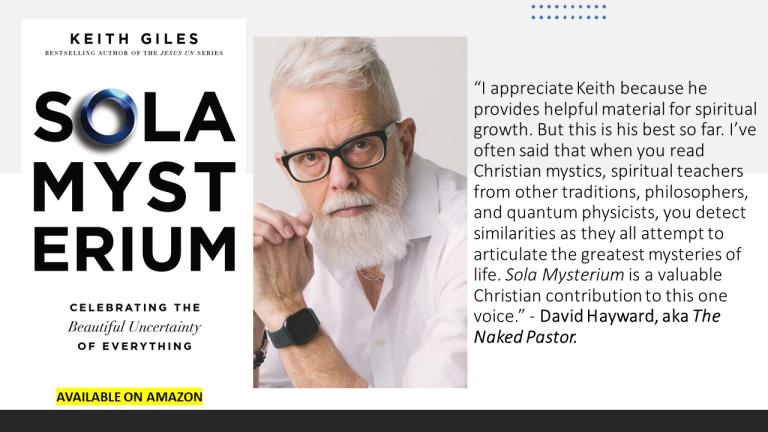
My new book, SOLA MYSTERIUM: Celebrating the Beautiful Uncertainty of Everything is available NOW on Amazon in Print and on Kindle.
**
Keith Giles is the author of the 7-part best-selling Jesus Un book series from Quoir Publishing. Keith is also the host of Second Cup with Keith [a new solo podcast available now on the Ethos Radio App, for Apple and Android and on Spotify; and the Heretic Happy Hour Podcast, and the new Apostate’s Anonymous podcast with Matthew Distefano**.**
Previous Post

July 12, 2022
INNER CIRCLE: Trolling The Disciples
Next Post

July 23, 2022 Escaping The Evangelical Cult
Browse Our Archives
Select a Category Art Biblicism Christian Politics Cosmic Christ Deconstruction Discipleship Dispensationalism Divine Unity Ekklesia End Time Stuff Eschatology Evergreen Following Jesus Gender General Christian Topics Gnostics God's Love Gospel of Judas Gospel of Mary Gospel of Philip Gospel of the Kingdom Gospel of Thomas Gospel of Truth Hell Historical Jesus Inner Circle Investigative Reporting Islam LGBTQ Issues Marriage Mental/Emotional Health Mystery Non-Duality Philosophy Podcast Poetry Politics Poverty Preemptive Love Prophecy Psychology Quantum Theology Racism Reconstruction Satire Sex Technology Theology Uncategorized Universalism
Select a Month October 2026 September 2026 August 2026 July 2026 June 2026 May 2026 April 2026 March 2026 February 2026 January 2026 December 2025 November 2025 October 2025 September 2025 August 2025 July 2025 June 2025 May 2025 April 2025 March 2025 February 2025 January 2025 December 2024 November 2024 October 2024 September 2024 August 2024 July 2024 June 2024 May 2024 April 2024 March 2024 February 2024 January 2024 December 2023 November 2023 October 2023 September 2023 August 2023 July 2023 June 2023 May 2023 April 2023 March 2023 February 2023 January 2023 December 2022 November 2022 October 2022 September 2022 August 2022 July 2022 June 2022 May 2022 April 2022 March 2022 February 2022 January 2022 December 2021 November 2021 October 2021 September 2021 August 2021 July 2021 June 2021 May 2021 April 2021 March 2021 February 2021 January 2021 December 2020 November 2020 October 2020 September 2020 August 2020 July 2020 June 2020 May 2020 April 2020 March 2020 February 2020 January 2020 December 2019 November 2019 October 2019 September 2019 August 2019 July 2019 June 2019 May 2019 April 2019 March 2019 February 2019 January 2019 December 2018 November 2018 October 2018 September 2018 August 2018 July 2018 June 2018 May 2018 April 2018 March 2018 February 2018 January 2018 December 2017 November 2017
Follow Us!
TAKE THE
Religious Wisdom Quiz
Which disciple brought his brother to Jesus, saying, 'We have found the Messiah'?
Select your answer to see how you score.
Peter Andrew James John
Books by This Author Books by Keith Giles
Related posts from Keith Giles

INNER CIRCLE: Profound Mystery (Of Christ In All...

INNER CIRCLE: Awaken the Sleeper

INNER CIRCLE: In Every Respect

TRENDING AT PATHEOS Progressive Christian

Nearly every morning, I make the drive to Detroit with my high-school-age...

The Real AI Story Is Adoption Without Trust
Artificial intelligence has crossed a political threshold. It is no longer a...

A new article, written by Jeff Lindsay and Gale L. Pooley,...

Swimfan: Forgotten Aughts Pleasures
This is a recovery effort. In 2002, My Big Fat Greek Wedding...

Top Three Anti-Catholic Lies About Catholicism
This is my initial transcript for the video, "THE 3 WORST...

Pope Leo Celebrates Mass for Nurses & Docs...
I don't have any idea how he did it, but Pope Leo...
view all Progressive Christian blogs
Ad-Free & Subscriber Log-In Subscription Support
- About Us
- 2026 Calendar
- Videos
- Podcasts
- Library of World Religions
- Faith In Media Tracker
- Advertise With Us
- Write for Us
- Privacy Policy
- Terms of Service
- Do Not Sell My Data
- Contact Us
- Radiant Digital
- Manage Newsletter Subscriptions
- Unsubscribe From Notifications
- Sitemap
Copyright 2008-2026, Patheos. All rights reserved.
Subscription Support Ad-Free & Subscriber Log-In
Follow Patheos