
BuddhistCatholicContemplativeEvangelicalGeneral ChristianHinduJewishLatter-day SaintMuslimNew VisionsProgressive Christian
Beliefs
- Buddhist
- Catholic
- Contemplative
- Evangelical
- General Christian
- Hindu
- Jewish
- Latter-day Saint
- More Voices
- Muslim
- New Visions
- Pagan
- Progressive Christian
Topics
- Religion News
- Food and Religion
- Sports and Religion
- Religious Art
- Religious Music and Entertainment
- Religious Events
- History and Religion
- Style and Religion
- Politics and Religion
- Women in Religion
- Recreation Outdoors and Religion
- Business Finance and Religion
- Careers Workplace and Religion
- Education and Religion
- Family Parenting and Religion
- Health Fitness and Religion
- Home and Religion
- Relationships and Religion
- Technology and Religion
- Travel and Religion
Columnists
- Buddhist Columnists
- Business Finance and Religion Columnists
- Careers Workplace and Religion Columnists
- Catholic Columnists
- Contemplative Columnists
- Education and Religion Columnists
- Evangelists Columnists
- Family Parenting and Religion Columnists
- General Christian Columnists
- Health Fitness and Religion Columnists
- Hindu Columnists
- History and Religion Columnists
- Home and Religion Columnists
- Jewish Columnists
- More Voices Columnists
- Latter Day Columnists
- Muslim Columnists
- New Visions Columnists
- Nonreligious Columnists
- Pagan Columnists
- Politics and Religion Columnists
- Progressive Columnists
- Recreation Outdoors and Religion Columnists
- Relationships and Religion Columnists
- Religion News Columnists
- Religious Art Columnists
- Religious Events Columnists
- Religious Music and Entertainment Columnists
- Sports and Religion Columnists
- Style and Religion Columnists
- Technology and Religion Columnists
- Travel and Religion Columnists
- Women in Religion Columnists
Resource Library
- 2026 Calendar
- Library of World Religions
- The 100 Most Holy Places on Earth
- Patheos Answers
- Podcasts
- Videos
- Faith Leaders Database
- Anglican Episcopalian
- Bahai
- Baptist
- Buddhism
- Christianity
- Confucianism
- Eastern Orthodoxy
- Hinduism
- Holiness and Pentecostal
- ISKCON
- Islam
- Judaism
- Lutheran
- Methodist
- The Church of Jesus Christ of Latter-day Saints
- New Age
- Paganism
- Presbytarian and Reformed
- Protestantism
- Religion Behind the Scenes
- Roman Catholic
- Scientology
- Shia Islam
- Sikhism
- Sufism
- Sunni Islam
- Taoism
- Zen
- See all religions
Research Tools
 Ad-Free & Subscriber Log-In Subscription Support
Ad-Free & Subscriber Log-In Subscription Support
Follow Patheos 

- Trending:
- Forgiveness
- |
- Marriage
- |
- Consciousness
- |
- Death Penalty
- |
- Election
- |
- Halloween

- Home
- Progressive Christian
- Part 4: Healing My Affluenza
Part 4: Healing My Affluenza
Last updated on: August 8, 2019 at 4:56 pm by Keith Giles
Part 4: Healing My Affluenza 2019-08-08T16:56:39+00:00 Keith Giles
Patheos Explore the world's faith through different perspectives on religion and spirituality! Patheos has the views of the prevalent religions and spiritualities of the world.

In this final section of the interview, my friend, Thomas Crisp and I talk about the Protestant confusion of the Gospel of the Atonement versus actually following Jesus daily.
**
KEITH: The whole thing with the Isaiah House is really a blessing. I love what you and Chase and AJ and others are doing to just spend time with the people there on Sunday mornings to share breakfast and listen to them and befriend them. It’s so beautiful. If I could split myself in two I’d be there every Sunday right along with all of you.
I really loved hanging out with you guys last Sunday and one thing that really hit me as we were all together and sharing what God was doing there was, you know, I think these Catholic’s really love Jesus.
(laughs)
As a really good protestant for all my life I have to say, wow, I think the Catholic’s get it in a way that a lot of my protestant friends don’t get it.
Especially these young people. I mean, these Catholic kids are young and they really understand what it means to follow Jesus.
THOMAS: Yeah, it’s like somehow the Catholics missed out on all the…I mean, the way I think about it may be simplistic, but I think what has really wreaked havoc in the lives of Evangelicals is having reduced the entirety of the Gospel into the theory of the Atonement.
KEITH: Yep. That’s it!
THOMAS: ….believing the right things about the Atonement.
KEITH: Yes. You understand this Atonement transaction. You do this. God does that. You get eternal life in exchange for believing in Jesus and your status changes from lost to found…
THOMAS: And that’s it!
KEITH: Yes. That’s all.
THOMAS: It’s Bar Code Christianity.
KEITH: When I interviewed Dallas Willard he called it Vampire Christianity. Because people only want enough of Jesus’ blood to get saved but they have no intention of actually following Jesus or putting His words into practice. They don’t want to be humble like Jesus. They don’t intend to suffer like Jesus. They don’t want to hang out with the poor or the outcast like Jesus. They only want His blood to get saved so they can go ahead with their life without Him.
THOMAS: You what it’s like? It’s like the Mystery Religions of the early Roman era, where you have an initiatory rite which secures your access to the afterlife, and in most cases it involved blood, but that’s it. There’s no community involvement or particular ethical demands placed on you. It’s just this one time event which secures your position in the afterlife. For a lot of Evangelicals we’ve turned the Gospel into a kind of Mystery Religion.
KEITH: You know, here’s what’s so weird about that to me, and I’ve participated in all that for most of my life so I think I understand it, but if you divorced yourself completely from everything you know about…let’s say we’re not even talking about Christianity, let’s say we’re going to come up with our own religion. In this religion it’s all about one-time, you just have to sign this piece of paper, say that you agree with these five truths, and then we’re going to certify that you’re going to be safe and secure from anything bad after you die, and that’s the whole thing. That’s it. That’s the beginning and the end of our religion. My question is, “How would you sustain that?”
It just seems like once you get them to sign on the dotted line you’ll eventually run out of people to sign up for your little club and then why would anyone continue to send you money, be a part of your group, come to your meetings…I mean, why? Do I have to go? No? Then why would anyone continue to be a part of that or give money to that or buy your products with your brand on it, or anything? I don’t get it. If our symbol is a triangle and we make triangle t-shirts and lunch boxes. Why would people buy our stuff with our logo on it to show they were a member of a club they joined 20 years ago? It just seems like if you designed something from the beginning to operate like that it would not work.
If you really, really thought that this is all that Christianity is about, why would you continue to participate in that? I mean, obviously Christianity IS more than that, but we’re reduced it to pretty much just this kind of foolishness.
THOMAS: Well, that’s the thing. Given this as a view of the Gospel, if you start reading the actual Gospels you start to see that the two don’t fit together. You’d have to force it into a really unnatural mold to get Jesus to say anything like what we have today.
KEITH: That’s the big disconnect, I think. You have to get around it by saying the the Sermon on the Mount and everything that Jesus said about the poor and the Kingdom and all of that is about the Kingdom that he intended to bring but the Jews rejected Him so it’s for a future Kingdom and it’s not for today. So, we put a pause button on all that Jesus said and then maybe when Jesus comes back again we can have all of that at the end of time. You basically make everything that Jesus said a real waste of our time if none of it was for us right now.
THOMAS: Yeah, so think about how bizarre that is. So, what we end up with then, is this historic movement that claims Jesus as our Master and we have no interest whatsoever in doing any of those things He said to do. None of that applies?
KEITH: Yeah, can you imagine meeting a Jew who didn’t know or follow Moses? Or a Muslim who didn’t really follow Mohammed? How can we say we’re followers of Jesus if we’re not actually following Him?
THOMAS: It’s especially startling when you look at how Jesus says, “If you don’t do the things I’m saying, you’re not my disciples.”
KEITH: Jesus says this over and over again in the Gospels. In John there are like two whole chapters, like 13 and 14 I think. He says it every possible way too so we don’t misunderstand him. “If you love me you’ll obey me.” “The one who loves me obeys me but the one who does not love me does not obey me.”
I’ve actually had debates with people over and over who deny that Jesus means what He’s saying so plainly.
That’s the whole point of the wise man who built his house upon the rock. Jesus says, “Let me tell what the person is like who hears my words and puts them into practice” – that’s the wise man, and the foolish man is the one who hears Jesus and does not put it into practice.
THOMAS: And the passage just before that Jesus says, “Not everyone who says to me ‘Lord, Lord’ will enter the Kingdom of God, only the one who does the will of my Father.”
KEITH: Obviously there are preachers and teachers who have this over-the-top version of Grace, where it’s all about ‘You can do nothing at all to earn your salvation” and that translates to, “Don’t ever do anything at all.” In fact, if you did do something you run the risk of trying to earn your salvation and you may negate God’s salvation by Grace.
THOMAS: Oh, yeah.
KEITH: Instead of going to Ephesians where Paul says that “we are saved by Grace to do good works,” and taking everything in context, we stop at the saved by Grace part and ignore the “to do good works” part.
THOMAS: I think people like N.T. Wright and James Dunn are correct when they point out that when Paul talks against works or legalism he’s not talking about caring for the poor or anything like that. He’s speaking against doing works related to keeping the Jewish Covenant like Fasting, Circumcision, Temple observance. Paul was saying that those things – the traditional, cultic marks, dietary laws, Sabbath observance, those things necessary for membership in the Old Covenant community – those are the works we should cease to do. Now, under the new covenant we are made righteous by faith in Christ and our salvation is by Grace. So, works of the Law aren’t necessary anymore. Paul would have said, “Of course, if you’re a follower of Jesus you will do works of righteousness.”
KEITH: Of course. Paul does affirm that. One of my favorite is in Galatians where Paul meets with Peter and James and John and they agree that he should go to the Gentiles and they will go to the Jews. It’s in Chapter 4, where Paul says, “They only asked one thing, one thing they required, that we would remember the poor.” And then the very next verse Paul says, “That was the one thing I was eager to do.” So, for Paul, of course we’re going to care for the poor.
The one thing Peter, James and John required was caring for the poor, and that was the one thing that Paul himself was eager to do. In other words, if we agree on anything we agree on this; We should care for the poor. It was unanimous. So, Paul would never say that caring for the poor was legalism or works.
I always say “Swimming won’t make you a fish, but if you’re a fish you will swim.” So, we’re certainly saved by Grace but once we’re saved we will obey Jesus and show the kind of love that He commands us to.
THOMAS: It’s also the Spirit of God. There’s some kind of movement of faith. I’m not sure how it happens, but somehow the Spirit starts urging us deeper and deeper, filling us more with love. Pretty soon we can’t help but want to do things like care for the poor and serve others.
KEITH: I agree. Then that becomes what marks us. Jesus said that this is how they would know that we were His disciples, that we love one another. It’s also what Jesus is saying in Matthew 25. “I know you love me because you showed love in tangible ways to all these different people in all these different contexts.” Not because you thought that if you did that you’d be saved. That’s why they say, “When did we visit you in prison?” “When did we feed you?” The followers of Christ couldn’t help but to demonstrate love to the people around them who needed mercy.
THOMAS: I like the metaphor that the Kingdom of God is like a mustard seed. It starts small and you look away for a few days and then, whoosh, it’s grown out of control. That’s who the Kingdom is. The Kingdom gets hold of a group of people trying to follow Jesus and it just starts growing up in their midst and drawing them in directions they never would’ve guessed.
KEITH: I love that too. It’s like this weed that just grows and grows. You won’t be able to stop it.
THOMAS: I also like that Jesus says that it will be a home for the fowls of the air. Not the doves or the songbirds.
KEITH: Yeah, the crows and the vultures.
THOMAS: What a perfect metaphor for the Kingdom. The low are at home there.
KEITH: I love digging into all those nuances. I used to think that Jesus was saying the Kingdom started small and grew into a beautiful tree. But really, the mustard seed is a weed and people used to work constantly to dig it out of their gardens and they didn’t see it as a beautiful tree but as a pest. And the part about the fowls of the air making nests in it. I mean, THAT’S the Kingdom of God? Really?
THOMAS: I think a lot of parables are like that. The prodigal son is a great example of one that we think is so beautiful but to their culture it was shameful. First the father shames himself by lifting up his robes, and then he shames himself by running to his son. Those were shameful things in that culture. So, Jesus is saying that God is doing something shameful which would’ve seemed strange to those people.
KEITH: Yeah, I think that Jesus was much more of a head-scratcher than we think. His parable about the Good Shepherd is like that too. People in that day would’ve called that the Parable of the Stupid Shepherd because he left thousands of dollars in livestock unprotected to go get one stupid lamb. Those 99 would easily have given birth to twenty more in a few months to replace that one lamb. No “good shepherd” would ever do what Jesus described.
The most obvious example, of course, is where he says that people must drink his blood and eat his flesh and most of the people abandon him. In fact, the Twelve are so bewildered that Peter can only say, “Where else can we go? You have the words of life.”
THOMAS: Amen.
[END OF INTERVIEW]
**
Keith Giles was formerly a licensed and ordained minister who walked away from organized church 11 years ago, to start a home fellowship that gave away 100% of the offering to the poor in the community. Today, He and his wife live in Meridian, Idaho, awaiting their next adventure.
Upcoming Event: Heretic Happy Hour 2nd Anniversary LIVE Podcast Show! Saturday, August 17 at 6pm in Costa Mesa, CA. Admission is FREE. Learn more HERE
Want Keith to come speak at your church or in your home town? Send and invitation HERE
Keith’s newest book, “Jesus Unveiled: Forsaking Church As We Know It For Ekklesia As God Intended” released on June 9, 2019 on Amazon, and features a Foreword by author Richard Jacobson.
Keith’s Podcast: Heretic Happy Hour Podcast is on iTunes and Podbean.
Can’t get enough? Get great bonus content: Patreon page.
Previous Post

August 7, 2019
Part 3: My Affluenza
Next Post

August 9, 2019 Why Are (Some) Christians So Mean?
Browse Our Archives
Select a Category Art Biblicism Christian Politics Cosmic Christ Deconstruction Discipleship Dispensationalism Divine Unity Ekklesia End Time Stuff Eschatology Evergreen Following Jesus Gender General Christian Topics Gnostics God's Love Gospel of Judas Gospel of Mary Gospel of Philip Gospel of the Kingdom Gospel of Thomas Gospel of Truth Hell Historical Jesus Inner Circle Investigative Reporting Islam LGBTQ Issues Marriage Mental/Emotional Health Mystery Non-Duality Philosophy Podcast Poetry Politics Poverty Preemptive Love Prophecy Psychology Quantum Theology Racism Reconstruction Satire Sex Technology Theology Uncategorized Universalism
Select a Month October 2026 September 2026 August 2026 July 2026 June 2026 May 2026 April 2026 March 2026 February 2026 January 2026 December 2025 November 2025 October 2025 September 2025 August 2025 July 2025 June 2025 May 2025 April 2025 March 2025 February 2025 January 2025 December 2024 November 2024 October 2024 September 2024 August 2024 July 2024 June 2024 May 2024 April 2024 March 2024 February 2024 January 2024 December 2023 November 2023 October 2023 September 2023 August 2023 July 2023 June 2023 May 2023 April 2023 March 2023 February 2023 January 2023 December 2022 November 2022 October 2022 September 2022 August 2022 July 2022 June 2022 May 2022 April 2022 March 2022 February 2022 January 2022 December 2021 November 2021 October 2021 September 2021 August 2021 July 2021 June 2021 May 2021 April 2021 March 2021 February 2021 January 2021 December 2020 November 2020 October 2020 September 2020 August 2020 July 2020 June 2020 May 2020 April 2020 March 2020 February 2020 January 2020 December 2019 November 2019 October 2019 September 2019 August 2019 July 2019 June 2019 May 2019 April 2019 March 2019 February 2019 January 2019 December 2018 November 2018 October 2018 September 2018 August 2018 July 2018 June 2018 May 2018 April 2018 March 2018 February 2018 January 2018 December 2017 November 2017
Follow Us!
TAKE THE
Religious Wisdom Quiz
Who was high priest when David ate the consecrated bread?
Select your answer to see how you score.
Aaron Caiaphas Ahimelech Eli
Books by This Author Books by Keith Giles
Related posts from Keith Giles

INNER CIRCLE: Of the Same Mind

INNER CIRCLE: Overcoming Evil with Good

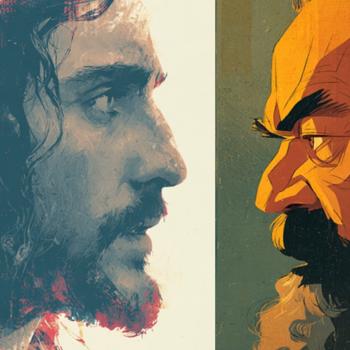
Jesus and Marx: Where They Both Agree
TRENDING AT PATHEOS Progressive Christian

Letters on Living the Faith by C.S. Lewis
Most of us met C.S. Lewis as a public intellectual. Mere Christianity....

When Halloween Unmasks Married Hearts
Written by Dr. David K. Ewen from Eternal Truth Bible College Behind...

Aristotle. He’s been called the father of logic, the father of the...

Methodist Central Hall and Westminster Abbey
Situated on the same square is Methodist Central Hall and Westminster Abbey. ...

57th Dove Awards Honor Dolly Parton, Crown New...
On gospel music’s biggest night, the 57th annual GMA Dove Awards honored...

The First Eucharistic Controversy: Christ’s Real Presence
For Catholics, the Eucharist is the source and summit of the Christian...
view all Progressive Christian blogs
Ad-Free & Subscriber Log-In Subscription Support
- About Us
- 2026 Calendar
- Videos
- Podcasts
- Library of World Religions
- Faith In Media Tracker
- Advertise With Us
- Write for Us
- Privacy Policy
- Terms of Service
- Do Not Sell My Data
- Contact Us
- Radiant Digital
- Manage Newsletter Subscriptions
- Unsubscribe From Notifications
- Sitemap
Copyright 2008-2026, Patheos. All rights reserved.
Subscription Support Ad-Free & Subscriber Log-In
Follow Patheos