
BuddhistCatholicContemplativeEvangelicalGeneral ChristianHinduJewishLatter-day SaintMuslimNew VisionsProgressive Christian
Beliefs
- Buddhist
- Catholic
- Contemplative
- Evangelical
- General Christian
- Hindu
- Jewish
- Latter-day Saint
- More Voices
- Muslim
- New Visions
- Pagan
- Progressive Christian
Topics
- Religion News
- Food and Religion
- Sports and Religion
- Religious Art
- Religious Music and Entertainment
- Religious Events
- History and Religion
- Style and Religion
- Politics and Religion
- Women in Religion
- Recreation Outdoors and Religion
- Business Finance and Religion
- Careers Workplace and Religion
- Education and Religion
- Family Parenting and Religion
- Health Fitness and Religion
- Home and Religion
- Relationships and Religion
- Technology and Religion
- Travel and Religion
Columnists
- Buddhist Columnists
- Business Finance and Religion Columnists
- Careers Workplace and Religion Columnists
- Catholic Columnists
- Contemplative Columnists
- Education and Religion Columnists
- Evangelists Columnists
- Family Parenting and Religion Columnists
- General Christian Columnists
- Health Fitness and Religion Columnists
- Hindu Columnists
- History and Religion Columnists
- Home and Religion Columnists
- Jewish Columnists
- More Voices Columnists
- Latter Day Columnists
- Muslim Columnists
- New Visions Columnists
- Nonreligious Columnists
- Pagan Columnists
- Politics and Religion Columnists
- Progressive Columnists
- Recreation Outdoors and Religion Columnists
- Relationships and Religion Columnists
- Religion News Columnists
- Religious Art Columnists
- Religious Events Columnists
- Religious Music and Entertainment Columnists
- Sports and Religion Columnists
- Style and Religion Columnists
- Technology and Religion Columnists
- Travel and Religion Columnists
- Women in Religion Columnists
Resource Library
- 2026 Calendar
- Library of World Religions
- The 100 Most Holy Places on Earth
- Patheos Answers
- Podcasts
- Videos
- Faith Leaders Database
- Anglican Episcopalian
- Bahai
- Baptist
- Buddhism
- Christianity
- Confucianism
- Eastern Orthodoxy
- Hinduism
- Holiness and Pentecostal
- ISKCON
- Islam
- Judaism
- Lutheran
- Methodist
- The Church of Jesus Christ of Latter-day Saints
- New Age
- Paganism
- Presbytarian and Reformed
- Protestantism
- Religion Behind the Scenes
- Roman Catholic
- Scientology
- Shia Islam
- Sikhism
- Sufism
- Sunni Islam
- Taoism
- Zen
- See all religions
Research Tools
 Ad-Free & Subscriber Log-In Subscription Support
Ad-Free & Subscriber Log-In Subscription Support
Follow Patheos 

- Trending:
- Forgiveness
- |
- Marriage
- |
- Consciousness
- |
- Death Penalty
- |
- Election
- |
- Halloween

- Home
- Progressive Christian
- The Spirit Often Contradicts What Is Written
The Spirit Often Contradicts What Is Written
Last updated on: September 15, 2018 at 12:27 am by Keith Giles
The Spirit Often Contradicts What Is Written 2018-09-15T00:27:56+00:00 Keith Giles
Patheos Explore the world's faith through different perspectives on religion and spirituality! Patheos has the views of the prevalent religions and spiritualities of the world.
Quite often when I suggest that believers today can hear the voice of Jesus and be led by the Holy Spirit, people are quick to say that the Holy Spirit would never contradict anything that had already been written down in the Scriptures.
This knee-jerk reaction is meant to do two things: First, it is meant to maintain the Bible as our ultimate authority. Nothing new or different can ever be introduced into our faith system because God’s Word (the Bible) has said everything that will ever need to be said about God.
Secondly, the statement is meant to downplay our experiences and subjugate those experiences to the Scriptures. In effect, all experiences are essentially pointless because anything they might reveal to us, and anything we might learn from those experiences, are subject to correction. Therefore, what good is experience if anything that might be learned from it is already written down in the Book for me?
The problem with this view is that the Scriptures themselves completely contradict this assumption.
Rather than a unified voice of agreement throughout the Bible, what we observe is an ongoing dialog where one prophet says something about God, and then, later on, another prophet challenges that idea. So, in other words, the Spirit speaks to the prophet who writes down what he hears, and later another prophet also hears from the Spirit and writes down something that modifies or enhances—or sometimes flatly contradicts—what the previous prophet wrote down.
This is what the Bible is: A series of progressively enlightened ideas about who God is and what God is like.
As we’ve already seen, for example, when Moses says that God requires animal sacrifice and other voices modify this until Jesus gives us the final word on the matter. Or, when Moses introduces the idea of “an eye for an eye and a tooth for a tooth”, but Jesus shows up and says, “But I say to you, love your enemies.”
Not only this, but Jesus also corrects Moses’s statements when He says that God “makes his sun rise on the evil and on the good, and sends rain on the just and on the unjust.” (See Matt. 5:45) Because, according to Moses, in Deuteronomy 28:12, God says to the righteous: “The Lord will open to you his good treasury, the heavens, to give the rain to your land in its season and to bless all the work of your hands.” But to the unrighteous God says: “The Lord will make the rain of your land powder. From heaven dust shall come down on you until you are destroyed.” (v. 24)
Jesus makes it clear in the Sermon on the Mount that Moses was wrong about God’s disposition towards people. He loves and blesses them both the same, and brings rain on both the just and the unjust alike.
Another good example of how some prophetic voices in Scripture correct what has been said previously is when Elijah commands a man named Jehu to strike down the entire house of his master, Ahab. (See 2 Kings 9:7-8) Once he obeys this command, Jehu is praised as a righteous man of God. However, later on, the prophet Hosea writes that God spoke to him saying: “I will punish the house of Jehu for the blood of Jezreel, and I will put an end to the kingdom of the house of Israel.” (Hosea 1:4)
So, I ask you: Are you still so convinced that the Holy Spirit will never contradict what has been written in the scriptures?
The fact is that the Holy Spirit almost always contradicts what has been written in the scriptures.
Peter learned that when the voice of the Lord spoke to him and commanded him to kill and eat the unclean animals. The Pharisees learned that when they brought the woman caught in adultery to Jesus. James and John learned that when they asked Jesus if they could call down fire on the Samaritans as Elijah had done.
In every single case, if these men had held tightly to their scriptures, they would have missed what Jesus was doing.
Peter would not have awakened to God’s plan to redeem the Gentiles.
The Pharisees would have executed an adulterous woman instead of showing her mercy.
James and John would have called down fire upon Samaritans before Philip could come and preach the Good News of the Kingdom to them. (See Acts 8:5)
The surprising truth is: The Holy Spirit will almost always contradict what has been written in the scriptures. In fact, we should probably expect it.
Jesus affirms this idea when he rebukes the Pharisees who cannot let go of their Scriptures long enough to accept what they have seen with their eyes and heard with their own ears.
They are blinded by their Bibles. The refuse to see that the eyes of the blind were opened and the lame were made whole because it didn’t fit with what their Scriptures told them.
So, because what they were seeing didn’t line up with what was written, they rejected their experiences of God and attributed the work of the Holy Spirit to Satan. Jesus responded to their blindness and warned them that the unforgivable sin was to reject what the Spirit of God was doing right in front of them.
“Truly I tell you, people can be forgiven all their sins and every slander they utter, but whoever blasphemes against the Holy Spirit will never be forgiven; they are guilty of an eternal sin.” (Mark 3:28-29)
The greatest sin, according to Jesus, is to deny what the Holy Spirit is doing and revealing to you—even if that revelation contradicts what has been written in the Scriptures.
This means that we must be willing to leave the safety and security of our Bibles to walk with Jesus in the uncertain and unknown realm of faith. This is why we are called to “test the spirits” (1 John 4:1) and to use discernment in our walk with Christ. Because we are expected to be venturing out into the deep with Him, not lounging comfortably in our pew clinging tightly to our absolute certainty, but holding fast to Jesus who is untamed and unbound by any book.
Jesus was most critical of the Pharisees because they were mired in the traditions of men (Mark 7:8) and unwilling to accept anything that didn’t line up with their understanding of Scripture. He begged them to see that the life they were seeking for in the Scriptures was only available through Him. They refused to come to Him for life because they were convinced that their Bible had all the answers. (John 5:40)
The Pharisees rejected Jesus because they assumed that the Holy Spirit would never contradict what was written down in their Scriptures. But, they were wrong about that. When the Holy Spirit did something they didn’t think aligned with their Book, they attributed that to Satan, and as a result, they totally missed the fulfillment of every prophecy in that same Holy Book.
He was standing right in front of them, and they missed Him.
Please don’t make the same mistake.
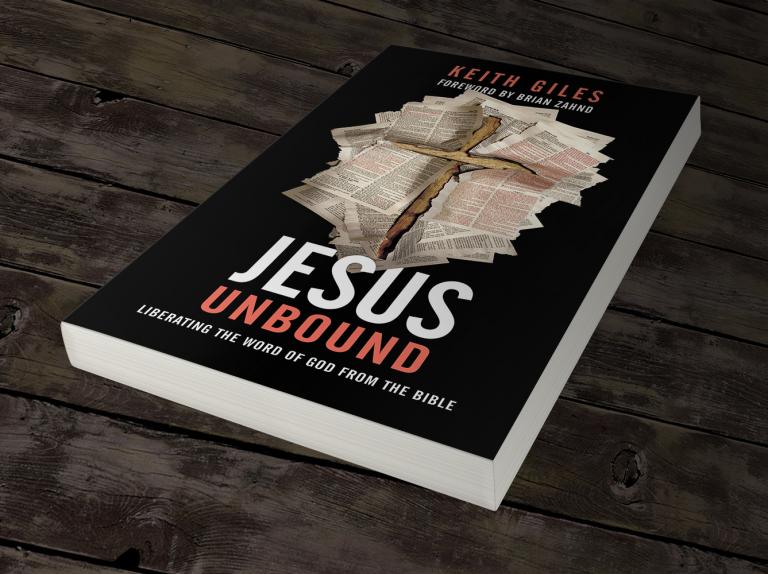
[Excerpted from Chapter 17 of Jesus Unbound: Liberating the Word of God from the Bible by Keith Giles]
**
Keith Giles is a former pastor who left the pulpit 11 years ago to start a church that gives away 100% of the offering to the poor in their community.
His new book “Jesus Unbound: Liberating the Word of God from the Bible”, is available now on Amazon and features a Foreword by author Brian Zahnd.
He is also the author of the Amazon best-seller, “Jesus Untangled: Crucifying Our Politics To Pledge Allegiance To The Lamb”.
Keith also co-hosts the Heretic Happy Hour Podcast on iTunes and Podbean. He and his wife live in Orange, CA with their two sons.
BONUS: Unlock exclusive content including blog articles, short stories, music, podcasts, videos and more on my Patreon page.
Previous Post

September 13, 2018
Over 7,000 Pastors Admit They Don't Follow Jesus
Next Post

September 19, 2018 Table Lessons by Jason Elam and Keith Giles
Browse Our Archives
Select a Category Art Biblicism Christian Politics Cosmic Christ Deconstruction Discipleship Dispensationalism Divine Unity Ekklesia End Time Stuff Eschatology Evergreen Following Jesus Gender General Christian Topics Gnostics God's Love Gospel of Judas Gospel of Mary Gospel of Philip Gospel of the Kingdom Gospel of Thomas Gospel of Truth Hell Historical Jesus Inner Circle Investigative Reporting Islam LGBTQ Issues Marriage Mental/Emotional Health Mystery Non-Duality Philosophy Podcast Poetry Politics Poverty Preemptive Love Prophecy Psychology Quantum Theology Racism Reconstruction Satire Sex Technology Theology Uncategorized Universalism
Select a Month October 2026 September 2026 August 2026 July 2026 June 2026 May 2026 April 2026 March 2026 February 2026 January 2026 December 2025 November 2025 October 2025 September 2025 August 2025 July 2025 June 2025 May 2025 April 2025 March 2025 February 2025 January 2025 December 2024 November 2024 October 2024 September 2024 August 2024 July 2024 June 2024 May 2024 April 2024 March 2024 February 2024 January 2024 December 2023 November 2023 October 2023 September 2023 August 2023 July 2023 June 2023 May 2023 April 2023 March 2023 February 2023 January 2023 December 2022 November 2022 October 2022 September 2022 August 2022 July 2022 June 2022 May 2022 April 2022 March 2022 February 2022 January 2022 December 2021 November 2021 October 2021 September 2021 August 2021 July 2021 June 2021 May 2021 April 2021 March 2021 February 2021 January 2021 December 2020 November 2020 October 2020 September 2020 August 2020 July 2020 June 2020 May 2020 April 2020 March 2020 February 2020 January 2020 December 2019 November 2019 October 2019 September 2019 August 2019 July 2019 June 2019 May 2019 April 2019 March 2019 February 2019 January 2019 December 2018 November 2018 October 2018 September 2018 August 2018 July 2018 June 2018 May 2018 April 2018 March 2018 February 2018 January 2018 December 2017 November 2017
Follow Us!
TAKE THE
Religious Wisdom Quiz
What did Jesus use to feed the 5,000?
Select your answer to see how you score.
Manna from heaven Five loaves and two fish Grapes and figs A basket of quail
Books by This Author Books by Keith Giles
Related posts from Keith Giles

Jesus and Marx: Where They Both Agree
The Metaphorical Miracles of Jesus

Here's Why You Don't Need A Bible
Why Paul Literally Reads Scripture Allegorically
TRENDING AT PATHEOS Progressive Christian

How to Make a Decision When You Can't...
Main point: It’s much more valuable to stay close to God so...

Archdiocese Hosts Military Marriage Retreat in Germany
RASTATT, Germany — The transient military lifestyle, with its frequent deployments and...

Nearly every morning, I make the drive to Detroit with my high-school-age...

The Real AI Story Is Adoption Without Trust
Artificial intelligence has crossed a political threshold. It is no longer a...

A new article, written by Jeff Lindsay and Gale L. Pooley,...

Swimfan: Forgotten Aughts Pleasures
This is a recovery effort. In 2002, My Big Fat Greek Wedding...
view all Progressive Christian blogs
Ad-Free & Subscriber Log-In Subscription Support
- About Us
- 2026 Calendar
- Videos
- Podcasts
- Library of World Religions
- Faith In Media Tracker
- Advertise With Us
- Write for Us
- Privacy Policy
- Terms of Service
- Do Not Sell My Data
- Contact Us
- Radiant Digital
- Manage Newsletter Subscriptions
- Unsubscribe From Notifications
- Sitemap
Copyright 2008-2026, Patheos. All rights reserved.
Subscription Support Ad-Free & Subscriber Log-In
Follow Patheos