
BuddhistCatholicContemplativeEvangelicalGeneral ChristianHinduJewishLatter-day SaintMuslimNew VisionsProgressive Christian
Beliefs
- Buddhist
- Catholic
- Contemplative
- Evangelical
- General Christian
- Hindu
- Jewish
- Latter-day Saint
- More Voices
- Muslim
- New Visions
- Pagan
- Progressive Christian
Topics
- Religion News
- Food and Religion
- Sports and Religion
- Religious Art
- Religious Music and Entertainment
- Religious Events
- History and Religion
- Style and Religion
- Politics and Religion
- Women in Religion
- Recreation Outdoors and Religion
- Business Finance and Religion
- Careers Workplace and Religion
- Education and Religion
- Family Parenting and Religion
- Health Fitness and Religion
- Home and Religion
- Relationships and Religion
- Technology and Religion
- Travel and Religion
Columnists
- Buddhist Columnists
- Business Finance and Religion Columnists
- Careers Workplace and Religion Columnists
- Catholic Columnists
- Contemplative Columnists
- Education and Religion Columnists
- Evangelists Columnists
- Family Parenting and Religion Columnists
- General Christian Columnists
- Health Fitness and Religion Columnists
- Hindu Columnists
- History and Religion Columnists
- Home and Religion Columnists
- Jewish Columnists
- More Voices Columnists
- Latter Day Columnists
- Muslim Columnists
- New Visions Columnists
- Nonreligious Columnists
- Pagan Columnists
- Politics and Religion Columnists
- Progressive Columnists
- Recreation Outdoors and Religion Columnists
- Relationships and Religion Columnists
- Religion News Columnists
- Religious Art Columnists
- Religious Events Columnists
- Religious Music and Entertainment Columnists
- Sports and Religion Columnists
- Style and Religion Columnists
- Technology and Religion Columnists
- Travel and Religion Columnists
- Women in Religion Columnists
Resource Library
- 2026 Calendar
- Library of World Religions
- The 100 Most Holy Places on Earth
- Patheos Answers
- Podcasts
- Videos
- Faith Leaders Database
- Anglican Episcopalian
- Bahai
- Baptist
- Buddhism
- Christianity
- Confucianism
- Eastern Orthodoxy
- Hinduism
- Holiness and Pentecostal
- ISKCON
- Islam
- Judaism
- Lutheran
- Methodist
- The Church of Jesus Christ of Latter-day Saints
- New Age
- Paganism
- Presbytarian and Reformed
- Protestantism
- Religion Behind the Scenes
- Roman Catholic
- Scientology
- Shia Islam
- Sikhism
- Sufism
- Sunni Islam
- Taoism
- Zen
- See all religions
Research Tools
 Ad-Free & Subscriber Log-In Subscription Support
Ad-Free & Subscriber Log-In Subscription Support
Follow Patheos 

- Trending:
- Forgiveness
- |
- Marriage
- |
- Consciousness
- |
- Death Penalty
- |
- Election
- |
- Halloween
 Keeping Her Keys
- Home
- Pagan
- Walking Hekate’s Road
Walking Hekate’s Road
Last updated on: June 11, 2020 at 4:29 pm by Cyndi Brannen
Walking Hekate’s Road 2020-06-11T16:29:42-04:00 Cyndi Brannen
Patheos Explore the world's faith through different perspectives on religion and spirituality! Patheos has the views of the prevalent religions and spiritualities of the world.
To walk the mother road is to seek the magick, medicine and mysteries of the Mother Goddess. Although she comes in many different faces, she is a guide along our journey down her twisting pathway. Long before the ancient scribes scratched Hekate’s name on their tablets, she was known as Enodia, the Goddess of the Way.
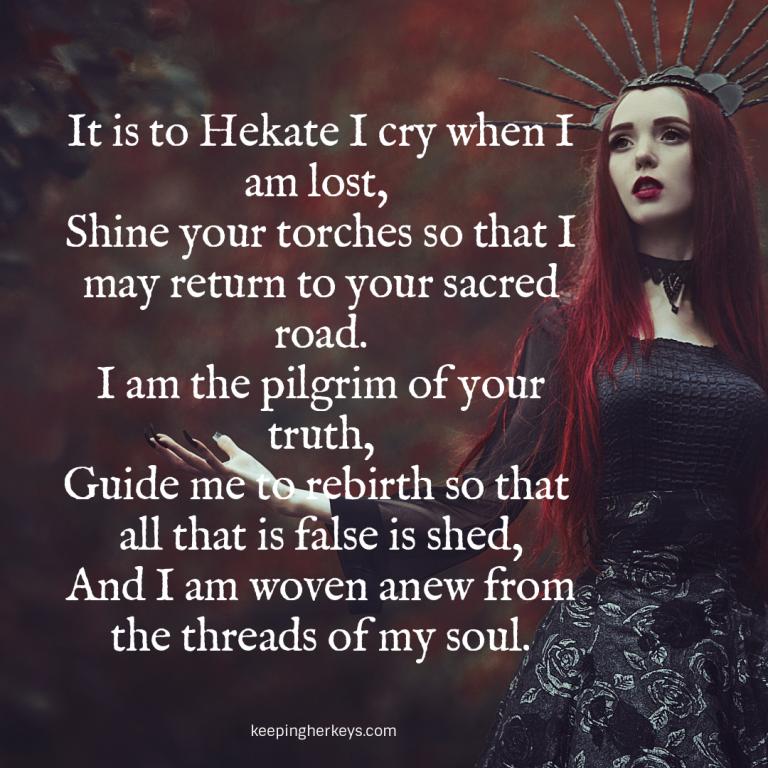
Hekate is Goddess of the Road, referring to her practical role in overseeing travelers and her mystical road for seekers of her magick.
Hekate: Goddess of the Way
“Enodia” is most often translated as meaning “of the road,” although sometimes it is described as “of the way.” Perhaps the most descriptive version is “she who stands on the road.” This title of Hekate is interconnected with her association with the crossroads, although there are distinctions between these roles. Enodia refers specifically to a goddess who watches over roadways. This appellation undoubtedly morphed into Hekate’s Roman associations with roads, notably in the title of Trivia. In the Greek, Trioditis refers to her specifically as “Goddess of the Three Roads.” This was both a practical reference to her guardianship offered for those making their pilgrimages and also a mystical association. The Road equating with The Way of her magick, medicine and mysteries.
Traveling the road back to the origins of this title of Hekate’s is a rather long and winding road. Enodia (sometimes spelled “Einodia” or “Ennodia) was an ancient Thessalian goddess whose name became a title for Hekate, Artemis, Persephone and Selene. There are tangential connections between Enodia, Hekate and Cybele, notably the evidence found in a stone throne in the Greek Isles.
Enodia And Wild Women
The path from a goddess of the north to being applied to Hekate in diverse regions in the world of the ancient Greeks and Romans parallels her transition from the earlier version of her portrayed by Hesiod to her entwinement with witchcraft. The trek from a sort of All-Mother Goddess to one revered, at least in some areas based on the historical records, as a night-wandering, horde-leading, terrifying witch-goddess coincides with the way that the government sought to separate from what was considered as uncivilized, in particular women, especially those who lived outside of the restrictions of society.
Hekate, thus, as she evolves in the historical records, is a mother figure for all the wild women who resisted the entrapments of the patriarchal system. Where the earliest records exclaim her to be revered above all gods, by the time the Romans got hold of her, she was fragmented into pieces, such as Trivia, and lent certain aspects to Diana.
The Many Faces of Enodia
There is no way to separate the history of Hekate from her frequent companions of Artemis, Persephone, and Selene. The ancients were no different in their practices than we are as modern goddess worshippers: they adapted theirs based on their understanding as individuals and as societies. This is where the overlap between these goddesses comes from, including their shared association with Enodia. What is important to learn from these entanglements in the historical record is that Enodia is a spirit far deeper, more powerful than any name assigned to a face of the goddess. Enodia is the primal guide along the mother road, regardless of what we may call her.
Hekate Of The Road
The first known use of Enodia as a title of Hekate is found in the fragments of one of Sophocles’ plays known as The Root Cutters. Contained within what remains is a partial telling of Medea’s story. When her witch-attendants were petitioning Hekate’s assistance for Medea’s spell to murder Pelias they call out, “Lord sun and holy fire, sword of Hecate of the roads, which she carries over Olympus as she attends and as she traverses the sacred crossroads of the land, crowned with oak and the woven coils of snakes, falling on her shoulders” (Ogden, 2002).
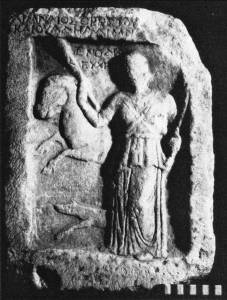
Hekate Enodia from ancient Macedonia, with torch, horse and hound.
The Friction Between Enodia And The “Civilized” World
What can we take away from this fragment as it relates to our modern understanding of Hekate? Most importantly, it firmly associates her as being summoned using Enodia as an epiclesis for the casting of a spell. It is an example of how being “of the road,” as a woman, implied nefarious inclinations. This contrasts with others who had the good sense to stay inside the home. Demeter, of course, failed in her attempts to stay wild herself and save her daughter from the capture of patriarchy. In the story of Medea, we find the friction between wild woman and the so-called civilized world. This is the common thread amongst all those called “Enodia.”
Enodia, Women and Children
Another shared aspect is the benevolence of Enodia towards women and children, including assistance with pregnancy and childbirth. This reflects upon the power structure’s suspicion of all things related to women’s reproduction. How little some things change even after two thousand years.
Enodia Is She Who Persists
This enmity between the wild and the civilized was a projection of those more powerful “southerners” who were writing these ancient plays and myths. Thus, “Enodia” is symbolic of the north which is synonymous with dangerous wildness. It is unsurprising the merely speaking the word “Enodia” evokes, even now, a deeper reverberation within the souls of all of us who seek to become unbound. She is the one who resists conformity, who practices the magick, medicine and mystery known by some as witchcraft, others herbalism, sorcery or the true healing arts.
The Mystery of Enodia
Herein lies the mystery of Enodia; that she stirs within the depths of the soul that call us to remember our own wild medicine. To Persephone, Hekate was Enodia, as she guided to her and from the Under World in order to change the seasons. Persephone had been robbed of her innocent wildness as a cautionary tale for any girl thinking she could escape the marriage bed. Hekate helped broker a deal that permitted Persephone to return to the wild world in exchange for her heavy yoke of being responsible for turning the wheel of the year.
The Mother Road Is the Only Path
Persephone, Medea and the wild women ancestors both known and forgotten, all walked this mother road with Hekate. Resisters, decampers and, at times, foolishly rebellious, we risk all to follow the torches of Enodia because this is the only road on which we belong.
Like Medea, who got caught up in Jason’s trickery, when we fall off the mother road, we can become angry, vengeful and afraid. As with Persephone, being allowed to walk the mother road often requires considerable negotiation. It must be said that Artemis as Enodia managed to maintain her journey on the mother road with little incident. Selene’s part in the mother road is to shine her light over our journeys, which must often be taken at night when the domineering eyes of the “civilized” are firmly closed.
The Urgency of Enodia
Enodia awakens within those of us who bear the code of the wild goddesses the urgency to get back on that mother road, no matter what the cost. She brings with her the reminder that there are those who will spin tales about us that paint us as evil, fearful, and, to use that modern epithet for a powerful wild woman, a bitch. As we all know, when powerful men afraid of female power speak, they tell great lies. To walk the mother road, we must disavow ourselves of believing such atrocities. Focusing on the road, we are only ourselves when we are following Enodia’s torches. It is imperative in these perilous times that we furiously embark on the mother road journey. All other paths lead to chaos and ruination.
Enodia’s Nourishing Torches
These torches guide us forward into the mysteries of Hekate’s wisdom. This is the modern interpretation of Enodia as guide along our earth-bound journey. Hekate is both guide and the road. The road always knows where the road is going, even though us pilgrims along it may not. There is a trust required of walking the mother road. We must turn inward to our own Enodia, which is the torch-fire of Hekate within our souls, leaning into our intuition and reserves.
Hekate nourishes our fire as we tread her road, healing and empowering us. Protecting us from the nasty glares and the sordid lies that may be told as we veer away from the false dead-end roads of the civilized world. We walk the roads of her great wheel, the strophalos, which loop and bend, leading in unexpected directions, yet always taking us back to our spiritual home, the crossroads.
The Serpent of Enodia
Embedded within her wheel is the sacred serpent, symbolizing the coiled powers of the natural world. The serpent was entwined with Hekate Enodia, representing the wild ones who were bane to the powerful. Before this archetypal serpent became villainized in the Christian myth, it was the powerful symbol of healing, deeply associated with the goddess, and symbolic of the natural cycles of the earth. Thus, the serpent accompanies us along the mother road, offering wisdom while demanding respect.
The serpent often comes in dreams and visions as we walk the mother road. At times, this serpent takes on an embodied form. Enodia sends her beloveds to teach us wisdom, they become the envoys of the great guide herself. A student of mine contacted me a few months ago, requesting a meeting because she was struggling with her lessons. Notably, the lesson required her to learn a meditation for awakening her soul-serpent. When we met, she spoke of her challenges and then proceeded to discuss what she had been doing instead of the prescribed curriculum after I asked her. She revealed that she had been performing daily healing on a python known as Nefertiti. This snake, the largest in captivity, had come to her as these things do when we walk the mother road. The student needed awakening her soul-serpent and Hekate presented her with an actual snake through which to accomplish this.
The Curriculum of The Mother
Herein lies a great teaching: that Hekate presents us with assignments as we walk the mother road. These may not be what is in the curriculum, but they are what is required for us to progress. The road climbs mountains straight to the heights of The Starry Road and goes into the deepest shadows of Hekate’s Cave. Enodia is guide to both locales, although Hekate morphs into different forms as we ascend or descend. Enodia is Hekate of the Middle World, the sacred garden of her plant, animal and other spirits of the natural world. All things that reside along the mother road.
Enodia’s Horses and Hounds
Ancient Enodia as a solitary goddess was associated with horses, those animals who walk the road of everyday life. Hekate Enodia is depicted with both the horse and the hound. These animals represent the tamed wildness that men feared. If the horse and hound were well-controlled, they were most useful. Such as with women. Like the horse, we often long for the freedom from the bridle and saddle that is found only on the mother road.
Colors of Enodia
The color of Enodia is red, representing the lifeblood of our earthly form and the sacred womb that births all. Our color as we venture onto the mother road can be whatever speaks true to us, with purple being especially potent to strengthen our sovereignty.
Stones of Enodia
Stones of Enodia include garnet and red jasper. Smokey quartz is particularly useful for awakening Enodia within and for use in preparation for the preparing to walk the road to rebirth. Use these as symbols in your altars, talismans and spells to awaken Enodia within your soul.
Plants of Enodia
Plants of Enodia can truly be all those of the roadside. Damiana, a long-time companion of mine, has been invaluable medicine for awakening my Enodia. Associated with sexual healing, protection, visions and the like, damiana is a complex plant teacher who nourishes as we walk the mother road. Damiana is Enodia embodied: sexual, strong, otherworldly, mysterious and feared by the power structure. Oak is a sovereignty powerhouse that is ideal for awakening Enodia. Bay laurel, a much more easy-going plant master, is particularly suited for summoning Hekate as Enodia, as it evokes the healing and power of abundance, visions and protection from harm. Wear as a talisman on a red cord.
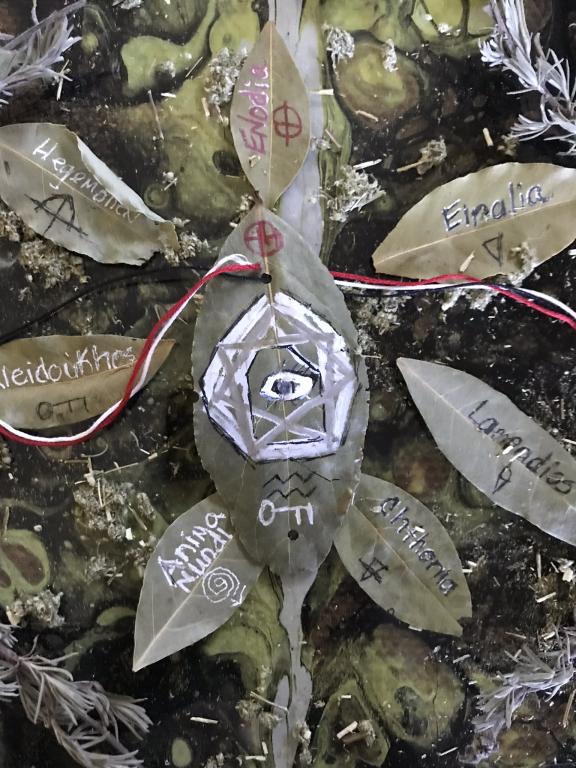
Talisman pendant of bay laurel.
Altars to Enodia: The Three Formed Hekate
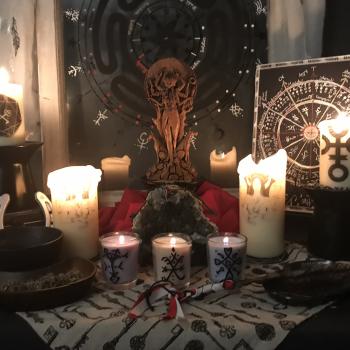
Create an altar to Enodia with plants gathered from the roadside, symbols of horse and hound, and an image of Hekate as the Three-Formed Queen. It is this image of her that best symbolizes her watchful eye on all roads, as demonstrated by the ancients who used this type of representation on their roadside shrines and threshold altars. Enodia sees all and knows where all the roads lead. She is past, present and future. She is the Mother Road.
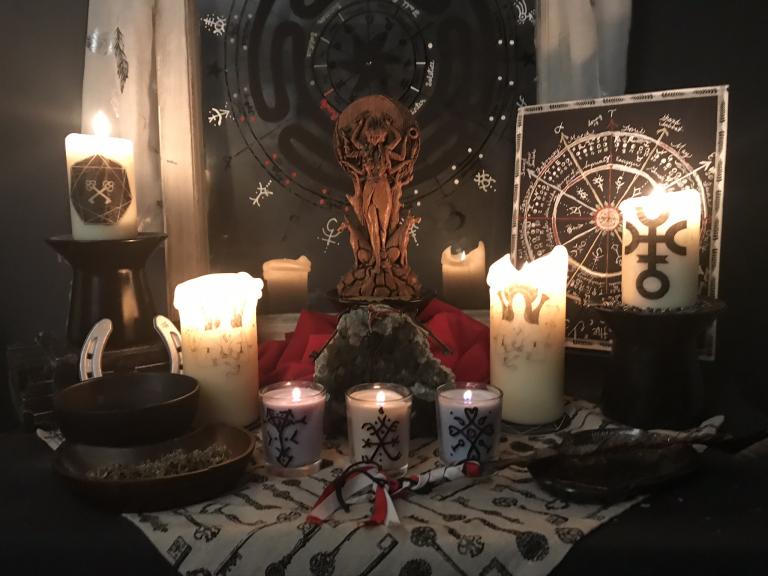
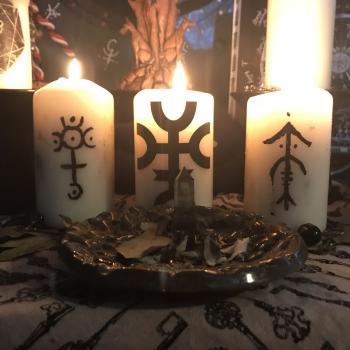
Altar to Hekate Enodia. For an explanation of the sigils on the three candles in the front, go here.
Calling Out to Enodia
Call out to Enodia for guidance on how to get back on the mother road, and, once your feet are upon it, for shining those torches of wisdom towards you. Hekate cannot forsake us, it is when we avert the true path for the phony road that we lose sight of both our own soul-fire and those torches.
Speak to Enodia and she will bestow you with healing and power, nourishment for walking her road.
Hekate Enodia is the guide as we travel the mother road towards rebirth, and she awaits on the other side as we are reborn as Kore, the reborn maiden. As Persephone, we triumph over the pain to reclaim our truth.
It is to Enodia I cry when I am lost,
Shine your torches so that I may return to your sacred road.
I am the pilgrim of your truth,
Guide me to rebirth so that all that is false is shed,
And I am woven anew from the threads of my soul.
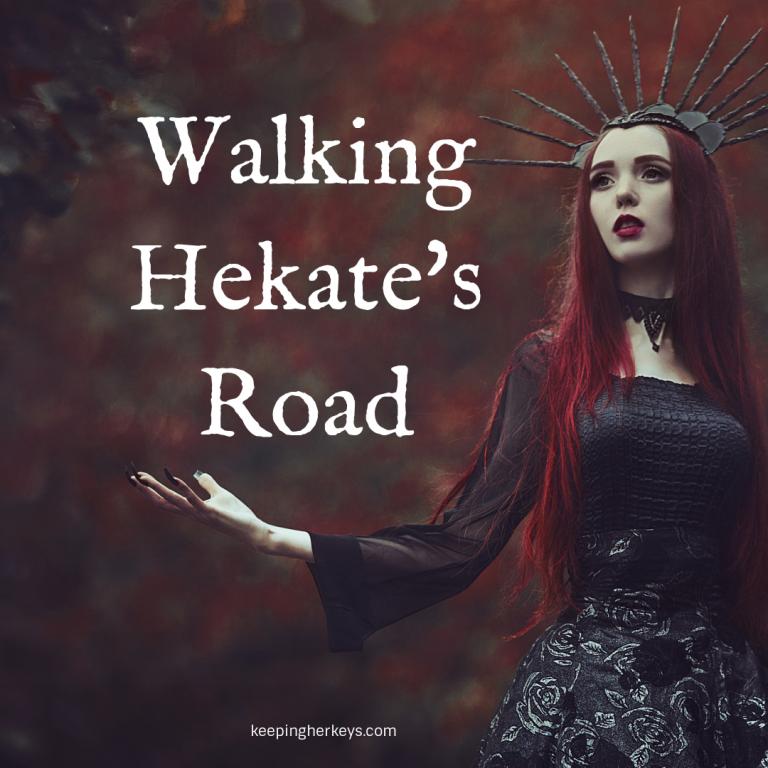
To those she calls, Hekate’s Road is a path of magick, medicine and mystery.
Please subscribe to my blog on keepingherkeys.com/read to receive updates about new articles which are completely free. No ads. No subscriptions. You can join my modern online coven network for the first month free. Try it out here.
Questions? Comments? [email protected] is where to send them.
Thanks to everyone for supporting Keeping Her Keys on Patheos. You can find me at keepingherkeys.com, on Facebook, Pinterest, Twitter or Instagram, in addition to the Keeping Her Keys network.
Stay true. Rise strong. Keep your own keys.
Deep Blessings,
Cyndi
Further Reading
Hekate: Goddess of Witches, Dark Mother And Keeper Of The Keys
Hekate’s Colors, Numbers, Stones and Symbols
Hekate And The Return of the Wild Woman
Entering Hekate’s Cauldron of Rebirth
Hekate’s Key Journey And The Keys Of Spiritual Journeying
Hekate’s Name: Origins, Meanings, Pronunciations and More
https://open.spotify.com/track/7EP3f1QBr5iv9NnRMQDs75?si=4Wj7uf5TQhyk6DRt7jKCYA
Selected Sources:
Chatzinikolaou, Kalliopi (2010). Locating Sanctuaries in Upper Macedonia According to Archaeological Data. In KERNOS: Revue international et pluridisciplinaire de religion grecque antique. (Vol. 23, pp 193-222). Available at:
https://doi.org/10.4000/kernos.1580
Serafini, Nicola (2015). The goddess Hecate and the places of passage: A protector to protect yourself from. In KERNOS: Revue international et pluridisciplinaire de religion grecque antique. (Vol. 28, pp p. 111-131). Available at:
https://journals.openedition.org/kernos/1580#tocto1n9
Ronan, Stephen (Ed.), The Goddess Hekate. Chthonios Books; Hastings; 1992.
Marquardt, Patricia, A. (1981). A Portrait of Hecate. The American Journal of Philology, Vol. 102, No. 3.
Ogden, Daniel (2002). Magic, Witchcraft, and Ghosts in the Greek and Roman Worlds: A Sourcebook.
Muller-Ebeling, Claudia, Ratsch, Christian, and Wolf-Dieter, Storl (2003). Witchcraft Medicine: Healing Arts, Shamanic Practices, and Forbidden Plants.
Read more about Enodia as an epithet of Hekate:
https://nehetisingsforhekate.tumblr.com/post/180630163486/epithetsobscure-gods-enodia
Join the Keeping Her Keys Modern Online Coven Network for one month free. https://bit.ly/KHKfreetrial

About Cyndi Brannen
Cyndi Brannen, PhD, teaches and writes from the crossroads of psychology, spirituality and traditional wisdom. Founder of the Keeping Her Keys system of spiritual witchcraft, she shares the keys of The Sacred Seven laws using practical methods ranging from journaling to journeying. Keeping Her Keys: An Introduction to Hekate’s Modern Witchcraft explores Hekate from her ancient origins to our modern understanding through magic and personal development. True Magic: Unleashing Your Inner Witch, based on the sacred seven principles of witchcraft, is a practical guide to better living through witchcraft. Read Dr. Brannen's journey from shattered to whole, and the courses she offers at keepingherkeys.com. Join the Keeping Her Keys Modern Online Coven Network at keepingherkeys.mn.co You can read more about the author here.

Next Post
May 13, 2020 Ritual Of Hekate During COVID-19 For The Vulnerable, Healers And The Departed
Browse Our Archives
Select a Category Goddesses Modern Hekatean Witchcraft Modern Witchcraft Moon Magick Personal Development Rituals Rituals Spells Spiritual Development Uncategorized Wheel of the Year
Select a Month June 2020 May 2020 April 2020 March 2020 February 2020 January 2020 December 2019 November 2019 October 2019 September 2019 August 2019 July 2019 June 2019 May 2019 April 2019 March 2019 February 2019 January 2019 December 2018 November 2018 October 2018 September 2018 August 2018 July 2018 June 2018 May 2018 April 2018 March 2018 February 2018 January 2018 December 2017 November 2017 October 2017
Follow Us!
TAKE THE
Religious Wisdom Quiz
What did Jesus heal on a man lowered through a roof in Capernaum?
Select your answer to see how you score.
Paralysis Blindness Leprosy Dumbness
Related posts from Keeping Her Keys
The Triple Moon Goddesses Ritual For Justice
The Keys and The Path: Beginning Spiritual Witchcraft
Leaning Into Hekate's Crossroads During Difficult Times
Ritual Of Hekate During COVID-19 For The Vulnerable,...
TRENDING AT PATHEOS Pagan

I was recently chatting with someone on Instagram. She asked me what...

While there are many people who share their results, the end of...

On July 23, I saw Christopher Nolan's The Odyssey which is Homer’s...

As I write this two big events have just finished up. One...

Restoring the Watershed of Divine Love
Perhaps cooperation is not something we manufacture through legislation, ideology, or moral...

Many UUs don’t pray because of bad experiences in a previous religion,...
view all Pagan blogs
Ad-Free & Subscriber Log-In Subscription Support
- About Us
- 2026 Calendar
- Videos
- Podcasts
- Library of World Religions
- Faith In Media Tracker
- Advertise With Us
- Write for Us
- Privacy Policy
- Terms of Service
- Do Not Sell My Data
- Contact Us
- Radiant Digital
- Manage Newsletter Subscriptions
- Unsubscribe From Notifications
- Sitemap
Copyright 2008-2026, Patheos. All rights reserved.
Subscription Support Ad-Free & Subscriber Log-In
Follow Patheos