
BuddhistCatholicContemplativeEvangelicalGeneral ChristianHinduJewishLatter-day SaintMuslimNew VisionsProgressive Christian
Beliefs
- Buddhist
- Catholic
- Contemplative
- Evangelical
- General Christian
- Hindu
- Jewish
- Latter-day Saint
- More Voices
- Muslim
- New Visions
- Pagan
- Progressive Christian
Topics
- Religion News
- Food and Religion
- Sports and Religion
- Religious Art
- Religious Music and Entertainment
- Religious Events
- History and Religion
- Style and Religion
- Politics and Religion
- Women in Religion
- Recreation Outdoors and Religion
- Business Finance and Religion
- Careers Workplace and Religion
- Education and Religion
- Family Parenting and Religion
- Health Fitness and Religion
- Home and Religion
- Relationships and Religion
- Technology and Religion
- Travel and Religion
Columnists
- Buddhist Columnists
- Business Finance and Religion Columnists
- Careers Workplace and Religion Columnists
- Catholic Columnists
- Contemplative Columnists
- Education and Religion Columnists
- Evangelists Columnists
- Family Parenting and Religion Columnists
- General Christian Columnists
- Health Fitness and Religion Columnists
- Hindu Columnists
- History and Religion Columnists
- Home and Religion Columnists
- Jewish Columnists
- More Voices Columnists
- Latter Day Columnists
- Muslim Columnists
- New Visions Columnists
- Nonreligious Columnists
- Pagan Columnists
- Politics and Religion Columnists
- Progressive Columnists
- Recreation Outdoors and Religion Columnists
- Relationships and Religion Columnists
- Religion News Columnists
- Religious Art Columnists
- Religious Events Columnists
- Religious Music and Entertainment Columnists
- Sports and Religion Columnists
- Style and Religion Columnists
- Technology and Religion Columnists
- Travel and Religion Columnists
- Women in Religion Columnists
Resource Library
- 2026 Calendar
- Library of World Religions
- The 100 Most Holy Places on Earth
- Patheos Answers
- Podcasts
- Videos
- Faith Leaders Database
- Anglican Episcopalian
- Bahai
- Baptist
- Buddhism
- Christianity
- Confucianism
- Eastern Orthodoxy
- Hinduism
- Holiness and Pentecostal
- ISKCON
- Islam
- Judaism
- Lutheran
- Methodist
- The Church of Jesus Christ of Latter-day Saints
- New Age
- Paganism
- Presbytarian and Reformed
- Protestantism
- Religion Behind the Scenes
- Roman Catholic
- Scientology
- Shia Islam
- Sikhism
- Sufism
- Sunni Islam
- Taoism
- Zen
- See all religions
Research Tools
 Ad-Free & Subscriber Log-In Subscription Support
Ad-Free & Subscriber Log-In Subscription Support
Follow Patheos 

- Trending:
- Forgiveness
- |
- Marriage
- |
- Consciousness
- |
- Death Penalty
- |
- Election
- |
- Halloween
 Seasons of Grace
- Home
- Catholic
- “The Poor You Will Always Have With You”: An Atheist Misunderstands Pope Francis, Again
“The Poor You Will Always Have With You”: An Atheist Misunderstands Pope Francis, Again
Last updated on: August 20, 2015 at 7:45 pm by Kathy Schiffer
“The Poor You Will Always Have With You”: An Atheist Misunderstands Pope Francis, Again 2015-08-20T19:45:19-05:00 Kathy Schiffer
Patheos Explore the world's faith through different perspectives on religion and spirituality! Patheos has the views of the prevalent religions and spiritualities of the world.
Matthew O’Neil, writing on Dan Arel’s Danthropology blog over on the Atheist Channel, has written what he considers to be a scathing indictment of Pope Francis which he titles “Pope Francis fails to lead a Christian life.” “[T]he person who leads the Catholic faith,” O’Neil writes,
“…does little to actually support the destitute, and, instead, redistributes the wealth within the empire of Catholicism. All the while using small measures to save face.”
O’Neil regards the Pope’s symbolic gestures as so much window dressing. He cites, then immediately dismisses examples of the Holy Father’s personal largesse: his inviting four homeless men and their dog to dine with him at the Casa Santa Marta, or his installation of three showers for the convenience of the poor of Rome, or his distribution of 400 sleeping bags. Merely for show, O’Neil says; a drop in the bucket, considering the Vatican’s vast wealth. He writes:
Especially after the slight few instances where Francis has barely even scratched the surface with being generous, especially with the means that the Vatican has, it is downright disgusting for him to even make such remarks as he has about helping the poor.
Like Sarah Silverman stated, we should consider selling the Vatican to help feed the world. If for no other reason other than it would have been what Jesus would have wanted.
Overlooking the fact that O’Neil draws his perspective from the rants of atheist stand-up comedian Sarah Silverman, I would like to counter some of his criticisms with facts. For one thing, the Catholic Church is a world-wide institution which is not owned and operated by a single individual. It’s difficult to quantify its charitable giving. Nonetheless, it is the largest funder of charitable projects in the world. Don’t believe me? Listen, instead, to Slate quote a study by the Economist:
Our best window into the overall financial picture of American Catholicism comes from a 2012 investigation by the Economist, which offered a rough-and-ready estimate of $170 billion in annual spending, of which almost $150 billion is associated with church-affiliated hospitals and institutions of higher education. The operating budget for ordinary parishes, at around $11 billion a year, is a relatively small share, and Catholic Charities is a smaller share still.
An older article in Time Magazine notes that the dividends from the Vatican’s financial investments help to pay for some of its charitable endeavors:
Dividends help pay for Vatican expenses and charities such as assisting 1,500,000 children and providing some measure of food and clothing to 7,000,000 needy Italians.
(And this is in 1965 dollars, so that dollar amount would have increased exponentially in the ensuing decades.) And of course, this says nothing about the additional expenditures for programs for the poor and underserved at diocesan level, at parish level, by Catholic nonprofit organizations, and from the pockets of individual churchgoers. Catholic social teaching has always cited what is called a “Preferential Option for the Poor.” Pope Benedict XVI, in his 2009 encyclical “Caritas in Veritate” (“Charity in Truth”), speaks at length about the requirement to help the poor as a matter of justice. He says,
“To desire the common good and strive towards it is a requirement of justice and charity…. The more we strive to secure a common good corresponding to the real needs of our neighbours, the more effectively we love them. Every Christian is called to practise this charity, in a manner corresponding to his vocation and according to the degree of influence he wields in the [state]. This is the institutional path–we might also call it the political path–of charity, no less excellent and effective than the kind of charity which encounters the neighbor directly…”
The U.S. Conference of Catholic Bishops has prepared an extensive aid regarding Church teachings on poverty. Included are links to the Compendium of Social Doctrine of the Church, the guide to Informing Consciences for Faithful Citizenship, the 2002 A Place at the Table: A Catholic Recommitment to Overcome Poverty and to Respect the Dignity of All God’s Children, the USCCB’s 2005 Statement Seven Themes of Catholic Social Teaching, Pope Benedict’s 2005 encyclical Deus Caritas Est (God Is Love), and much more.
I invite Matthew O’Neil and Dan Arel, if they really want to research Catholic giving, to learn about that of which they speak. Pope Francis’ generosity is a demonstration project of how we are to live in loving outreach to our homeless brethren. It is a tangible example of charity; but is hardly the only charity which the Church exercises in her daily ministry.
My point is this: Matthew O’Neil has zero cred when it comes to talking about how the Church spends its money. He doesn’t understand his subject. There are other reasons, though, to reconsider the tired old “Sell St. Peter’s” meme. I’ve written on it once before, and have appended that post here. First, though, an image from my travels in Austria: At the Cathedral of St. Rupert and St. Virgilius in Salzburg, Austria, I snapped this photo: 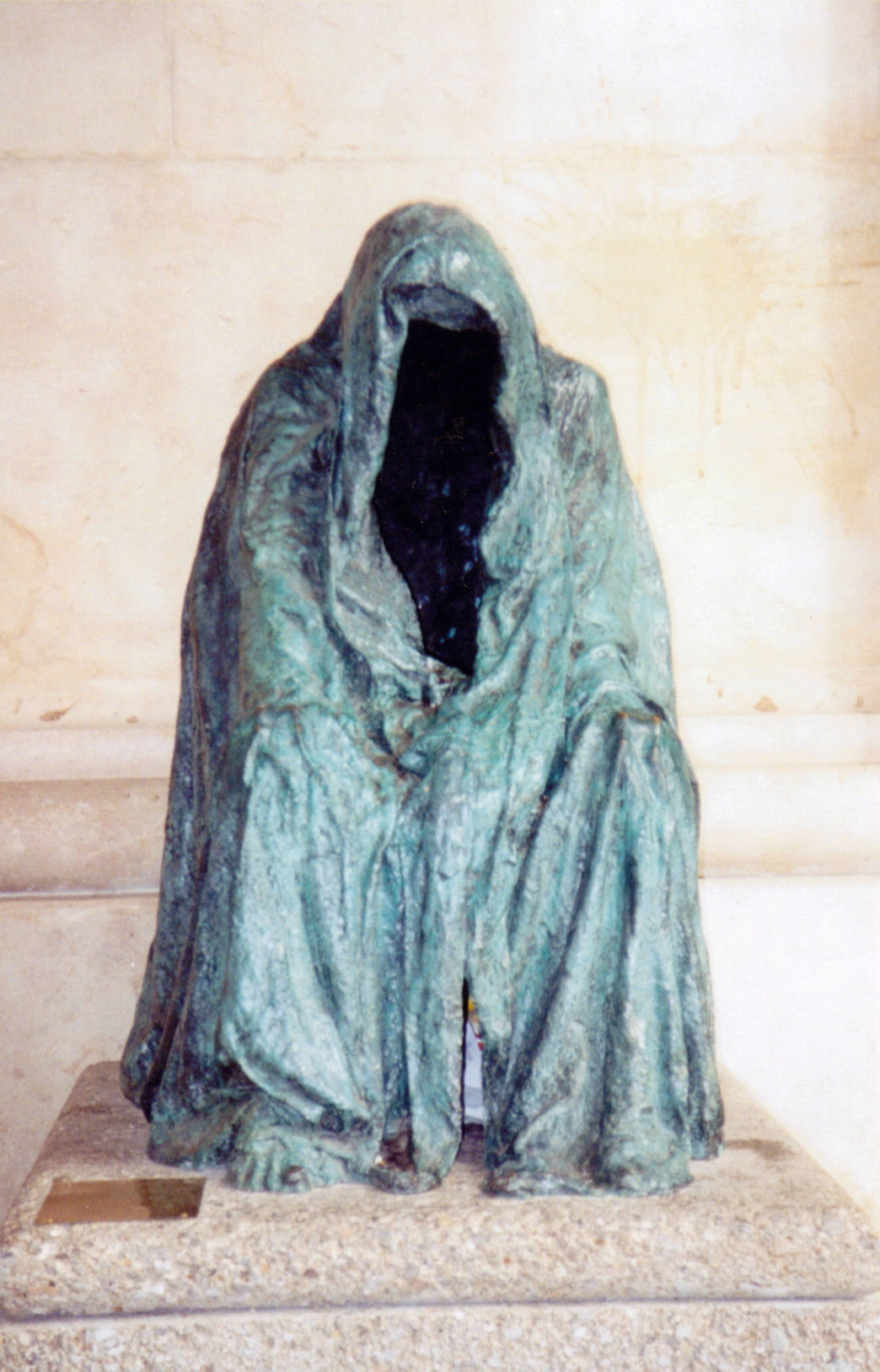 This wonderful brass sculpture stands beside the Cathedral. It’s “empty”–there’s a tunic and veil, but there’s no face staring out from the folds. It represents the “invisible poor.”
* * * * *
My earlier post, which seems to carry this discussion in a new but still relevant direction, was written after an encounter on an Amtrak train en route from Chicago to Detroit. I’d met a man named Mark, who raised important questions regarding the Church’s wealth and her charity.
Mark described himself as a Christian but not a Catholic. As Amtrak #358 sped along the track from Chicago, where I’d been attending a conference, to Dearborn, Mark and I chatted about a lot of things: about our families, about our work, and about faith. When he heard that I was a Catholic writer, he embraced the opportunity to raise a few questions about Pope Francis and to express some concerns that he had with the Church, as he understood it.
Talking about his travels to Rome, Mark said of St. Peter’s Basilica:
“I looked up at the great basilica, and I had two reactions: First, I appreciated its beauty and reverence; but then I thought, ‘What corruption caused someone to spend so much on this building when people are hungry’?”
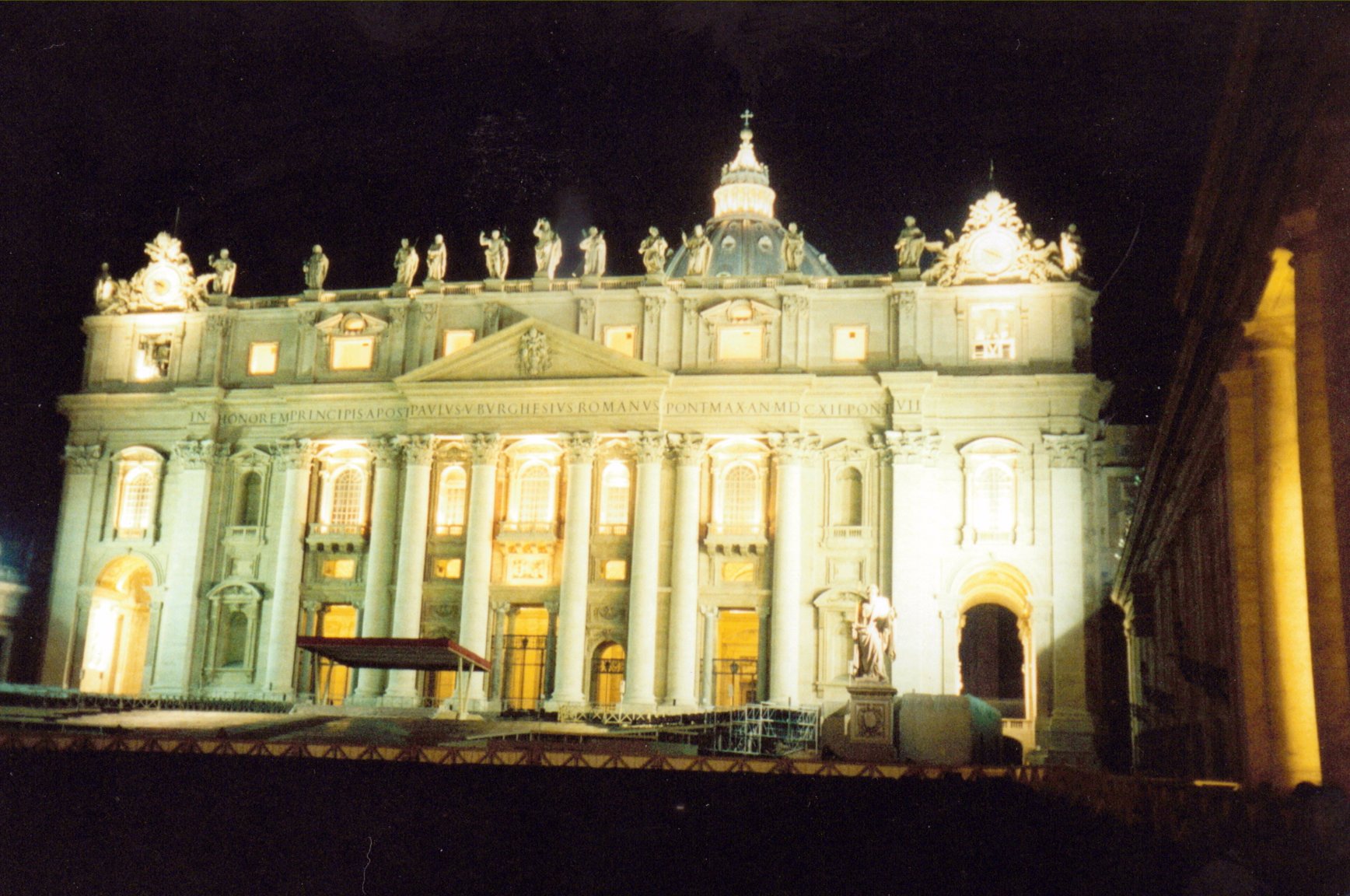
St. Peter’s Basilica at night (Photo: Kathy Schiffer)
I know that Mark’s questions are echoed by many others who see the Church from the outside, but who have never talked to a real Catholic to get an insider’s perspective.
Mark had a good point: Certainly there are widows and orphans to feed, refugees to house, expectant mothers to assist and abandoned spouses to comfort. Mindful of all of these profound needs, shouldn’t the Church divest itself of its great wealth and give it all to the poor?
I’d like to suggest four key reasons why selling all is NOT the approach mandated by the Scriptures.
1. Gratitude Requires That We Preserve the Gifts of Those Who Have Gone Before Us.
Wouldn’t you seem ungrateful if your parents had scrimped and saved to give you a pricey wedding gift, only to have you cast it aside? Likewise, past generations of the faithful–grateful for God’s beneficent care, and eager to share their appreciation by giving of their blessings–have donated the funds, or contributed the artwork, or supported the artist, with the expectation that their gift will be appreciated and will serve as an inspiration to prayer for future generations.
2. Jesus himself expected that we would honor him with our wealth.
Remember the story in Luke 12, when the woman washes Jesus’ feet with her hair, and anoints them with expensive nard? It’s Judas who objects–insisting that the perfume could have been sold, and the money used to feed the poor. But rather than agreeing with Judas, Jesus scolds him–reminding him that the poor, we will always have with us. Here is the story (American Standard Version):
3 Mary therefore took a pound of ointment of pure nard, very precious, and anointed the feet of Jesus, and wiped his feet with her hair: and the house was filled with the odor of the ointment.
4 But Judas Iscariot, one of his disciples, that should betray him, saith,
5 Why was not this ointment sold for three hundred shillings, and given to the poor?
6 Now this he said, not because he cared for the poor; but because he was a thief, and having the bag took away what was put therein.
7 Jesus therefore said, Suffer her to keep it against the day of my burying.
8 For the poor ye have always with you; but me ye have not always.
Jesus was God, and was worthy of devotion. Even though there were poor people to be served, it was fitting that he should have been honored by her anointing with the precious oil. In the same way, it is right and good to build something (or paint something, or sculpt something) truly beautiful for God.
3. The Poor Deserve Beauty, Too.
If the great art of the Church were sold, it would most likely be preserved behind closed doors, in private collections of the very wealthy. Better, I think, to allow everyone–even persons of humble means–to enjoy the works of the Masters, to allow their hearts and minds to be drawn upward toward heaven by the rich imagery of the saints, by the glow of alabaster and the sheen of marble and the intricacy of fine metalwork. The Church has been a repository of great art, and has made its treasures available for all to enjoy.
4. Beauty Leads Us to Holiness.
Thomas Aquinas named three characteristics of beauty: integritas (integrity), consonantia (proportion), and claritas (clarity). Beauty is something which we recognize in creation, and it leads us to greater understanding of God, who in creating the Beautiful has shown us a little of His boundless Beauty. As we appreciate the beauty of a flower, we begin to understand a little more of the beauty of its Creator, and we are drawn to love Him more. Likewise, when a stained glass window enraptures us with its shimmering color and its profound imagery, we appreciate the creator (the artist), and the Creator of the creator (God).
Next Post

March 19, 2015 OF MICE AND MEN (and Cecil Clayton): Death Penalty On Trial in Missouri
Browse Our Archives
Select a Category #Synod14 Abortion Abstinence Abuse Addiction Adoption Advent Adventure Advertising Aging Agnosticism All Saints Day All Souls Day Amish Anathema Angels Anglican Animals Annulment Annunciation Apocalypse Apologetics Apostles Apostleship of the Sea Apparitions Archangels Archbishop Cordileone Archbishop Dolan Archbishop Vigneron Archeology Architecture Art Art Buchwald Ash Wednesday Assisted Suicide Astronauts Atheism Athletes Babies Baptism Beatification Beauty Bible Biochemistry Bioethics Birds Bishop Lori Bishops Blasphemy Books Canon Law Canonization Capital Punishment Cardinal Burke Cardinal Dolan Cardinal George Caritas Catechesis Catechism of the Catholic Church Catholic Catholic Education Catholic Higher Education Catholic Social Teaching Celibacy Cemeteries Character Charity Chastity Cheapskate Christian Unity Christmas Churches Civil Rights Cloning Comedy Communion of Saints Community Kitchens Confession Confirmation Conscience Consequences Consistory Constitution Contraception Conversion Cooking Councils of the Church Creativity Criminal Justice Cristero War Crucifixion Crystal Cathedral Culture Death Death and Dying Death Penalty Department of Health and Human Services Diaconate Dictatorship of Relativism Dignity Disability Discrimination Dissidence Divorce Doctors of the Church Early Church Fathers Easter Economics Ecumenism Education Encyclicals Environmentalism Episcopal Church Eucharist Euthanasia Evangelism Evangelists Evangelization Evolution Excuses Facebook Faith Families Family Fashion Fasting Fatherhood Federal Government Feminism Fiction Film First Amendment First Communion For Greater Glory Forgiveness Free Speech Friends Friendship Gender Discrimination Germany Gnosticism Good Friday Government Grace Greed Gregorian Calendar Happiness Health Heaven Heresy History Holidays Holiness Hollywood Holy Land Holy Saturday Holy Spirit Holy Week Holy Year Home Sweet Home Homosexuality Hope Humanism Humility Humor Imagination Immaculate Conception Immigration Impulsivity In Vitro Fertilization Incarnation Indulgences Infallibility Internet Islam Italy Jerusalem Jesus Judaism Justice Kathleen Sebelius Labor Movement LCWR Lent Life Literature Liturgy Lourdes Love Magi Marketing Marriage Martyrdom Martyrs Mary Mass Media Medical Ethics Mexico Michigan Miracles Missionaries Modernism Modesty Monks Monothelitism Motherhood Movies Mushrooms Music Muslim Mystery Mysticism Mythology Nativity Natural Law Nature New Evangelization New Media New Year New Year's Resolutions Nostalgia Obscenity Occult Old Testament Origen Orthodox Orvieto Pallium Papacy Parenting Patience Patriarch Bartholomew Patriotism Peace Peace and Justice Penitence Pentecost People Persecution Philosophy Poetry Political activism Political Correctness Politics Polls Pop Culture Pope Benedict XVI Pope Francis Pope John Paul II Pope John XXIII Pope Paul VI Pope St. Pius X Pope Urban VII Population Prayer Preaching Prejudice Pride Priesthood Pro-Life Protestantism Psychology Purgatory Queenship of Mary Racism Rape Real Presence Reconciliation Reformation Relics Religious Religious Liberty Reliquary Renewal Reproductive Technology Resurrection Rights Romance Rome Royalty Sacraments Sacred Heart Saints Satanism Science Science Fiction Scripture Seal of Confession Secularism Seniors September 11 Seventy Times Seven Sexuality Sharks Sin Smoking Social Communications Social Justice Social Networking Social Sciences Space Exploration Spirituality Sports St. Luke St. Patrick's Day St. Paul St. Peter St. Teresa of Avila Stations of the Cross Steve Jobs Superstition Supreme Court Symbolism Synod Technology Teen Rebellion Television Terrorism Thankfulness Thanksgiving Theology Think This, Not That Tobit Toilets Toys Tradition Traditions Transplants Travel Trinity Twitter U.S. Air Force Uncategorized United Nations USCCB Valentine Vatican Vatican Archives Vatican Blogfest Virtue Vocations Where We Pray White Heart Women World Day of Social Communications World Meeting of Families World News World Youth Day Worship Writing Year of Consecrated Life Year of Faith Year of Mercy Youth
Select a Month December 2015 November 2015 October 2015 September 2015 August 2015 July 2015 June 2015 May 2015 April 2015 March 2015 February 2015 January 2015 December 2014 November 2014 October 2014 September 2014 August 2014 July 2014 June 2014 May 2014 April 2014 March 2014 February 2014 January 2014 December 2013 November 2013 October 2013 September 2013 August 2013 July 2013 June 2013 May 2013 April 2013 March 2013 February 2013 January 2013 December 2012 November 2012 October 2012 September 2012 August 2012 July 2012 June 2012 May 2012 April 2012 March 2012 February 2012 January 2012 December 2011 November 2011 October 2011 September 2011 August 2011 July 2011 June 2011 May 2011 April 2011 March 2011 February 2011 January 2011 December 2010 November 2010 October 2010
TAKE THE
Religious Wisdom Quiz
How many Beatitudes are in the Sermon on the Mount?
Select your answer to see how you score.
10 12 8 7
Related posts from Seasons of Grace

LOOKING BACK: Eight Really Big Stories from "Seasons...

Wear the Veil Day: Catholic Young Women Veil...
Ordinariate of the Chair of St. Peter Just...

A Pencil in God's Hand: Mother Teresa's Story...
TRENDING AT PATHEOS Catholic

Creation, Preservation, and Teleology in Catholic Theology
As I write this, it is very early Monday morning. Like millions...

The Parable Of The Sower And The Word...
One of Christ’s most famous parables is that of the sower who...

Rejecting Doom: Christian Hope And Human Action
Christianity is a religion of hope. We are to have hope and...

Why I Choose the Eucharist Over the Sermon
Choose the Eucharist, Not the Sermon What are we supposed to get...

5 Design Elements Found in Spiritually Rooted Homes
Putting Spirituality Into Home Decor Our homes are more than our living...

Credo: A Story of God Told with the...
About 10 years ago, I began to imagine a personal "Credo" that...
view all Catholic blogs
Ad-Free & Subscriber Log-In Subscription Support
- About Us
- 2026 Calendar
- Videos
- Podcasts
- Library of World Religions
- Faith In Media Tracker
- Advertise With Us
- Write for Us
- Privacy Policy
- Terms of Service
- Do Not Sell My Data
- Contact Us
- Radiant Digital
- Manage Newsletter Subscriptions
- Unsubscribe From Notifications
- Sitemap
Copyright 2008-2026, Patheos. All rights reserved.
Subscription Support Ad-Free & Subscriber Log-In
Follow Patheos