
BuddhistCatholicContemplativeEvangelicalGeneral ChristianHinduJewishLatter-day SaintMuslimNew VisionsProgressive Christian
Beliefs
- Buddhist
- Catholic
- Contemplative
- Evangelical
- General Christian
- Hindu
- Jewish
- Latter-day Saint
- More Voices
- Muslim
- New Visions
- Pagan
- Progressive Christian
Topics
- Religion News
- Food and Religion
- Sports and Religion
- Religious Art
- Religious Music and Entertainment
- Religious Events
- History and Religion
- Style and Religion
- Politics and Religion
- Women in Religion
- Recreation Outdoors and Religion
- Business Finance and Religion
- Careers Workplace and Religion
- Education and Religion
- Family Parenting and Religion
- Health Fitness and Religion
- Home and Religion
- Relationships and Religion
- Technology and Religion
- Travel and Religion
Columnists
- Buddhist Columnists
- Business Finance and Religion Columnists
- Careers Workplace and Religion Columnists
- Catholic Columnists
- Contemplative Columnists
- Education and Religion Columnists
- Evangelists Columnists
- Family Parenting and Religion Columnists
- General Christian Columnists
- Health Fitness and Religion Columnists
- Hindu Columnists
- History and Religion Columnists
- Home and Religion Columnists
- Jewish Columnists
- More Voices Columnists
- Latter Day Columnists
- Muslim Columnists
- New Visions Columnists
- Nonreligious Columnists
- Pagan Columnists
- Politics and Religion Columnists
- Progressive Columnists
- Recreation Outdoors and Religion Columnists
- Relationships and Religion Columnists
- Religion News Columnists
- Religious Art Columnists
- Religious Events Columnists
- Religious Music and Entertainment Columnists
- Sports and Religion Columnists
- Style and Religion Columnists
- Technology and Religion Columnists
- Travel and Religion Columnists
- Women in Religion Columnists
Resource Library
- 2026 Calendar
- Library of World Religions
- The 100 Most Holy Places on Earth
- Patheos Answers
- Podcasts
- Videos
- Faith Leaders Database
- Anglican Episcopalian
- Bahai
- Baptist
- Buddhism
- Christianity
- Confucianism
- Eastern Orthodoxy
- Hinduism
- Holiness and Pentecostal
- ISKCON
- Islam
- Judaism
- Lutheran
- Methodist
- The Church of Jesus Christ of Latter-day Saints
- New Age
- Paganism
- Presbytarian and Reformed
- Protestantism
- Religion Behind the Scenes
- Roman Catholic
- Scientology
- Shia Islam
- Sikhism
- Sufism
- Sunni Islam
- Taoism
- Zen
- See all religions
Research Tools
 Ad-Free & Subscriber Log-In Subscription Support
Ad-Free & Subscriber Log-In Subscription Support
Follow Patheos 

- Trending:
- Forgiveness
- |
- Marriage
- |
- Consciousness
- |
- Death Penalty
- |
- Election
- |
- Halloween
 Kathryn Lopez
- Home
- Catholic
- 30 Thomas Aquinas Things that Caught My Eye Today (Jan. 28, 2016)
30 Thomas Aquinas Things that Caught My Eye Today (Jan. 28, 2016)
Last updated on: January 28, 2016 at 3:27 pm by Kathryn Jean Lopez
30 Thomas Aquinas Things that Caught My Eye Today (Jan. 28, 2016) 2016-01-28T15:27:10-05:00 Kathryn Jean Lopez
Patheos Explore the world's faith through different perspectives on religion and spirituality! Patheos has the views of the prevalent religions and spiritualities of the world.
1.
Happy feast of St Thomas Aquinas, Common Doctor of the Church! @ Dominican House of Studies,… https://t.co/pj676xQo7e
— Fr Lawrence Lew OP (@LawrenceOP) January 28, 2016
2. A decent list of 12 I put together last year on this day that includes B16, Fr. Romanus Cessario, O.P., Frank Sheed and more.
3.
St. Thomas Aquinas, help us to combine faith and reason to spread our Catholic faith with charity of the intellect and heart.
— Bishop Barres (@BishopBarres) January 28, 2016
4.
“It is better to illuminate than merely to shine." -St Thomas Aquinas
— Matt Swaim (@mattswaim) January 28, 2016
5.
— FrSteveGrunow (@FrSteveGrunow) January 28, 2016
6. From a conference by Saint Thomas Aquinas in the Office of the Readings in the Liturgy of the Hours today:
Why did the Son of God have to suffer for us? There was a great need, and it can be considered in a twofold way: in the first place, as a remedy for sin, and secondly, as an example of how to act.
It is a remedy, for, in the face of all the evils which we incur on account of our sins, we have found relief through the passion of Christ. Yet, it is no less an example, for the passion of Christ completely suffices to fashion our lives. Whoever wishes to live perfectly should do nothing but disdain what Christ disdained on the cross and desire what he desired, for the cross exemplifies every virtue.
If you seek the example of love: Greater love than this no man has, than to lay down his life for his friends. Such a man was Christ on the cross. And if he gave his life for us, then it should not be difficult to bear whatever hardships arise for his sake.
If you seek patience, you will find no better example than the cross. Great patience occurs in two ways: either when one patiently suffers much, or when one suffers things which one is able to avoid and yet does not avoid. Christ endured much on the cross, and did so patiently, because when he suffered he did not threaten; he was led like a sheep to the slaughter and he did not open his mouth. Therefore Christ’s patience on the cross was great. In patience let us run for the prize set before us, looking upon Jesus, the author and perfecter of our faith who, for the joy set before him, bore his cross and despised the shame.
If you seek an example of humility, look upon the crucified one, for God wished to be judged by Pontius Pilate and to die.
If you seek an example of obedience, follow him who became obedient to the Father even unto death. For just as by the disobedience of one man, namely, Adam, many were made sinners, so by the obedience of one man, many were made righteous.
If you seek an example of despising earthly things, follow him who is the King of kings and the Lord of lords, in whom are hidden all the treasures of wisdom and knowledge. Upon the cross he was stripped, mocked, spat upon, struck, crowned with thorns, and given only vinegar and gall to drink.
Do not be attached, therefore, to clothing and riches, because they divided my garments among themselves. Nor to honors, for he experienced harsh words and scourgings. Nor to greatness of rank, for weaving a crown of thorns they placed it on my head. Nor to anything delightful, for in my thirst they gave me vinegar to drink.
7.
Lippi's #ThomasAquinas Adoring Christ Crucified (1491) pic.twitter.com/RCniTQspwM
— Chad Pecknold (@ccpecknold) January 28, 2016
8. From my friend Father Aquinas Guilbeau, O.P. in a recent symposium on the jubilee of mercy:
As practically minded Americans, we’re quick to approach most problems with a cool plan of action. If someone approaches us with a need, for example, we strategize how best to alleviate the need quickly, effectively, and efficiently, spending the minimum of energy and passion required. How many of us, when approaching the homeless veteran on the street, coordinate every movement of our bodies so as drop a few coins into his jangling cup without either breaking stride or saying hello?
Mercy requires more of us. It demands not only a quick, efficient plan of action but also a change of heart. St. Thomas Aquinas defines the merciful person as one who is “affected with sorrow at the misery of another as though it were his own,” such that he “endeavors to dispel the misery of this other as if it were his own.” According to Aquinas, mercy is as much about compassion as it is about action. Moved to pity at the pity of another, we act with human affection as well as cunning to remove the defects at the source of the other’s pity.
Why this emphasis on compassion? Because we are human, Aquinas explains. Because happiness is so proper to the human being, one ordered to happiness cannot but be moved to pity when another like himself lacks happiness. The one suffering shares our dignity and vocation. Hence he requires our warm solidarity in his suffering. Our cool justice does not suffice as a human response.
Aquinas notes also that, at a deeper level, to show mercy to another is to acknowledge that we ourselves have been shown mercy, first of all by God, who in the very act of creating us — in drawing us out of nothing — acted mercifully on our behalf.
9.
Through the intercession of Saint Thomas Aquinas, may we learn the Lord's Truth and express it in works of charity.
— Bishop Burbidge (@BishopBurbidge) January 28, 2016
10. Did you know that it is not too late to get spiritual direction from Thomas Aquinas? Peter Kreeft’s book on the topic is excellent (super practical). Q&A here.
11.
"I am lost, all lost in wonder at the God thou art!"–St Thomas Aquinas meditating on the beauty of the Eucharist. pic.twitter.com/qTZ69wLDtQ
— Fr. Willy Raymond (@FrWilly) January 28, 2016
12.
Fr Cameron OP says #ThomasAquinas knew bullying, family strife, loneliness, but dedicated himself to love of God. @MarysShrine @CatholicUniv
— Chad Pecknold (@ccpecknold) January 28, 2016
It was a beautiful homily he — who is editor of Magnificat — delivered – more about that soon. Maybe especially (it’s all good!) this:
even though, as Saint Thomas says, the great things of God’s love exceed our longings and desires, the only way not to give up when the loneliness and misery of life afflict us is by remaining always faithful to our own desires.
Saint Thomas wrote:
The life of the human being consists in the affection which principally sustains a person and in which that person finds his greatest satisfaction.
What is the affection that principally sustains you and in which you find your greatest satisfaction?
The trouble is that when happiness doesn’t happen according to our plan, and we begin to feel the void, the abysmalness of life, we very often side step and compromise our desire in favor of something that ultimately cannot satisfy.
For example, in the Summa, Saint Thomas asks this question: “What are the things in which the human being’s happiness consists?” And in searching for an answer, he invokes the usual suspects: Does happiness consist in wealth? In fame or glory? In power? In pleasure? In any created good?
If we are honest with ourselves, we see that none of these things can suffice…none of these things can ever be enough. Because all of these things are finite. And there is one thing that your desire and my desire and the desire of every person in this basilica and in the world has in common: which is that our desire is infinite. Which means the only thing that can satisfy our infinite desire is the Infinite.
The American poet Christian Wiman—who rediscovered his Christian faith through an excruciating bout with cancer—wrote:
I did not know what love was until I encountered one that kept opening and opening and opening. And until I acknowledged that what that love was opening onto, and into, was God.
Toward the end of his life, Saint Thomas was praying in a chapel, and Jesus himself spoke to Thomas from a crucifix hanging on the wall. Jesus said: “You have written well of me, Thomas! What do you desire?” To which, Thomas replied, “ Non nisi te, Domine.” Only you, Lord.
This is the other reason why I love Saint Thomas Aquinas so much. Yes, he is an incomparable philosopher and theologian—the Patron of Catholic Schools, including my own Alma Mater The Catholic University of America. But Saint Thomas is also an amazing poet whose Non nisi te, Domine made it possible for him to compose the most beautiful hymns to the Holy Eucharist the world has ever known.
Because Saint Thomas really “got” the meaning of the Eucharist. As he wrote:
Christ would not be so intimately united to us were we, in the Eucharist, to share only in his power: how much better that he should give us his very self, not merely his effects, for the perfect joining of head and members. What a proof of friendship, that he should feed us himself.
And, as Saint Thomas asked in commenting on the works of Aristotle, “Without friends, who would want to live? [In every situation and at whatever age] “friendship is what is most necessary to live.”
So you, who have been made a friend of Jesus Christ…you for whom every expression of God’s love for you is an understatement…you, you light of the world you, go out and be a friend to others. Live your life as a risk. Someone out there needs you. Someone close is on the verge of despair and maybe even of death. So come to Jesus, receive your Friend in Holy Communion, and then go out and do what he does: give to others your very self.
St. Thomas Aquinas, great patron of friendship, pray for us.
13. From the late Fr. Kurt Pritzl, O.P.’s homily in 2010 at that same annual Mass:
Thomas Aquinas, in all gentleness and humility, responded fully to the grace of God. He knew and lived what the Book of Wisdom says: “For [God] is the guide of Wisdom and the director of the wise. For both we and our words are in his hand, as well as all prudence and knowledge of crafts.” And whatever Thomas learned was gained as a gift by the prayer and pleading for “prudence” and “the spirit of wisdom” that is preferable to scepter and throne, riches, health and good looks, just as our passage from the Book of Wisdom tells us.
Jesus teaches that all his faithful, listening disciples are “the salt of the earth” and “the light of the world” in imitation of their Lord, who is the salt and the light. Many unlettered followers of the Lord, rather than university professors, have been genuine salt and light in this world of ours. Thomas Aquinas, as an unfailing disciple, is salt and light in this same way, and especially for us in the university. As Saint Thomas Aquinas we know him not just through his writings. We have him as a friend and patron, someone we can count to be with us and guide us, through the communion of saints, where the separations of earthly life and eternal life are transcended.
14.
Happy feast of St. Thomas Aquinas, O.P. pic.twitter.com/orKEwpKC57
— Joseph-Anthony Kress (@JAKressOP) January 28, 2016
15. From Magnificat today:
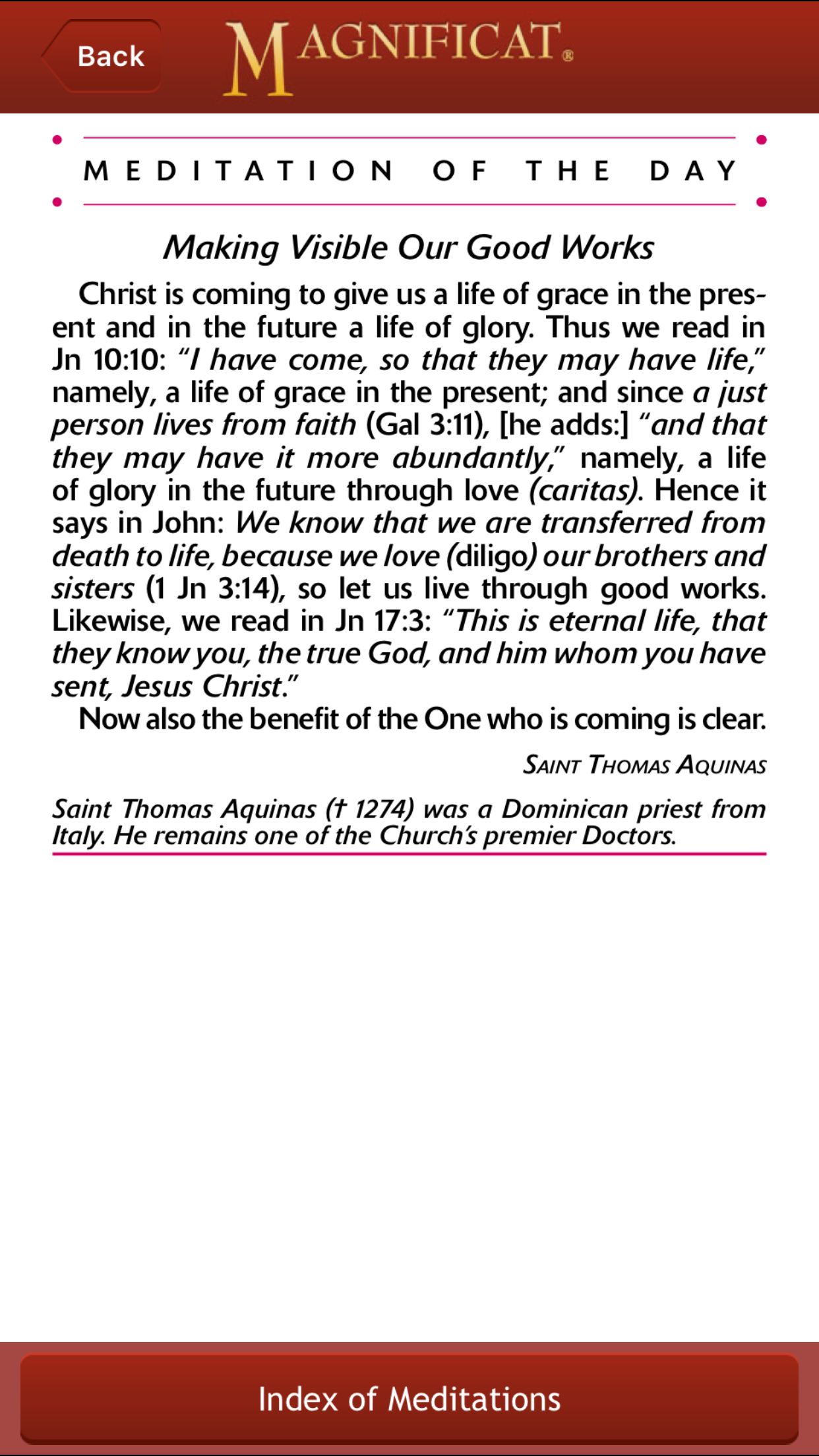
16.
— FrSteveGrunow (@FrSteveGrunow) January 28, 2016
17. And from Fr. Grunow’s homily today:
We live in an age of the Church’s life in which there has been a tragic devaluation of the importance of the life of the mind in relation to the Christian way of life. Thinking about the faith is seen as a distraction from practical and emotional matters. Creative and inspired scholarship is needed and sorely lacking.
Some, embracing philosophical and ideological trends construe scholarship in the Church as project of debunking the Church’s beliefs or as a means used to make sure that the practices of the Christian life serve secular conceits. The legacy of Christian witness if presented at all, is presented so as to be dismissed.
Others, see scholarship in the Church as merely akin to the conservation of a museum piece, not appreciating the Church’s intellectual inheritance as something living and vital. The Faith becomes an archaism, rather than a way of life.
And there are those who see little need for the Church to think at all, preferring the solace of emotions and sentiment alone without recourse to reason or so fearful of the unpredictability of life, preferring the retreat from reason into credulity that becomes the terrors of fundamentalism.
St. Thomas Aquinas invites us to abandon a faith that is content with little, if any, understanding or thinks the life of the mind inhibits sanctity, rather than enhancing it.
The Church needs a new generation of scholars who like St. Thomas Aquinas, will take seriously the life of the mind and that mature faith always seeks to understand what the Church believes and practices and why.
18. Thomas Aquinas on Good Friday here and here.
19.
Happy Feast of St. Thomas Aquinas! pic.twitter.com/QxB0pO8JKz
— Crystalina Evert (@CrystalinaEvert) January 28, 2016
20. St. Thomas Aquinas: A Guide in Our Call to Virtue
21. Uh, wow:
St Thomas and the Blessed Sacrament. #ThomasAquinas https://t.co/v5NyZahebx
— P.C. Outsider (@PhilOutsider) January 28, 2016
22.
The only thing that can satisfy our deepest desire is the Infinite – that is, Jesus Christ #ThomasAquinas #cua
— Fr. Eric Leyble (@FrEricLeyble) January 28, 2016
23. 10 resources from Bishop Robert Barron.
24. And Bishop Barron on Thomas Aquinas’ writing:
25.
Pray for Us, St. Thomas Aquinas! #saints #prayforus pic.twitter.com/oyMDk2xkYt
— Knights of Columbus (@KofC) January 28, 2016
26. At his Wednesday audience:
Addressing young people, the sick, and newlyweds at the end of his weekly General Audience on Wednesday in St. Peter’s Square, Pope Francis said, “Let [St. Thomas’] example push you, dear young people, to see in Jesus the one merciful life teacher.” He went on to say, “May his intercession obtain for you, dear sick people, serenity and peace in the mystery of the Cross.” Pope Francis also prayed, “May his doctrine be an encouragement for you, dear newlyweds, to entrust yourselves to the wisdom of the heart, that you might fulfil your mission.”
27. Fr. Paul Murray, O.P., on Thomas Aquinas and talking to God:
29. From a homily from Fr. Roger Landry:
as influential as his theological and philosophical corpus has been in the history of Christian thought, I believe his greatest legacy flowed out of his prayerful heart. After the Eucharistic Miracle of Bolsena, Pope Urban IV asked him and St. Bonaventure to compose the Office to celebrate the Feast of Corpus Christi — the hymns, the lessons, the prayers. St. Thomas won the competition against his holy Franciscan friend. And we are still very much profiting from the fruits of his contemplation. He wrote the Tantum Ergo and the O Salutaris we still sing at Eucharistic Adoration. He wrote the Panis Angelicus. He wrote the Adoro Te Devote. They all flow from his Eucharistic piety. He let his faith shine as a light that has illumined all of us.
I’ve always been very impacted by one of his lines from the Sacris Solemnis, the last two verses of which form the Panis Angelicus. If in the first reading David was awed at what God was going to do for him, we should have a similar, even a greater awe. We sing: “O Res mirabilis, manducat Dominum, pauper servus et humilis.” “O what an unbelievable reality: a poor and humble servant eats his Lord.” St. Thomas measured out all of his love for the Lord in these Eucharistic hymns and he’s been training all of us ever since in that same love for the Lord and same wonder for the miraculous reality that the Lord we devoutly worship before this “so great a Sacrament” we actually are given the privilege to consume.
That leads to the last point I’d like to say about St. Thomas, which sums up his entire life. He was a man who took care of the Word of God and the God of that word. Toward the end of his life he had two great mystical experiences (that we know of). In the first, he was so moved by the presence of the Lord that he stopped writing all together, recognizing everything he had written — some of the most important and penetrating theology anyone has ever written — were “like straw” compared to the experience he had of God in prayer. The second experience was when Jesus spoke to him from the Crucifix about three months before he died at the age of 49. Jesus said, “Bene scripsisti de me Thoma; quam ergo mercedem accipias?” “You have written well of me Thomas? What reward would you receive? What do you wish that I give you?” Thomas could have asked for anything, but he knew well who is treasure was. “Non aliam, Domini, nisi te ipsum,” he replied. “Nothing but you, Lord!” His whole life, his whole treasure, was the Lord. The Lord was the One he sought in his vocation even against the objections and obstacles of his family. The Lord was the One he sought in his study of Sacred Scripture and all his Sacred Theology. The Lord was the One he loved in all of his Eucharistic hymns. He only and always wanted the Lord as his reward, and now, on this feast day, we rejoice with him that with all the saints he has that “mercedem” — and from heaven, the light of the Lord that shone through him shines still.
At the beginning of this Mass we prayed to God that he would grant us to “understand what [St. Thomas] taught and imitate what we accomplished.” Few of us will ever be able to read and understand all St. Thomas’ theology, but we can understand the most important thing he taught — about the primacy of the love and worship of God and the need to believe what word of truth has said — as we pray that we may imitate what he accomplished, doing God’s holy will with abandon, so that we might be able to enjoy forever with him the “res mirabilis” of eternal life!
30.
My favourite statue of today's saint, Thomas Aquinas, from the Dominican church in Mexico City #op800 https://t.co/IOuLohe9dG
— Fr Lawrence Lew OP (@LawrenceOP) January 28, 2016
St. Thomas Aquinas, pray for us.
Previous Post
January 27, 2016
10 Things That Caught My Eye on St. Angela Merici Day (Jan. 27, 2016)
Next Post
February 1, 2016 10 Catholic Things that Caught My Eye Today (Feb. 1, 2016)
Browse Our Archives
Select a Category B16 Christian Persecution Christianity Today Culture Good Links/Must Read HHS Mandate Holy Land Must Reads Prayer Religious Liberty Uncategorized
Select a Month July 2016 June 2016 May 2016 April 2016 March 2016 February 2016 January 2016 December 2015 November 2015 October 2015 September 2015 August 2015 July 2015 June 2015 May 2015 April 2015 March 2015 February 2015 January 2015 December 2014 November 2014 October 2014 September 2014 August 2014 July 2014 June 2014 May 2014 April 2014 March 2014 February 2014 January 2014 December 2013 November 2013 October 2013 September 2013 August 2013 July 2013 June 2013 May 2013 April 2013 March 2013 February 2013 January 2013 December 2012 November 2012 October 2012 September 2012 August 2012 July 2012 June 2012 May 2012 April 2012 March 2012 February 2012
Follow Us!
TAKE THE
Religious Wisdom Quiz
What animal tricked Eve into eating the forbidden fruit?
Select your answer to see how you score.
Serpent Eagle Bear Lion
Related posts from Kathryn Lopez
Athirst? Moving Deeper into the Trinity
10 Catholic Things that Caught My Eye Today...
10 Things that Caught My Eye on Maria...
10 Saint Serra Things that Caught My Eye...
TRENDING AT PATHEOS Catholic

Rejecting Doom: Christian Hope And Human Action
Christianity is a religion of hope. We are to have hope and...

It’s What Comes From Within Which Matters
One of the most difficult things for us to understand is why...

Why I Choose the Eucharist Over the Sermon
Choose the Eucharist, Not the Sermon What are we supposed to get...

5 Design Elements Found in Spiritually Rooted Homes
Putting Spirituality Into Home Decor Our homes are more than our living...

Credo: A Story of God Told with the...
About 10 years ago, I began to imagine a personal "Credo" that...

The Anatomy of Divine Revelation in Catholic Thought
The claim that God has made Himself known to human beings is...
view all Catholic blogs
Ad-Free & Subscriber Log-In Subscription Support
- About Us
- 2026 Calendar
- Videos
- Podcasts
- Library of World Religions
- Faith In Media Tracker
- Advertise With Us
- Write for Us
- Privacy Policy
- Terms of Service
- Do Not Sell My Data
- Contact Us
- Radiant Digital
- Manage Newsletter Subscriptions
- Unsubscribe From Notifications
- Sitemap
Copyright 2008-2026, Patheos. All rights reserved.
Subscription Support Ad-Free & Subscriber Log-In
Follow Patheos