
BuddhistCatholicContemplativeEvangelicalGeneral ChristianHinduJewishLatter-day SaintMuslimNew VisionsProgressive Christian
Beliefs
- Buddhist
- Catholic
- Contemplative
- Evangelical
- General Christian
- Hindu
- Jewish
- Latter-day Saint
- More Voices
- Muslim
- New Visions
- Pagan
- Progressive Christian
Topics
- Religion News
- Food and Religion
- Sports and Religion
- Religious Art
- Religious Music and Entertainment
- Religious Events
- History and Religion
- Style and Religion
- Politics and Religion
- Women in Religion
- Recreation Outdoors and Religion
- Business Finance and Religion
- Careers Workplace and Religion
- Education and Religion
- Family Parenting and Religion
- Health Fitness and Religion
- Home and Religion
- Relationships and Religion
- Technology and Religion
- Travel and Religion
Columnists
- Buddhist Columnists
- Business Finance and Religion Columnists
- Careers Workplace and Religion Columnists
- Catholic Columnists
- Contemplative Columnists
- Education and Religion Columnists
- Evangelists Columnists
- Family Parenting and Religion Columnists
- General Christian Columnists
- Health Fitness and Religion Columnists
- Hindu Columnists
- History and Religion Columnists
- Home and Religion Columnists
- Jewish Columnists
- More Voices Columnists
- Latter Day Columnists
- Muslim Columnists
- New Visions Columnists
- Nonreligious Columnists
- Pagan Columnists
- Politics and Religion Columnists
- Progressive Columnists
- Recreation Outdoors and Religion Columnists
- Relationships and Religion Columnists
- Religion News Columnists
- Religious Art Columnists
- Religious Events Columnists
- Religious Music and Entertainment Columnists
- Sports and Religion Columnists
- Style and Religion Columnists
- Technology and Religion Columnists
- Travel and Religion Columnists
- Women in Religion Columnists
Resource Library
- 2026 Calendar
- Library of World Religions
- The 100 Most Holy Places on Earth
- Patheos Answers
- Podcasts
- Videos
- Faith Leaders Database
- Anglican Episcopalian
- Bahai
- Baptist
- Buddhism
- Christianity
- Confucianism
- Eastern Orthodoxy
- Hinduism
- Holiness and Pentecostal
- ISKCON
- Islam
- Judaism
- Lutheran
- Methodist
- The Church of Jesus Christ of Latter-day Saints
- New Age
- Paganism
- Presbytarian and Reformed
- Protestantism
- Religion Behind the Scenes
- Roman Catholic
- Scientology
- Shia Islam
- Sikhism
- Sufism
- Sunni Islam
- Taoism
- Zen
- See all religions
Research Tools
 Ad-Free & Subscriber Log-In Subscription Support
Ad-Free & Subscriber Log-In Subscription Support
Follow Patheos 

- Trending:
- Forgiveness
- |
- Marriage
- |
- Consciousness
- |
- Death Penalty
- |
- Election
- |
- Halloween
 Kathryn Lopez
- Home
- Catholic
- 15 St. Bonaventure Things that Caught My Eye Today (July 15)
15 St. Bonaventure Things that Caught My Eye Today (July 15)
Last updated on: July 15, 2015 at 12:46 pm by Kathryn Jean Lopez
15 St. Bonaventure Things that Caught My Eye Today (July 15) 2015-07-15T12:46:12-05:00 Kathryn Jean Lopez
Patheos Explore the world's faith through different perspectives on religion and spirituality! Patheos has the views of the prevalent religions and spiritualities of the world.
1.
"The heart of the Christian life is to be united with the God of Jesus Christ by means of communion with one another." St. Bonaventure
— SrMadeleine Miller (@SrMadeleine) July 15, 2015
2. From the Liturgy of the Hours today, from St. Bonaventure’s Journey of the Mind of God:
Christ is both the way and the door. Christ is the staircase and the vehicle, like the throne of mercy over the Ark of the Covenant, and the mystery hidden from the ages. A man should turn his full attention to this throne of mercy, and should gaze at him hanging on the cross, full of faith, hope and charity, devoted, full of wonder and joy, marked by gratitude, and open to praise and jubilation. Then such a man will make with Christ a pasch, that is, a passing-over. Through the branches of the cross he will pass over the Red Sea, leaving Egypt and entering the desert. There he will taste the hidden manna, and rest with Christ in the sepulchre, as if he were dead to things outside. He will experience, as much as is possible for one who is still living, what was promised to the thief who hung beside Christ: Today you will be with me in paradise.
For this passover to be perfect, we must suspend all the operations of the mind and we must transform the peak of our affections, directing them to God alone. This is a sacred mystical experience. It cannot be comprehended by anyone unless he surrenders himself to it; nor can he surrender himself to it unless he longs for it; nor can he long for it unless the Holy Spirit, whom Christ sent into the world, should come and inflame his innermost soul. Hence the Apostle says that this mystical wisdom is revealed by the Holy Spirit.
If you ask how such things can occur, seek the answer in God’s grace, not in doctrine; in the longing of the will, not in the understanding; in the sighs of prayer, not in research; seek the bridegroom not the teacher; God and not man; darkness not daylight; and look not to the light but rather to the raging fire that carries the soul to God with intense fervor and glowing love. The fire is God, and the furnace is in Jerusalem, fired by Christ in the ardor of his loving passion. Only he understood this who said: My soul chose hanging and my bones death. Anyone who cherishes this kind of death can see God, for it is certainly true that: No man can look upon me and live.
Let us die, then, and enter into the darkness, silencing our anxieties, our passions and all the fantasies of our imagination. Let us pass over with the crucified Christ from this world to the Father so that, when the Father has shown himself to us, we can say with Philip: It is enough. We may hear with Paul: My grace is sufficient for you; and we can rejoice with David, saying: My flesh and my heart fail me, but God is the strength of my heart and my heritage for ever. Blessed be the Lord for ever, and let all the people say: Amen. Amen!
3. New Advent on St. Bonaventure
4. Pope Benedict XVI on his beloved Bonaventure:
What image of St Francis emerged from the heart and pen of his follower and successor, St Bonaventure? The key point: Francis is an alter Christus, a man who sought Christ passionately. In the love that impelled Francis to imitate Christ, he was entirely conformed to Christ. Bonaventure pointed out this living ideal to all Francis’ followers. This ideal, valid for every Christian, yesterday, today and for ever, was also proposed as a programme for the Church in the Third Millennium by my Predecessor, Venerable John Paul II. This programme, he wrote in his Letter Novo Millennio Ineunte, is centred “in Christ himself, who is to be known, loved and imitated, so that in him we may live the life of the Trinity, and with him transform history until its fulfilment in the heavenly Jerusalem” (n. 29).
In 1273, St Bonaventure experienced another great change in his life. Pope Gregory X wanted to consecrate him a Bishop and to appoint him a Cardinal. The Pope also asked him to prepare the Second Ecumenical Council of Lyons, a most important ecclesial event, for the purpose of re-establishing communion between the Latin Church and the Greek Church. Boniface dedicated himself diligently to this task but was unable to see the conclusion of this ecumenical session because he died before it ended. An anonymous papal notary composed a eulogy to Bonaventure which gives us a conclusive portrait of this great Saint and excellent theologian. “A good, affable, devout and compassionate man, full of virtue, beloved of God and human beings alike…. God in fact had bestowed upon him such grace that all who saw him were pervaded by a love that their hearts could not conceal”.
Let us gather the heritage of this holy doctor of the Church who reminds us of the meaning of our life with the following words: “On earth… we may contemplate the divine immensity through reasoning and admiration; in the heavenly homeland, on the other hand, through the vision, when we are likened to God and through ecstasy… we shall enter into the joy of God”.
I’m praying for our pope emeritus today.
5.
"Whoever bears the mark of a servant of Mary is already enrolled in the Book of Life." St. Bonaventure May St… http://t.co/NK94hxZesQ
— CWL Victoria & Wagga (@CWL_VIC_Wagga) July 15, 2015
6. From a second Benedict audience on Bonaventure:
I would like to mention only one of these writings, which are the soul of his government and point out the way to follow, both for the individual and for the community: the Itinerarium mentis in Deum, [The Mind’s Road to God], which is a “manual” for mystical contemplation. This book was conceived in a deeply spiritual place: Mount La Verna, where St Francis had received the stigmata. In the introduction the author describes the circumstances that gave rise to this writing: “While I meditated on the possible ascent of the mind to God, amongst other things there occurred that miracle which happened in the same place to the blessed Francis himself, namely the vision of the winged Seraph in the form of a Crucifix. While meditating upon this vision, I immediately saw that it offered me the ecstatic contemplation of Fr Francis himself as well as the way that leads to it”.
The six wings of the Seraph thus became the symbol of the six stages that lead man progressively from the knowledge of God, through the observation of the world and creatures and through the exploration of the soul itself with its faculties, to the satisfying union with the Trinity through Christ, in imitation of St Francis of Assisi. The last words of St Bonaventure’s Itinerarium, which respond to the question of how it is possible to reach this mystical communion with God, should be made to sink to the depths of the heart: “If you should wish to know how these things come about, (the mystical communion with God) question grace, not instruction; desire, not intellect; the cry of prayer, not pursuit of study; the spouse, not the teacher; God, not man; darkness, not clarity; not light, but the fire that inflames all and transports to God with fullest unction and burning affection…. Let us then… pass over into darkness; let us impose silence on cares, concupiscence, and phantasms; let us pass over with the Crucified Christ from this world to the Father, so that when the Father is shown to us we may say with Philip, “It is enough for me'”.
Dear friends, let us accept the invitation addressed to us by St Bonaventure, the Seraphic Doctor, and learn at the school of the divine Teacher: let us listen to his word of life and truth that resonates in the depths of our soul. Let us purify our thoughts and actions so that he may dwell within us and that we may understand his divine voice which draws us towards true happiness.
7. B16 went another round with Bonaventure:
The whole creation speaks loudly of God, of the good and beautiful God; of his love. Hence for St Bonaventure the whole of our life is a “journey”, a pilgrimage, an ascent to God. But with our own strength alone we are incapable of climbing to the loftiness of God. God himself must help us, must “pull” us up. Thus prayer is necessary. Prayer, says the Saint, is the mother and the origin of the upward movement – “sursum actio”, an action that lifts us up, Bonaventure says. Accordingly I conclude with the prayer with which he begins his “Journey”: “Let us therefore say to the Lord Our God: “Lead me forth, Lord, in thy way, and let me step in thy truth; let my heart be glad, that it fears thy name’ “.
They are all quite beautiful.
8.
S.Bonaventure pray for us, pray for the Church! Read his life to know better why we all must live the Evangelical Counsels in our own lives.
— Bishop David Kagan (@VescovoDDK) July 15, 2015
9. From the Catechism of the Catholic Church:
293 Scripture and Tradition never cease to teach and celebrate this fundamental truth: “The world was made for the glory of God.” St. Bonaventure explains that God created all things “not to increase his glory, but to show it forth and to communicate it”,135 for God has no other reason for creating than his love and goodness: “Creatures came into existence when the key of love opened his hand.” The First Vatican Council explains:
This one, true God, of his own goodness and “almighty power”, not for increasing his own beatitude, nor for attaining his perfection, but in order to manifest this perfection through the benefits which he bestows on creatures, with absolute freedom of counsel “and from the beginning of time, made out of nothing both orders of creatures, the spiritual and the corporeal. . .”
10. Saint Bonaventure on why you should read the Bible:
Saint Bonaventure says in the Breviloquium: “The fruit of sacred Scripture is not any fruit whatsoever, but the very fullness of eternal happiness. Sacred Scripture is the book containing the words of eternal life, so that we may not only believe in, but also possess eternal life, in which we will see and love, and all our desires will be fulfilled”
Saint Bonaventure pops up many other times in Verbum Domini.
11. When reading Laudato Si’, I imagined the pope emeritus smiling at the Bonaventure references.
See here:
Francis helps us to see that an integral ecology calls for openness to categories which transcend the language of mathematics and biology, and take us to the heart of what it is to be human. Just as happens when we fall in love with someone, whenever he would gaze at the sun, the moon or the smallest of animals, he burst into song, drawing all other creatures into his praise. He communed with all creation, even preaching to the flowers, inviting them “to praise the Lord, just as if they were endowed with reason”. His response to the world around him was so much more than intellectual appreciation or economic calculus, for to him each and every creature was a sister united to him by bonds of affection. That is why he felt called to care for all that exists. His disciple Saint Bonaventure tells us that, “from a reflection on the primary source of all things, filled with even more abundant piety, he would call creatures, no matter how small, by the name of ‘brother’ or ‘sister’”. Such a conviction cannot be written off as naive romanticism, for it affects the choices which determine our behaviour. If we approach nature and the environment without this openness to awe and wonder, if we no longer speak the language of fraternity and beauty in our relationship with the world, our attitude will be that of masters, consumers, ruthless exploiters, unable to set limits on their immediate needs. By contrast, if we feel intimately united with all that exists, then sobriety and care will well up spontaneously. The poverty and austerity of Saint Francis were no mere veneer of asceticism, but something much more radical: a refusal to turn reality into an object simply to be used and controlled.
And:
Saint Bonaventure held that, through universal reconciliation with every creature, Saint Francis in some way returned to the state of original innocence.
And:
Saint Bonaventure teaches us that “contemplation deepens the more we feel the working of God’s grace within our hearts, and the better we learn to encounter God in creatures outside ourselves”
And:
For Christians, believing in one God who is trinitarian communion suggests that the Trinity has left its mark on all creation. Saint Bonaventure went so far as to say that human beings, before sin, were able to see how each creature “testifies that God is three”. The reflection of the Trinity was there to be recognized in nature “when that book was open to man and our eyes had not yet become darkened”. The Franciscan saint teaches us that each creature bears in itself a specifically Trinitarian structure, so real that it could be readily contemplated if only the human gaze were not so partial, dark and fragile. In this way, he points out to us the challenge of trying to read reality in a Trinitarian key.
12.
Happy #FeastDay of Saint Bonaventure… 13th century scholar, Friar, Bishop, and Doctor of the Church. pic.twitter.com/xn7iR1XMkh
— Xt3.com (@Xt3dotcom) July 15, 2015
13. Many Bonaventure links here.
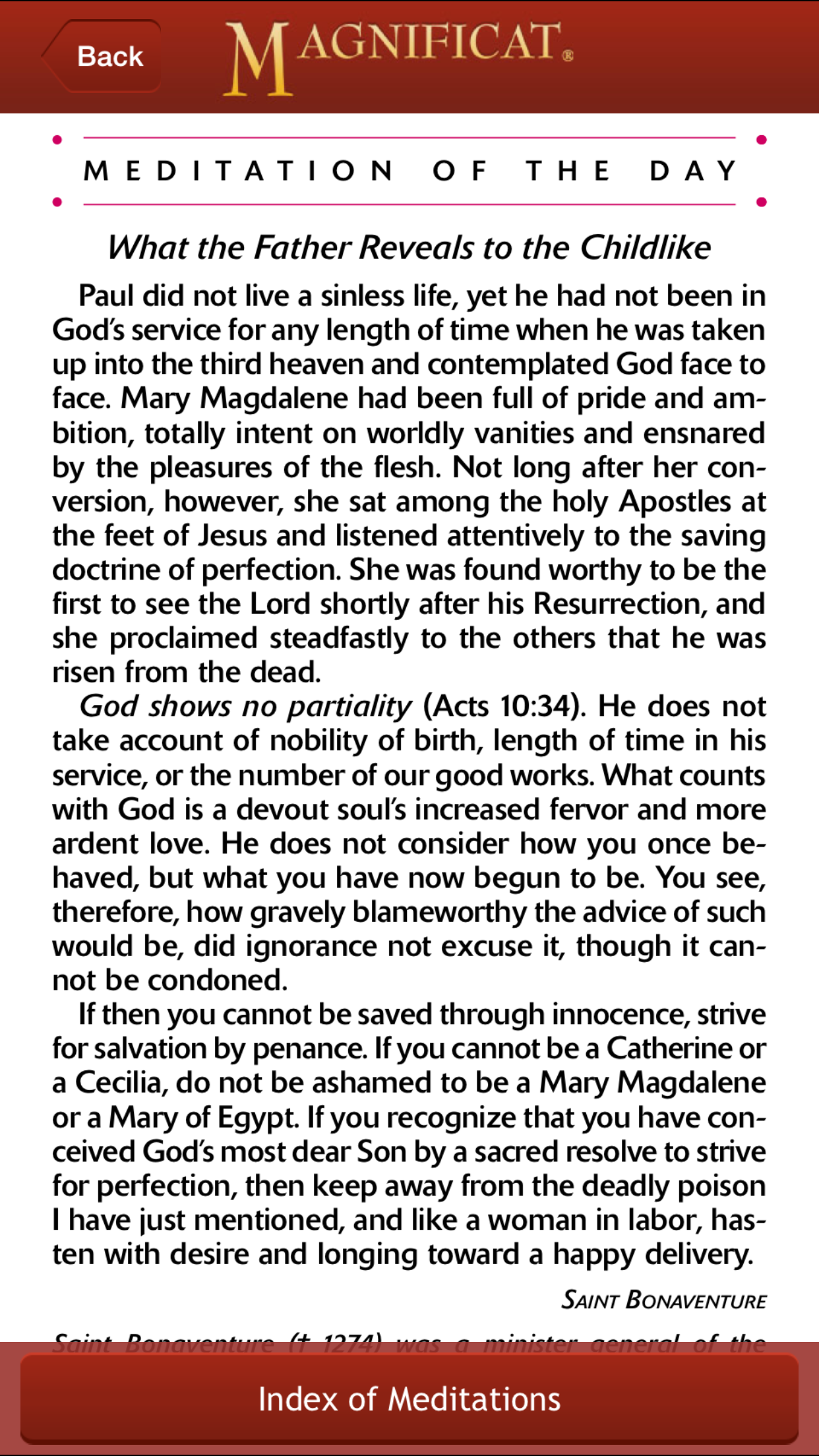
14. 
15. A prayer:
Pierce, O most sweet Lord Jesus, my inmost soul with the most joyous and healthful wound of Thy love, and with true, calm and most holy apostolic charity, that my soul may ever languish and melt with entire love and longing for Thee, may yearn for Thee and for thy courts, may long to be dissolved and to be with Thee.
Grant that my soul may hunger after Thee, the Bread of Angels, the refreshment of holy souls, our daily and super substantial bread, having all sweetness and savor and every delightful taste.
May my heart ever hunger after and feed upon Thee, Whom the angels desire to look upon, and may my inmost soul be filled with the sweetness of Thy savor; may it ever thirst for Thee, the fountain of life, the fountain of wisdom and knowledge, the fountain of eternal light, the torrent of pleasure, the fullness of the house of God;
may it ever compass Thee, seek Thee, find Thee, run to Thee, come up to Thee, meditate on Thee, speak of Thee, and do all for the praise and glory of Thy name, with humility and discretion, with love and delight, with ease and affection, with perseverance to the end; and be Thou alone ever my hope, my entire confidence, my riches, my delight, my pleasure, my joy, my rest and tranquility, my peace, my sweetness, my food, my refreshment, my refuge, my help, my wisdom, my portion, my possession, my treasure; in Whom may my mind and my heart be ever fixed and firm and rooted immovably. Amen.
Saint Bonaventure, pray for us.
PLUS: Today’s readings.
UPDATED: If you haven’t gotten enough of Bonaventure yet, Fr. Roger Landry has his homily for today:
St. Bonaventure regularly made that journey in all his prayer but the foremost way that he did so was at Mass. It was at Mass and adoring Jesus outside of Mass that received the Son’s definitive mysterious revelation of the Father’s burning love. He wrote a prayer, his famous Transfige, which the Church continues to pray after Mass to the Lord we have received within.
And:
"man should turn his full attention to this throne of mercy, and should gaze at him hanging on the cross" ~ St Bonaventure
— Fr Brad Sweet (@BradBradsweet) July 15, 2015
Next Post
July 16, 2015 10 Our Lady of Mount Carmel Things that Caught My Eye Today
Browse Our Archives
Select a Category B16 Christian Persecution Christianity Today Culture Good Links/Must Read HHS Mandate Holy Land Must Reads Prayer Religious Liberty Uncategorized
Select a Month July 2016 June 2016 May 2016 April 2016 March 2016 February 2016 January 2016 December 2015 November 2015 October 2015 September 2015 August 2015 July 2015 June 2015 May 2015 April 2015 March 2015 February 2015 January 2015 December 2014 November 2014 October 2014 September 2014 August 2014 July 2014 June 2014 May 2014 April 2014 March 2014 February 2014 January 2014 December 2013 November 2013 October 2013 September 2013 August 2013 July 2013 June 2013 May 2013 April 2013 March 2013 February 2013 January 2013 December 2012 November 2012 October 2012 September 2012 August 2012 July 2012 June 2012 May 2012 April 2012 March 2012 February 2012
Follow Us!
TAKE THE
Religious Wisdom Quiz
What event marked the start of the early church?
Select your answer to see how you score.
Pentecost Jesus’ Baptism The Ascension The Crucifixion
Related posts from Kathryn Lopez
Athirst? Moving Deeper into the Trinity
10 Catholic Things that Caught My Eye Today...
10 Things that Caught My Eye on Maria...
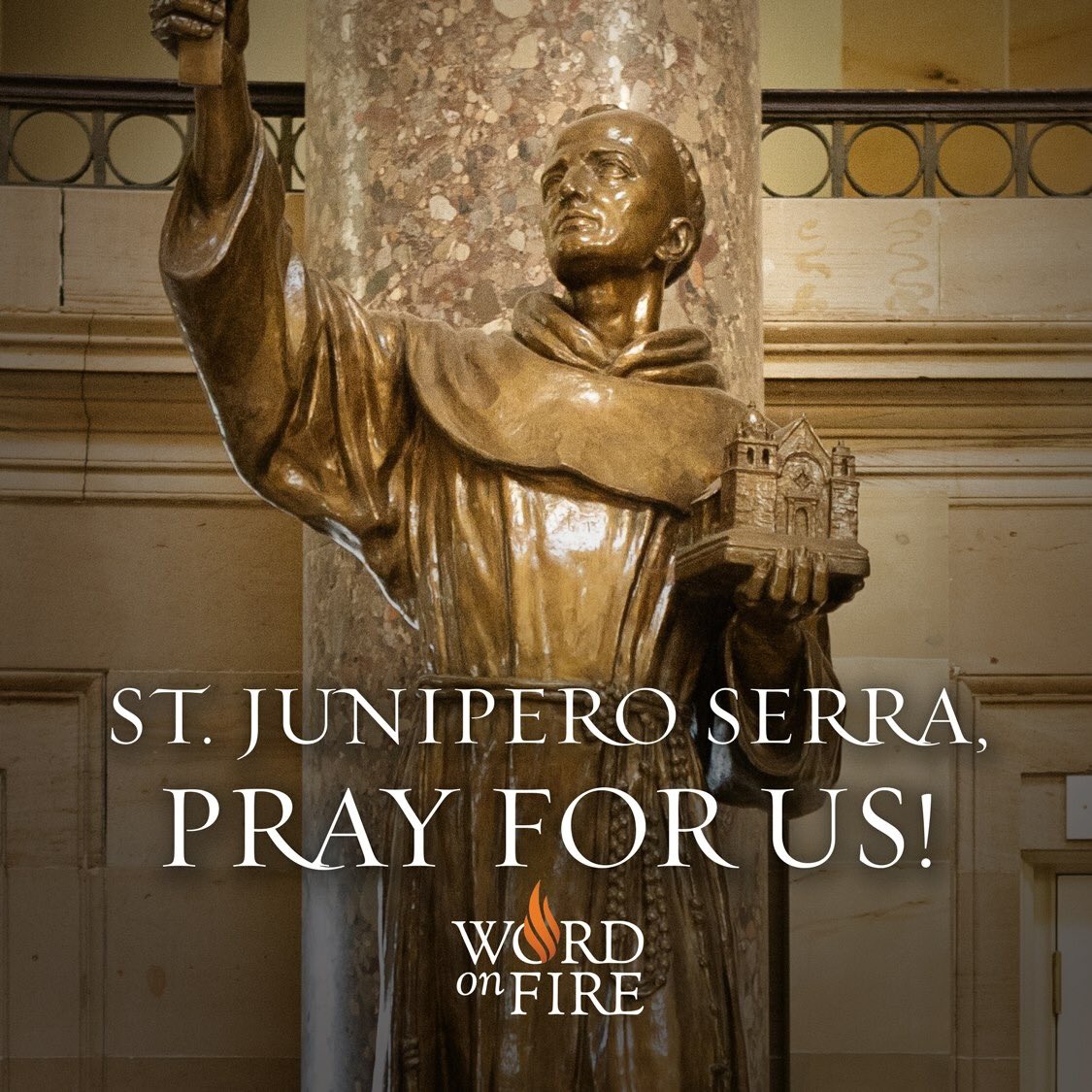
10 Saint Serra Things that Caught My Eye...
TRENDING AT PATHEOS Catholic

The Parable Of The Sower And The Word...
One of Christ’s most famous parables is that of the sower who...

Rejecting Doom: Christian Hope And Human Action
Christianity is a religion of hope. We are to have hope and...

Why I Choose the Eucharist Over the Sermon
Choose the Eucharist, Not the Sermon What are we supposed to get...

5 Design Elements Found in Spiritually Rooted Homes
Putting Spirituality Into Home Decor Our homes are more than our living...

Credo: A Story of God Told with the...
About 10 years ago, I began to imagine a personal "Credo" that...

The Anatomy of Divine Revelation in Catholic Thought
The claim that God has made Himself known to human beings is...
view all Catholic blogs
Ad-Free & Subscriber Log-In Subscription Support
- About Us
- 2026 Calendar
- Videos
- Podcasts
- Library of World Religions
- Faith In Media Tracker
- Advertise With Us
- Write for Us
- Privacy Policy
- Terms of Service
- Do Not Sell My Data
- Contact Us
- Radiant Digital
- Manage Newsletter Subscriptions
- Unsubscribe From Notifications
- Sitemap
Copyright 2008-2026, Patheos. All rights reserved.
Subscription Support Ad-Free & Subscriber Log-In
Follow Patheos